GetCrux Review (2026): Ad Spy Pricing, Limits & Alternatives
Bottom line
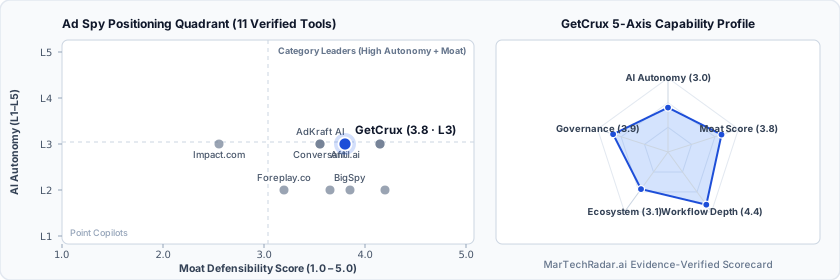
GetCrux is a Web SaaS tool for Ad Spy (Ad Spy, Creative Intelligence & Affiliate) in AdTech & Paid Media. Pricing: $1,500/mo · Enterprise plan. Best suited to B2B SaaS and Marketing & Growth Teams. Editor ratings: AI autonomy L3 (conditional automation); moat score 3.8/5.0 (Proprietary moat). Fact-checked by Julie Brot on Oct 16, 2026.
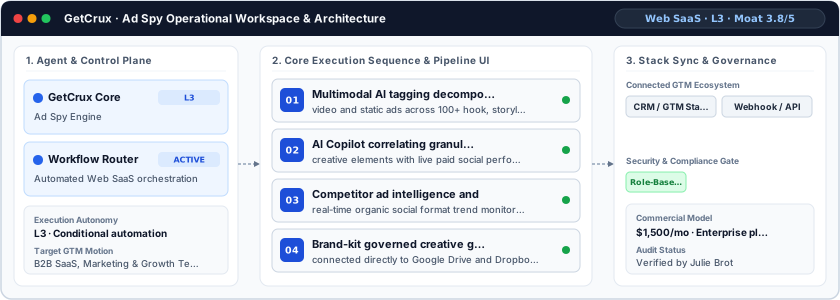
AI creative strategist and Creative OS tagging paid ads across 100+ multimodal parameters to diagnose winning patterns and generate ad creatives.
GetCrux buyer fit verdict: when to choose vs. when to walk away
Choose GetCrux if (Best Fit)
- Target ICP & Stack Fit: You operate as B2B SaaS and Marketing & Growth Teams requiring a Web SaaS deployment for Ad Spy.
- L3 Architecture & Defensibility: Decomposing historical video and static ad libraries across 100+ multimodal creative parameters correlated with live ROAS and CAC metrics builds a compounding proprietary creative dataset.
- Commercial Model Fit: Your procurement budget aligns with $1,500/mo · Enterprise plan.
Walk away from GetCrux if (Deal-Breakers)
- Walk away if your team is at early validation stage with a <$250/mo tool budget (GetCrux starts at $1,500/mo · Enterprise plan before seat or usage expansion).
- Walk away if your workflow cannot tolerate historical ad volume cold start: A primary statistical limitation is that multi-parameter correlation requires sufficient creative testing volume and historical spend; newly launched ad accounts struggle with a cold start data bottleneck before pattern diagnostics become reliable.
- Walk away if taxonomy alignment learning curve is a deal-breaker for your team: Mapping automated 100-parameter AI tags onto legacy agency naming conventions and custom BI reporting schemas introduces an onboarding learning curve and workflow friction for media analysts.
GetCrux key facts & scorecard
| Pricing | $1,500/mo · Enterprise planVendor pricing page |
|---|---|
| Free plan | No / not disclosed |
| Delivery | Web SaaS |
| Audience | B2B SaaS, Marketing & Growth Teams |
| AI autonomy level | L3 · Conditional automationEditor-verified |
| Moat tier & score | 3.8 / 5.0 · Proprietary moatEditor-verified |
| Funding | Seed |
| Total funding | $2.6M |
| Founders | Atharva Padhye, Himank Jain, Prabhat Singh |
| Company size | 1-10 employees |
| Governance & docs | Privacy ↗ |
| Headquarters | San Francisco, California |
| Founded | 2022 |
| Last verified |
GetCrux pros & cons: strengths vs. operational limitations
Pros: core strengths & capabilities
- Multimodal AI tagging decomposing: video and static ads across 100+ hook, storyline, music, and pacing parameters
- AI Copilot correlating granular: creative elements with live paid social performance to surface winning patterns
- Competitor ad intelligence and: real-time organic social format trend monitoring across UGC and short-form video
- Brand-kit governed creative generation: connected directly to Google Drive and Dropbox content libraries
Cons: operational limitations & risks
- Historical Ad Volume Cold Start: A primary statistical limitation is that multi-parameter correlation requires sufficient creative testing volume and historical spend; newly launched ad accounts struggle with a cold start data bottleneck before pattern diagnostics become reliable.
- Taxonomy Alignment Learning Curve: Mapping automated 100-parameter AI tags onto legacy agency naming conventions and custom BI reporting schemas introduces an onboarding learning curve and workflow friction for media analysts.
- Brand Approval Governance Barrier: Scaling automated creative variations across regulated consumer categories still requires manual legal review for product claims, creating a governance barrier prior to live campaign publishing.
GetCrux TCO & deal-breaker stress test
Simulate 12-month stepped TCO, hidden cost multipliers, contract lock-in exposure, and stack failure modes using only facts verified by Julie Brot on · Capture SHA 0b5e24a4.
GetCrux triggers high-severity friction under your 5-seat / $800/mo constraints. Benchmark the verified subtrack alternatives below before committing.
| Plan / Tier | Verified Rate | Scale Fit | Scope & Quota Notes |
|---|---|---|---|
| Entry / Starter | $1500/mo | 1–2 seats | Verified $1500/mo published rate on vendor pricing schedule. |
| Enterprise / Custom | Custom quote | 15–50+ seats (Enterprise SLA) | Sales-negotiated annual contract for custom volume, SSO/RBAC governance, and dedicated SLA. |
- Moat Score
- 3.8 / 5.0
- AI Autonomy
- L3
- Free Tier / Trial
- None disclosed
Triggered audit signals & failure modes
- Budget Ceiling Breached ($1,500/mo vs. $800/mo cap)Verified Pricing Ledger
At 5 seats, GetCrux's verified entry floor ($1,500/mo · Enterprise plan) exceeds your $800/mo budget before add-ons or overages.
- Published Self-Serve Entry FloorVerified Pricing Ledger
GetCrux publishes a transparent entry point ($1,500/mo · Enterprise plan) for initial validation before committing.
- Primary Operational Bottleneck: Historical Ad Volume Cold StartAudit by Julie Brot
A primary statistical limitation is that multi-parameter correlation requires sufficient creative testing volume and historical spend; newly launched ad accounts struggle with a cold start data bottleneck before pattern diagnostics become reliable.
Hidden TCO Multipliers & Quota Gates
- Credit & Usage Burn Multiplier: Automated workflows consume metered credits/usage quotas; multi-step enrichment, voice minutes, or high-frequency agent runs can trigger mid-cycle top-up packs.
- Enterprise Governance & Add-On Gating: Advanced capabilities such as Single Sign-On (SSO), custom role permissions, or specialized analytics modules are gated behind upper tiers or paid add-ons.
When to Walk Away & Negotiation Levers
- Walk away if your team is at early validation stage with a <$250/mo tool budget (GetCrux starts at $1,500/mo · Enterprise plan before seat or usage expansion).
- Walk away if your workflow cannot tolerate historical ad volume cold start: A primary statistical limitation is that multi-parameter correlation requires sufficient creative testing volume and historical spend; newly launched ad accounts struggle with a cold start data bottleneck before pattern diagnostics become reliable.
- Walk away if taxonomy alignment learning curve is a deal-breaker for your team: Mapping automated 100-parameter AI tags onto legacy agency naming conventions and custom BI reporting schemas introduces an onboarding learning curve and workflow friction for media analysts.
- Negotiate price-lock protection on additional seats and overage credits above the $1,500/mo · Enterprise plan entry tier.
- Require a sandbox proof-of-concept testing historical ad volume cold start against your live CRM/data schema before annual sign-off.
Ask a custom procurement or TCO stress-test question about GetCrux
Lower 5-seat floor (~$30/mo vs. From $1,500 / mo)
Lower 5-seat floor (~$69/mo vs. From $1,500 / mo)
GetCrux moat & subtrack positioning
Decomposing historical video and static ad libraries across 100+ multimodal creative parameters correlated with live ROAS and CAC metrics builds a compounding proprietary creative dataset.
Editorial review
Fact-checked by Julie Brot (Enterprise SaaS Governance & Procurement Editor) on .
Background
Founded in 2022 by Himank Jain, Atharva Padhye, and Prabhat Singh and headquartered in San Francisco, California, GetCrux (getcrux.ai) is an AI Creative Strategist and Creative OS built for performance marketers, growth teams, and paid social media buyers. Operating with a team of 2 to 10 employees and backed by $2.6M in Seed funding from Y Combinator (W24), Emergent Ventures, First Cheque, Neon Fund, and Aayush Phumbhra, the company solves the guesswork behind ad creative fatigue by quantifying exactly why specific paid ads win or fail and recommending what to launch next.
How GetCrux works
GetCrux operates at Level 3 autonomy by ingesting a brand's raw content libraries from Google Drive and Dropbox alongside live performance telemetry from paid social ad networks. Its multimodal computer-vision and audio analysis pipeline automatically tags every video and static ad across more than 100 granular parameters—including opening visual hooks, value-proposition messaging, storyline arcs, voiceover pacing, and background music. The platform's AI Copilot cross-references these creative attributes against conversion and customer acquisition metrics while tracking competitor ad launches and viral organic social formats (such as day-in-the-life UGC reels and street interviews). Teams then use the built-in Creative OS to generate new ad variations constrained by their Brand Kit rules for logo usage, color palettes, and photography.
Limitations
Operational limitations and technical trade-offs include:
- Historical Ad Volume Cold Start: A primary statistical limitation is that multi-parameter correlation requires sufficient creative testing volume and historical spend; newly launched ad accounts struggle with a cold start data bottleneck before pattern diagnostics become reliable.
- Taxonomy Alignment Learning Curve: Mapping automated 100-parameter AI tags onto legacy agency naming conventions and custom BI reporting schemas introduces an onboarding learning curve and workflow friction for media analysts.
- Brand Approval Governance Barrier: Scaling automated creative variations across regulated consumer categories still requires manual legal review for product claims, creating a governance barrier prior to live campaign publishing.
GetCrux pricing
GetCrux offers transparent subscription tiers that include unlimited team members on every plan. The Starter plan is priced at $1,500/mo for growth teams managing moderate monthly ad spend and bundles the AI Copilot, Creative Insights, AI Tagging, Competitor Insights, Ad Inspiration, Organic Social Trends, and Creative Generation modules. A custom-priced Professional tier is available via sales consultation for high-volume advertisers scaling larger monthly paid media budgets.
How GetCrux compares
Within the Creative Performance Analytics & Fatigue Prediction category, GetCrux competes against creative analytics and swipe-file alternatives such as Motion, Foreplay, and Veriad. Versus visual reporting dashboards like Motion that rely on manual naming conventions or static inspiration boards like Foreplay, GetCrux differentiates itself by combining automated 100-parameter multimodal AI tagging with organic trend tracking and brand-governed ad generation in one workspace. Performance-driven consumer and B2B brands choose GetCrux to systematically lower CAC, whereas low-spend advertisers may rely on native platform reporting.
Frequently asked questions about GetCrux
How much does GetCrux cost and what pricing tiers are available?
Published pricing summary for GetCrux: $1,500/mo · Enterprise plan. A permanent free plan is not disclosed for GetCrux. Verified tier schedule: Entry / Starter ($1500/mo for 1–2 seats); Enterprise / Custom (Custom quote for 15–50+ seats (Enterprise SLA)). GetCrux offers transparent subscription tiers that include unlimited team members on every plan.
How does GetCrux work and how autonomous is its AI architecture?
AI creative strategist and Creative OS tagging paid ads across 100+ multimodal parameters to diagnose winning patterns and generate ad creatives. Within Ad Spy (Ad Spy, Creative Intelligence & Affiliate), MarTechRadar rates its execution architecture at L3 · Conditional automation with a verified Moat Score of 3.8 / 5.0 (Proprietary moat). Decomposing historical video and static ad libraries across 100+ multimodal creative parameters correlated with live ROAS and CAC metrics builds a compounding proprietary creative dataset. Corporate profile: Founded by Atharva Padhye, Himank Jain, Prabhat Singh, operating at 1-10 employees scale.
What are the main limitations of GetCrux and when should buyers walk away?
Based on our editorial technical audit, key operational considerations and boundaries for GetCrux include: (1) Historical Ad Volume Cold Start: A primary statistical limitation is that multi-parameter correlation requires sufficient creative testing volume and historical spend; newly launched ad accounts struggle with a cold start data bottleneck before pattern diagnostics become reliable. (2) Taxonomy Alignment Learning Curve: Mapping automated 100-parameter AI tags onto legacy agency naming conventions and custom BI reporting schemas introduces an onboarding learning curve and workflow friction for media analysts. (3) Brand Approval Governance Barrier: Scaling automated creative variations across regulated consumer categories still requires manual legal review for product claims, creating a governance barrier prior to live campaign publishing. Primary procurement walk-away rule: Walk away if your team is at early validation stage with a <$250/mo tool budget (GetCrux starts at $1,500/mo · Enterprise plan before seat or usage expansion).
What integrations, compliance certifications, and contract terms apply to GetCrux?
Key TCO multiplier to watch: Credit & Usage Burn Multiplier (Automated workflows consume metered credits/usage quotas; multi-step enrichment, voice minutes, or high-frequency agent runs can trigger mid-cycle top-up packs.) Before signing a contract, procurement teams should negotiate price-lock protection on additional seats and overage credits above the $1,500/mo · Enterprise plan entry tier.
What are the best GetCrux alternatives and head-to-head competitors in 2026?
Top fact-checked alternatives to GetCrux in Ad Spy (Ad Spy, Creative Intelligence & Affiliate) include Veriad (Pricing not disclosed), Impact.com ($30–$10,000/mo), Levanta (From $3/mo), MagicBrief (Custom / enterprise pricing). Within the Creative Performance Analytics & Fatigue Prediction category, GetCrux competes against creative analytics and swipe-file alternatives such as Motion, Foreplay, and Veriad.
Verified sources & evidence trail
- Official product domain: http://getcrux.ai/
- Commercial pricing verification: https://getcrux.ai/pricing
- Verified corporate entity profiles (
sameAs): LinkedIn Company Profile · Crunchbase Entity Record - First-party governance & documentation links: Privacy
- Editorial audit sign-off: Fact-checked by Julie Brot on under the MarTechRadar Evidence-Ledger Protocol.