Veriad Review (2026): AI PPC Pricing, Limits & Alternatives
Bottom line
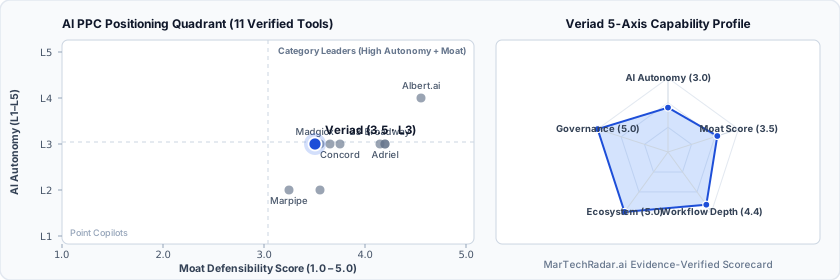
Veriad is a Web SaaS tool for AI PPC (Autonomous Bidding & Budget Management) in AdTech & Paid Media. Pricing: Pricing not disclosed. Best suited to B2B SaaS and Marketing & Growth Teams. Editor ratings: AI autonomy L3 (conditional automation); moat score 3.5/5.0 (Proprietary moat). Fact-checked by Julie Brot on Oct 16, 2026.
Enterprise AI advertising OS unifying multi-channel media planning, creative brand compliance, and warehouse-connected incrementality measurement.
Veriad buyer fit verdict: when to choose vs. when to walk away
Choose Veriad if (Best Fit)
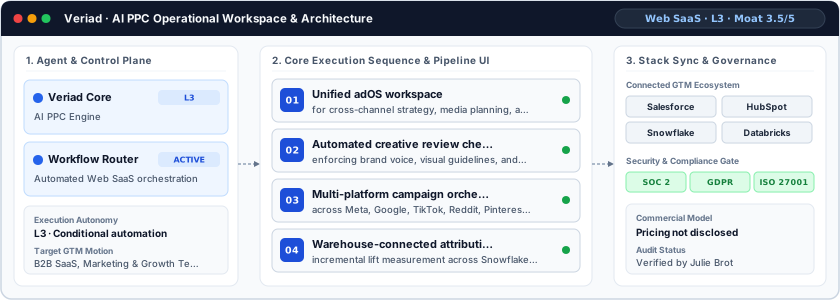
- Target ICP & Stack Fit: You operate as B2B SaaS and Marketing & Growth Teams requiring a Web SaaS deployment for AI PPC, with verified ecosystem connectivity for Salesforce, HubSpot, Snowflake, Databricks.
- L3 Architecture & Defensibility: Connecting multi-channel paid media orchestration directly with enterprise data warehouses, CRMs, and automated creative compliance checklists creates deep operational lock-in for in-house marketing teams.
- Commercial Model Fit: Your procurement budget aligns with Pricing not disclosed.
Walk away from Veriad if (Deal-Breakers)
- Walk away if you require transparent self-serve monthly billing or your budget ceiling is under $1,000/mo (Veriad requires sales-gated custom quoting).
- Walk away if your workflow cannot tolerate warehouse integration onboarding latency: A core deployment limitation is that full-funnel attribution and incrementality modeling require connecting enterprise CRM and cloud data warehouse schemas, introducing initial data-engineering latency compared to standalone ad tools.
- Walk away if cold start incrementality bottleneck is a deal-breaker for your team: Accounts with low historical spend or sparse multi-channel conversion telemetry struggle with statistical lift separation, creating a cold start bottleneck for smaller advertisers.
Veriad key facts & scorecard
| Pricing | Pricing not disclosed |
|---|---|
| Free plan | No / not disclosed |
| Delivery | Web SaaS |
| Audience | B2B SaaS, Marketing & Growth Teams |
| AI autonomy level | L3 · Conditional automationEditor-verified |
| Moat tier & score | 3.5 / 5.0 · Proprietary moatEditor-verified |
| Funding | Pre-seed |
| Total funding | $500K |
| Founders | Anton Muratov, Rohan Mahendraker |
| Company size | 2-10 employees |
| Ecosystem integrations | Salesforce, HubSpot, Snowflake, Databricks, Shopify, Google Analytics 4 (GA4) |
| Compliance & governance | SOC 2, GDPR, ISO 27001 |
| Governance & docs | Trust & Security ↗ · Terms ↗ · Privacy ↗ |
| Headquarters | San Francisco, California |
| Founded | 2025 |
| Last verified |
Veriad pros & cons: strengths vs. operational limitations
Pros: core strengths & capabilities
- Unified adOS workspace: for cross-channel strategy, media planning, and budget allocation
- Automated creative review checklists: enforcing brand voice, visual guidelines, and regulatory claims compliance
- Multi-platform campaign orchestration: across Meta, Google, TikTok, Reddit, Pinterest, and Snapchat
- Warehouse-connected attribution and weekly: incremental lift measurement across Snowflake, Databricks, and Salesforce
Cons: operational limitations & risks
- Warehouse Integration Onboarding Latency: A core deployment limitation is that full-funnel attribution and incrementality modeling require connecting enterprise CRM and cloud data warehouse schemas, introducing initial data-engineering latency compared to standalone ad tools.
- Cold Start Incrementality Bottleneck: Accounts with low historical spend or sparse multi-channel conversion telemetry struggle with statistical lift separation, creating a cold start bottleneck for smaller advertisers.
- In-House Workflow Learning Curve: Transitioning multi-brand campaign approvals from external agency retainers into an internal agentic operating system creates change-management friction and a governance barrier for legal and creative reviewers.
Veriad TCO & deal-breaker stress test
Simulate 12-month stepped TCO, hidden cost multipliers, contract lock-in exposure, and stack failure modes using only facts verified by Julie Brot on · Capture SHA 9b617505.
Veriad triggers high-severity friction under your 5-seat / $800/mo constraints. Benchmark the verified subtrack alternatives below before committing.
| Plan / Tier | Verified Rate | Scale Fit | Scope & Quota Notes |
|---|---|---|---|
| Enterprise / Custom | Custom quote | 15–50+ seats (Enterprise SLA) | Sales-negotiated annual contract for custom volume, SSO/RBAC governance, and dedicated SLA. |
- Moat Score
- 3.5 / 5.0
- AI Autonomy
- L3
- Free Tier / Trial
- None disclosed
Triggered audit signals & failure modes
- Opaque Enterprise Quoting vs. SMB/Mid-Market BudgetVerified Pricing Ledger
Veriad does not disclose a public self-serve floor (Pricing not disclosed). Buyers with a $800/mo cap face high sales-qualification friction.
- Sales-Gated Contract TermsFact-checked by Julie Brot
Pricing is available on request through enterprise sales quotes, with customized tiers based on seat counts or usage volume.
- Primary Operational Bottleneck: Warehouse Integration Onboarding LatencyAudit by Julie Brot
A core deployment limitation is that full-funnel attribution and incrementality modeling require connecting enterprise CRM and cloud data warehouse schemas, introducing initial data-engineering latency compared to standalone ad tools.
Hidden TCO Multipliers & Quota Gates
- Warehouse Integration Onboarding Latency: A core deployment limitation is that full-funnel attribution and incrementality modeling require connecting enterprise CRM and cloud data warehouse schemas, introducing initial data-engineering latency compared to standalone ad tools.
- Cold Start Incrementality Bottleneck: Accounts with low historical spend or sparse multi-channel conversion telemetry struggle with statistical lift separation, creating a cold start bottleneck for smaller advertisers.
When to Walk Away & Negotiation Levers
- Walk away if you require transparent self-serve monthly billing or your budget ceiling is under $1,000/mo (Veriad requires sales-gated custom quoting).
- Walk away if your workflow cannot tolerate warehouse integration onboarding latency: A core deployment limitation is that full-funnel attribution and incrementality modeling require connecting enterprise CRM and cloud data warehouse schemas, introducing initial data-engineering latency compared to standalone ad tools.
- Walk away if cold start incrementality bottleneck is a deal-breaker for your team: Accounts with low historical spend or sparse multi-channel conversion telemetry struggle with statistical lift separation, creating a cold start bottleneck for smaller advertisers.
- Demand a 30- to 60-day paid pilot opt-out clause in the Veriad order form before signing a 12-month enterprise commitment.
- Require a sandbox proof-of-concept testing warehouse integration onboarding latency against your live CRM/data schema before annual sign-off.
Ask a custom procurement or TCO stress-test question about Veriad
Lower 5-seat floor (~$500/mo vs. Custom Quote) · Transparent self-serve entry without mandatory annual lock-in
Lower 5-seat floor (~$49/mo vs. Custom Quote) · Transparent self-serve entry without mandatory annual lock-in
Veriad key entities, modules & ecosystem stack
Veriad moat & subtrack positioning
Connecting multi-channel paid media orchestration directly with enterprise data warehouses, CRMs, and automated creative compliance checklists creates deep operational lock-in for in-house marketing teams.
Editorial review
Fact-checked by Julie Brot (Enterprise SaaS Governance & Procurement Editor) on .
Background
Founded in 2025 by Anton Muratov and Rohan Mahendraker and headquartered in San Francisco, California, with a technical engineering team in the United Kingdom, Veriad (veriad.com) is an enterprise AI advertising operating system built for in-house brand, creative, and performance marketing organizations. Operating with a team of 2 to 10 employees and backed by $500K in Pre-Seed funding from Y Combinator (W26), the company builds marketing agents and its flagship adOS workspace so enterprises can plan, create, execute, and measure paid media campaigns end-to-end in-house rather than relying on fragmented external agencies.
How Veriad works
Veriad operates at Level 3 autonomy by connecting six stages of the enterprise advertising lifecycle—strategy, media planning, creative compliance, campaign execution, optimization, and incrementality reporting—inside one governed architecture. Marketing teams use the platform to model budget allocations across Meta, Google, TikTok, Reddit, Pinterest, and Snapchat, while running automated pre-launch audits that verify creative assets against brand voice rules, visual standards, and legal claims checklists. Through native integrations with Adobe AEM, Google Analytics, Shopify, Salesforce, HubSpot, Dynamics 365, SAP, Snowflake, and Databricks, Veriad joins ad platform delivery data with CRM and warehouse revenue records to calculate weekly incremental lift above baseline. The platform has achieved CASA Tier 2 verification and UK GDPR compliance while progressing toward ISO 27001 and SOC 2 Type II standards.
Limitations
Operational limitations and technical trade-offs include:
- Warehouse Integration Onboarding Latency: A core deployment limitation is that full-funnel attribution and incrementality modeling require connecting enterprise CRM and cloud data warehouse schemas, introducing initial data-engineering latency compared to standalone ad tools.
- Cold Start Incrementality Bottleneck: Accounts with low historical spend or sparse multi-channel conversion telemetry struggle with statistical lift separation, creating a cold start bottleneck for smaller advertisers.
- In-House Workflow Learning Curve: Transitioning multi-brand campaign approvals from external agency retainers into an internal agentic operating system creates change-management friction and a governance barrier for legal and creative reviewers.
Veriad pricing
Pricing is available on request through enterprise sales quotes, with customized tiers based on seat counts or usage volume. Veriad scopes annual enterprise contracts through live product demonstrations and architectural discovery sessions tailored to a customer's active ad channels, security requirements, and warehouse integrations.
How Veriad compares
Within the Autonomous Media Buying & Campaign Automation category, Veriad competes against paid media alternatives such as Smartly.io, Albert AI, and GetCrux. Versus point creative analytics platforms like GetCrux or social templating suites like Smartly.io, Veriad differentiates itself by combining cross-channel media planning, automated regulatory claims compliance, and warehouse-native incrementality measurement in one unified operating system. Mid-market and enterprise CMOs bringing agency capabilities in-house choose Veriad, whereas solo advertisers only need native ad manager tools.
Frequently asked questions about Veriad
How much does Veriad cost and does it require a custom enterprise quote?
Published pricing summary for Veriad: Pricing not disclosed. A permanent free plan is not disclosed for Veriad. Pricing is available on request through enterprise sales quotes, with customized tiers based on seat counts or usage volume.
How does Veriad work and how autonomous is its AI architecture?
Enterprise AI advertising OS unifying multi-channel media planning, creative brand compliance, and warehouse-connected incrementality measurement. Within AI PPC (Autonomous Bidding & Budget Management), MarTechRadar rates its execution architecture at L3 · Conditional automation with a verified Moat Score of 3.5 / 5.0 (Proprietary moat). Connecting multi-channel paid media orchestration directly with enterprise data warehouses, CRMs, and automated creative compliance checklists creates deep operational lock-in for in-house marketing teams. Corporate profile: Founded by Anton Muratov, Rohan Mahendraker, operating at 2-10 employees scale.
What are the main limitations of Veriad and when should buyers walk away?
Based on our editorial technical audit, key operational considerations and boundaries for Veriad include: (1) Warehouse Integration Onboarding Latency: A core deployment limitation is that full-funnel attribution and incrementality modeling require connecting enterprise CRM and cloud data warehouse schemas, introducing initial data-engineering latency compared to standalone ad tools. (2) Cold Start Incrementality Bottleneck: Accounts with low historical spend or sparse multi-channel conversion telemetry struggle with statistical lift separation, creating a cold start bottleneck for smaller advertisers. (3) In-House Workflow Learning Curve: Transitioning multi-brand campaign approvals from external agency retainers into an internal agentic operating system creates change-management friction and a governance barrier for legal and creative reviewers. Primary procurement walk-away rule: Walk away if you require transparent self-serve monthly billing or your budget ceiling is under $1,000/mo (Veriad requires sales-gated custom quoting).
What integrations, compliance certifications, and contract terms apply to Veriad?
Verified ecosystem and stack integrations include Salesforce, HubSpot, Snowflake, Databricks, Shopify, Google Analytics 4 (GA4). Documented security and governance attestations include SOC 2, GDPR, ISO 27001. First-party governance and developer endpoints verified on domain include: Trust/Security (https://www.veriad.com/security). Key TCO multiplier to watch: Warehouse Integration Onboarding Latency (A core deployment limitation is that full-funnel attribution and incrementality modeling require connecting enterprise CRM and cloud data warehouse schemas, introducing initial data-engineering latency compared to standalone ad tools.) Before signing a contract, procurement teams should demand a 30- to 60-day paid pilot opt-out clause in the Veriad order form before signing a 12-month enterprise commitment.
What are the best Veriad alternatives and head-to-head competitors in 2026?
Top fact-checked alternatives to Veriad in AI PPC (Autonomous Bidding & Budget Management) include GetCrux ($1,500/mo · Enterprise plan), Nanigans (Custom / enterprise pricing), Zalster (Custom / enterprise pricing), Smartly.io (Custom / enterprise pricing). Within the Autonomous Media Buying & Campaign Automation category, Veriad competes against paid media alternatives such as Smartly.io, Albert AI, and GetCrux.
Verified sources & evidence trail
- Official product domain: https://veriad.com
- Commercial pricing verification: Verified against official vendor pricing policy (Pricing not disclosed)
- Verified corporate entity profiles (
sameAs): LinkedIn Company Profile · Crunchbase Entity Record - First-party governance & documentation links: Trust & Security · Terms · Privacy
- Editorial audit sign-off: Fact-checked by Julie Brot on under the MarTechRadar Evidence-Ledger Protocol.