23 Broadway Review (2026): AI PPC Pricing, Limits & Alternatives
Bottom line
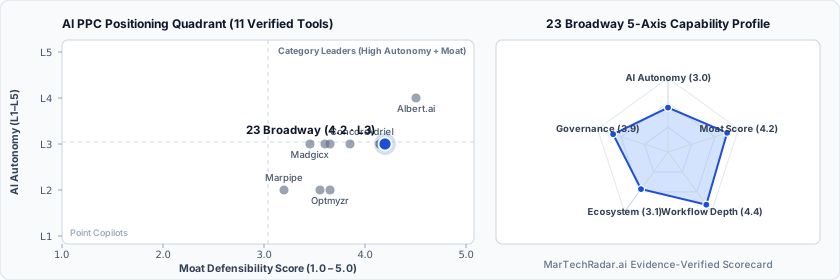
23 Broadway is a Web SaaS tool for AI PPC (Autonomous Bidding & Budget Management) in AdTech & Paid Media. Pricing: Custom / enterprise pricing. Best suited to Performance Marketing Directors, Ad Agencies and Retail Media Advertisers. Editor ratings: AI autonomy L3 (conditional automation); moat score 4.2/5.0 (Proprietary moat). Fact-checked by Tim Fenolz on Oct 11, 2026.
Algorithmic user acquisition intelligence platform pairing automated cohort performance forecasting with non-dilutive programmatic growth capital.
23 Broadway buyer fit verdict: when to choose vs. when to walk away
Choose 23 Broadway if (Best Fit)
- Target ICP & Stack Fit: You operate as Performance Marketing Directors, Ad Agencies and Retail Media Advertisers requiring a Web SaaS deployment for AI PPC.
- L3 Architecture & Defensibility: Proprietary credit and portfolio risk underwriting models tied directly into real-time advertising attribution pipelines and merchant payment gateways, blending performance intelligence with capital access.
- Commercial Model Fit: Your procurement budget aligns with Custom / enterprise pricing.
Walk away from 23 Broadway if (Deal-Breakers)
- Walk away if you require transparent self-serve monthly billing or your budget ceiling is under $1,000/mo (23 Broadway requires sales-gated custom quoting).
- Walk away if your workflow cannot tolerate data ingestion latency: Delayed conversion signals and attribution lag across third-party ad networks can distort intra-day payback estimations and delay budget underwriting adjustments.
- Walk away if platform channel dependencies is a deal-breaker for your team: API rate limits and tracking policy shifts from major networks degrade cohort modeling accuracy unless backed by high-fidelity server-side tracking implementations.
23 Broadway key facts & scorecard
| Pricing | Custom / enterprise pricing |
|---|---|
| Free plan | No / not disclosed |
| Delivery | Web SaaS |
| Audience | Performance Marketing Directors, Ad Agencies, Retail Media Advertisers |
| AI autonomy level | L3 · Conditional automationEditor-verified |
| Moat tier & score | 4.2 / 5.0 · Proprietary moatEditor-verified |
| Funding | Seed |
| Total funding | $3.3MBacked by Will Ventures, 359 Capital, Betty, CEAS Investments, Dave Bateman |
| Founders | Jordan Tuch |
| Company size | 11-50 employees |
| Headquarters | New York, United States |
| Founded | 2024 |
| Last verified |
23 Broadway pros & cons: strengths vs. operational limitations
Pros: core strengths & capabilities
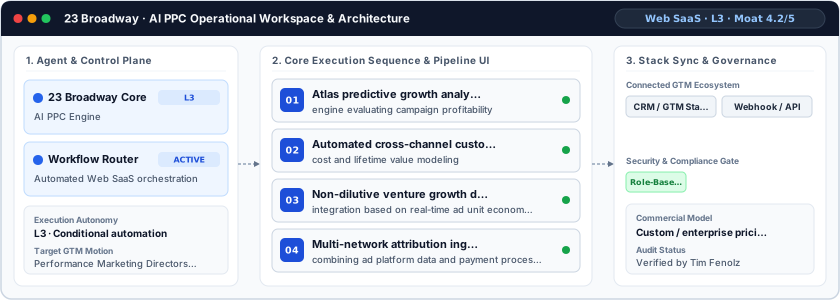
- Atlas predictive growth analytics: engine evaluating campaign profitability
- Automated cross-channel customer acquisition: cost and lifetime value modeling
- Non-dilutive venture growth debt: integration based on real-time ad unit economics
- Multi-network attribution ingest: combining ad platform data and payment processor receipts
Cons: operational limitations & risks
- Data Ingestion Latency: Delayed conversion signals and attribution lag across third-party ad networks can distort intra-day payback estimations and delay budget underwriting adjustments.
- Platform Channel Dependencies: API rate limits and tracking policy shifts from major networks degrade cohort modeling accuracy unless backed by high-fidelity server-side tracking implementations.
- Merchant Eligibility Gaps: Early-stage businesses with irregular cash collections or volatile refund rates trigger algorithmic underwriting circuit breakers, restricting automated capital drawdowns.
23 Broadway TCO & deal-breaker stress test
Simulate 12-month stepped TCO, hidden cost multipliers, contract lock-in exposure, and stack failure modes using only facts verified by Tim Fenolz on · Capture SHA 25a018e6.
23 Broadway triggers high-severity friction under your 5-seat / $800/mo constraints. Benchmark the verified subtrack alternatives below before committing.
| Plan / Tier | Verified Rate | Scale Fit | Scope & Quota Notes |
|---|---|---|---|
| Enterprise / Custom | Custom quote | 15–50+ seats (Enterprise SLA) | Sales-negotiated annual contract for custom volume, SSO/RBAC governance, and dedicated SLA. |
- Moat Score
- 4.2 / 5.0
- AI Autonomy
- L3
- Free Tier / Trial
- None disclosed
Triggered audit signals & failure modes
- Opaque Enterprise Quoting vs. SMB/Mid-Market BudgetVerified Pricing Ledger
23 Broadway does not disclose a public self-serve floor (Custom / enterprise pricing). Buyers with a $800/mo cap face high sales-qualification friction.
- Sales-Gated Contract TermsFact-checked by Tim Fenolz
Commercial access to 23 Broadway follows a custom enterprise model where software licensing and credit structures are available on request through tailored enterprise sales quotes based on organizational scale and seats.
- Primary Operational Bottleneck: Data Ingestion LatencyAudit by Tim Fenolz
Delayed conversion signals and attribution lag across third-party ad networks can distort intra-day payback estimations and delay budget underwriting adjustments.
Hidden TCO Multipliers & Quota Gates
- Credit & Usage Burn Multiplier: Automated workflows consume metered credits/usage quotas; multi-step enrichment, voice minutes, or high-frequency agent runs can trigger mid-cycle top-up packs.
- Data Ingestion Latency: Delayed conversion signals and attribution lag across third-party ad networks can distort intra-day payback estimations and delay budget underwriting adjustments.
- Platform Channel Dependencies: API rate limits and tracking policy shifts from major networks degrade cohort modeling accuracy unless backed by high-fidelity server-side tracking implementations.
When to Walk Away & Negotiation Levers
- Walk away if you require transparent self-serve monthly billing or your budget ceiling is under $1,000/mo (23 Broadway requires sales-gated custom quoting).
- Walk away if your workflow cannot tolerate data ingestion latency: Delayed conversion signals and attribution lag across third-party ad networks can distort intra-day payback estimations and delay budget underwriting adjustments.
- Walk away if platform channel dependencies is a deal-breaker for your team: API rate limits and tracking policy shifts from major networks degrade cohort modeling accuracy unless backed by high-fidelity server-side tracking implementations.
- Demand a 30- to 60-day paid pilot opt-out clause in the 23 Broadway order form before signing a 12-month enterprise commitment.
- Require a sandbox proof-of-concept testing data ingestion latency against your live CRM/data schema before annual sign-off.
Ask a custom procurement or TCO stress-test question about 23 Broadway
Lower 5-seat floor (~$500/mo vs. Custom Quote) · Transparent self-serve entry without mandatory annual lock-in
Lower 5-seat floor (~$49/mo vs. Custom Quote) · Transparent self-serve entry without mandatory annual lock-in
23 Broadway moat & subtrack positioning
Proprietary credit and portfolio risk underwriting models tied directly into real-time advertising attribution pipelines and merchant payment gateways, blending performance intelligence with capital access.
Editorial review
Fact-checked by Tim Fenolz (Lead AdTech, Programmatic & Attribution Analyst) on .
Background
Established in 2024 in New York, United States, 23 Broadway entered the market with $3.3M in venture funding to combine paid growth underwriting with non-dilutive liquidity. Built for heads of growth, chief marketing officers, and financial controllers at subscription apps and digital retailers, the company addresses the structural inefficiencies of using venture equity to finance paid acquisition campaigns. By uniting algorithmic attribution modeling with growth financing, 23 Broadway positions its Atlas engine as an autonomous growth underwriting system.
How 23 Broadway works
At its architectural core, 23 Broadway deploys its Atlas engine at an L3 autonomy tier to ingest campaign metadata, ad spend trajectories, and payment settlement webhooks across primary acquisition networks. The platform aggregates conversion touchpoints and normalizes attribution data against actual merchant revenue feeds. Machine learning pipelines calculate rolling customer lifetime values and cohort-specific return on ad spend, evaluating campaign longevity to identify profitable scaling thresholds and automatically determine safe capital deployment boundaries for portfolio spend.
Limitations
Operational considerations and platform boundaries include:
- Data Ingestion Latency: Delayed conversion signals and attribution lag across third-party ad networks can distort intra-day payback estimations and delay budget underwriting adjustments.
- Platform Channel Dependencies: API rate limits and tracking policy shifts from major networks degrade cohort modeling accuracy unless backed by high-fidelity server-side tracking implementations.
- Merchant Eligibility Gaps: Early-stage businesses with irregular cash collections or volatile refund rates trigger algorithmic underwriting circuit breakers, restricting automated capital drawdowns.
23 Broadway pricing
Commercial access to 23 Broadway follows a custom enterprise model where software licensing and credit structures are available on request through tailored enterprise sales quotes based on organizational scale and seats. The model pairs platform analytics capabilities with non-dilutive underwriting facilities, establishing customized contractual arrangements rather than standardized retail SaaS tiers.
How 23 Broadway compares
Within the AI PPC and performance automation landscape, 23 Broadway diverges from pure execution platforms like Adriel, Albert.ai, and Concord by anchoring campaign attribution directly to debt capital. While Albert.ai focuses on autonomous autonomous creative and bid orchestration, and Adriel prioritizes operational business intelligence across fragmented ad platforms, 23 Broadway targets risk-adjusted liquidity allocation. It is best suited for capitalized subscription and consumer brands requiring growth debt paired with quantitative campaign controls.
Direct competitors & market radar
Top algorithmic competitors based on category positioning, capability overlap, and ICP alignment.
Frequently asked questions about 23 Broadway
How much does 23 Broadway cost and does it require a custom enterprise quote?
Published pricing summary for 23 Broadway: Custom / enterprise pricing. A permanent free plan is not disclosed for 23 Broadway. Commercial access to 23 Broadway follows a custom enterprise model where software licensing and credit structures are available on request through tailored enterprise sales quotes based on organizational scale and seats.
How does 23 Broadway work and how autonomous is its AI architecture?
Algorithmic user acquisition intelligence platform pairing automated cohort performance forecasting with non-dilutive programmatic growth capital. Within AI PPC (Autonomous Bidding & Budget Management), MarTechRadar rates its execution architecture at L3 · Conditional automation with a verified Moat Score of 4.2 / 5.0 (Proprietary moat). Proprietary credit and portfolio risk underwriting models tied directly into real-time advertising attribution pipelines and merchant payment gateways, blending performance intelligence with capital access. Corporate profile: Founded by Jordan Tuch, operating at 11-50 employees scale.
What are the main limitations of 23 Broadway and when should buyers walk away?
Based on our editorial technical audit, key operational considerations and boundaries for 23 Broadway include: (1) Data Ingestion Latency: Delayed conversion signals and attribution lag across third-party ad networks can distort intra-day payback estimations and delay budget underwriting adjustments. (2) Platform Channel Dependencies: API rate limits and tracking policy shifts from major networks degrade cohort modeling accuracy unless backed by high-fidelity server-side tracking implementations. (3) Merchant Eligibility Gaps: Early-stage businesses with irregular cash collections or volatile refund rates trigger algorithmic underwriting circuit breakers, restricting automated capital drawdowns. Primary procurement walk-away rule: Walk away if you require transparent self-serve monthly billing or your budget ceiling is under $1,000/mo (23 Broadway requires sales-gated custom quoting).
What integrations, compliance certifications, and contract terms apply to 23 Broadway?
Key TCO multiplier to watch: Credit & Usage Burn Multiplier (Automated workflows consume metered credits/usage quotas; multi-step enrichment, voice minutes, or high-frequency agent runs can trigger mid-cycle top-up packs.) Before signing a contract, procurement teams should demand a 30- to 60-day paid pilot opt-out clause in the 23 Broadway order form before signing a 12-month enterprise commitment.
What are the best 23 Broadway alternatives and head-to-head competitors in 2026?
Top fact-checked alternatives to 23 Broadway in AI PPC (Autonomous Bidding & Budget Management) include Concord (Custom / enterprise pricing), Trapica (Custom / enterprise pricing), paretos (Custom / enterprise pricing), Shape.io (Custom / enterprise pricing). Within the AI PPC and performance automation landscape, 23 Broadway diverges from pure execution platforms like Adriel, Albert.ai, and Concord by anchoring campaign attribution directly to debt capital.
Verified sources & evidence trail
- Official product domain: https://23broadway.com
- Commercial pricing verification: Verified against official vendor pricing policy (Custom / enterprise pricing)
- Verified corporate entity profiles (
sameAs): LinkedIn Company Profile · Crunchbase Entity Record - Editorial audit sign-off: Fact-checked by Tim Fenolz on under the MarTechRadar Evidence-Ledger Protocol.