Quartile Review (2026): AI PPC Pricing, Pros & Cons
Bottom line
Quartile is a Web SaaS tool for AI PPC (Autonomous Bidding & Budget Management) in AdTech & Paid Media. Pricing: Custom / enterprise pricing. Best suited to DTC / eCommerce and Enterprise Brands. Editor ratings: AI autonomy L3 (conditional automation); moat score 2.3/5.0 (Workflow-embedded). Fact-checked by MarTechRadar Research Desk on Oct 14, 2026.
Algorithmic retail media optimization platform automating cross-channel bids, keyword harvest, and budget pacing across major e-commerce marketplaces.
Is Quartile worth it in 2026? Buyer fit & when to walk away
Choose Quartile if (Best Fit)
- Target ICP & Stack Fit: You operate as DTC / eCommerce and Enterprise Brands requiring a Web SaaS deployment for AI PPC.
- L3 Architecture & Defensibility: Proprietary predictive retail media bidding algorithms paired with deep API-level integrations across Amazon, Walmart, Google Shopping, and Instacart, providing high-frequency bid execution at catalog scale.
- Commercial Model Fit: Your procurement budget aligns with Custom / enterprise pricing.
Walk away from Quartile if (Deal-Breakers)
- Walk away if you need published self-serve pricing: Quartile is sold by custom quote.
- Walk away if your workflow cannot tolerate marketplace API latency and rate limits: Bid propagation and reporting synchronization remain subject to upstream marketplace throttling, occasionally delaying fast-reacting spend controls during peak retail events.
- Walk away if cold-start attribution volatility is a deal-breaker for your team: New SKU introductions with sparse historical transaction records require prolonged learning phases, leading to unpredictable algorithmic spending before stabilizing.
Quartile pricing, free plan & scorecard at a glance
| Pricing | Custom / enterprise pricing |
|---|---|
| Free plan | No / not disclosed |
| Delivery | Web SaaS |
| Audience | DTC / eCommerce, Enterprise Brands |
| AI autonomy level | L3 · Conditional automationEditor-verified |
| Moat tier & score | 2.3 / 5.0 · Workflow-embeddedEditor-verified |
| Funding | Venture-backed |
| Founders | Daniel Knijnik, Sylvio Lindenberg |
| Company size | 1-10 employees |
| Governance & docs | Privacy ↗ |
| Headquarters | New York, United States |
| Founded | 2016 |
| Last verified | Oct 14, 2026 |
Quartile pros & cons: strengths vs. operational limitations
Pros: core strengths & capabilities
- Predictive retail media bidding: engine adjusting bids continuously based on product-level conversion probabilities
- Automated cross-channel budget management: synchronizing spend across Amazon, Walmart, Google Shopping, and Instacart
- Autonomous keyword harvesting and negative match isolation to minimize retail ad waste
- Unified reporting dashboards aggregating: marketplace advertising attribution and catalog-level margin data
Cons: operational limitations & risks
- Marketplace API latency and rate limits: Bid propagation and reporting synchronization remain subject to upstream marketplace throttling, occasionally delaying fast-reacting spend controls during peak retail events.
- Cold-start attribution volatility: New SKU introductions with sparse historical transaction records require prolonged learning phases, leading to unpredictable algorithmic spending before stabilizing.
- Algorithmic transparency constraints: The closed-box nature of the automated bidding models limits granular diagnostic visibility into why specific negative match exclusions or bid adjustments were applied.
Quartile TCO & deal-breaker stress test
Simulate 12-month stepped TCO, hidden cost multipliers, contract lock-in exposure, and stack failure modes using only facts verified by MarTechRadar Research Desk on 2026-10-14.
Quartile triggers high-severity friction under your 5-seat / $800/mo constraints. Benchmark the verified subtrack alternatives below before committing.
- Moat Score
- 2.3 / 5.0
- AI Autonomy
- L3
- Free Tier / Trial
- None disclosed
Triggered audit signals & failure modes
- Opaque Enterprise Quoting vs. SMB/Mid-Market BudgetVerified Pricing Ledger
Quartile does not disclose a public self-serve floor (Custom / enterprise pricing). Buyers with a $800/mo cap face high sales-qualification friction.
- Sales-Gated Contract TermsFact-checked by MarTechRadar Research Desk
Quartile operates under an enterprise managed SaaS framework where commercial pricing is available on request through tailored enterprise sales quotes based on organizational scale and seats.
- Primary Operational Bottleneck: Marketplace API latency and rate limitsAudit by MarTechRadar Research Desk
Bid propagation and reporting synchronization remain subject to upstream marketplace throttling, occasionally delaying fast-reacting spend controls during peak retail events.
Test a custom Quartile budget or stack constraint
Lower 5-seat floor (~$695/mo vs. Custom Quote) · Transparent self-serve entry without mandatory annual lock-in
Lower 5-seat floor (~$125/mo vs. Custom Quote)
Quartile AI moat & AI PPC positioning
Proprietary predictive retail media bidding algorithms paired with deep API-level integrations across Amazon, Walmart, Google Shopping, and Instacart, providing high-frequency bid execution at catalog scale.
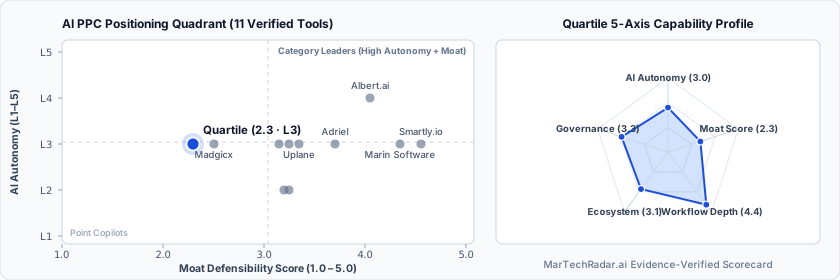
Quartile in-depth review, pricing & architecture analysis
Editor sign-off: Oct 14, 2026. How profiles are made.
What is Quartile? Overview & background
E-commerce brands and retail growth agencies frequently confront operational gridlock when manually adjusting thousands of marketplace ad campaigns across fragmented channels. Headquartered in New York, United States, and established in 2016, Quartile provides an algorithmic retail media optimization platform engineered to automate multi-marketplace ad spend. The software targets performance marketing directors, retail media buyers, and brand manufacturers executing campaigns across complex digital storefronts.
How Quartile works: architecture & workflow
Quartile functions as an L3 autonomous optimization layer using predictive algorithmic modeling to govern paid search and retail display. The platform ingests real-time catalog data, stock levels, historical conversion figures, and attribution feeds directly via retail partner APIs, including Amazon Advertising, Walmart Connect, Google Shopping, and Instacart Ads. Its core bidding engine computes expected revenue per click based on hourly traffic dynamics and unit economics. It autonomously executes hourly bid adjustments, generates long-tail keyword targets, and dynamically transfers media spend across channels without human operational intervention.
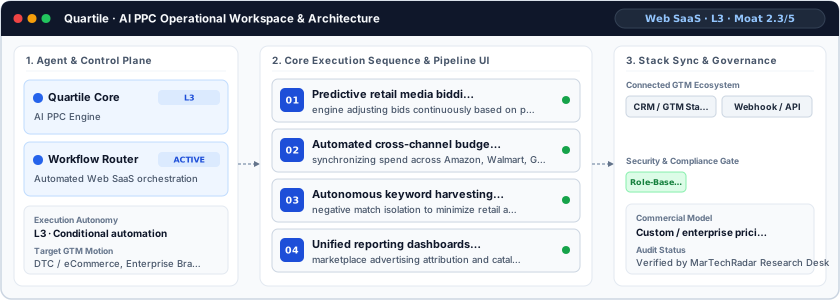
Quartile limitations, drawbacks & risks
Operational considerations and platform boundaries include:
- Marketplace API latency and rate limits: Bid propagation and reporting synchronization remain subject to upstream marketplace throttling, occasionally delaying fast-reacting spend controls during peak retail events.
- Cold-start attribution volatility: New SKU introductions with sparse historical transaction records require prolonged learning phases, leading to unpredictable algorithmic spending before stabilizing.
- Algorithmic transparency constraints: The closed-box nature of the automated bidding models limits granular diagnostic visibility into why specific negative match exclusions or bid adjustments were applied.
Quartile pricing, plans & cost breakdown
Quartile operates under an enterprise managed SaaS framework where commercial pricing is available on request through tailored enterprise sales quotes based on organizational scale and seats. Contracts are customized around aggregate marketplace ad spend tiers, total active catalog size, and supplemental managed services support.
| Plan / Tier | Verified Price & Billing | Included Scope & Contract Terms |
|---|---|---|
| Enterprise / Custom | Custom quote | Custom-quoted plan; terms come from the vendor's sales team. |
How Quartile compares vs. competitors & alternatives
Within the autonomous bidding sector, Quartile competes against solutions like Albert.ai, Adriel, and Smartly.io within the AI PPC segment. While Albert.ai delivers autonomous execution tailored for cross-channel enterprise brand awareness and Adriel focuses on visual dashboard aggregation across diverse ad networks, Quartile differentiates through deep retail marketplace integrations and SKU-level margin modeling. It is best suited for high-volume retail brands and multi-brand agencies managing thousands of marketplace ASINs requiring continuous programmatic bid adjustments.
Direct competitors & market radar
Top algorithmic competitors based on category positioning, capability overlap, and ICP alignment.
Frequently asked questions about Quartile
Does Quartile publish pricing or require an enterprise quote?
Quartile pricing: Custom / enterprise pricing. No free plan is publicly disclosed. Quartile operates under an enterprise managed SaaS framework where commercial pricing is available on request through tailored enterprise sales quotes based on organizational scale and seats.
What are the top Quartile alternatives in AI PPC?
Verified AI PPC alternatives include Skai (From $114,000/yr · Enterprise plan), Perpetua (From $695/mo), PulseAd (From $1,500/yr), Uplane (Custom / enterprise pricing). Within the autonomous bidding sector, Quartile competes against solutions like Albert.ai, Adriel, and Smartly.io within the AI PPC segment.
What are the main limitations and trade-offs of Quartile?
Operational considerations and platform boundaries include: Marketplace API latency and rate limits: Bid propagation and reporting synchronization remain subject to upstream marketplace throttling, occasionally delaying fast-reacting spend controls during peak retail events. Walk away if you need published self-serve pricing: Quartile is sold by custom quote.
Verified sources & evidence trail
- Official product domain: https://quartile.com
- Commercial pricing verification: Verified against official vendor pricing policy (Custom / enterprise pricing)
- Verified corporate entity profiles (
sameAs): Crunchbase Entity Record - First-party governance & documentation links: Privacy
- Editor sign-off: Oct 14, 2026 (how profiles are made).
