BidX Review (2026): Product Feed Management Pricing, Pros & Cons
Bottom line
BidX is a Web SaaS tool for Product Feed Management (Retail Media & Product Feed Management) in AdTech & Paid Media. Pricing: Custom / enterprise pricing. Best suited to DTC / eCommerce. Editor ratings: AI autonomy L2 (workflow copilot); moat score 3.5/5.0 (Proprietary moat). Fact-checked by MarTechRadar Research Desk on Oct 12, 2026.
Amazon advertising automation platform providing programmatic bid management, rule-based campaign optimization, and search term harvesting for retail.
Is BidX worth it in 2026? Buyer fit & when to walk away
Choose BidX if (Best Fit)
- Target ICP & Stack Fit: You operate as DTC / eCommerce requiring a Web SaaS deployment for Product Feed Management.
- L2 Architecture & Defensibility: Deep direct integration with the Amazon Advertising API combined with specialized multi-region campaign restructuring heuristics that maintain operational bid guardrails under volatile marketplace competition.
- Commercial Model Fit: Your procurement budget aligns with Custom / enterprise pricing.
Walk away from BidX if (Deal-Breakers)
- Walk away if you need published self-serve pricing: BidX is sold by custom quote.
- Walk away if your workflow cannot tolerate marketplace dependency: Optimization is heavily tied to Amazon Advertising API rate limits, which introduces data synchronization lag during high-traffic promotional periods.
- Walk away if attribution window latency is a deal-breaker for your team: Rule executions risk over-correcting bids if 7-day to 14-day delayed conversion attributions are not manually accounted for in aggressive rulesets.
BidX pricing, free plan & scorecard at a glance
| Pricing | Custom / enterprise pricing |
|---|---|
| Free plan | No / not disclosed |
| Delivery | Web SaaS |
| Audience | DTC / eCommerce |
| AI autonomy level | L2 · Workflow copilotEditor-verified |
| Moat tier & score | 3.5 / 5.0 · Proprietary moatEditor-verified |
| Funding | AcquiredAcquired by Worldeye |
| Founders | Dominik Thüsing, Max Hofmann, Nadine Schöpper |
| Company size | 11-50 employees |
| Headquarters | Darmstadt, Hesse |
| Founded | 2018 |
| Last verified | Oct 12, 2026 |
BidX pros & cons: strengths vs. operational limitations
Pros: core strengths & capabilities
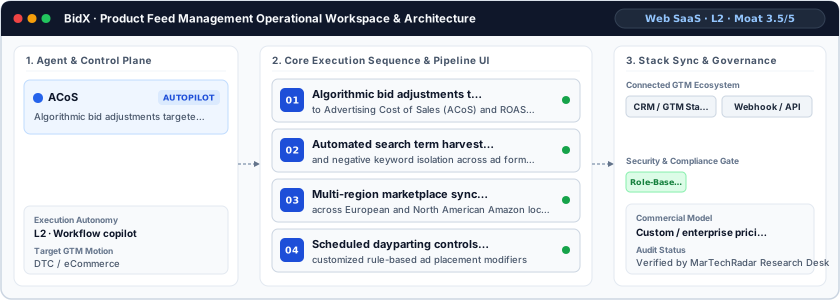
- Algorithmic bid adjustments targeted: to Advertising Cost of Sales (ACoS) and ROAS thresholds
- Automated search term harvesting and negative keyword isolation across ad formats
- Multi-region marketplace synchronization: across European and North American Amazon locales
- Scheduled dayparting controls and customized rule-based ad placement modifiers
Cons: operational limitations & risks
- Marketplace Dependency: Optimization is heavily tied to Amazon Advertising API rate limits, which introduces data synchronization lag during high-traffic promotional periods.
- Attribution Window Latency: Rule executions risk over-correcting bids if 7-day to 14-day delayed conversion attributions are not manually accounted for in aggressive rulesets.
- Cross-Channel Scope: Platform architecture centers primarily on Amazon channels, lacking unified native bid execution pipelines for non-Amazon retail media networks like Walmart or Target.
BidX TCO & deal-breaker stress test
Simulate 12-month stepped TCO, hidden cost multipliers, contract lock-in exposure, and stack failure modes using only facts verified by MarTechRadar Research Desk on 2026-10-12.
BidX triggers high-severity friction under your 5-seat / $800/mo constraints. Benchmark the verified subtrack alternatives below before committing.
- Moat Score
- 3.5 / 5.0
- AI Autonomy
- L2
- Free Tier / Trial
- None disclosed
Triggered audit signals & failure modes
- Opaque Enterprise Quoting vs. SMB/Mid-Market BudgetVerified Pricing Ledger
BidX does not disclose a public self-serve floor (Custom / enterprise pricing). Buyers with a $800/mo cap face high sales-qualification friction.
- Sales-Gated Contract TermsFact-checked by MarTechRadar Research Desk
Commercial access is offered through tailored enterprise sales quotes based on organizational scale, managed ad spend thresholds, and required seat configurations.
- Primary Operational Bottleneck: Marketplace DependencyAudit by MarTechRadar Research Desk
Optimization is heavily tied to Amazon Advertising API rate limits, which introduces data synchronization lag during high-traffic promotional periods.
Test a custom BidX budget or stack constraint
Lower 5-seat floor (~$29/mo vs. Custom Quote) · Transparent self-serve entry without mandatory annual lock-in
Lower 5-seat floor (~$695/mo vs. Custom Quote) · Transparent self-serve entry without mandatory annual lock-in
BidX integrations, API, security & compliance stack
Algorithmic bid adjustments targeted to Advertising Cost of Sales and ROAS thresholds
BidX AI moat & Product Feed Management positioning
Deep direct integration with the Amazon Advertising API combined with specialized multi-region campaign restructuring heuristics that maintain operational bid guardrails under volatile marketplace competition.
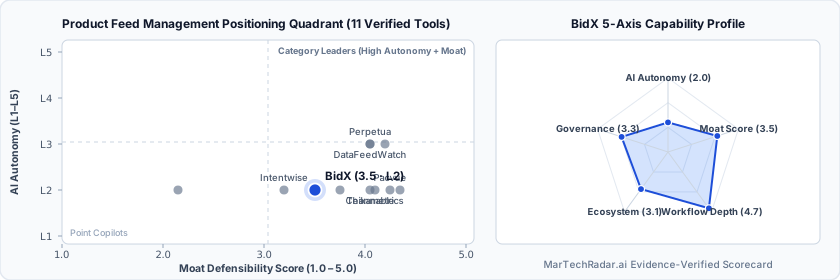
BidX in-depth review, pricing & architecture analysis
Editor sign-off: Oct 12, 2026. How profiles are made.
What is BidX? Overview & background
Established in 2018 in Darmstadt, Hesse, and subsequently acquired by Worldeye, BidX addresses the labor-intensive friction of managing high-frequency marketplace advertising across multi-region Amazon accounts. Built primarily for Amazon marketplace sellers, performance marketing agencies, and brand managers, the platform automates retail media execution. Rather than handling manual bid adjustments and bid optimization spreadsheets, operations teams employ the platform to programmatically govern Sponsored Products, Sponsored Brands, and Sponsored Display initiatives.
How BidX works: architecture & workflow
At the architectural layer, the system execution autonomy, the system connects directly to the Amazon Advertising API to ingest hourly conversion metrics, search query logs, and attribution signals. User configurations establish target parameters such as Advertising Cost of Sales (ACoS) and Return on Ad Spend (ROAS). The rules-based optimization engine evaluates these metrics against custom bounds, adjusting cost-per-click values and running negative keyword actions based on historical query conversion rates.
BidX limitations, drawbacks & risks
Operational considerations and platform boundaries include:
- Marketplace Dependency: Optimization is heavily tied to Amazon Advertising API rate limits, which introduces data synchronization lag during high-traffic promotional periods.
- Attribution Window Latency: Rule executions risk over-correcting bids if 7-day to 14-day delayed conversion attributions are not manually accounted for in aggressive rulesets.
- Cross-Channel Scope: Platform architecture centers primarily on Amazon channels, lacking unified native bid execution pipelines for non-Amazon retail media networks like Walmart or Target.
BidX pricing, plans & cost breakdown
Commercial access is offered through tailored enterprise sales quotes based on organizational scale, managed ad spend thresholds, and required seat configurations. The vendor does not publish fixed public tiers, requiring brand operators and agencies to contact sales for custom contracted packages.
| Plan / Tier | Verified Price & Billing | Included Scope & Contract Terms |
|---|---|---|
| Enterprise / Custom | Custom quote | Custom-quoted plan; terms come from the vendor's sales team. |
How BidX compares vs. competitors & alternatives
Whereas catalog-centric solutions like Channable, DataFeedWatch, and Feedonomics focus primarily on product feed syndication, taxonomy transformation, and multichannel catalog hygiene, BidX functions specifically as an ad bid automation engine within the Product Feed Management segment. Organizations managing feed validation across dozens of general commerce channels require dedicated syndication platforms, while high-velocity Amazon merchants prioritizing automated ACoS management find fit in BidX's specialized bidding engine.
Direct competitors & market radar
Top algorithmic competitors based on category positioning, capability overlap, and ICP alignment.
Frequently asked questions about BidX
Does BidX publish pricing or require an enterprise quote?
BidX pricing: Custom / enterprise pricing. No free plan is publicly disclosed. Commercial access is offered through tailored enterprise sales quotes based on organizational scale, managed ad spend thresholds, and required seat configurations.
What are the top BidX alternatives in Product Feed Management?
Verified Product Feed Management alternatives include Intentwise (Custom / enterprise pricing), Perpetua (From $695/mo), Teikametrics (From $149/yr), Pacvue (Custom / enterprise pricing). Whereas catalog-centric solutions like Channable, DataFeedWatch, and Feedonomics focus primarily on product feed syndication, taxonomy transformation, and multichannel catalog hygiene, BidX functions specifically as an ad bid automation engine within the Product Feed Management segment.
What are the main limitations and trade-offs of BidX?
Operational considerations and platform boundaries include: Marketplace Dependency: Optimization is heavily tied to Amazon Advertising API rate limits, which introduces data synchronization lag during high-traffic promotional periods. Walk away if you need published self-serve pricing: BidX is sold by custom quote.
Verified sources & evidence trail
- Official product domain: https://bidx.io
- Commercial pricing verification: Verified against official vendor pricing policy (Custom / enterprise pricing)
- Verified corporate entity profiles (
sameAs): LinkedIn Company Profile · Crunchbase Entity Record - Editor sign-off: Oct 12, 2026 (how profiles are made).
