Channable Review (2026): Product Feed Management Pricing, Pros & Cons
Bottom line
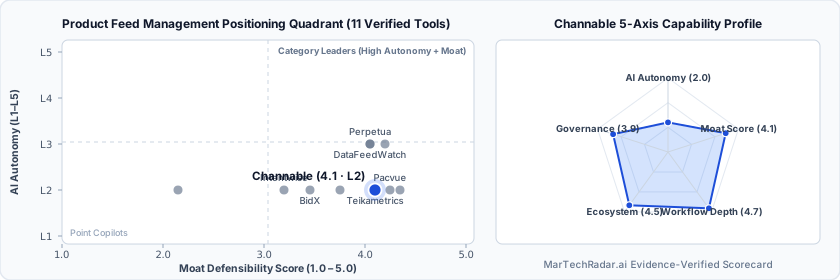
Channable is a Web SaaS tool for Product Feed Management (Retail Media & Product Feed Management) in AdTech & Paid Media. Pricing: From $29/mo. Best suited to DTC / eCommerce. Editor ratings: AI autonomy L2 (workflow copilot); moat score 4.1/5.0 (Proprietary moat). Fact-checked by MarTechRadar Research Desk on Oct 12, 2026.
Multichannel e-commerce product feed management and marketplace integration engine automating catalog syndication and rule-based feed optimization.
Is Channable worth it in 2026? Buyer fit & when to walk away
Choose Channable if (Best Fit)
- Target ICP & Stack Fit: You operate as DTC / eCommerce requiring a Web SaaS deployment for Product Feed Management, with verified ecosystem connectivity for Shopify, Magento, Google Ads.
- L2 Architecture & Defensibility: Deep European marketplace API integrations, consolidated feed ETL with integrated PPC campaign generation, and scalable rule-based data transformation mechanics supported by extensive agency adoption.
- Commercial Model Fit: Your procurement budget aligns with From $29/mo.
Walk away from Channable if (Deal-Breakers)
- Walk away if your workflow cannot tolerate API rate limits and sync latency: High-velocity inventory fluctuations can outpace scheduled batch sync frequencies, creating temporary out-of-stock discrepancies on high-traffic marketplace channels.
- Walk away if transformation rule complexity is a deal-breaker for your team: Extensive logic chains built via the visual IF-THEN builder lack native programmatic version control, complicating debugging when hundreds of overlapping transformation conditions interact.
Channable pricing, free plan & scorecard at a glance
| Pricing | From $29/moVendor pricing page |
|---|---|
| Free plan | No / not disclosed |
| Delivery | Web SaaS |
| Audience | DTC / eCommerce |
| AI autonomy level | L2 · Workflow copilotEditor-verified |
| Moat tier & score | 4.1 / 5.0 · Proprietary moatEditor-verified |
| Funding | Venture-backed |
| Total funding | €55.8MBacked by Partech, Peak |
| Founders | Rob van Nuenen, Stefan Hospes |
| Company size | 201-500 employees |
| Ecosystem integrations | Shopify, Magento, Google Ads |
| Governance & docs | Privacy ↗ |
| Headquarters | Utrecht |
| Founded | 2014 |
| Last verified | Oct 12, 2026 |
Channable pros & cons: strengths vs. operational limitations
Pros: core strengths & capabilities
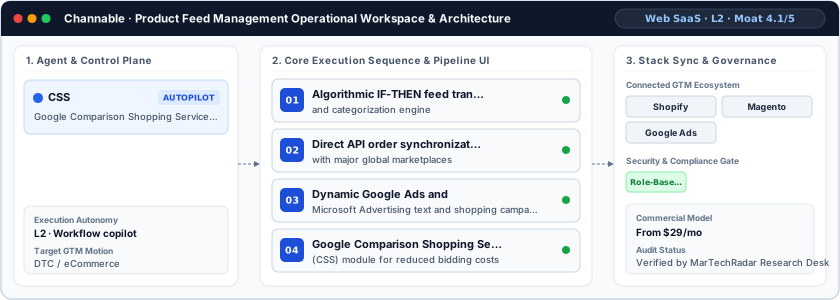
- Algorithmic IF-THEN feed transformation and categorization engine
- Direct API order synchronization: with major global marketplaces
- Dynamic Google Ads and Microsoft Advertising text and shopping campaign generator
- Google Comparison Shopping Service: (CSS) module for reduced bidding costs
Cons: operational limitations & risks
- API Rate Limits and Sync Latency: High-velocity inventory fluctuations can outpace scheduled batch sync frequencies, creating temporary out-of-stock discrepancies on high-traffic marketplace channels.
- Transformation Rule Complexity: Extensive logic chains built via the visual IF-THEN builder lack native programmatic version control, complicating debugging when hundreds of overlapping transformation conditions interact.
- Marketplace Order Reconciliation: Two-way order sync requires strict schema mapping between disparate merchant ERPs and target channel endpoints, introducing operational maintenance overhead during API version deprecations.
Channable TCO & deal-breaker stress test
Simulate 12-month stepped TCO, hidden cost multipliers, contract lock-in exposure, and stack failure modes using only facts verified by MarTechRadar Research Desk on 2026-10-12 · Capture SHA 8fe3927e.
Channable aligns with your 5-seat / $800/mo profile. Review the walk-away triggers and contract levers below before deployment.
- Moat Score
- 4.1 / 5.0
- AI Autonomy
- L2
- Free Tier / Trial
- None disclosed
Triggered audit signals & failure modes
- Published Self-Serve Entry FloorVerified Pricing Ledger
Channable publishes a transparent entry point (From $29/mo) for initial validation before committing.
- Primary Operational Bottleneck: API Rate Limits and Sync LatencyAudit by MarTechRadar Research Desk
High-velocity inventory fluctuations can outpace scheduled batch sync frequencies, creating temporary out-of-stock discrepancies on high-traffic marketplace channels.
Test a custom Channable budget or stack constraint
Lower 5-seat floor (~$24/mo vs. From $29 / mo)
Lower 5-seat floor (~$12/mo vs. From $29 / mo)
Channable integrations, API, security & compliance stack
Google Comparison Shopping Service module for reduced bidding costs
Channable AI moat & Product Feed Management positioning
Deep European marketplace API integrations, consolidated feed ETL with integrated PPC campaign generation, and scalable rule-based data transformation mechanics supported by extensive agency adoption.
Channable in-depth review, pricing & architecture analysis
Editor sign-off: Oct 12, 2026. How profiles are made.
What is Channable? Overview & background
Established in 2014 in Utrecht, Netherlands, Channable expanded with €55.8M in venture funding to address the technical overhead of multichannel catalog syndication. Built specifically for e-commerce performance marketers, catalog managers, and digital agencies, the platform standardizes disparate inventory data across global advertising networks and shopping destinations. Rather than requiring bespoke custom code for every export channel, Channable provides a unified data integration middle-office that normalizes product schemas before network delivery.
How Channable works: architecture & workflow
At its technical core, Channable executes continuous ETL ingestion from e-commerce backends like Shopify and Magento via API, XML, or CSV endpoints. Operating with Level 2 autonomy, the platform applies deterministic IF-THEN rule pipelines to filter, sanitize, and enrich attributes such as pricing, stock availability, and taxonomy structures. It converts these validated datasets into platform-specific feeds or direct REST API pushes to Amazon, eBay, and Google Shopping, while simultaneously updating dynamic search and shopping ad copy based on real-time stock availability.
Channable limitations, drawbacks & risks
Operational considerations and platform boundaries include:
- API Rate Limits and Sync Latency: High-velocity inventory fluctuations can outpace scheduled batch sync frequencies, creating temporary out-of-stock discrepancies on high-traffic marketplace channels.
- Transformation Rule Complexity: Extensive logic chains built via the visual IF-THEN builder lack native programmatic version control, complicating debugging when hundreds of overlapping transformation conditions interact.
- Marketplace Order Reconciliation: Two-way order sync requires strict schema mapping between disparate merchant ERPs and target channel endpoints, introducing operational maintenance overhead during API version deprecations.
Channable pricing, plans & cost breakdown
Channable utilizes a modular software-as-a-service pricing model tied to catalog SKU volume, project count, and exported channel connections. Entry-level access starts from $29/month for Core feed processing, scaling upward as catalog item tiers, marketplace order automation modules, and Comparison Shopping Service (CSS) capabilities are added. Enterprise packages include dedicated customer success managers and customized sync interval Service Level Agreements.
How Channable compares vs. competitors & alternatives
Within the product feed management landscape, Channable targets mid-market merchants and marketing agencies seeking configurable operational control. Unlike Feedonomics, which operates primarily as a managed service with high deployment overhead, Channable delivers self-service configuration. Compared to DataFeedWatch, Channable incorporates native dynamic PPC ad creation, while diverging from Amazon-focused optimization tools like BidX by prioritizing broad multi-channel marketplace distribution and Google CSS cost-reduction workflows.
Direct competitors & market radar
Top algorithmic competitors based on category positioning, capability overlap, and ICP alignment.
Frequently asked questions about Channable
How much does Channable cost in 2026?
Channable pricing: From $29/mo. No free plan is publicly disclosed. Channable utilizes a modular software-as-a-service pricing model tied to catalog SKU volume, project count, and exported channel connections.
What are the top Channable alternatives in Product Feed Management?
Verified Product Feed Management alternatives include DataFeedWatch ($64–$239/mo), Feedonomics (Custom / enterprise pricing), BidX (Custom / enterprise pricing), Perpetua (From $695/mo). Within the product feed management landscape, Channable targets mid-market merchants and marketing agencies seeking configurable operational control.
What are the main limitations and trade-offs of Channable?
Operational considerations and platform boundaries include: API Rate Limits and Sync Latency: High-velocity inventory fluctuations can outpace scheduled batch sync frequencies, creating temporary out-of-stock discrepancies on high-traffic marketplace channels. Walk away if your workflow cannot tolerate API rate limits and sync latency: High-velocity inventory fluctuations can outpace scheduled batch sync frequencies, creating temporary out-of-stock discrepancies on high-traffic marketplace channels.
Verified sources & evidence trail
- Official product domain: https://channable.com
- Commercial pricing verification: https://www.channable.com/pricing
- Verified corporate entity profiles (
sameAs): LinkedIn Company Profile · Crunchbase Entity Record - First-party governance & documentation links: Privacy
- Editor sign-off: Oct 12, 2026 (how profiles are made).
