DataFeedWatch Review (2026): Product Feed Management Pricing, Limits & Alternatives
Bottom line
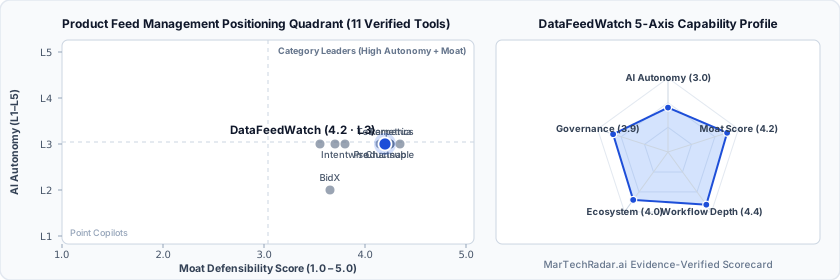
DataFeedWatch is a Web SaaS tool for Product Feed Management (Retail Media & Product Feed Management) in AdTech & Paid Media. Pricing: $64–$239/mo. Best suited to DTC / eCommerce. Editor ratings: AI autonomy L3 (conditional automation); moat score 4.2/5.0 (Proprietary moat). Fact-checked by Anna Xia on Oct 12, 2026.
E-commerce product feed management and optimization platform that ingests, cleanses, enriches, and distributes multi-channel catalog feeds to global.
DataFeedWatch buyer fit verdict: when to choose vs. when to walk away
Choose DataFeedWatch if (Best Fit)
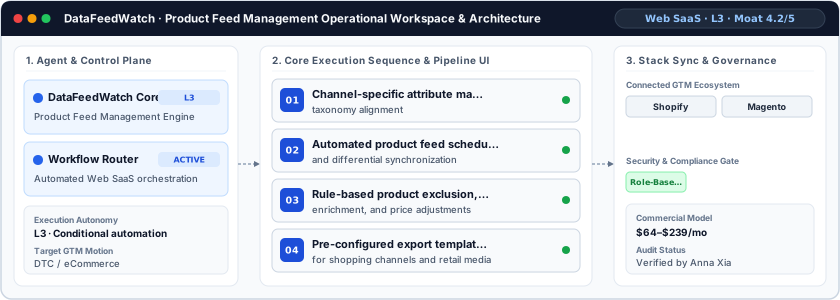
- Target ICP & Stack Fit: You operate as DTC / eCommerce requiring a Web SaaS deployment for Product Feed Management, with verified ecosystem connectivity for Shopify, Magento.
- L3 Architecture & Defensibility: Extensive pre-built channel taxonomy catalog covering global e-commerce destinations coupled with an accessible rule engine for non-developer merchant operations.
- Commercial Model Fit: Your procurement budget aligns with $64–$239/mo.
Walk away from DataFeedWatch if (Deal-Breakers)
- Walk away if your workflow requires uncapped enterprise volume on the $64–$239/mo entry plan without upgrading tiers.
- Walk away if your workflow cannot tolerate sync latency and high-frequency sku volatility: Catalog refreshes depend on batch-interval processing schedules rather than continuous real-time webhooks, leading to short-term pricing discrepancies on rapid inventory shifts.
- Walk away if complex custom schema logic is a deal-breaker for your team: Advanced attribute restructuring requiring heavy relational queries or cross-object calculations pushes the boundaries of its visual condition-builder, demanding pre-processed data.
DataFeedWatch key facts & scorecard
| Pricing | $64–$239/moVendor pricing page |
|---|---|
| Free plan | No / not disclosed |
| Delivery | Web SaaS |
| Audience | DTC / eCommerce |
| AI autonomy level | L3 · Conditional automationEditor-verified |
| Moat tier & score | 4.2 / 5.0 · Proprietary moatEditor-verified |
| Funding | AcquiredAcquired by Revmatics |
| Total funding | $1.4MBacked by Credo Ventures |
| Founders | Jacques Wilt |
| Company size | 51-200 employees |
| Ecosystem integrations | Shopify, Magento |
| Governance & docs | Privacy ↗ |
| Headquarters | San Mateo, CA |
| Founded | 2012 |
| Last verified |
DataFeedWatch pros & cons: strengths vs. operational limitations
Pros: core strengths & capabilities
- Channel-specific attribute mapping and: taxonomy alignment
- Automated product feed scheduling: and differential synchronization
- Rule-based product exclusion, title: enrichment, and price adjustments
- Pre-configured export templates: for shopping channels and retail media
Cons: operational limitations & risks
- Sync Latency and High-Frequency SKU Volatility: Catalog refreshes depend on batch-interval processing schedules rather than continuous real-time webhooks, leading to short-term pricing discrepancies on rapid inventory shifts.
- Complex Custom Schema Logic: Advanced attribute restructuring requiring heavy relational queries or cross-object calculations pushes the boundaries of its visual condition-builder, demanding pre-processed data.
- Marketplace Order Routing Constraints: While optimized for outbound feed delivery and catalog syndication, two-way order synchronization capabilities are narrow compared to dedicated multi-channel order management systems.
DataFeedWatch TCO & deal-breaker stress test
Simulate 12-month stepped TCO, hidden cost multipliers, contract lock-in exposure, and stack failure modes using only facts verified by Anna Xia on · Capture SHA 3c582032.
DataFeedWatch aligns with your 5-seat / $800/mo profile. Review the walk-away triggers and contract levers below before deployment.
| Plan / Tier | Verified Rate | Scale Fit | Scope & Quota Notes |
|---|---|---|---|
| Entry / Starter | $64/mo | Unlimited seats (Entry credits) | Verified $64/mo tier from vendor pricing schedule. |
| Growth / Professional | $84/mo | Unlimited seats (Growth credits) | Verified $84/mo tier from vendor pricing schedule. |
| Agency | $239/mo | Unlimited seats (Scale credits) | For agencies and brands needing dedicated support |
- Moat Score
- 4.2 / 5.0
- AI Autonomy
- L3
- Free Tier / Trial
- None disclosed
Triggered audit signals & failure modes
- Published Self-Serve Entry FloorVerified Pricing Ledger
DataFeedWatch publishes a transparent entry point ($64–$239/mo) for initial validation before committing.
- Tier Fit for 5-Seat Scale: Growth / Professional ($84/mo)Verified Tier Schedule
Verified $84/mo tier from vendor pricing schedule.
- Primary Operational Bottleneck: Sync Latency and High-Frequency SKU VolatilityAudit by Anna Xia
Catalog refreshes depend on batch-interval processing schedules rather than continuous real-time webhooks, leading to short-term pricing discrepancies on rapid inventory shifts.
Hidden TCO Multipliers & Quota Gates
- Credit & Usage Burn Multiplier: Automated workflows consume metered credits/usage quotas; multi-step enrichment, voice minutes, or high-frequency agent runs can trigger mid-cycle top-up packs.
- Enterprise Governance & Add-On Gating: Advanced capabilities such as Single Sign-On (SSO), custom role permissions, or specialized analytics modules are gated behind upper tiers or paid add-ons.
When to Walk Away & Negotiation Levers
- Walk away if your workflow requires uncapped enterprise volume on the $64–$239/mo entry plan without upgrading tiers.
- Walk away if your workflow cannot tolerate sync latency and high-frequency sku volatility: Catalog refreshes depend on batch-interval processing schedules rather than continuous real-time webhooks, leading to short-term pricing discrepancies on rapid inventory shifts.
- Walk away if complex custom schema logic is a deal-breaker for your team: Advanced attribute restructuring requiring heavy relational queries or cross-object calculations pushes the boundaries of its visual condition-builder, demanding pre-processed data.
- Validate exact quota thresholds (seats, credits, or API calls) included in DataFeedWatch's $64–$239/mo tier before converting from monthly to annual billing.
- Require a sandbox proof-of-concept testing sync latency and high-frequency sku volatility against your live CRM/data schema before annual sign-off.
Ask a custom procurement or TCO stress-test question about DataFeedWatch
Lower 5-seat floor (~$29/mo vs. $84 / mo)
Lower 5-seat floor (~$12/mo vs. $84 / mo)
DataFeedWatch key entities, modules & ecosystem stack
DataFeedWatch moat & subtrack positioning
Extensive pre-built channel taxonomy catalog covering global e-commerce destinations coupled with an accessible rule engine for non-developer merchant operations.
Editorial review
Fact-checked by Anna Xia (Senior B2B GTM & Revenue Systems Analyst) on .
Background
Architectured to resolve catalog data fragmentation across digital retail channels, DataFeedWatch operates as an e-commerce feed optimization and syndication platform. Established in 2012 and headquartered in San Mateo, CA, the company scaled on $1.4M in early capital funding. The platform serves performance marketers, retail merchandisers, and e-commerce growth teams who manage distributed product catalogs across advertising networks, price comparison engines, and digital marketplaces.
How DataFeedWatch works
The platform functions via a scheduled data ingestion pipeline that syncs master inventory records from e-commerce backends like Shopify, Magento, and BigCommerce. Once ingested, raw SKU payloads run through an evaluation engine applying conditional transformation logic, attribute enrichment routines, and categorization matching. The system maps merchant taxonomy against distinct channel schemas—such as Google Shopping and Meta catalogs—enabling dynamic price modification, custom label assignment, and automated zero-stock item exclusions before pushing feeds downstream.
Limitations
Operational considerations and platform boundaries include:
- Sync Latency and High-Frequency SKU Volatility: Catalog refreshes depend on batch-interval processing schedules rather than continuous real-time webhooks, leading to short-term pricing discrepancies on rapid inventory shifts.
- Complex Custom Schema Logic: Advanced attribute restructuring requiring heavy relational queries or cross-object calculations pushes the boundaries of its visual condition-builder, demanding pre-processed data.
- Marketplace Order Routing Constraints: While optimized for outbound feed delivery and catalog syndication, two-way order synchronization capabilities are narrow compared to dedicated multi-channel order management systems.
DataFeedWatch pricing
Commercial tiers scale according to SKU volume, store count, and distribution endpoints. Plans start with the Shop tier at $64 per month for basic needs, followed by the Merchant tier at $84 per month for growing brands and the Agency tier at $239 per month for agencies needing dedicated support. SKUs above a plan's limit are billed pay-as-you-go at $2 to $5 per 1,000 SKUs depending on the tier.
How DataFeedWatch compares
Within the product syndication domain, DataFeedWatch competes directly with Channable, Feedonomics, and BidX. Where Feedonomics delivers high-touch managed services and BidX specializes in algorithmic Amazon bid workflows, DataFeedWatch emphasizes self-serve feed manipulation and accessible onboarding. Channable offers broader PPC automation tooling, while DataFeedWatch prioritizes deterministic, cost-effective attribute optimization tailored for mid-market e-commerce merchants and digital agencies managing multi-channel ad spend.
Direct competitors & market radar
Top algorithmic competitors based on category positioning, capability overlap, and ICP alignment.
Frequently asked questions about DataFeedWatch
How much does DataFeedWatch cost and what pricing tiers are available?
Published pricing summary for DataFeedWatch: $64–$239/mo. A permanent free plan is not disclosed for DataFeedWatch. Verified tier schedule: Entry / Starter ($64/mo for Unlimited seats (Entry credits)); Growth / Professional ($84/mo for Unlimited seats (Growth credits)); Agency ($239/mo for Unlimited seats (Scale credits)). Commercial tiers scale according to SKU volume, store count, and distribution endpoints. Plans start with the Shop tier at $64 per month for basic needs, followed by the Merchant tier at $84 per month for growing brands and the Agency tier at $239 per month for agencies needing dedicated support.
How does DataFeedWatch work and how autonomous is its AI architecture?
E-commerce product feed management and optimization platform that ingests, cleanses, enriches, and distributes multi-channel catalog feeds to global. Within Product Feed Management (Retail Media & Product Feed Management), MarTechRadar rates its execution architecture at L3 · Conditional automation with a verified Moat Score of 4.2 / 5.0 (Proprietary moat). Extensive pre-built channel taxonomy catalog covering global e-commerce destinations coupled with an accessible rule engine for non-developer merchant operations. Corporate profile: Founded by Jacques Wilt, operating at 51-200 employees scale, acquired by Revmatics.
What are the main limitations of DataFeedWatch and when should buyers walk away?
Based on our editorial technical audit, key operational considerations and boundaries for DataFeedWatch include: (1) Sync Latency and High-Frequency SKU Volatility: Catalog refreshes depend on batch-interval processing schedules rather than continuous real-time webhooks, leading to short-term pricing discrepancies on rapid inventory shifts. (2) Complex Custom Schema Logic: Advanced attribute restructuring requiring heavy relational queries or cross-object calculations pushes the boundaries of its visual condition-builder, demanding pre-processed data. (3) Marketplace Order Routing Constraints: While optimized for outbound feed delivery and catalog syndication, two-way order synchronization capabilities are narrow compared to dedicated multi-channel order management systems. Primary procurement walk-away rule: Walk away if your workflow requires uncapped enterprise volume on the $64–$239/mo entry plan without upgrading tiers.
What integrations, compliance certifications, and contract terms apply to DataFeedWatch?
Verified ecosystem and stack integrations include Shopify, Magento. Key TCO multiplier to watch: Credit & Usage Burn Multiplier (Automated workflows consume metered credits/usage quotas; multi-step enrichment, voice minutes, or high-frequency agent runs can trigger mid-cycle top-up packs.) Before signing a contract, procurement teams should validate exact quota thresholds (seats, credits, or API calls) included in DataFeedWatch's $64–$239/mo tier before converting from monthly to annual billing.
What are the best DataFeedWatch alternatives and head-to-head competitors in 2026?
Top fact-checked alternatives to DataFeedWatch in Product Feed Management (Retail Media & Product Feed Management) include Channable (From $29/mo), Feedonomics (Custom / enterprise pricing), Perpetua (From $695/mo), Teikametrics (From $149/yr). Within the product syndication domain, DataFeedWatch competes directly with Channable, Feedonomics, and BidX. Where Feedonomics delivers high-touch managed services and BidX specializes in algorithmic Amazon bid workflows, DataFeedWatch emphasizes self-serve feed manipulation and accessible onboarding.
Verified sources & evidence trail
- Official product domain: https://datafeedwatch.com
- Commercial pricing verification: https://www.datafeedwatch.com/pricing
- Verified corporate entity profiles (
sameAs): LinkedIn Company Profile · Crunchbase Entity Record - First-party governance & documentation links: Privacy
- Editorial audit sign-off: Fact-checked by Anna Xia on under the MarTechRadar Evidence-Ledger Protocol.