Feedonomics Review (2026): Product Feed Management Pricing, Pros & Cons
Bottom line
Feedonomics is a Web SaaS tool for Product Feed Management (Retail Media & Product Feed Management) in AdTech & Paid Media. Pricing: Custom / enterprise pricing. Best suited to DTC / eCommerce and Enterprise Brands. Editor ratings: AI autonomy L3 (conditional automation); moat score 4.2/5.0 (Proprietary moat). Fact-checked by MarTechRadar Research Desk on Nov 22, 2026.
Enterprise product feed management and catalog syndication engine optimizing structured e-commerce data across marketplaces and advertising channels.
Is Feedonomics worth it in 2026? Buyer fit & when to walk away
Choose Feedonomics if (Best Fit)
- Target ICP & Stack Fit: You operate as DTC / eCommerce and Enterprise Brands requiring a Web SaaS deployment for Product Feed Management, with verified ecosystem connectivity for Salesforce, Shopify, WooCommerce.
- L3 Architecture & Defensibility: Deep catalog governance infrastructure combining the FeedIQ rule engine, multi-channel taxonomy normalization, managed feed operations, and native integration within BigCommerce's ecosystem.
- Commercial Model Fit: Your procurement budget aligns with Custom / enterprise pricing.
Walk away from Feedonomics if (Deal-Breakers)
- Walk away if you need published self-serve pricing: Feedonomics is sold by custom quote.
- Walk away if your workflow cannot tolerate marketplace rule changes: When Amazon or Google Shopping changes required product fields, feed rules still need fast updates to avoid listing warnings.
- Walk away if multi-million sku sync lag is a deal-breaker for your team: Flash sales across millions of SKUs can hit outside marketplace API batch limits and cause brief stock sync delays.
Feedonomics pricing, free plan & scorecard at a glance
| Pricing | Custom / enterprise pricing |
|---|---|
| Free plan | No / not disclosed |
| Delivery | Web SaaS |
| Audience | DTC / eCommerce, Enterprise Brands |
| AI autonomy level | L3 · Conditional automationEditor-verified |
| Moat tier & score | 4.2 / 5.0 · Proprietary moatEditor-verified |
| Funding | AcquiredAcquired by BigCommerce |
| Total funding | $145.0MBacked by BigCommerce |
| Founders | Brian Roizen, Robert Roizen, Shawn Lipman |
| Company size | 201-500 employees |
| Ecosystem integrations | Salesforce, Shopify, WooCommerce |
| Governance & docs | Privacy ↗ |
| Headquarters | Austin, Texas, United States |
| Founded | 2014 |
| Last verified | Nov 22, 2026 |
Feedonomics pros & cons: strengths vs. operational limitations
Pros: core strengths & capabilities
- Automated product catalog ingestion: from ERPs, databases, and e-commerce platforms
- Algorithmic attribute mapping and dynamic text enrichment for channel requirements
- Bidirectional inventory and order: synchronization across global marketplaces
- Continuous channel error monitoring,: feed validation, and schema governance
Cons: operational limitations & risks
- Marketplace Rule Changes: When Amazon or Google Shopping changes required product fields, feed rules still need fast updates to avoid listing warnings.
- Multi-Million SKU Sync Lag: Flash sales across millions of SKUs can hit outside marketplace API batch limits and cause brief stock sync delays.
- Complex Rule Debugging: Deeply nested custom rules inside FeedIQ can make it harder for new admins to trace why a SKU price or title changed.
Feedonomics TCO & deal-breaker stress test
Simulate 12-month stepped TCO, hidden cost multipliers, contract lock-in exposure, and stack failure modes using only facts verified by MarTechRadar Research Desk on 2026-11-22.
Feedonomics triggers high-severity friction under your 5-seat / $800/mo constraints. Benchmark the verified subtrack alternatives below before committing.
- Moat Score
- 4.2 / 5.0
- AI Autonomy
- L3
- Free Tier / Trial
- None disclosed
Triggered audit signals & failure modes
- Opaque Enterprise Quoting vs. SMB/Mid-Market BudgetVerified Pricing Ledger
Feedonomics does not disclose a public self-serve floor (Custom / enterprise pricing). Buyers with a $800/mo cap face high sales-qualification friction.
- Sales-Gated Contract TermsFact-checked by MarTechRadar Research Desk
Feedonomics sells custom enterprise plans quoted by catalog size, SKU count, linked shopping and ad channels, and service level. Buyers can pick self-serve platform access with support or full-service managed feeds where dedicated feed specialists build and run channel pipelines.
- Primary Operational Bottleneck: Marketplace Rule ChangesAudit by MarTechRadar Research Desk
When Amazon or Google Shopping changes required product fields, feed rules still need fast updates to avoid listing warnings.
Test a custom Feedonomics budget or stack constraint
Lower 5-seat floor (~$29/mo vs. Custom Quote) · Transparent self-serve entry without mandatory annual lock-in
Lower 5-seat floor (~$64/mo vs. Custom Quote) · Transparent self-serve entry without mandatory annual lock-in
Feedonomics integrations, API, security & compliance stack
Feedonomics AI moat & Product Feed Management positioning
Deep catalog governance infrastructure combining the FeedIQ rule engine, multi-channel taxonomy normalization, managed feed operations, and native integration within BigCommerce's ecosystem.
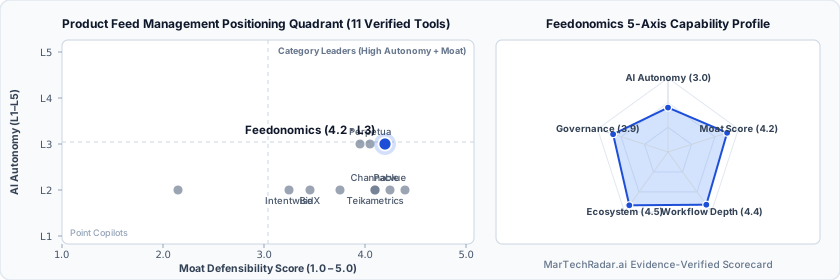
Feedonomics in-depth review, pricing & architecture analysis
Editor sign-off: Nov 22, 2026. How profiles are made.
What is Feedonomics? Overview & background
Founded in 2014, headquartered in Austin, Texas, and bought by BigCommerce in a $145.0M deal, Feedonomics (feedonomics.com) is a product feed and catalog management platform. It serves retail marketing leads, e-commerce teams, and ad agencies. The system sits between back-office ERPs or online stores and hundreds of outside shopping and ad channels. It cleans, maps, and syncs product data so large catalogs follow listing rules across global marketplaces.
How Feedonomics works: architecture & workflow
At Level 3 autonomy, Feedonomics runs an automated catalog pipeline built on its FeedIQ rule engine. The platform pulls raw product records via API webhooks, SFTP drops, or direct links to Shopify, BigCommerce, Salesforce, and WooCommerce. It then cleans messy fields into a single product layout. Next, it runs automated field rules, title updates, and category maps for channels like Google Shopping, Amazon, Walmart, Meta, and TikTok Shop. Two-way sync sends marketplace orders, price updates, and stock counts back to the main store while catching feed errors before listings get blocked.
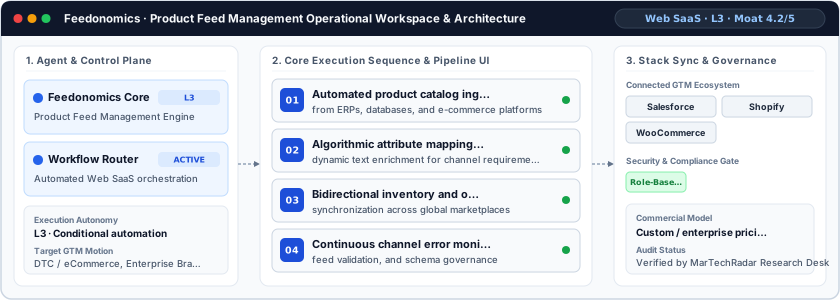
Feedonomics limitations, drawbacks & risks
Key platform limits and trade-offs include:
- Marketplace Rule Changes: When Amazon or Google Shopping changes required product fields, feed rules still need fast updates to avoid listing warnings.
- Multi-Million SKU Sync Lag: Flash sales across millions of SKUs can hit outside marketplace API batch limits and cause brief stock sync delays.
- Complex Rule Debugging: Deeply nested custom rules inside FeedIQ can make it harder for new admins to trace why a SKU price or title changed.
Feedonomics pricing, plans & cost breakdown
Feedonomics sells custom enterprise plans quoted by catalog size, SKU count, linked shopping and ad channels, and service level. Buyers can pick self-serve platform access with support or full-service managed feeds where dedicated feed specialists build and run channel pipelines.
| Plan / Tier | Verified Price & Billing | Included Scope & Contract Terms |
|---|---|---|
| Enterprise / Custom | Custom quote | Custom-quoted plan; terms come from the vendor's sales team. |
How Feedonomics compares vs. competitors & alternatives
In the e-commerce product feed market, Feedonomics competes with Productsup, Channable, DataFeedWatch, and GoDataFeed. Channable and DataFeedWatch focus on self-serve mid-market setup. By contrast, Feedonomics pairs heavy-duty FeedIQ rule logic with 24/7 managed feed specialists. It fits enterprise retailers and agencies running complex multi-channel catalogs across hundreds of thousands or millions of SKUs.
Direct competitors & market radar
Top algorithmic competitors based on category positioning, capability overlap, and ICP alignment.
Frequently asked questions about Feedonomics
Does Feedonomics publish pricing or require an enterprise quote?
Feedonomics pricing: Custom / enterprise pricing. No free plan is publicly disclosed. Feedonomics sells custom enterprise plans quoted by catalog size, SKU count, linked shopping and ad channels, and service level.
What are the top Feedonomics alternatives in Product Feed Management?
Verified Product Feed Management alternatives include Channable (From $29/mo), Productsup (Custom / enterprise pricing), DataFeedWatch ($64–$239/mo), GoDataFeed ($39–$399/mo). In the e-commerce product feed market, Feedonomics competes with Productsup, Channable, DataFeedWatch, and GoDataFeed. Channable and DataFeedWatch focus on self-serve mid-market setup.
What are the main limitations and trade-offs of Feedonomics?
Key platform limits and trade-offs include: Marketplace Rule Changes: When Amazon or Google Shopping changes required product fields, feed rules still need fast updates to avoid listing warnings. Walk away if you need published self-serve pricing: Feedonomics is sold by custom quote.
Verified sources & evidence trail
- Official product domain: https://feedonomics.com
- Commercial pricing verification: Verified against official vendor pricing policy (Custom / enterprise pricing)
- Verified corporate entity profiles (
sameAs): LinkedIn Company Profile · Crunchbase Entity Record - First-party governance & documentation links: Privacy
- Editor sign-off: Nov 22, 2026 (how profiles are made).
