Revealbot Review (2026): AI PPC Pricing, Pros & Cons
Bottom line
Revealbot is a Web SaaS tool for AI PPC (Autonomous Bidding & Budget Management) in AdTech & Paid Media. Pricing: $45–$99/mo. Best suited to DTC / eCommerce. Editor ratings: AI autonomy L3 (conditional automation); moat score 3.2/5.0 (Workflow-embedded (strong)). Fact-checked by MarTechRadar Research Desk on Oct 14, 2026.
Automated ad management platform executing conditional rule logic to optimize budgets, bids, and creatives across major social advertising channels.
Is Revealbot worth it in 2026? Buyer fit & when to walk away
Choose Revealbot if (Best Fit)
- Target ICP & Stack Fit: You operate as DTC / eCommerce requiring a Web SaaS deployment for AI PPC, with verified ecosystem connectivity for Slack, Twilio Segment, Google Ads, Meta Ads.
- L3 Architecture & Defensibility: Proprietary nested rule-building engine integrated deeply with programmatic ad APIs, supported by battle-tested scheduling infrastructure for paid media operations.
- Commercial Model Fit: Your procurement budget aligns with $45–$99/mo.
Walk away from Revealbot if (Deal-Breakers)
- Walk away if your workflow cannot tolerate API rate limits and polling latency: Automated actions depend on vendor API polling schedules, creating a lag window where sudden ad spend spikes can occur before rules trigger.
- Walk away if attribution window lag is a deal-breaker for your team: Delayed reporting signals from ad networks can cause deterministic rules to pause high-converting ads prematurely due to incomplete conversion attribution.
Revealbot pricing, free plan & scorecard at a glance
| Pricing | $45–$99/moVendor pricing page |
|---|---|
| Free plan | No / not disclosed |
| Delivery | Web SaaS |
| Audience | DTC / eCommerce |
| AI autonomy level | L3 · Conditional automationEditor-verified |
| Moat tier & score | 3.2 / 5.0 · Workflow-embedded (strong)Editor-verified |
| Funding | Seed |
| Total funding | $130K |
| Founders | Iskander Musaev, Mikhail Salosin, Mikhail Trofimov |
| Company size | 11-50 employees |
| Ecosystem integrations | Slack, Twilio Segment, Google Ads, Meta Ads, TikTok Ads |
| Governance & docs | Terms ↗ · Privacy ↗ |
| Headquarters | New York, United States |
| Founded | 2016 |
| Last verified | Oct 14, 2026 |
Revealbot pros & cons: strengths vs. operational limitations
Pros: core strengths & capabilities
- Conditional automated rule engine: for scaling and pausing ad campaigns
- Cross-platform campaign orchestration covering: Meta, Google Ads, and TikTok
- Custom frequency scheduling down: to 15-minute polling intervals
- Integrated performance reporting and webhook notifications via Slack
Cons: operational limitations & risks
- API Rate Limits and Polling Latency: Automated actions depend on vendor API polling schedules, creating a lag window where sudden ad spend spikes can occur before rules trigger.
- Attribution Window Lag: Delayed reporting signals from ad networks can cause deterministic rules to pause high-converting ads prematurely due to incomplete conversion attribution.
- Rule Maintenance Overhead: Complex setups with dozens of nested conditional triggers require continuous manual schema adjustments to avoid conflicting rules fighting for budget reallocation.
Revealbot TCO & deal-breaker stress test
Simulate 12-month stepped TCO, hidden cost multipliers, contract lock-in exposure, and stack failure modes using only facts verified by MarTechRadar Research Desk on 2026-10-14 · Capture SHA ba394ec4.
Revealbot aligns with your 5-seat / $800/mo profile. Review the walk-away triggers and contract levers below before deployment.
- Moat Score
- 3.2 / 5.0
- AI Autonomy
- L3
- Free Tier / Trial
- None disclosed
Triggered audit signals & failure modes
- Published Self-Serve Entry FloorVerified Pricing Ledger
Revealbot publishes a transparent entry point ($45–$99/mo) for initial validation before committing.
- Tier Fit for 5-Seat Scale: Essential ($45/mo (annual))Verified Tier Schedule
Up to $10K/mo ad spend baseline ($49/mo monthly), automated rules across Meta, Google, TikTok & Snapchat, unlimited seats.
- Primary Operational Bottleneck: Rule Maintenance OverheadAudit by MarTechRadar Research Desk
Complex setups with dozens of nested conditional triggers require continuous manual schema adjustments to avoid conflicting rules fighting for budget reallocation.
Test a custom Revealbot budget or stack constraint
Fits within $800/mo budget (From $500/mo)
Fits within $800/mo budget (From $499/mo)
Revealbot integrations, API, security & compliance stack
Revealbot AI moat & AI PPC positioning
Proprietary nested rule-building engine integrated deeply with programmatic ad APIs, supported by battle-tested scheduling infrastructure for paid media operations.
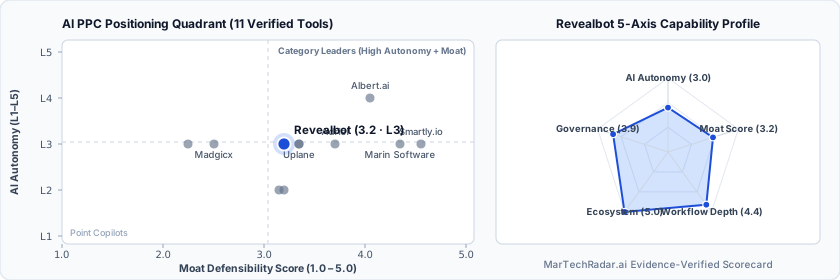
Revealbot in-depth review, pricing & architecture analysis
Editor sign-off: Oct 14, 2026. How profiles are made.
What is Revealbot? Overview & background
Established in 2016 in New York, United States, Revealbot built its operational footing on $130K in early capital before expanding into a self-sustaining automation layer for digital advertisers. Designed specifically for performance marketing teams and agency media buyers managing complex paid portfolios, the platform replaces manual ad adjustments with autonomous execution scripts. Rather than relying purely on proprietary algorithmic black boxes, the system anchors itself around deterministic governance, giving teams programmatic oversight across volatile paid channels without requiring constant operator intervention.
How Revealbot works: architecture & workflow
Operating at Level 3 conditional autonomy, Revealbot (now branded as Bïrch) integrates directly with ad network endpoints, including Meta Ads, Google Ads, TikTok Ads, and Snapchat Ads. The pipeline continuously ingests campaign metrics across customizable polling intervals, parsing impressions, conversion value, and cost-per-acquisition against nested conditional rules. When real-time campaign performance crosses predefined logic thresholds, the execution engine dispatches programmatic API commands to scale budgets, pause fatigued creatives, reallocate spend, or rotate creative variations without human authorization.
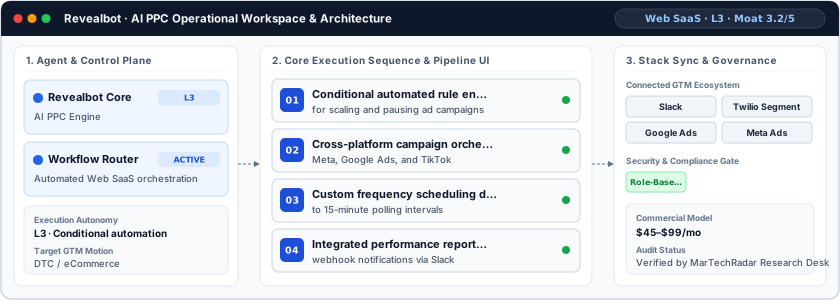
Revealbot limitations, drawbacks & risks
Operational considerations and platform boundaries include:
- API Rate Limits and Polling Latency: Automated actions depend on vendor API polling schedules, creating a lag window where sudden ad spend spikes can occur before rules trigger.
- Attribution Window Lag: Delayed reporting signals from ad networks can cause deterministic rules to pause high-converting ads prematurely due to incomplete conversion attribution.
- Rule Maintenance Overhead: Complex setups with dozens of nested conditional triggers require continuous manual schema adjustments to avoid conflicting rules fighting for budget reallocation.
Revealbot pricing, plans & cost breakdown
Commercial access is structured around tracked monthly ad spend across connected accounts (starting at the up-to-$10K monthly ad spend bracket) with unlimited team seats on paid plans. The Essential tier begins at $45 per month billed annually ($540/year) or $49 per month billed monthly, while the Pro tier starts at $91 per month billed annually ($1,090/year) or $99 per month billed monthly. As tracked monthly media budgets expand above the baseline spend bracket, subscription fees scale proportionally without gating core automated rule builders.
| Plan / Tier | Verified Price & Billing | Included Scope & Contract Terms |
|---|---|---|
| Essential | $45/mo (annual) | Up to $10K/mo ad spend baseline ($49/mo monthly), automated rules across Meta, Google, TikTok & Snapchat, unlimited seats. |
| Pro | $91/mo (annual) | Up to $10K/mo ad spend baseline ($99/mo monthly), creative insights, Slack webhooks & unlimited team seats. |
How Revealbot compares vs. competitors & alternatives
Within the autonomous bidding space, Revealbot diverges from black-box systems like Albert.ai by prioritizing deterministic, transparent rule logic over unsupervised neural optimization within the AI PPC segment. Compared to Adriel and Smartly.io, which emphasize consolidated multi-channel dashboards and creative analytics, Revealbot concentrates heavily on granular execution mechanics and programmatic safety boundaries. It remains best suited for performance-driven mid-market agencies and direct-to-consumer growth teams that require precise algorithmic control over automated spend adjustments.
Direct competitors & market radar
Top algorithmic competitors based on category positioning, capability overlap, and ICP alignment.
Frequently asked questions about Revealbot
How much does Revealbot cost in 2026?
Revealbot pricing: $45–$99/mo. No free plan is publicly disclosed. Published tiers: Essential ($45/mo (annual)); Pro ($91/mo (annual)). Commercial access is structured around tracked monthly ad spend across connected accounts (starting at the up-to-$10K monthly ad spend bracket) with unlimited team seats on paid plans.
What are the top Revealbot alternatives in AI PPC?
Verified AI PPC alternatives include Albert.ai (Custom / enterprise pricing), Glitch Ads (From $499/mo), Adriel (From $500/mo), Ryze AI ($62.30–$1,499/mo). Within the autonomous bidding space, Revealbot diverges from black-box systems like Albert.ai by prioritizing deterministic, transparent rule logic over unsupervised neural optimization within the AI PPC segment.
What are the main limitations and trade-offs of Revealbot?
Operational considerations and platform boundaries include: API Rate Limits and Polling Latency: Automated actions depend on vendor API polling schedules, creating a lag window where sudden ad spend spikes can occur before rules trigger. Walk away if your workflow cannot tolerate API rate limits and polling latency: Automated actions depend on vendor API polling schedules, creating a lag window where sudden ad spend spikes can occur before rules trigger.
Verified sources & evidence trail
- Official product domain: https://revealbot.com
- Commercial pricing verification: https://bir.ch/pricing
- Verified corporate entity profiles (
sameAs): LinkedIn Company Profile · Crunchbase Entity Record - First-party governance & documentation links: Terms · Privacy
- Editor sign-off: Oct 14, 2026 (how profiles are made).
