paretos Review (2026): AI PPC Pricing, Limits & Alternatives
Bottom line
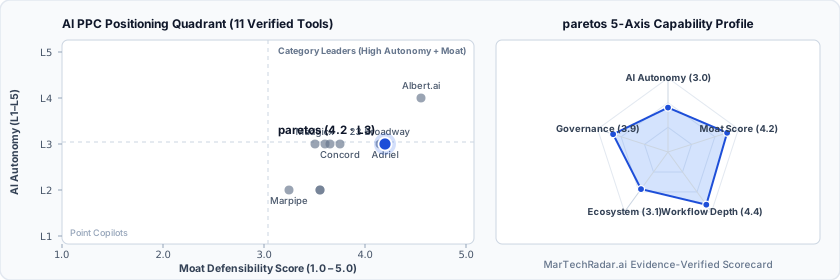
paretos is a Web SaaS tool for AI PPC (Autonomous Bidding & Budget Management) in AdTech & Paid Media. Pricing: Custom / enterprise pricing. Best suited to Performance Marketing Directors, Ad Agencies and Retail Media Advertisers. Editor ratings: AI autonomy L3 (conditional automation); moat score 4.2/5.0 (Proprietary moat). Fact-checked by Julie Brot on Oct 12, 2026.
Decision intelligence and autonomous planning platform utilizing multi-objective optimization and agentic AI to forecast demand and allocate budgets.
paretos buyer fit verdict: when to choose vs. when to walk away
Choose paretos if (Best Fit)
- Target ICP & Stack Fit: You operate as Performance Marketing Directors, Ad Agencies and Retail Media Advertisers requiring a Web SaaS deployment for AI PPC.
- L3 Architecture & Defensibility: Paretos builds defensive defensibility around its proprietary multi-objective optimization framework and the Socrates autonomous decision agent, resolving complex operational trade-offs across enterprise data silos.
- Commercial Model Fit: Your procurement budget aligns with Custom / enterprise pricing.
Walk away from paretos if (Deal-Breakers)
- Walk away if you require transparent self-serve monthly billing or your budget ceiling is under $1,000/mo (paretos requires sales-gated custom quoting).
- Walk away if your workflow cannot tolerate high ingestion data quality thresholds: The predictive accuracy of the optimization engine collapses when historical ERP, spend, or inventory datasets suffer from sparse reporting, requiring significant upstream schema cleansing before models converge.
- Walk away if algorithmic interpretability latency is a deal-breaker for your team: Resolving high-dimensional Pareto frontiers across dozens of conflicting constraints requires substantial computational time, limiting its utility for sub-second, real-time programmatic ad exchange auction bidding.
paretos key facts & scorecard
| Pricing | Custom / enterprise pricing |
|---|---|
| Free plan | No / not disclosed |
| Delivery | Web SaaS |
| Audience | Performance Marketing Directors, Ad Agencies, Retail Media Advertisers |
| AI autonomy level | L3 · Conditional automationEditor-verified |
| Moat tier & score | 4.2 / 5.0 · Proprietary moatEditor-verified |
| Funding | Series A |
| Total funding | €22MBacked by Acton Capital |
| Founders | Fabian Rang, Thorsten Heilig |
| Company size | 51-200 employees |
| Governance & docs | Privacy ↗ |
| Headquarters | Heidelberg, Baden-Württemberg, Germany |
| Founded | 2020 |
| Last verified |
paretos pros & cons: strengths vs. operational limitations
Pros: core strengths & capabilities
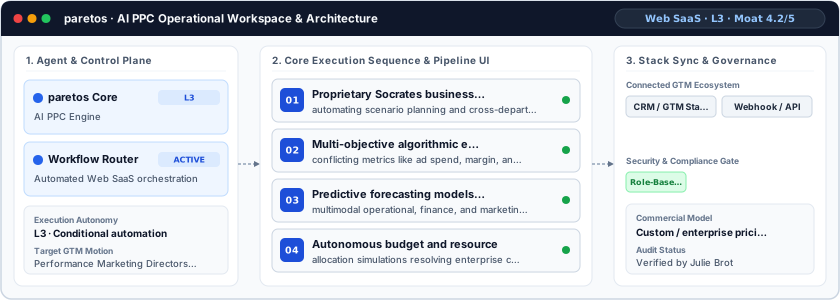
- Proprietary Socrates business agent: automating scenario planning and cross-departmental decision intelligence
- Multi-objective algorithmic engine balancing: conflicting metrics like ad spend, margin, and inventory volume
- Predictive forecasting models ingesting: multimodal operational, finance, and marketing data pipelines
- Autonomous budget and resource: allocation simulations resolving enterprise capital bottlenecks
Cons: operational limitations & risks
- High Ingestion Data Quality Thresholds: The predictive accuracy of the optimization engine collapses when historical ERP, spend, or inventory datasets suffer from sparse reporting, requiring significant upstream schema cleansing before models converge.
- Algorithmic Interpretability Latency: Resolving high-dimensional Pareto frontiers across dozens of conflicting constraints requires substantial computational time, limiting its utility for sub-second, real-time programmatic ad exchange auction bidding.
- Upstream Connector Maintenance Overhead: Connecting heterogeneous warehouse sources, custom financial schemas, and paid media APIs demands continuous pipeline maintenance to prevent missing data vectors from skewing scenario simulations.
paretos TCO & deal-breaker stress test
Simulate 12-month stepped TCO, hidden cost multipliers, contract lock-in exposure, and stack failure modes using only facts verified by Julie Brot on · Capture SHA ffbfcb3b.
paretos triggers high-severity friction under your 5-seat / $800/mo constraints. Benchmark the verified subtrack alternatives below before committing.
| Plan / Tier | Verified Rate | Scale Fit | Scope & Quota Notes |
|---|---|---|---|
| Enterprise / Custom | Custom quote | 15–50+ seats (Enterprise SLA) | Sales-negotiated annual contract for custom volume, SSO/RBAC governance, and dedicated SLA. |
- Moat Score
- 4.2 / 5.0
- AI Autonomy
- L3
- Free Tier / Trial
- None disclosed
Triggered audit signals & failure modes
- Opaque Enterprise Quoting vs. SMB/Mid-Market BudgetVerified Pricing Ledger
paretos does not disclose a public self-serve floor (Custom / enterprise pricing). Buyers with a $800/mo cap face high sales-qualification friction.
- Sales-Gated Contract TermsFact-checked by Julie Brot
Commercial pricing for paretos is available on request through tailored enterprise sales quotes based on organizational scale and seats.
- Primary Operational Bottleneck: High Ingestion Data Quality ThresholdsAudit by Julie Brot
The predictive accuracy of the optimization engine collapses when historical ERP, spend, or inventory datasets suffer from sparse reporting, requiring significant upstream schema cleansing before models converge.
Hidden TCO Multipliers & Quota Gates
- High Ingestion Data Quality Thresholds: The predictive accuracy of the optimization engine collapses when historical ERP, spend, or inventory datasets suffer from sparse reporting, requiring significant upstream schema cleansing before models converge.
- Algorithmic Interpretability Latency: Resolving high-dimensional Pareto frontiers across dozens of conflicting constraints requires substantial computational time, limiting its utility for sub-second, real-time programmatic ad exchange auction bidding.
When to Walk Away & Negotiation Levers
- Walk away if you require transparent self-serve monthly billing or your budget ceiling is under $1,000/mo (paretos requires sales-gated custom quoting).
- Walk away if your workflow cannot tolerate high ingestion data quality thresholds: The predictive accuracy of the optimization engine collapses when historical ERP, spend, or inventory datasets suffer from sparse reporting, requiring significant upstream schema cleansing before models converge.
- Walk away if algorithmic interpretability latency is a deal-breaker for your team: Resolving high-dimensional Pareto frontiers across dozens of conflicting constraints requires substantial computational time, limiting its utility for sub-second, real-time programmatic ad exchange auction bidding.
- Demand a 30- to 60-day paid pilot opt-out clause in the paretos order form before signing a 12-month enterprise commitment.
- Require a sandbox proof-of-concept testing high ingestion data quality thresholds against your live CRM/data schema before annual sign-off.
Ask a custom procurement or TCO stress-test question about paretos
Lower 5-seat floor (~$500/mo vs. Custom Quote) · Transparent self-serve entry without mandatory annual lock-in
Lower 5-seat floor (~$49/mo vs. Custom Quote) · Transparent self-serve entry without mandatory annual lock-in
paretos moat & subtrack positioning
Paretos builds defensive defensibility around its proprietary multi-objective optimization framework and the Socrates autonomous decision agent, resolving complex operational trade-offs across enterprise data silos.
Editorial review
Fact-checked by Julie Brot (Enterprise SaaS Governance & Procurement Editor) on .
Background
Backed by €22M in venture funding and established in 2020 in Heidelberg, Baden-Württemberg, Germany, paretos operates as an agentic decision intelligence platform built for enterprise planning, finance, and operations leaders. Rather than confining budget allocation to reactive spreadsheet modeling or isolated ad consoles, paretos establishes an algorithmic decision layer that reconciles conflicting commercial goals. The platform targets supply chain directors, financial planners, and revenue operations executives who require predictive decision-making across complex distribution and spending channels.
How paretos works
At its architectural core, paretos deploys a multi-objective optimization engine operating at an L3 autonomy profile, moving beyond descriptive metrics into active prescriptive execution. Ingesting historical sales, operational demand, and multi-channel spending logs, the system runs predictive time-series models to simulate forward-looking outcomes. Its proprietary Socrates business agent dynamically weighs trade-offs between inventory limits, cost constraints, and margin thresholds. Once parameters are tuned, the platform generates mathematical allocations that guide programmatic spending and operational resource distribution without manual intervention.
Limitations
Operational considerations and platform boundaries include:
- High Ingestion Data Quality Thresholds: The predictive accuracy of the optimization engine collapses when historical ERP, spend, or inventory datasets suffer from sparse reporting, requiring significant upstream schema cleansing before models converge.
- Algorithmic Interpretability Latency: Resolving high-dimensional Pareto frontiers across dozens of conflicting constraints requires substantial computational time, limiting its utility for sub-second, real-time programmatic ad exchange auction bidding.
- Upstream Connector Maintenance Overhead: Connecting heterogeneous warehouse sources, custom financial schemas, and paid media APIs demands continuous pipeline maintenance to prevent missing data vectors from skewing scenario simulations.
paretos pricing
Commercial pricing for paretos is available on request through tailored enterprise sales quotes based on organizational scale and seats. Deployments do not utilize public self-serve tiers, instead structuring contracts around data ingestion scale, compute overhead for predictive simulations, and dedicated engineering onboarding support for enterprise system integration.
How paretos compares
Within the autonomous budget allocation and planning category, paretos occupies a broader operational tier compared to ad-centric point solutions. While Adriel focuses primarily on cross-channel marketing dashboarding and dashboard-driven alerting, and Albert.ai executes tactical programmatic bidding directly on ad networks, paretos aligns paid acquisition with enterprise supply chain and financial constraints. Similarly, 23 Broadway optimizes ad performance, whereas paretos addresses holistic operational balance. Consequently, paretos is optimal for multi-channel commerce brands and manufacturers that need marketing spend synchronized directly with supply chain realities.
Direct competitors & market radar
Top algorithmic competitors based on category positioning, capability overlap, and ICP alignment.
Frequently asked questions about paretos
How much does paretos cost and does it require a custom enterprise quote?
Published pricing summary for paretos: Custom / enterprise pricing. A permanent free plan is not disclosed for paretos. Commercial pricing for paretos is available on request through tailored enterprise sales quotes based on organizational scale and seats.
How does paretos work and how autonomous is its AI architecture?
Decision intelligence and autonomous planning platform utilizing multi-objective optimization and agentic AI to forecast demand and allocate budgets. Within AI PPC (Autonomous Bidding & Budget Management), MarTechRadar rates its execution architecture at L3 · Conditional automation with a verified Moat Score of 4.2 / 5.0 (Proprietary moat). Paretos builds defensive defensibility around its proprietary multi-objective optimization framework and the Socrates autonomous decision agent, resolving complex operational trade-offs across enterprise data silos. Corporate profile: Founded by Fabian Rang, Thorsten Heilig, operating at 51-200 employees scale.
What are the main limitations of paretos and when should buyers walk away?
Based on our editorial technical audit, key operational considerations and boundaries for paretos include: (1) High Ingestion Data Quality Thresholds: The predictive accuracy of the optimization engine collapses when historical ERP, spend, or inventory datasets suffer from sparse reporting, requiring significant upstream schema cleansing before models converge. (2) Algorithmic Interpretability Latency: Resolving high-dimensional Pareto frontiers across dozens of conflicting constraints requires substantial computational time, limiting its utility for sub-second, real-time programmatic ad exchange auction bidding. (3) Upstream Connector Maintenance Overhead: Connecting heterogeneous warehouse sources, custom financial schemas, and paid media APIs demands continuous pipeline maintenance to prevent missing data vectors from skewing scenario simulations. Primary procurement walk-away rule: Walk away if you require transparent self-serve monthly billing or your budget ceiling is under $1,000/mo (paretos requires sales-gated custom quoting).
What integrations, compliance certifications, and contract terms apply to paretos?
Key TCO multiplier to watch: High Ingestion Data Quality Thresholds (The predictive accuracy of the optimization engine collapses when historical ERP, spend, or inventory datasets suffer from sparse reporting, requiring significant upstream schema cleansing before models converge.) Before signing a contract, procurement teams should demand a 30- to 60-day paid pilot opt-out clause in the paretos order form before signing a 12-month enterprise commitment.
What are the best paretos alternatives and head-to-head competitors in 2026?
Top fact-checked alternatives to paretos in AI PPC (Autonomous Bidding & Budget Management) include 23 Broadway (Custom / enterprise pricing), Concord (Custom / enterprise pricing), Shape.io (Custom / enterprise pricing), Zalster (Custom / enterprise pricing). Within the autonomous budget allocation and planning category, paretos occupies a broader operational tier compared to ad-centric point solutions.
Verified sources & evidence trail
- Official product domain: https://paretos.com
- Commercial pricing verification: Verified against official vendor pricing policy (Custom / enterprise pricing)
- Verified corporate entity profiles (
sameAs): LinkedIn Company Profile · Crunchbase Entity Record - First-party governance & documentation links: Privacy
- Editorial audit sign-off: Fact-checked by Julie Brot on under the MarTechRadar Evidence-Ledger Protocol.