Levanta Review (2026): Ad Spy Pricing, Pros & Cons
Bottom line
Levanta is a Web SaaS tool for Ad Spy (Ad Spy, Creative Intelligence & Affiliate) in AdTech & Paid Media. Pricing: $350–$750/mo. Best suited to DTC / eCommerce and Enterprise Brands. Editor ratings: AI autonomy L3 (conditional automation); moat score 3.9/5.0 (Proprietary moat). Fact-checked by MarTechRadar Research Desk on Oct 14, 2026.
Creator affiliate and marketplace attribution platform connecting e-commerce brands with publishers via automated tracking and commission workflows.
Is Levanta worth it in 2026? Buyer fit & when to walk away
Choose Levanta if (Best Fit)
- Target ICP & Stack Fit: You operate as DTC / eCommerce and Enterprise Brands requiring a Web SaaS deployment for Ad Spy.
- L3 Architecture & Defensibility: Deep programmatic integration with the Amazon Attribution API paired with a specialized two-sided publisher network purpose-built for marketplace seller economics.
- Commercial Model Fit: Your procurement budget aligns with $350–$750/mo.
Walk away from Levanta if (Deal-Breakers)
- Walk away if your workflow cannot tolerate attribution latency: Data synchronization depends on Amazon Attribution API batch reporting cycles, causing conversion reporting lags of up to 24 to 48 hours for external referral sales.
- Walk away if channel dependency is a deal-breaker for your team: Workflows remain heavily tied to Amazon marketplace architecture, reducing feature parity when brands attempt attribution across proprietary storefronts or non-supported marketplaces.
Levanta pricing, free plan & scorecard at a glance
| Pricing | $350–$750/moVendor pricing page |
|---|---|
| Free plan | No / not disclosed |
| Delivery | Web SaaS |
| Audience | DTC / eCommerce, Enterprise Brands |
| AI autonomy level | L3 · Conditional automationEditor-verified |
| Moat tier & score | 3.9 / 5.0 · Proprietary moatEditor-verified |
| Funding | Venture-backed |
| Total funding | $43.4M |
| Founders | Ian Brodie, Rob Schab, Spencer McKenney |
| Company size | 51-200 employees |
| Governance & docs | DPA ↗ · Terms ↗ · Privacy ↗ |
| Headquarters | Seattle, Washington |
| Founded | 2023 |
| Last verified | Oct 14, 2026 |
Levanta pros & cons: strengths vs. operational limitations
Pros: core strengths & capabilities
- Core capability: Amazon Attribution API tracking integration
- Direct creator and publisher: marketplace recruitment
- Automated commission payouts tied: to confirmed marketplace orders
- Core capability: Multi-ASIN attribution and conversion reporting
Cons: operational limitations & risks
- Attribution Latency: Data synchronization depends on Amazon Attribution API batch reporting cycles, causing conversion reporting lags of up to 24 to 48 hours for external referral sales.
- Channel Dependency: Workflows remain heavily tied to Amazon marketplace architecture, reducing feature parity when brands attempt attribution across proprietary storefronts or non-supported marketplaces.
- Catalog Drift Overhead: Out-of-stock events and SKU variations require ongoing manual link audits to prevent creators from routing referral traffic to unavailable marketplace listings.
Levanta TCO & deal-breaker stress test
Simulate 12-month stepped TCO, hidden cost multipliers, contract lock-in exposure, and stack failure modes using only facts verified by MarTechRadar Research Desk on 2026-10-14 · Capture SHA 160a30b6.
Levanta aligns with your 5-seat / $800/mo profile. Review the walk-away triggers and contract levers below before deployment.
- Moat Score
- 3.9 / 5.0
- AI Autonomy
- L3
- Free Tier / Trial
- None disclosed
Triggered audit signals & failure modes
- Published Self-Serve Entry FloorVerified Pricing Ledger
Levanta publishes a transparent entry point ($350–$750/mo) for initial validation before committing.
- Primary Operational Bottleneck: Attribution LatencyAudit by MarTechRadar Research Desk
Data synchronization depends on Amazon Attribution API batch reporting cycles, causing conversion reporting lags of up to 24 to 48 hours for external referral sales.
Test a custom Levanta budget or stack constraint
Lower 5-seat floor (~$30/mo vs. From $350 / mo)
Lower 5-seat floor (~$129/mo vs. From $350 / mo)
Levanta AI moat & Ad Spy positioning
Deep programmatic integration with the Amazon Attribution API paired with a specialized two-sided publisher network purpose-built for marketplace seller economics.
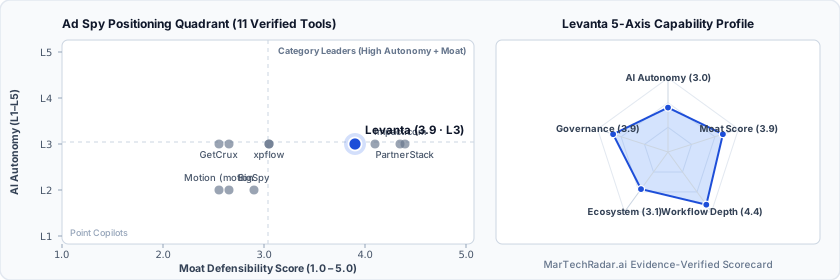
Levanta in-depth review, pricing & architecture analysis
Editor sign-off: Oct 14, 2026. How profiles are made.
What is Levanta? Overview & background
Supported by $43.4M in institutional venture capital, Levanta was founded in 2023 in Seattle, Washington, to solve external traffic attribution for marketplace retail brands. Operating in the commerce affiliate infrastructure category, the platform caters to Amazon sellers, direct-to-consumer brand operators, and growth marketing teams seeking deterministic attribution for off-platform creator partnerships.
How Levanta works: architecture & workflow
Levanta operates an attribution pipeline functioning at Level 3 autonomy through direct synchronization with the Amazon Attribution API and marketplace merchant APIs. The software automates tag generation, mapping unique referral parameters to individual creator profiles and catalog ASINs. When a creator publishes a tagged link, Levanta tracks clicks, off-channel conversion events, and downstream sales velocity. The engine programmatically reconciles 14-day conversion windows against raw marketplace reporting, automating publisher commission calculations and payout disbursements without manual spreadsheet audits, alongside native workflow integrations for Slack and Shopify.
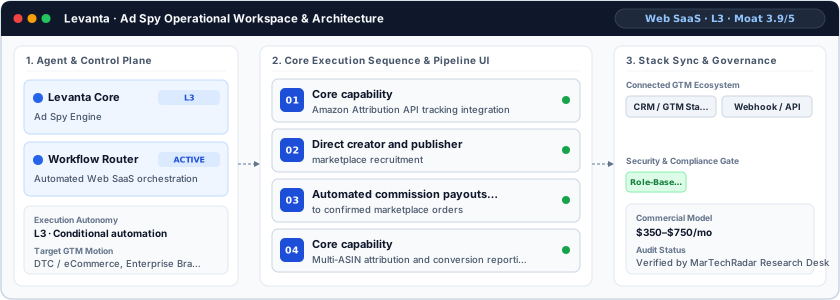
Levanta limitations, drawbacks & risks
Operational considerations and platform boundaries include:
- Attribution Latency: Data synchronization depends on Amazon Attribution API batch reporting cycles, causing conversion reporting lags of up to 24 to 48 hours for external referral sales.
- Channel Dependency: Workflows remain heavily tied to Amazon marketplace architecture, reducing feature parity when brands attempt attribution across proprietary storefronts or non-supported marketplaces.
- Catalog Drift Overhead: Out-of-stock events and SKU variations require ongoing manual link audits to prevent creators from routing referral traffic to unavailable marketplace listings.
Levanta pricing, plans & cost breakdown
Levanta deploys a tiered SaaS subscription structure based on merchant scale, catalog volume, and creator seats, with published plans at $350 per month and $750 per month plus 3.5% of affiliate-driven sales. Contract tiers scale alongside marketplace revenue and custom recruitment access, while enterprise brands negotiate custom terms for multi-market deployments and managed affiliate onboarding.
How Levanta compares vs. competitors & alternatives
Within ad spy, creative intelligence, and affiliate ecosystems, Levanta occupies a transactional attribution role. Platforms like Foreplay.co and BigSpy prioritize competitor creative discovery and ad tracking, whereas Affil.ai focuses on generative affiliate content workflows. Levanta trades ad-intelligence scraping for deterministic attribution telemetry, making it ideal for Amazon-centric merchants prioritizing verified creator ROI.
Frequently asked questions about Levanta
How much does Levanta cost in 2026?
Levanta pricing: $350–$750/mo. No free plan is publicly disclosed. Levanta deploys a tiered SaaS subscription structure based on merchant scale, catalog volume, and creator seats, with published plans at $350 per month and $750 per month plus 3.5% of affiliate-driven sales.
What are the top Levanta alternatives in Ad Spy?
Verified Ad Spy alternatives include Impact.com ($30–$10,000/mo), Affil.ai (Custom / enterprise pricing), GetCrux ($1,500/mo · Enterprise plan), Atria ($129–$959/mo). Within ad spy, creative intelligence, and affiliate ecosystems, Levanta occupies a transactional attribution role.
What are the main limitations and trade-offs of Levanta?
Operational considerations and platform boundaries include: Attribution Latency: Data synchronization depends on Amazon Attribution API batch reporting cycles, causing conversion reporting lags of up to 24 to 48 hours for external referral sales. Walk away if your workflow cannot tolerate attribution latency: Data synchronization depends on Amazon Attribution API batch reporting cycles, causing conversion reporting lags of up to 24 to 48 hours for external referral sales.
Verified sources & evidence trail
- Official product domain: https://levanta.io
- Commercial pricing verification: https://levanta.io/pricing/
- Verified corporate entity profiles (
sameAs): LinkedIn Company Profile · Crunchbase Entity Record - First-party governance & documentation links: DPA · Terms · Privacy
- Editor sign-off: Oct 14, 2026 (how profiles are made).
