Motion (motionapp.com) Review (2026): Ad Spy Pricing, Pros & Cons
Bottom line
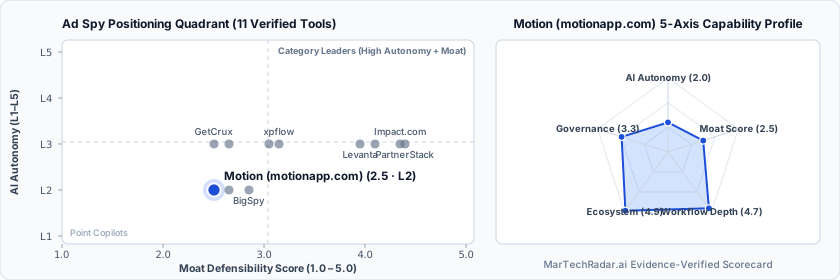
Motion (motionapp.com) is a Web SaaS tool for Ad Spy (Ad Spy, Creative Intelligence & Affiliate) in AdTech & Paid Media. Pricing: From $50/mo. Best suited to B2B SaaS and Marketing Agencies. Editor ratings: AI autonomy L2 (workflow copilot); moat score 2.5/5.0 (Workflow-embedded). Fact-checked by MarTechRadar Research Desk on Oct 14, 2026.
Motion delivers creative intelligence and visual ad analytics by pairing performance metrics directly with creative video and image assets across major.
Is Motion (motionapp.com) worth it in 2026? Buyer fit & when to walk away
Choose Motion (motionapp.com) if (Best Fit)
- Target ICP & Stack Fit: You operate as B2B SaaS and Marketing Agencies requiring a Web SaaS deployment for Ad Spy, with verified ecosystem connectivity for Slack, Twilio Segment, Google Analytics 4 (GA4), Model Context Protocol (MCP).
- L2 Architecture & Defensibility: Motion pairs creative asset ingestion pipelines with automated tagging and Slack-integrated creative intelligence (Runneth). Its defensibility stems from high-frequency ad account synchronization, creative-native performance visualization, and embedded cross-functional workflows between media buyers and designers.
- Commercial Model Fit: Your procurement budget aligns with From $50/mo.
Walk away from Motion (motionapp.com) if (Deal-Breakers)
- Walk away if your workflow cannot tolerate attribution window lag: Asset performance metrics inherit delayed attribution updates directly from platform APIs, distorting real-time creative comparisons during short-window promotions.
- Walk away if multi-variant creative grouping is a deal-breaker for your team: Automated asset grouping encounters edge-case failures when processing slight visual alterations or dynamic creative optimization setups, requiring manual taxonomy fixes.
Motion (motionapp.com) pricing, free plan & scorecard at a glance
| Pricing | From $50/moVendor pricing page |
|---|---|
| Free plan | No / not disclosed |
| Delivery | Web SaaS |
| Audience | B2B SaaS, Marketing Agencies |
| AI autonomy level | L2 · Workflow copilotEditor-verified |
| Moat tier & score | 2.5 / 5.0 · Workflow-embeddedEditor-verified |
| Funding | Undisclosed |
| Company size | 51-200 employees |
| Ecosystem integrations | Slack, Twilio Segment, Google Analytics 4 (GA4), Model Context Protocol (MCP) |
| Governance & docs | Terms ↗ · Privacy ↗ |
| Headquarters | Toronto, CA |
| Founded | 2021 |
| Last verified | Oct 14, 2026 |
Motion (motionapp.com) pros & cons: strengths vs. operational limitations
Pros: core strengths & capabilities
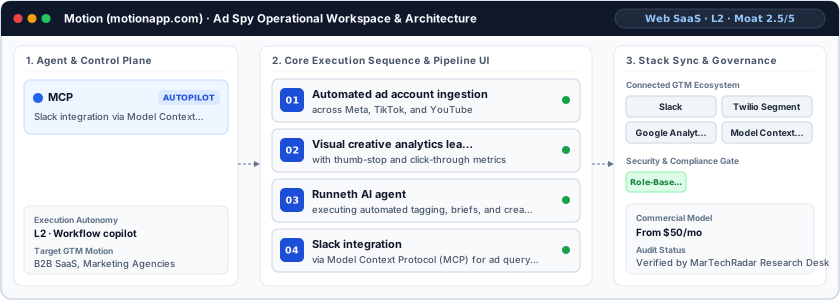
- Automated ad account ingestion: across Meta, TikTok, and YouTube
- Visual creative analytics leaderboards: with thumb-stop and click-through metrics
- Runneth AI agent: executing automated tagging, briefs, and creative routines
- Slack integration: via Model Context Protocol (MCP) for ad query execution
Cons: operational limitations & risks
- Attribution Window Lag: Asset performance metrics inherit delayed attribution updates directly from platform APIs, distorting real-time creative comparisons during short-window promotions.
- Multi-Variant Creative Grouping: Automated asset grouping encounters edge-case failures when processing slight visual alterations or dynamic creative optimization setups, requiring manual taxonomy fixes.
- Third-Party API Rate Quotas: High-volume ad accounts with tens of thousands of active ads risk API throttling during full historical ingestion and synchronization cycles.
Motion (motionapp.com) TCO & deal-breaker stress test
Simulate 12-month stepped TCO, hidden cost multipliers, contract lock-in exposure, and stack failure modes using only facts verified by MarTechRadar Research Desk on 2026-10-14 · Capture SHA 78e1e96f.
Motion (motionapp.com) aligns with your 5-seat / $800/mo profile. Review the walk-away triggers and contract levers below before deployment.
- Moat Score
- 2.5 / 5.0
- AI Autonomy
- L2
- Free Tier / Trial
- None disclosed
Triggered audit signals & failure modes
- Published Self-Serve Entry FloorVerified Pricing Ledger
Motion (motionapp.com) publishes a transparent entry point (From $50/mo) for initial validation before committing.
- Primary Operational Bottleneck: Attribution Window LagAudit by MarTechRadar Research Desk
Asset performance metrics inherit delayed attribution updates directly from platform APIs, distorting real-time creative comparisons during short-window promotions.
Test a custom Motion (motionapp.com) budget or stack constraint
Lower 5-seat floor (~$30/mo vs. From $50 / mo)
Lower 5-seat floor (~$49/mo vs. From $50 / mo)
Motion (motionapp.com) integrations, API, security & compliance stack
Slack integration via Model Context Protocol for ad query execution
Motion (motionapp.com) AI moat & Ad Spy positioning
Motion pairs creative asset ingestion pipelines with automated tagging and Slack-integrated creative intelligence (Runneth). Its defensibility stems from high-frequency ad account synchronization, creative-native performance visualization, and embedded cross-functional workflows between media buyers and designers.
Motion (motionapp.com) in-depth review, pricing & architecture analysis
Editor sign-off: Oct 14, 2026. How profiles are made.
What is Motion (motionapp.com)? Overview & background
Performance marketing teams and creative strategists operate across a structural divide between media buying dashboards and design workflows. Headquartered in Toronto, CA, and founded in 2021, Motion addresses this operational disconnect by translating quantitative paid advertising data into visual creative reporting. Built for direct-to-consumer growth leads and creative directors, the software converts raw ad attribution data into asset-level intelligence, avoiding manual metric matching across paid social channels.
How Motion (motionapp.com) works: architecture & workflow
Motion operates an ingestion pipeline via ad platform APIs to ingest visual assets, ad copy, and performance figures across Meta, TikTok, and YouTube. Creative video and static files are indexed alongside retention curves, thumb-stop rates, and outbound conversions. The architecture deploys dedicated virtual machine compute to power Runneth, an analytical agent that auto-tags creative elements, surfaces top-performing hooks, and serves queries directly within internal Slack workspaces via Model Context Protocol interfaces under Level 2 operational autonomy, alongside native workflow integrations for Google Analytics.
Motion (motionapp.com) limitations, drawbacks & risks
Operational considerations and platform boundaries include:
- Attribution Window Lag: Asset performance metrics inherit delayed attribution updates directly from platform APIs, distorting real-time creative comparisons during short-window promotions.
- Multi-Variant Creative Grouping: Automated asset grouping encounters edge-case failures when processing slight visual alterations or dynamic creative optimization setups, requiring manual taxonomy fixes.
- Third-Party API Rate Quotas: High-volume ad accounts with tens of thousands of active ads risk API throttling during full historical ingestion and synchronization cycles.
Motion (motionapp.com) pricing, plans & cost breakdown
Motion structures its subscriptions primarily around tracked monthly ad spend and feature access. Commercial subscriptions start at $50 per month, scaling up through dedicated enterprise and operator tiers such as the Starter tier at $750 per month for ad accounts spending up to $50k monthly. Upper tiers include dedicated VM instances, full Model Context Protocol access, and unmetered seat licensing.
How Motion (motionapp.com) compares vs. competitors & alternatives
While Foreplay.co focuses on competitive asset aggregation and swipe file management, and BigSpy serves as a horizontal competitor ad discovery engine, Motion prioritizes first-party creative analytics and internal team synthesis within the Ad Spy segment. Unlike Affil.ai, which centers on partner distribution mechanics, Motion specifically targets mid-market to enterprise DTC brands requiring tight coordination between media buyers and production designers.
Direct competitors & market radar
Top algorithmic competitors based on category positioning, capability overlap, and ICP alignment.
Frequently asked questions about Motion (motionapp.com)
How much does Motion (motionapp.com) cost in 2026?
Motion (motionapp.com) pricing: From $50/mo. No free plan is publicly disclosed. Motion structures its subscriptions primarily around tracked monthly ad spend and feature access.
What are the top Motion (motionapp.com) alternatives in Ad Spy?
Verified Ad Spy alternatives include Alison.ai (Custom / enterprise pricing), Affil.ai (Custom / enterprise pricing), Impact.com ($30–$10,000/mo), BigSpy ($69–$499/mo). While Foreplay.co focuses on competitive asset aggregation and swipe file management, and BigSpy serves as a horizontal competitor ad discovery engine, Motion prioritizes first-party creative analytics and internal team synthesis within the Ad Spy segment.
What are the main limitations and trade-offs of Motion (motionapp.com)?
Operational considerations and platform boundaries include: Attribution Window Lag: Asset performance metrics inherit delayed attribution updates directly from platform APIs, distorting real-time creative comparisons during short-window promotions. Walk away if your workflow cannot tolerate attribution window lag: Asset performance metrics inherit delayed attribution updates directly from platform APIs, distorting real-time creative comparisons during short-window promotions.
Verified sources & evidence trail
- Official product domain: https://motionapp.com
- Commercial pricing verification: https://motionapp.com/pricing/
- Verified corporate entity profiles (
sameAs): LinkedIn Company Profile - First-party governance & documentation links: Terms · Privacy
- Editor sign-off: Oct 14, 2026 (how profiles are made).
