MagicBrief Review (2026): Ad Spy Pricing, Pros & Cons
Bottom line
MagicBrief is a Web SaaS tool for Ad Spy (Ad Spy, Creative Intelligence & Affiliate) in AdTech & Paid Media. Pricing: Custom / enterprise pricing. Best suited to DTC / eCommerce and Marketing Agencies. Editor ratings: AI autonomy L2 (workflow copilot); moat score 2.7/5.0 (Workflow-embedded). Fact-checked by MarTechRadar Research Desk on Oct 14, 2026.
Creative intelligence and ad curation engine capturing competitor social video assets, extracting storyboard sequences, and translating performance trends.
Is MagicBrief worth it in 2026? Buyer fit & when to walk away
Choose MagicBrief if (Best Fit)
- Target ICP & Stack Fit: You operate as DTC / eCommerce and Marketing Agencies requiring a Web SaaS deployment for Ad Spy.
- L2 Architecture & Defensibility: Defensibility centers on high-fidelity scraping infrastructure for ephemeral ad libraries, automated video frame decomposition, and proprietary ingestion pipelines integrated into Canva.
- Commercial Model Fit: Your procurement budget aligns with Custom / enterprise pricing.
Walk away from MagicBrief if (Deal-Breakers)
- Walk away if you need published self-serve pricing: MagicBrief is sold by custom quote.
- Walk away if your workflow cannot tolerate platform lifecycle sunset: The standalone product faces a structured decommission date in 2026, forcing technical migrations toward Canva Grow workflows.
- Walk away if upstream scraper vulnerability is a deal-breaker for your team: Data capture depends entirely on volatile DOM structures across public ad repositories, causing capture failures whenever parent ad networks modify their client-side code.
MagicBrief pricing, free plan & scorecard at a glance
| Pricing | Custom / enterprise pricing |
|---|---|
| Free plan | No / not disclosed |
| Delivery | Web SaaS |
| Audience | DTC / eCommerce, Marketing Agencies |
| AI autonomy level | L2 · Workflow copilotEditor-verified |
| Moat tier & score | 2.7 / 5.0 · Workflow-embeddedEditor-verified |
| Funding | AcquiredAcquired by Canva |
| Total funding | $2M |
| Founders | Dan Nolan, George Howes |
| Company size | 2-10 employees |
| Governance & docs | Terms ↗ · Privacy ↗ |
| Headquarters | Sydney, New South Wales, Australia |
| Founded | 2022 |
| Last verified | Oct 14, 2026 |
MagicBrief pros & cons: strengths vs. operational limitations
Pros: core strengths & capabilities
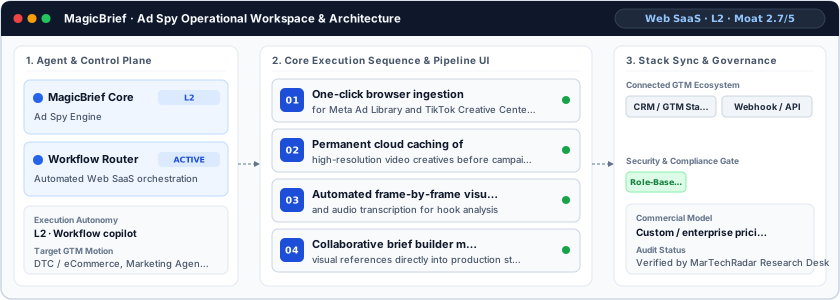
- One-click browser ingestion: for Meta Ad Library and TikTok Creative Center assets
- Permanent cloud caching of high-resolution video creatives before campaign deprecation
- Automated frame-by-frame visual decomposition and audio transcription for hook analysis
- Collaborative brief builder mapping: visual references directly into production storyboards
Cons: operational limitations & risks
- Platform Lifecycle Sunset: The standalone product faces a structured decommission date in 2026, forcing technical migrations toward Canva Grow workflows.
- Upstream Scraper Vulnerability: Data capture depends entirely on volatile DOM structures across public ad repositories, causing capture failures whenever parent ad networks modify their client-side code.
- Attribution Signal Absence: The pipeline captures visual assets and run durations but lacks direct integration with downstream first-party attribution data to verify actual spend or return on ad spend.
MagicBrief TCO & deal-breaker stress test
Simulate 12-month stepped TCO, hidden cost multipliers, contract lock-in exposure, and stack failure modes using only facts verified by MarTechRadar Research Desk on 2026-10-14.
MagicBrief triggers high-severity friction under your 5-seat / $800/mo constraints. Benchmark the verified subtrack alternatives below before committing.
- Moat Score
- 2.7 / 5.0
- AI Autonomy
- L2
- Free Tier / Trial
- None disclosed
Triggered audit signals & failure modes
- Opaque Enterprise Quoting vs. SMB/Mid-Market BudgetVerified Pricing Ledger
MagicBrief does not disclose a public self-serve floor (Custom / enterprise pricing). Buyers with a $800/mo cap face high sales-qualification friction.
- Sales-Gated Contract TermsFact-checked by MarTechRadar Research Desk
MagicBrief operates under custom enterprise pricing, with access provisioned through tailored commercial quotes based on seat count and creative storage capacity.
- Primary Operational Bottleneck: Platform Lifecycle SunsetAudit by MarTechRadar Research Desk
The standalone product faces a structured decommission date in 2026, forcing technical migrations toward Canva Grow workflows.
Test a custom MagicBrief budget or stack constraint
Lower 5-seat floor (~$30/mo vs. Custom Quote) · Transparent self-serve entry without mandatory annual lock-in
Lower 5-seat floor (~$50/mo vs. Custom Quote) · Transparent self-serve entry without mandatory annual lock-in
MagicBrief AI moat & Ad Spy positioning
Defensibility centers on high-fidelity scraping infrastructure for ephemeral ad libraries, automated video frame decomposition, and proprietary ingestion pipelines integrated into Canva.
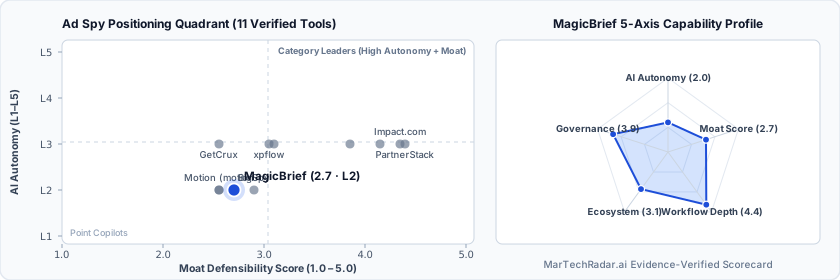
MagicBrief in-depth review, pricing & architecture analysis
Editor sign-off: Oct 14, 2026. How profiles are made.
What is MagicBrief? Overview & background
Backed by $2M in venture funding and established in 2022 in Sydney, New South Wales, Australia, MagicBrief entered the ad spy and creative intelligence market to resolve the friction between digital ad surveillance and production briefing. Following its strategic acquisition by Canva, the platform's core technology serves performance marketing leads, creative strategists, and direct-to-consumer growth teams seeking structured visual intelligence rather than ephemeral ad-library screenshots.
How MagicBrief works: architecture & workflow
At an architectural level, the system deploys a browser extension hook coupled with asynchronous ingestion workers that capture raw video payloads and metadata from networks like Meta and TikTok. Ingested assets bypass typical library deprecation cycles by streaming directly to dedicated object storage. A secondary processing pipeline executes audio transcription and frame-by-frame scene segmentation, isolating hooks, calls to action, and visual pacing into modular blocks for collaborative creative production at an L2 autonomy rating.
MagicBrief limitations, drawbacks & risks
Operational considerations and platform boundaries include:
- Platform Lifecycle Sunset: The standalone product faces a structured decommission date in 2026, forcing technical migrations toward Canva Grow workflows.
- Upstream Scraper Vulnerability: Data capture depends entirely on volatile DOM structures across public ad repositories, causing capture failures whenever parent ad networks modify their client-side code.
- Attribution Signal Absence: The pipeline captures visual assets and run durations but lacks direct integration with downstream first-party attribution data to verify actual spend or return on ad spend.
MagicBrief pricing, plans & cost breakdown
MagicBrief operates under custom enterprise pricing, with access provisioned through tailored commercial quotes based on seat count and creative storage capacity. Procurement teams must request custom sales terms directly, as public tiered plans have been replaced by structured transition packages facilitating enterprise migrations into Canva's broader growth suite.
| Plan / Tier | Verified Price & Billing | Included Scope & Contract Terms |
|---|---|---|
| Enterprise / Custom | Custom quote | Custom-quoted plan; terms come from the vendor's sales team. |
How MagicBrief compares vs. competitors & alternatives
Relative to competitors like Foreplay.co, which focuses heavily on agency collaboration workflows, and BigSpy or Affil.ai, which prioritize raw volume across affiliate display networks, MagicBrief distinguishes itself through structural storyboarding and visual decomposition. However, its impending sunset limits long-term standalone viability, making it primarily relevant for organizations planning strategic integration into Canva enterprise ecosystems.
Direct competitors & market radar
Top algorithmic competitors based on category positioning, capability overlap, and ICP alignment.
Frequently asked questions about MagicBrief
Does MagicBrief publish pricing or require an enterprise quote?
MagicBrief pricing: Custom / enterprise pricing. No free plan is publicly disclosed. MagicBrief operates under custom enterprise pricing, with access provisioned through tailored commercial quotes based on seat count and creative storage capacity.
What are the top MagicBrief alternatives in Ad Spy?
Verified Ad Spy alternatives include Impact.com ($30–$10,000/mo), PartnerStack (Custom / enterprise pricing), Motion (motionapp.com) (From $50/mo), Sovrn (Custom / enterprise pricing). Relative to competitors like Foreplay.co, which focuses heavily on agency collaboration workflows, and BigSpy or Affil.ai, which prioritize raw volume across affiliate display networks, MagicBrief distinguishes itself through structural storyboarding and visual decomposition.
What are the main limitations and trade-offs of MagicBrief?
Operational considerations and platform boundaries include: Platform Lifecycle Sunset: The standalone product faces a structured decommission date in 2026, forcing technical migrations toward Canva Grow workflows. Walk away if you need published self-serve pricing: MagicBrief is sold by custom quote.
Verified sources & evidence trail
- Official product domain: https://magicbrief.com
- Commercial pricing verification: Verified against official vendor pricing policy (Custom / enterprise pricing)
- Verified corporate entity profiles (
sameAs): LinkedIn Company Profile · Crunchbase Entity Record - First-party governance & documentation links: Terms · Privacy
- Editor sign-off: Oct 14, 2026 (how profiles are made).
