Conversant Review (2026): Ad Spy Pricing, Pros & Cons
Bottom line
Conversant is a Web SaaS tool for Ad Spy (Ad Spy, Creative Intelligence & Affiliate) in AdTech & Paid Media. Pricing: Custom / enterprise pricing. Best suited to DTC / eCommerce and Enterprise Brands. Editor ratings: AI autonomy L3 (conditional automation); moat score 2.7/5.0 (Workflow-embedded). Fact-checked by MarTechRadar Research Desk on Oct 14, 2026.
Enterprise digital advertising and affiliate identity platform uniting deterministic transaction data with cross-device programmatic execution.
Is Conversant worth it in 2026? Buyer fit & when to walk away
Choose Conversant if (Best Fit)
- Target ICP & Stack Fit: You operate as DTC / eCommerce and Enterprise Brands requiring a Web SaaS deployment for Ad Spy.
- L3 Architecture & Defensibility: Deep structural moat grounded in an extensive persistent identity graph, long-standing deterministic transaction datasets, and integrated publisher affiliate networks operating at global scale.
- Commercial Model Fit: Your procurement budget aligns with Custom / enterprise pricing.
Walk away from Conversant if (Deal-Breakers)
- Walk away if you need published self-serve pricing: Conversant is sold by custom quote.
- Walk away if your workflow cannot tolerate identity resolution latency: Reconciliation between batch-uploaded in-store transaction logs and live digital identity graphs can experience processing lags, delaying rapid closed-loop optimizations for fast-moving promotional campaigns.
- Walk away if implementation overhead is a deal-breaker for your team: Configuring the enterprise data pipeline requires significant technical coordination, dedicated engineering resources, and deep enterprise data-cleansing cycles to establish reliable CRM and POS ingest flows.
Conversant pricing, free plan & scorecard at a glance
| Pricing | Custom / enterprise pricing |
|---|---|
| Free plan | No / not disclosed |
| Delivery | Web SaaS |
| Audience | DTC / eCommerce, Enterprise Brands |
| AI autonomy level | L3 · Conditional automationEditor-verified |
| Moat tier & score | 2.7 / 5.0 · Workflow-embeddedEditor-verified |
| Funding | Undisclosed |
| Founders | Brian Coryat, Farshad Fardad |
| Company size | 5001-10000 employees |
| Headquarters | Irving, Texas |
| Founded | 1998 |
| Last verified | Oct 14, 2026 |
Conversant pros & cons: strengths vs. operational limitations
Pros: core strengths & capabilities
- Persistent consumer identity resolution: matching offline purchase records with digital identifiers
- Omnichannel programmatic media execution: across display, video, connected TV, and mobile
- Integrated affiliate marketing infrastructure: via enterprise publisher network distribution
- Closed-loop sales attribution connecting: impression logs directly to point-of-sale transactions
Cons: operational limitations & risks
- Identity Resolution Latency: Reconciliation between batch-uploaded in-store transaction logs and live digital identity graphs can experience processing lags, delaying rapid closed-loop optimizations for fast-moving promotional campaigns.
- Implementation Overhead: Configuring the enterprise data pipeline requires significant technical coordination, dedicated engineering resources, and deep enterprise data-cleansing cycles to establish reliable CRM and POS ingest flows.
- Third-Party Signal Degradation: Tightening browser-level privacy controls and mobile identifier deprecation place operational pressure on device-bridging graphs, necessitating continuous reliance on direct, authenticated brand data streams.
Conversant TCO & deal-breaker stress test
Simulate 12-month stepped TCO, hidden cost multipliers, contract lock-in exposure, and stack failure modes using only facts verified by MarTechRadar Research Desk on 2026-10-14.
Conversant triggers high-severity friction under your 5-seat / $800/mo constraints. Benchmark the verified subtrack alternatives below before committing.
- Moat Score
- 2.7 / 5.0
- AI Autonomy
- L3
- Free Tier / Trial
- None disclosed
Triggered audit signals & failure modes
- Opaque Enterprise Quoting vs. SMB/Mid-Market BudgetVerified Pricing Ledger
Conversant does not disclose a public self-serve floor (Custom / enterprise pricing). Buyers with a $800/mo cap face high sales-qualification friction.
- Sales-Gated Contract TermsFact-checked by MarTechRadar Research Desk
Conversant operates strictly on an enterprise managed-service and custom software licensing model.
- Primary Operational Bottleneck: Identity Resolution LatencyAudit by MarTechRadar Research Desk
Reconciliation between batch-uploaded in-store transaction logs and live digital identity graphs can experience processing lags, delaying rapid closed-loop optimizations for fast-moving promotional campaigns.
Test a custom Conversant budget or stack constraint
Lower 5-seat floor (~$129/mo vs. Custom Quote) · Transparent self-serve entry without mandatory annual lock-in
Lower 5-seat floor (~$80/mo vs. Custom Quote) · Transparent self-serve entry without mandatory annual lock-in
Conversant AI moat & Ad Spy positioning
Deep structural moat grounded in an extensive persistent identity graph, long-standing deterministic transaction datasets, and integrated publisher affiliate networks operating at global scale.
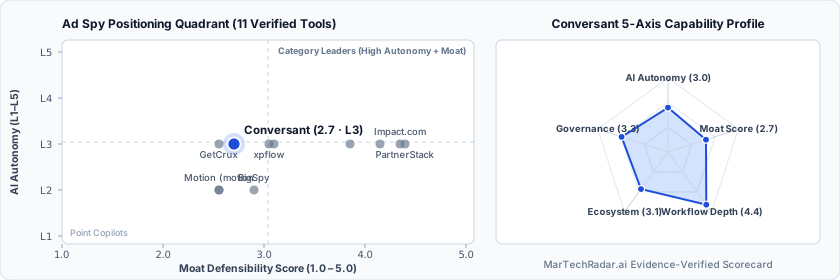
Conversant in-depth review, pricing & architecture analysis
Editor sign-off: Oct 14, 2026. How profiles are made.
What is Conversant? Overview & background
Within omnichannel media execution and performance marketing, Conversant, established in 1998 in Irving, Texas, operates as an enterprise data and digital advertising ecosystem. Designed primarily for VP-level digital marketers, enterprise media buyers, and affiliate program directors at retail and financial conglomerates, the platform links digital brand interactions with real-world consumer identity. Rather than serving merely as an isolated creative repository or affiliate dashboard, Conversant anchors programmatic decisioning and publisher partnerships directly to persistent consumer profiles across channels.
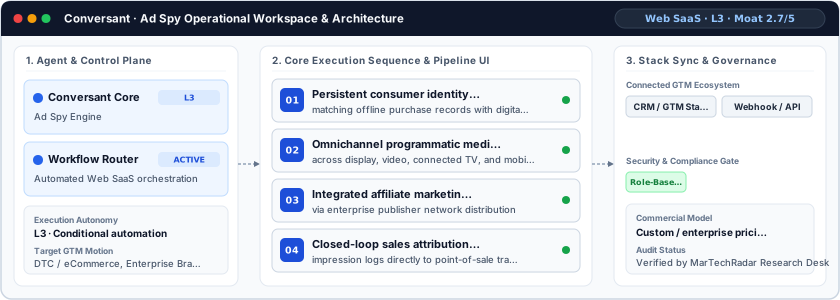
How Conversant works: architecture & workflow
At its operational core, Conversant ingests first-party consumer transaction records, offline point-of-sale datasets, and cross-channel digital touchpoints into a unified identity graph. Operating at Level 3 conditional autonomy, the system programmatically evaluates incoming ad requests and affiliate clicks, autonomously matching identifiers against deterministic individual-level profiles. It calculates real-time bidding bids and dynamic creative variations based on past buying propensity, continuously feeding post-conversion attribution metrics back into the pipeline to adjust algorithmic media targeting without manual intervention.
Conversant limitations, drawbacks & risks
Operational considerations and platform boundaries include:
- Identity Resolution Latency: Reconciliation between batch-uploaded in-store transaction logs and live digital identity graphs can experience processing lags, delaying rapid closed-loop optimizations for fast-moving promotional campaigns.
- Implementation Overhead: Configuring the enterprise data pipeline requires significant technical coordination, dedicated engineering resources, and deep enterprise data-cleansing cycles to establish reliable CRM and POS ingest flows.
- Third-Party Signal Degradation: Tightening browser-level privacy controls and mobile identifier deprecation place operational pressure on device-bridging graphs, necessitating continuous reliance on direct, authenticated brand data streams.
Conversant pricing, plans & cost breakdown
Conversant operates strictly on an enterprise managed-service and custom software licensing model. Commercial pricing is available on request through tailored enterprise sales quotes based on organizational scale and seats, media spend throughput, and dedicated data-integration requirements. Engagements generally involve annual commitments structured around percentage of media spend, volume of tracked transactions, and custom onboarding fees.
| Plan / Tier | Verified Price & Billing | Included Scope & Contract Terms |
|---|---|---|
| Enterprise / Custom | Custom quote | Custom-quoted plan; terms come from the vendor's sales team. |
How Conversant compares vs. competitors & alternatives
Compared to creative intelligence repositories and tactical scraping tools like Affil.ai, BigSpy, and Foreplay.co, Conversant occupies a fundamentally different tier within the Ad Spy segment. While tools like BigSpy and Foreplay.co focus on surface-level social ad inspiration and swipe-file curation, Conversant delivers full-funnel programmatic delivery coupled with native affiliate network mechanics. The platform is purpose-built for global enterprise advertisers managing large consumer datasets, whereas creative intelligence point tools cater to agile direct-to-consumer creative teams.
Frequently asked questions about Conversant
Does Conversant publish pricing or require an enterprise quote?
Conversant pricing: Custom / enterprise pricing. No free plan is publicly disclosed. Conversant operates strictly on an enterprise managed-service and custom software licensing model.
What are the top Conversant alternatives in Ad Spy?
Verified Ad Spy alternatives include Affil.ai (Custom / enterprise pricing), Atria ($129–$959/mo), MagicBrief (Custom / enterprise pricing), AdKraft AI (Custom / enterprise pricing). Compared to creative intelligence repositories and tactical scraping tools like Affil.ai, BigSpy, and Foreplay.co, Conversant occupies a fundamentally different tier within the Ad Spy segment.
What are the main limitations and trade-offs of Conversant?
Operational considerations and platform boundaries include: Identity Resolution Latency: Reconciliation between batch-uploaded in-store transaction logs and live digital identity graphs can experience processing lags, delaying rapid closed-loop optimizations for fast-moving promotional campaigns. Walk away if you need published self-serve pricing: Conversant is sold by custom quote.
Verified sources & evidence trail
- Official product domain: https://conversantmedia.com
- Commercial pricing verification: Verified against official vendor pricing policy (Custom / enterprise pricing)
- Verified corporate entity profiles (
sameAs): LinkedIn Company Profile · Crunchbase Entity Record - Editor sign-off: Oct 14, 2026 (how profiles are made).
