Firebender Review (2026): Sales Intelligence Pricing, Limits & Alternatives
Bottom line
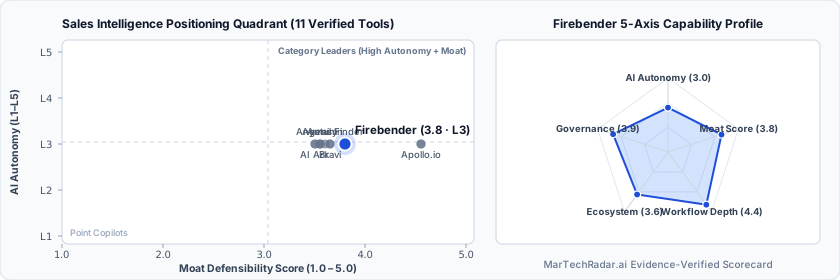
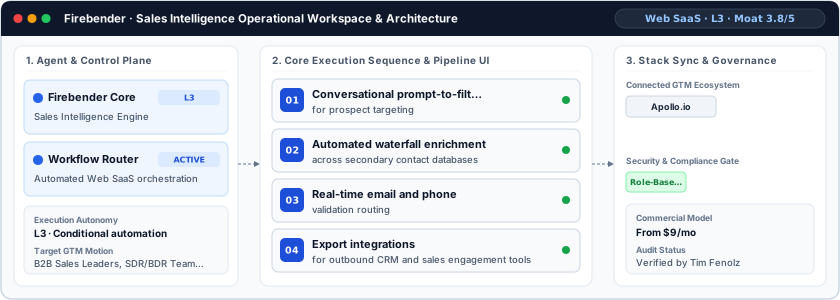
Firebender is a Web SaaS tool for Sales Intelligence (Lead Enrichment & Waterfall Orchestration) in AI SDR & Outbound. Pricing: From $9/mo. Best suited to B2B Sales Leaders, SDR/BDR Teams and Revenue Operations (RevOps). Editor ratings: AI autonomy L3 (conditional automation); moat score 3.8/5.0 (Proprietary moat). Fact-checked by Tim Fenolz on Oct 11, 2026.
Natural language prospect discovery and waterfall enrichment engine that converts conversational target criteria into verified B2B account and contact.
Firebender buyer fit verdict: when to choose vs. when to walk away
Choose Firebender if (Best Fit)
- Target ICP & Stack Fit: You operate as B2B Sales Leaders, SDR/BDR Teams and Revenue Operations (RevOps) requiring a Web SaaS deployment for Sales Intelligence, with verified ecosystem connectivity for Apollo.io.
- L3 Architecture & Defensibility: Low defensibility due to dependency on commoditized underlying data providers and third-party LLM APIs, coupled with strategic product pivots that dilute specialized data moats.
- Commercial Model Fit: Your procurement budget aligns with From $9/mo.
Walk away from Firebender if (Deal-Breakers)
- Walk away if your workflow requires uncapped enterprise volume on the From $9/mo entry plan without upgrading tiers.
- Walk away if your workflow cannot tolerate strategic roadmap volatility: The vendor has displayed substantial shifts in technical focus, pivoting between sales enrichment tooling and developer-centric IDE agents, introducing lifecycle and maintenance risk.
- Walk away if enrichment latency is a deal-breaker for your team: Multi-tier waterfall routing causes significant execution lag when resolving low-density niche profiles across disparate commercial registries.
Firebender key facts & scorecard
| Pricing | From $9/moVendor pricing page |
|---|---|
| Free plan | No / not disclosed |
| Delivery | Web SaaS |
| Audience | B2B Sales Leaders, SDR/BDR Teams, Revenue Operations (RevOps) |
| AI autonomy level | L3 · Conditional automationEditor-verified |
| Moat tier & score | 3.8 / 5.0 · Proprietary moatEditor-verified |
| Funding | Pre-seed |
| Total funding | $500KBacked by Y Combinator, Eight Capital |
| Founders | Aman Gottumukkala, Kevin Tang |
| Company size | 2-10 employees |
| Ecosystem integrations | Apollo.io |
| Governance & docs | API & Docs ↗ · Privacy ↗ |
| Headquarters | San Francisco, California |
| Founded | 2024 |
| Last verified |
Firebender pros & cons: strengths vs. operational limitations
Pros: core strengths & capabilities
- Conversational prompt-to-filter query generation: for prospect targeting
- Automated waterfall enrichment: across secondary contact databases
- Real-time email and phone: validation routing
- Export integrations: for outbound CRM and sales engagement tools
Cons: operational limitations & risks
- Strategic Roadmap Volatility: The vendor has displayed substantial shifts in technical focus, pivoting between sales enrichment tooling and developer-centric IDE agents, introducing lifecycle and maintenance risk.
- Enrichment Latency: Multi-tier waterfall routing causes significant execution lag when resolving low-density niche profiles across disparate commercial registries.
- Complex Query Hallucinations: Parsing nuanced intent via LLMs occasionally generates inaccurate taxonomy parameters, leading to misaligned prospect lists that require manual verification.
Firebender TCO & deal-breaker stress test
Simulate 12-month stepped TCO, hidden cost multipliers, contract lock-in exposure, and stack failure modes using only facts verified by Tim Fenolz on · Capture SHA b4b1a8d4.
Firebender aligns with your 5-seat / $800/mo profile. Review the walk-away triggers and contract levers below before deployment.
| Plan / Tier | Verified Rate | Scale Fit | Scope & Quota Notes |
|---|---|---|---|
| Entry / Starter | $9/mo | 1–2 seats | Unlimited autocomplete |
| Unlimited | $30/mo | 5 seats | On demand and BYOK with token fee |
| Custom | $75/mo | 15 seats | IntelliJ refactor tools |
- Moat Score
- 3.8 / 5.0
- AI Autonomy
- L3
- Free Tier / Trial
- None disclosed
Triggered audit signals & failure modes
- Published Self-Serve Entry FloorVerified Pricing Ledger
Firebender publishes a transparent entry point (From $9/mo) for initial validation before committing.
- Tier Fit for 5-Seat Scale: Unlimited ($30/mo)Verified Tier Schedule
On demand and BYOK with token fee
- Primary Operational Bottleneck: Enrichment LatencyAudit by Tim Fenolz
Multi-tier waterfall routing causes significant execution lag when resolving low-density niche profiles across disparate commercial registries.
Hidden TCO Multipliers & Quota Gates
- Per-Seat Linear Scaling: Firebender prices licenses on a per-user/seat basis (From $9/mo); expanding from 2 to 15+ operators multiplies base recurring spend linearly.
- Credit & Usage Burn Multiplier: Automated workflows consume metered credits/usage quotas; multi-step enrichment, voice minutes, or high-frequency agent runs can trigger mid-cycle top-up packs.
- Enterprise Governance & Add-On Gating: Advanced capabilities such as Single Sign-On (SSO), custom role permissions, or specialized analytics modules are gated behind upper tiers or paid add-ons.
When to Walk Away & Negotiation Levers
- Walk away if your workflow requires uncapped enterprise volume on the From $9/mo entry plan without upgrading tiers.
- Walk away if your workflow cannot tolerate strategic roadmap volatility: The vendor has displayed substantial shifts in technical focus, pivoting between sales enrichment tooling and developer-centric IDE agents, introducing lifecycle and maintenance risk.
- Walk away if enrichment latency is a deal-breaker for your team: Multi-tier waterfall routing causes significant execution lag when resolving low-density niche profiles across disparate commercial registries.
- Validate exact quota thresholds (seats, credits, or API calls) included in Firebender's From $9/mo tier before converting from monthly to annual billing.
- Require a sandbox proof-of-concept testing strategic roadmap volatility against your live CRM/data schema before annual sign-off.
Ask a custom procurement or TCO stress-test question about Firebender
Fits within $800/mo budget (Free plan · $49–$119/seat/mo · Enterprise plan)
Fits within $800/mo budget (Free plan · $54–$180/mo)
Firebender key entities, modules & ecosystem stack
Firebender moat & subtrack positioning
Low defensibility due to dependency on commoditized underlying data providers and third-party LLM APIs, coupled with strategic product pivots that dilute specialized data moats.
Editorial review
Fact-checked by Tim Fenolz (Lead AdTech, Programmatic & Attribution Analyst) on .
Background
Backed by Y Combinator with $500K in seed capital, Firebender was founded in 2024 in San Francisco, California, to re-engineer outbound data discovery for revenue teams. Built primarily for sales development representatives, growth marketers, and early-stage founders, the platform addresses the operational friction of navigating complex multi-parameter database filters. By positioning natural language processing as the primary interface for lead discovery and enrichment, Firebender provides an alternative to manual search query construction in commercial prospecting.
How Firebender works
At its technical foundation, the platform operates as an L3 prospecting agent that translates unstructured natural language requirements into structured SQL and database queries. The system processes account-based constraints, maps semantic intent to standard B2B taxonomy codes, and interrogates secondary data repositories. Once matching entities are identified, the pipeline executes a multi-vendor waterfall enrichment workflow to append corporate email addresses, direct phone numbers, and firmographic attributes before running automated validation checks to confirm deliverability.
Limitations
Operational considerations and platform boundaries include:
- Strategic Roadmap Volatility: The vendor has displayed substantial shifts in technical focus, pivoting between sales enrichment tooling and developer-centric IDE agents, introducing lifecycle and maintenance risk.
- Enrichment Latency: Multi-tier waterfall routing causes significant execution lag when resolving low-density niche profiles across disparate commercial registries.
- Complex Query Hallucinations: Parsing nuanced intent via LLMs occasionally generates inaccurate taxonomy parameters, leading to misaligned prospect lists that require manual verification.
Firebender pricing
Commercial access is structured around modular seat licensing and data consumption allowances, starting at $9 per month for entry-level access. Higher tiers scale to $30 and $75 per month to accommodate extended agent usage, increased token allocations, and higher volume enrichment lookups. Organizations with advanced usage profiles must account for token consumption and data append overages when scaling outbound pipeline volumes.
How Firebender compares
Within the lead intelligence ecosystem, Firebender competes directly with established data providers and orchestration engines including Clay, Apollo.io, and AI Ark. While Clay delivers deeply customizable programmatic waterfall workflows and Apollo.io provides a substantial proprietary database, Firebender targets rapid query construction through conversational prompts. It is best suited for lean outbound teams seeking immediate, flexible list generation without the overhead of architecting complex data enrichment tables.
Direct competitors & market radar
Top algorithmic competitors based on category positioning, capability overlap, and ICP alignment.
Frequently asked questions about Firebender
How much does Firebender cost and what pricing tiers are available?
Published pricing summary for Firebender: From $9/mo. A permanent free plan is not disclosed for Firebender. Verified tier schedule: Entry / Starter ($9/mo for 1–2 seats); Unlimited ($30/mo for 5 seats); Custom ($75/mo for 15 seats). Commercial access is structured around modular seat licensing and data consumption allowances, starting at $9 per month for entry-level access. Higher tiers scale to $30 and $75 per month to accommodate extended agent usage, increased token allocations, and higher volume enrichment lookups.
How does Firebender work and how autonomous is its AI architecture?
Natural language prospect discovery and waterfall enrichment engine that converts conversational target criteria into verified B2B account and contact. Within Sales Intelligence (Lead Enrichment & Waterfall Orchestration), MarTechRadar rates its execution architecture at L3 · Conditional automation with a verified Moat Score of 3.8 / 5.0 (Proprietary moat). Low defensibility due to dependency on commoditized underlying data providers and third-party LLM APIs, coupled with strategic product pivots that dilute specialized data moats. Corporate profile: Founded by Aman Gottumukkala, Kevin Tang, operating at 2-10 employees scale.
What are the main limitations of Firebender and when should buyers walk away?
Based on our editorial technical audit, key operational considerations and boundaries for Firebender include: (1) Strategic Roadmap Volatility: The vendor has displayed substantial shifts in technical focus, pivoting between sales enrichment tooling and developer-centric IDE agents, introducing lifecycle and maintenance risk. (2) Enrichment Latency: Multi-tier waterfall routing causes significant execution lag when resolving low-density niche profiles across disparate commercial registries. (3) Complex Query Hallucinations: Parsing nuanced intent via LLMs occasionally generates inaccurate taxonomy parameters, leading to misaligned prospect lists that require manual verification. Primary procurement walk-away rule: Walk away if your workflow requires uncapped enterprise volume on the From $9/mo entry plan without upgrading tiers.
What integrations, compliance certifications, and contract terms apply to Firebender?
Verified ecosystem and stack integrations include Apollo.io. First-party governance and developer endpoints verified on domain include: API Docs (https://docs.firebender.com). Key TCO multiplier to watch: Per-Seat Linear Scaling (Firebender prices licenses on a per-user/seat basis (From $9/mo); expanding from 2 to 15+ operators multiplies base recurring spend linearly.) Before signing a contract, procurement teams should validate exact quota thresholds (seats, credits, or API calls) included in Firebender's From $9/mo tier before converting from monthly to annual billing.
What are the best Firebender alternatives and head-to-head competitors in 2026?
Top fact-checked alternatives to Firebender in Sales Intelligence (Lead Enrichment & Waterfall Orchestration) include Apollo.io (Free plan · $49–$119/seat/mo · Enterprise plan), Clay (Free plan · $54–$180/mo), Lusha (Free plan · $0/mo · Enterprise plan), AI Ark ($49/mo). Within the lead intelligence ecosystem, Firebender competes directly with established data providers and orchestration engines including Clay, Apollo.io, and AI Ark.
Verified sources & evidence trail
- Official product domain: https://firebender.com/
- Commercial pricing verification: https://firebender.com/pricing
- Verified corporate entity profiles (
sameAs): LinkedIn Company Profile · Crunchbase Entity Record - First-party governance & documentation links: API & Docs · Privacy
- Editorial audit sign-off: Fact-checked by Tim Fenolz on under the MarTechRadar Evidence-Ledger Protocol.