Docket Review (2026): Sales Intelligence Pricing, Limits & Alternatives
Bottom line
Docket is a Web SaaS tool for Sales Intelligence (Lead Enrichment & Waterfall Orchestration) in AI SDR & Outbound. Pricing: Custom / enterprise pricing. Best suited to B2B Sales Leaders, SDR/BDR Teams and Revenue Operations (RevOps). Editor ratings: AI autonomy L3 (conditional automation); moat score 4.2/5.0 (Proprietary moat). Fact-checked by Sarah Per on Oct 11, 2026.
Autonomous inbound demand platform that engages website visitors through conversational AI to qualify intent, route meetings, and sync context into CRMs.
Docket buyer fit verdict: when to choose vs. when to walk away
Choose Docket if (Best Fit)
- Target ICP & Stack Fit: You operate as B2B Sales Leaders, SDR/BDR Teams and Revenue Operations (RevOps) requiring a Web SaaS deployment for Sales Intelligence, with verified ecosystem connectivity for Apollo.io.
- L3 Architecture & Defensibility: Docket builds defensibility through its contextual conversation-to-pipeline engine that unifies real-time intent extraction with automated qualification logic and bi-directional CRM context injection.
- Commercial Model Fit: Your procurement budget aligns with Custom / enterprise pricing.
Walk away from Docket if (Deal-Breakers)
- Walk away if you require transparent self-serve monthly billing or your budget ceiling is under $1,000/mo (Docket requires sales-gated custom quoting).
- Walk away if your workflow cannot tolerate anonymized traffic resolution: When visitors connect via commercial VPNs or decentralized consumer networks, IP-to-domain matching fails, leaving the qualification agent without upfront account context.
- Walk away if CRM schema drift is a deal-breaker for your team: Changes to custom field structures or validation rules inside the host CRM can break transcript payload syncs, requiring ongoing field-mapping governance.
Docket key facts & scorecard
| Pricing | Custom / enterprise pricing |
|---|---|
| Free plan | No / not disclosed |
| Delivery | Web SaaS |
| Audience | B2B Sales Leaders, SDR/BDR Teams, Revenue Operations (RevOps) |
| AI autonomy level | L3 · Conditional automationEditor-verified |
| Moat tier & score | 4.2 / 5.0 · Proprietary moatEditor-verified |
| Funding | Series A |
| Total funding | $20.4MBacked by Mayfield Fund, Foundation Capital |
| Founders | Anoop Thomas Mathew, Arjun Pillai |
| Company size | 11-50 employees |
| Ecosystem integrations | Apollo.io |
| Governance & docs | Privacy ↗ |
| Headquarters | Palo Alto, California |
| Founded | 2023 |
| Last verified |
Docket pros & cons: strengths vs. operational limitations
Pros: core strengths & capabilities
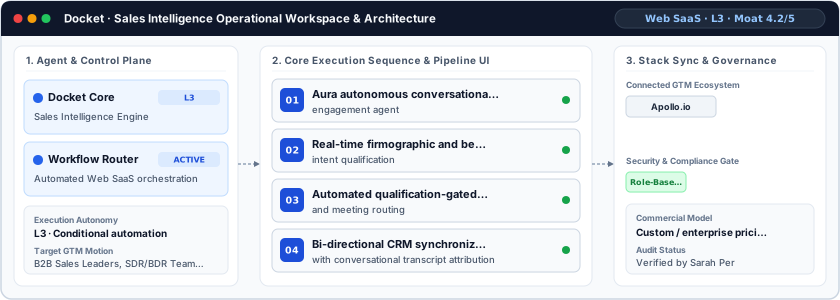
- Aura autonomous conversational inbound: engagement agent
- Real-time firmographic and behavioral: intent qualification
- Automated qualification-gated calendar scheduling: and meeting routing
- Bi-directional CRM synchronization: with conversational transcript attribution
Cons: operational limitations & risks
- Anonymized Traffic Resolution: When visitors connect via commercial VPNs or decentralized consumer networks, IP-to-domain matching fails, leaving the qualification agent without upfront account context.
- CRM Schema Drift: Changes to custom field structures or validation rules inside the host CRM can break transcript payload syncs, requiring ongoing field-mapping governance.
- Hallucination Risk on Niche Technical Queries: Unconstrained technical inquiries can occasionally trigger inaccurate feature confirmations if the underlying vector knowledge base lacks structured, bounded prompt policies.
Docket TCO & deal-breaker stress test
Simulate 12-month stepped TCO, hidden cost multipliers, contract lock-in exposure, and stack failure modes using only facts verified by Sarah Per on · Capture SHA 59dd3368.
Docket triggers high-severity friction under your 5-seat / $800/mo constraints. Benchmark the verified subtrack alternatives below before committing.
| Plan / Tier | Verified Rate | Scale Fit | Scope & Quota Notes |
|---|---|---|---|
| Enterprise / Custom | Custom quote | 15–50+ seats (Enterprise SLA) | Sales-negotiated annual contract for custom volume, SSO/RBAC governance, and dedicated SLA. |
- Moat Score
- 4.2 / 5.0
- AI Autonomy
- L3
- Free Tier / Trial
- None disclosed
Triggered audit signals & failure modes
- Opaque Enterprise Quoting vs. SMB/Mid-Market BudgetVerified Pricing Ledger
Docket does not disclose a public self-serve floor (Custom / enterprise pricing). Buyers with a $800/mo cap face high sales-qualification friction.
- Sales-Gated Contract TermsFact-checked by Sarah Per
Commercial pricing is available on request through tailored enterprise sales quotes based on organizational scale and seats.
- Primary Operational Bottleneck: Anonymized Traffic ResolutionAudit by Sarah Per
When visitors connect via commercial VPNs or decentralized consumer networks, IP-to-domain matching fails, leaving the qualification agent without upfront account context.
Hidden TCO Multipliers & Quota Gates
- Annual Billing Headline vs. Monthly Premium: Headline entry rates reflect annual billing commitments; month-to-month flexibility carries a higher effective monthly rate or requires annual prepayment.
- Credit & Usage Burn Multiplier: Automated workflows consume metered credits/usage quotas; multi-step enrichment, voice minutes, or high-frequency agent runs can trigger mid-cycle top-up packs.
- Enterprise Governance & Add-On Gating: Advanced capabilities such as Single Sign-On (SSO), custom role permissions, or specialized analytics modules are gated behind upper tiers or paid add-ons.
When to Walk Away & Negotiation Levers
- Walk away if you require transparent self-serve monthly billing or your budget ceiling is under $1,000/mo (Docket requires sales-gated custom quoting).
- Walk away if your workflow cannot tolerate anonymized traffic resolution: When visitors connect via commercial VPNs or decentralized consumer networks, IP-to-domain matching fails, leaving the qualification agent without upfront account context.
- Walk away if CRM schema drift is a deal-breaker for your team: Changes to custom field structures or validation rules inside the host CRM can break transcript payload syncs, requiring ongoing field-mapping governance.
- Demand a 30- to 60-day paid pilot opt-out clause in the Docket order form before signing a 12-month enterprise commitment.
- Require a sandbox proof-of-concept testing anonymized traffic resolution against your live CRM/data schema before annual sign-off.
Ask a custom procurement or TCO stress-test question about Docket
Lower 5-seat floor (~$54/mo vs. Custom Quote) · Transparent self-serve entry without mandatory annual lock-in
Lower 5-seat floor (~$5/mo vs. Custom Quote) · Transparent self-serve entry without mandatory annual lock-in
Docket key entities, modules & ecosystem stack
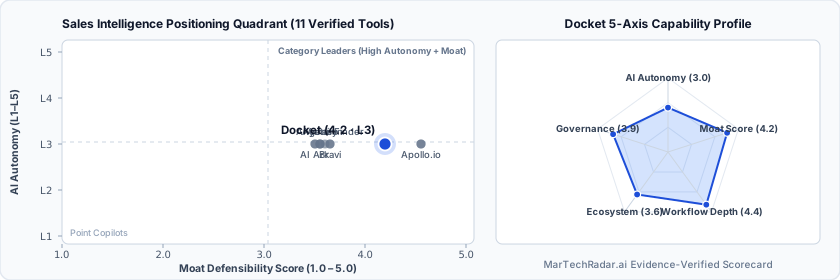
Docket moat & subtrack positioning
Docket builds defensibility through its contextual conversation-to-pipeline engine that unifies real-time intent extraction with automated qualification logic and bi-directional CRM context injection.
Editorial review
Fact-checked by Sarah Per (Principal Content Systems & Generative Media Editor) on .
Background
For enterprise marketing and revenue operations leaders struggling with pipeline drop-off at static inbound capture forms, Docket delivers an autonomous conversational interface that qualifies inbound traffic dynamically. Established in 2023 in Palo Alto, California, Docket secured $20.4M in institutional financing to eliminate friction between web visits and sales meetings. The platform targets growth-stage and enterprise revenue teams who need to convert anonymous high-intent web traffic into pipeline without forcing prospects through traditional qualification forms or delayed sales development triage.
How Docket works
Operating as an L3 autonomous qualification system, the platform deploys its conversational engine, Aura, via a client-side JavaScript tag. When a visitor lands on an enterprise site, Docket executes reverse-IP firmographic enrichment against incoming network metadata, matching account data with real-time on-page clickstream behaviors. The platform passes dynamic context into an LLM-driven dialog controller that generates context-aware, non-deterministic discovery prompts. As the prospect responds, the system extracts budget, authority, and timeline attributes, matching them against defined qualification schemas before orchestrating automated calendar routing and streaming conversation summaries directly into target CRM objects.
Limitations
Operational considerations and platform boundaries include:
- Anonymized Traffic Resolution: When visitors connect via commercial VPNs or decentralized consumer networks, IP-to-domain matching fails, leaving the qualification agent without upfront account context.
- CRM Schema Drift: Changes to custom field structures or validation rules inside the host CRM can break transcript payload syncs, requiring ongoing field-mapping governance.
- Hallucination Risk on Niche Technical Queries: Unconstrained technical inquiries can occasionally trigger inaccurate feature confirmations if the underlying vector knowledge base lacks structured, bounded prompt policies.
Docket pricing
Commercial pricing is available on request through tailored enterprise sales quotes based on organizational scale and seats. Docket structures licensing through annual commitments across Core, Pro, and Enterprise packages, scaling primarily on feature tiers, conversation volumes, and required integrations. Implementation, conversation allowances, data connections, and customer success management are bundled directly into annual enterprise service agreements.
How Docket compares
Within modern revenue architectures, Docket addresses real-time inbound conversion, contrasting with backend waterfall enrichment and pipeline orchestration providers such as Clay, Apollo.io, and AI Ark. While Clay and Apollo.io emphasize asynchronous data enrichment, multi-source contact waterfalls, and outbound cadence sequencing across static database records, Docket operates strictly at the point of inbound website interaction. It is purpose-built for mid-market and enterprise B2B software vendors seeking to replace passive capture forms with autonomous, real-time qualification.
Direct competitors & market radar
Top algorithmic competitors based on category positioning, capability overlap, and ICP alignment.
Frequently asked questions about Docket
How much does Docket cost and does it require a custom enterprise quote?
Published pricing summary for Docket: Custom / enterprise pricing. A permanent free plan is not disclosed for Docket. Commercial pricing is available on request through tailored enterprise sales quotes based on organizational scale and seats. Docket structures licensing through annual commitments across Core, Pro, and Enterprise packages, scaling primarily on feature tiers, conversation volumes, and required integrations.
How does Docket work and how autonomous is its AI architecture?
Autonomous inbound demand platform that engages website visitors through conversational AI to qualify intent, route meetings, and sync context into CRMs. Within Sales Intelligence (Lead Enrichment & Waterfall Orchestration), MarTechRadar rates its execution architecture at L3 · Conditional automation with a verified Moat Score of 4.2 / 5.0 (Proprietary moat). Docket builds defensibility through its contextual conversation-to-pipeline engine that unifies real-time intent extraction with automated qualification logic and bi-directional CRM context injection. Corporate profile: Founded by Anoop Thomas Mathew, Arjun Pillai, operating at 11-50 employees scale.
What are the main limitations of Docket and when should buyers walk away?
Based on our editorial technical audit, key operational considerations and boundaries for Docket include: (1) Anonymized Traffic Resolution: When visitors connect via commercial VPNs or decentralized consumer networks, IP-to-domain matching fails, leaving the qualification agent without upfront account context. (2) CRM Schema Drift: Changes to custom field structures or validation rules inside the host CRM can break transcript payload syncs, requiring ongoing field-mapping governance. (3) Hallucination Risk on Niche Technical Queries: Unconstrained technical inquiries can occasionally trigger inaccurate feature confirmations if the underlying vector knowledge base lacks structured, bounded prompt policies. Primary procurement walk-away rule: Walk away if you require transparent self-serve monthly billing or your budget ceiling is under $1,000/mo (Docket requires sales-gated custom quoting).
What integrations, compliance certifications, and contract terms apply to Docket?
Verified ecosystem and stack integrations include Apollo.io. Key TCO multiplier to watch: Annual Billing Headline vs. Monthly Premium (Headline entry rates reflect annual billing commitments; month-to-month flexibility carries a higher effective monthly rate or requires annual prepayment.) Before signing a contract, procurement teams should demand a 30- to 60-day paid pilot opt-out clause in the Docket order form before signing a 12-month enterprise commitment.
What are the best Docket alternatives and head-to-head competitors in 2026?
Top fact-checked alternatives to Docket in Sales Intelligence (Lead Enrichment & Waterfall Orchestration) include Clay (Free plan · $54–$180/mo), AI Ark ($49/mo), Captain Data (From $5/mo), Dokwise (From $159/mo). Within modern revenue architectures, Docket addresses real-time inbound conversion, contrasting with backend waterfall enrichment and pipeline orchestration providers such as Clay, Apollo.io, and AI Ark.
Verified sources & evidence trail
- Official product domain: https://www.docket.io/
- Commercial pricing verification: Verified against official vendor pricing policy (Custom / enterprise pricing)
- Verified corporate entity profiles (
sameAs): LinkedIn Company Profile · Crunchbase Entity Record - First-party governance & documentation links: Privacy
- Editorial audit sign-off: Fact-checked by Sarah Per on under the MarTechRadar Evidence-Ledger Protocol.