DeepL Write Review (2026): AI Translation Pricing, Pros & Cons
Bottom line
DeepL Write is a Web SaaS tool for AI Translation (Multilingual & Global Localization) in Copy & Content. Pricing: Custom / enterprise pricing. Best suited to B2B SaaS, DTC / eCommerce and Enterprise Brands. Editor ratings: AI autonomy L1 (prompt-assisted); moat score 2.4/5.0 (Workflow-embedded). Fact-checked by MarTechRadar Research Desk on Oct 7, 2026.
AI-powered writing and stylistic refinement tool optimizing enterprise phrasing, tone, and grammatical accuracy across corporate communications.
Is DeepL Write worth it in 2026? Buyer fit & when to walk away
Choose DeepL Write if (Best Fit)
- Target ICP & Stack Fit: You operate as B2B SaaS, DTC / eCommerce and Enterprise Brands requiring a Web SaaS deployment for AI Translation.
- L1 Architecture & Defensibility: Proprietary linguistic datasets and neural syntax models built on DeepL's established translation architecture, enabling context-aware monolingual editing.
- Commercial Model Fit: Your procurement budget aligns with Custom / enterprise pricing.
Walk away from DeepL Write if (Deal-Breakers)
- Walk away if you need published self-serve pricing: DeepL Write is sold by custom quote.
- Walk away if your workflow cannot tolerate contextual token window: The system processes content in localized textual blocks, occasionally losing overarching discourse coherence and cross-chapter rhetorical continuity in multi-page corporate manuscripts.
- Walk away if domain-specific lexicon drift is a deal-breaker for your team: Without manually trained proprietary glossaries, deep industrial terminology and niche engineering acronyms risk inappropriate replacement by generic linguistic synonyms.
DeepL Write pricing, free plan & scorecard at a glance
| Pricing | Custom / enterprise pricing |
|---|---|
| Free plan | No / not disclosed |
| Delivery | Web SaaS |
| Audience | B2B SaaS, DTC / eCommerce, Enterprise Brands |
| AI autonomy level | L1 · Prompt-assistedEditor-verified |
| Moat tier & score | 2.4 / 5.0 · Workflow-embeddedEditor-verified |
| Funding | Series C+ |
| Total funding | Series C+Backed by Index Ventures, IVP, Atomico, Teachers' Venture Growth (TVG) |
| Governance & docs | Trust & Security ↗ · System Status ↗ · API & Docs ↗ · Privacy ↗ |
| Headquarters | United States |
| Founded | 2017 |
| Last verified | Oct 7, 2026 |
DeepL Write pros & cons: strengths vs. operational limitations
Pros: core strengths & capabilities
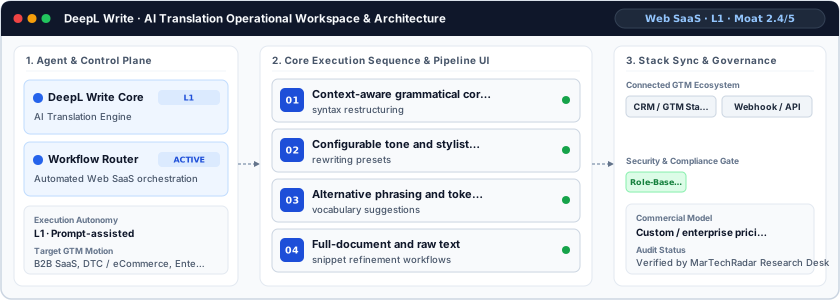
- Context-aware grammatical correction and syntax restructuring
- Configurable tone and stylistic: rewriting presets
- Alternative phrasing and token-level: vocabulary suggestions
- Full-document and raw text: snippet refinement workflows
Cons: operational limitations & risks
- Contextual Token Window: The system processes content in localized textual blocks, occasionally losing overarching discourse coherence and cross-chapter rhetorical continuity in multi-page corporate manuscripts.
- Domain-Specific Lexicon Drift: Without manually trained proprietary glossaries, deep industrial terminology and niche engineering acronyms risk inappropriate replacement by generic linguistic synonyms.
- Restricted Workflow Automation: Because the tool functions strictly under human-in-the-loop oversight, it lacks autonomous batch-processing triggers and headless governance pipelines for large unmonitored CMS catalogs.
DeepL Write TCO & deal-breaker stress test
Simulate 12-month stepped TCO, hidden cost multipliers, contract lock-in exposure, and stack failure modes using only facts verified by MarTechRadar Research Desk on 2026-10-07.
DeepL Write triggers high-severity friction under your 5-seat / $800/mo constraints. Benchmark the verified subtrack alternatives below before committing.
- Moat Score
- 2.4 / 5.0
- AI Autonomy
- L1
- Free Tier / Trial
- None disclosed
Triggered audit signals & failure modes
- Opaque Enterprise Quoting vs. SMB/Mid-Market BudgetVerified Pricing Ledger
DeepL Write does not disclose a public self-serve floor (Custom / enterprise pricing). Buyers with a $800/mo cap face high sales-qualification friction.
- Sales-Gated Contract TermsFact-checked by MarTechRadar Research Desk
Commercial access to the platform is structured through an enterprise software model. Commercial pricing is available on request through tailored enterprise sales quotes based on organizational scale and seats.
- Primary Operational Bottleneck: Contextual Token WindowAudit by MarTechRadar Research Desk
The system processes content in localized textual blocks, occasionally losing overarching discourse coherence and cross-chapter rhetorical continuity in multi-page corporate manuscripts.
Test a custom DeepL Write budget or stack constraint
Lower 5-seat floor (~$100/mo vs. Custom Quote) · Transparent self-serve entry without mandatory annual lock-in
DeepL Write AI moat & AI Translation positioning
Proprietary linguistic datasets and neural syntax models built on DeepL's established translation architecture, enabling context-aware monolingual editing.
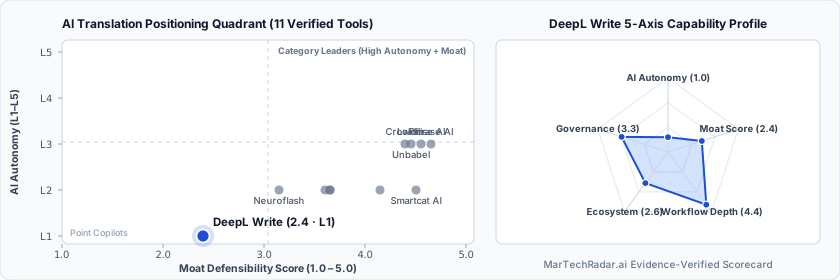
DeepL Write in-depth review, pricing & architecture analysis
Editor sign-off: Oct 7, 2026. How profiles are made.
What is DeepL Write? Overview & background
Headquartered in the United States, DeepL Write addresses the operational friction of linguistic ambiguity, grammatical inconsistencies, and stylistic divergence in business communications. Designed specifically for corporate communications specialists, localization operators, and cross-border teams, the software eliminates repetitive copyediting cycles. Operating as an AI-powered writing companion, the system processes raw text inputs to deliver contextually refined corporate prose. Rather than generating greenfield generative copy, the tool centers on surgical syntactic enhancement and stylistic leveling for professional stakeholders.
How DeepL Write works: architecture & workflow
At its architectural core, the system operates at an L1 assistive autonomy tier, requiring human initiation and selection of generated outputs. Input text passes through proprietary neural language models trained on curated multilingual and stylistic corpora. The model assesses syntactic trees, semantic coherence, and token-level contextual embeddings to generate non-destructive editing proposals. Users interact with dynamic alternate phrasing recommendations, stylistic tone adjustments, and localized idiom suggestions via an interactive editor or REST API endpoints, retaining complete editorial control over final prose serialization.
DeepL Write limitations, drawbacks & risks
Operational considerations and platform boundaries include:
- Contextual Token Window: The system processes content in localized textual blocks, occasionally losing overarching discourse coherence and cross-chapter rhetorical continuity in multi-page corporate manuscripts.
- Domain-Specific Lexicon Drift: Without manually trained proprietary glossaries, deep industrial terminology and niche engineering acronyms risk inappropriate replacement by generic linguistic synonyms.
- Restricted Workflow Automation: Because the tool functions strictly under human-in-the-loop oversight, it lacks autonomous batch-processing triggers and headless governance pipelines for large unmonitored CMS catalogs.
DeepL Write pricing, plans & cost breakdown
Commercial access to the platform is structured through an enterprise software model. Commercial pricing is available on request through tailored enterprise sales quotes based on organizational scale and seats. Deployments typically differentiate access levels through individual team provisions, centralized administrative control consoles, enhanced data privacy guarantees that prevent model retraining on corporate inputs, and dedicated technical support agreements.
| Plan / Tier | Verified Price & Billing | Included Scope & Contract Terms |
|---|---|---|
| Enterprise / Custom | Custom quote | Custom-quoted plan; terms come from the vendor's sales team. |
How DeepL Write compares vs. competitors & alternatives
Within global content workflows, DeepL Write occupies a targeted niche distinct from broader ecosystem competitors. While Neuroflash emphasizes multi-format marketing generation, and Transifex orchestrates end-to-end continuous localization pipelines, DeepL Write concentrates strictly on linguistic precision and real-time stylistic polishing. Compared to parent engine DeepL's core cross-lingual translation workflows, this system serves organizations prioritizing mono-language polishing, tone calibration, and clarity enforcement for high-stakes business communiques.
Frequently asked questions about DeepL Write
Does DeepL Write publish pricing or require an enterprise quote?
DeepL Write pricing: Custom / enterprise pricing. No free plan is publicly disclosed. Commercial access to the platform is structured through an enterprise software model. Commercial pricing is available on request through tailored enterprise sales quotes based on organizational scale and seats.
What are the top DeepL Write alternatives in AI Translation?
Verified AI Translation alternatives include Transifex (Custom / enterprise pricing), Drift (Custom / enterprise pricing), Neuroflash (€42–€84/mo), Lokalise AI (From $100/mo). Within global content workflows, DeepL Write occupies a targeted niche distinct from broader ecosystem competitors.
What are the main limitations and trade-offs of DeepL Write?
Operational considerations and platform boundaries include: Contextual Token Window: The system processes content in localized textual blocks, occasionally losing overarching discourse coherence and cross-chapter rhetorical continuity in multi-page corporate manuscripts. Walk away if you need published self-serve pricing: DeepL Write is sold by custom quote.
Verified sources & evidence trail
- Official product domain: https://deepl.com/write
- Commercial pricing verification: Verified against official vendor pricing policy (Custom / enterprise pricing)
- First-party governance & documentation links: Trust & Security · System Status · API & Docs · Privacy
- Editor sign-off: Oct 7, 2026 (how profiles are made).
