Celonis Review (2026): AI Marketing Agent Pricing, Pros & Cons
Bottom line
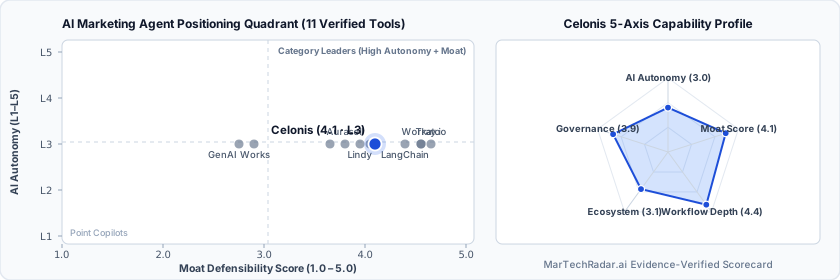
Celonis is a Web SaaS tool for AI Marketing Agent (Autonomous Marketing Agents & Digital Coworkers) in Agent & Marketing Ops. Pricing: Custom / enterprise pricing. Best suited to DTC / eCommerce and Enterprise Brands. Editor ratings: AI autonomy L3 (conditional automation); moat score 4.1/5.0 (Proprietary moat). Fact-checked by MarTechRadar Research Desk on Oct 14, 2026.
Process intelligence and enterprise agent orchestration platform that grounds autonomous workflows in operational event-log context.
Is Celonis worth it in 2026? Buyer fit & when to walk away
Choose Celonis if (Best Fit)
- Target ICP & Stack Fit: You operate as DTC / eCommerce and Enterprise Brands requiring a Web SaaS deployment for AI Marketing Agent.
- L3 Architecture & Defensibility: Deep structural moat derived from patented process mining algorithms, widely deployed enterprise ERP and CRM connectors, and the proprietary Process Intelligence Graph that supplies contextual truth to autonomous agents.
- Commercial Model Fit: Your procurement budget aligns with Custom / enterprise pricing.
Walk away from Celonis if (Deal-Breakers)
- Walk away if you need published self-serve pricing: Celonis is sold by custom quote.
- Walk away if your workflow cannot tolerate event extraction latency: Near-real-time ingestion pipelines depend heavily on target database transaction-log replication, which can induce synchronization delays on high-throughput marketing endpoints.
- Walk away if data model maintenance overhead is a deal-breaker for your team: Custom event definitions and shifting schema mappings require ongoing engineering support to prevent broken graph dependencies across rapidly changing SaaS stacks.
Celonis pricing, free plan & scorecard at a glance
| Pricing | Custom / enterprise pricing |
|---|---|
| Free plan | No / not disclosed |
| Delivery | Web SaaS |
| Audience | DTC / eCommerce, Enterprise Brands |
| AI autonomy level | L3 · Conditional automationEditor-verified |
| Moat tier & score | 4.1 / 5.0 · Proprietary moatEditor-verified |
| Funding | Venture-backed |
| Total funding | $2.4B |
| Founders | Alexander Rinke, Bastian Nominacher, Martin Klenk |
| Company size | 1,001-5,000 employees |
| Headquarters | New York City, New York |
| Founded | 2011 |
| Last verified | Oct 14, 2026 |
Celonis pros & cons: strengths vs. operational limitations
Pros: core strengths & capabilities
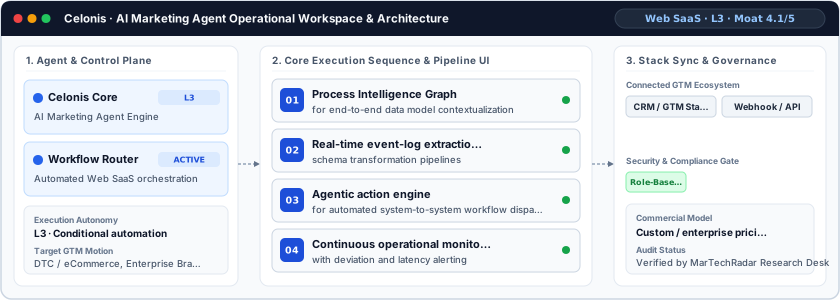
- Process Intelligence Graph: for end-to-end data model contextualization
- Real-time event-log extraction and schema transformation pipelines
- Agentic action engine: for automated system-to-system workflow dispatch
- Continuous operational monitoring: with deviation and latency alerting
Cons: operational limitations & risks
- Event Extraction Latency: Near-real-time ingestion pipelines depend heavily on target database transaction-log replication, which can induce synchronization delays on high-throughput marketing endpoints.
- Data Model Maintenance Overhead: Custom event definitions and shifting schema mappings require ongoing engineering support to prevent broken graph dependencies across rapidly changing SaaS stacks.
- Governed Action Guardrails: Automated cross-system updates require strict permission scoping and rollback handling, limiting unmonitored L3 execution in heavily regulated operational environments.
Celonis TCO & deal-breaker stress test
Simulate 12-month stepped TCO, hidden cost multipliers, contract lock-in exposure, and stack failure modes using only facts verified by MarTechRadar Research Desk on 2026-10-14.
Celonis triggers high-severity friction under your 5-seat / $800/mo constraints. Benchmark the verified subtrack alternatives below before committing.
- Moat Score
- 4.1 / 5.0
- AI Autonomy
- L3
- Free Tier / Trial
- None disclosed
Triggered audit signals & failure modes
- Opaque Enterprise Quoting vs. SMB/Mid-Market BudgetVerified Pricing Ledger
Celonis does not disclose a public self-serve floor (Custom / enterprise pricing). Buyers with a $800/mo cap face high sales-qualification friction.
- Sales-Gated Contract TermsFact-checked by MarTechRadar Research Desk
Celonis operates an enterprise-tier licensing framework. Commercial pricing is available on request through tailored enterprise sales quotes based on organizational scale and seats, process data ingestion volume, and platform module configurations.
- Primary Operational Bottleneck: Event Extraction LatencyAudit by MarTechRadar Research Desk
Near-real-time ingestion pipelines depend heavily on target database transaction-log replication, which can induce synchronization delays on high-throughput marketing endpoints.
Test a custom Celonis budget or stack constraint
Lower 5-seat floor (~$100/mo vs. Custom Quote) · Transparent self-serve entry without mandatory annual lock-in
Lower 5-seat floor (~$49/mo vs. Custom Quote) · Transparent self-serve entry without mandatory annual lock-in
Celonis AI moat & AI Marketing Agent positioning
Deep structural moat derived from patented process mining algorithms, widely deployed enterprise ERP and CRM connectors, and the proprietary Process Intelligence Graph that supplies contextual truth to autonomous agents.
Celonis in-depth review, pricing & architecture analysis
Editor sign-off: Oct 14, 2026. How profiles are made.
What is Celonis? Overview & background
Architected to solve enterprise execution gaps by operationalizing system logs into structured intelligence, Celonis functions as an execution management and agent orchestration environment. Headquartered in New York City, New York, and founded in 2011, the company has secured $2.4B in total venture capitalization. The platform is directed at revenue operations leaders and enterprise systems architects seeking to supply autonomous agents and digital coworkers with business context derived directly from underlying transactional software stacks.
How Celonis works: architecture & workflow
At its architectural core, Celonis ingests continuous event-log data from distributed enterprise systems such as ERPs, CRMs, and marketing automation stacks via native connectors. This ingestion stream feeds the Process Intelligence Graph, an abstraction layer that maps disparate tables into unified business object lifecycles. Operating at an L3 conditional autonomy tier, the system pairs process digital twins with programmatic trigger policies. When operational bottlenecks or conversion anomalies surface, the platform issues deterministic API payloads or deploys contextualized LLM-driven workers to execute corrective cross-application tasks.
Celonis limitations, drawbacks & risks
Operational considerations and platform boundaries include:
- Event Extraction Latency: Near-real-time ingestion pipelines depend heavily on target database transaction-log replication, which can induce synchronization delays on high-throughput marketing endpoints.
- Data Model Maintenance Overhead: Custom event definitions and shifting schema mappings require ongoing engineering support to prevent broken graph dependencies across rapidly changing SaaS stacks.
- Governed Action Guardrails: Automated cross-system updates require strict permission scoping and rollback handling, limiting unmonitored L3 execution in heavily regulated operational environments.
Celonis pricing, plans & cost breakdown
Celonis operates an enterprise-tier licensing framework. Commercial pricing is available on request through tailored enterprise sales quotes based on organizational scale and seats, process data ingestion volume, and platform module configurations. Deployment packages scale according to consumed computing capacities, analytical user seats, and production connector counts, with standard procurement requiring structured technical discovery and direct commercial contracting.
| Plan / Tier | Verified Price & Billing | Included Scope & Contract Terms |
|---|---|---|
| Enterprise / Custom | Custom quote | Custom-quoted plan; terms come from the vendor's sales team. |
How Celonis compares vs. competitors & alternatives
Within the ecosystem of autonomous coworkers, Celonis addresses systemic process mechanics rather than purely conversational or desktop-level tasks. Point solutions like ai-marketing-claude, allGood, and AskElephant primarily focus on conversational prompt routing, individual inbox operations, or localized content generation. In contrast, Celonis enforces global data reconciliation across transactional systems of record, making it appropriate for large global enterprises with complex, multi-system revenue architectures rather than teams seeking turnkey, lightweight agent wrappers.
Frequently asked questions about Celonis
Does Celonis publish pricing or require an enterprise quote?
Celonis pricing: Custom / enterprise pricing. No free plan is publicly disclosed. Celonis operates an enterprise-tier licensing framework.
What are the top Celonis alternatives in AI Marketing Agent?
Verified AI Marketing Agent alternatives include ATC Analytics (From $100/mo), Botpress (Custom / enterprise pricing), LemonLime (From $999/mo), MadeThis (From $49/mo). Within the ecosystem of autonomous coworkers, Celonis addresses systemic process mechanics rather than purely conversational or desktop-level tasks.
What are the main limitations and trade-offs of Celonis?
Operational considerations and platform boundaries include: Event Extraction Latency: Near-real-time ingestion pipelines depend heavily on target database transaction-log replication, which can induce synchronization delays on high-throughput marketing endpoints. Walk away if you need published self-serve pricing: Celonis is sold by custom quote.
Verified sources & evidence trail
- Official product domain: https://celonis.com
- Commercial pricing verification: Verified against official vendor pricing policy (Custom / enterprise pricing)
- Verified corporate entity profiles (
sameAs): LinkedIn Company Profile · Crunchbase Entity Record - Editor sign-off: Oct 14, 2026 (how profiles are made).
