MadeThis Review (2026): Email Marketing Pricing, Limits & Alternatives
Bottom line
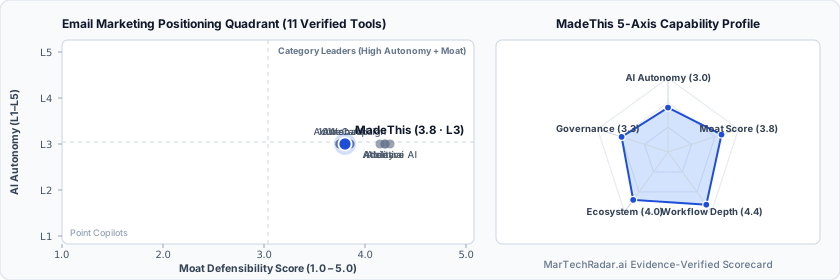
MadeThis is a Web SaaS tool for Email Marketing (AI Email Marketing & Lifecycle Journeys) in Lifecycle & CDP. Pricing: From $49/mo. Best suited to CRM & Lifecycle Marketers, eCommerce Growth Teams and Customer Experience Directors. Editor ratings: AI autonomy L3 (conditional automation); moat score 3.8/5.0 (Proprietary moat). Fact-checked by Jagmeet Sine on Oct 11, 2026.
Autonomous venture generation platform deploying AI agent teams to design, launch, and market businesses including landing pages and outbound campaigns.
MadeThis buyer fit verdict: when to choose vs. when to walk away
Choose MadeThis if (Best Fit)
- Target ICP & Stack Fit: You operate as CRM & Lifecycle Marketers, eCommerce Growth Teams and Customer Experience Directors requiring a Web SaaS deployment for Email Marketing, with verified ecosystem connectivity for Outreach, WordPress.
- L3 Architecture & Defensibility: Proprietary multi-agent execution workflows combining website generation, creative asset drafting, and cold email outreach in a unified workspace.
- Commercial Model Fit: Your procurement budget aligns with From $49/mo.
Walk away from MadeThis if (Deal-Breakers)
- Walk away if your workflow requires uncapped enterprise volume on the From $49/mo entry plan without upgrading tiers.
- Walk away if your workflow cannot tolerate email deliverability risks: The embedded outbound engine lacks enterprise-grade automated mailbox warming schedules, creating critical domain reputation vulnerabilities during unmonitored cold email bursts.
- Walk away if deep customization bottlenecks is a deal-breaker for your team: Agent-generated codebase templates enforce rigid schema constraints, restricting deep custom database integrations or complex transactional backend engineering.
MadeThis key facts & scorecard
| Pricing | From $49/moVendor pricing page |
|---|---|
| Free plan | No / not disclosed |
| Delivery | Web SaaS |
| Audience | CRM & Lifecycle Marketers, eCommerce Growth Teams, Customer Experience Directors |
| AI autonomy level | L3 · Conditional automationEditor-verified |
| Moat tier & score | 3.8 / 5.0 · Proprietary moatEditor-verified |
| Funding | Pre-seed |
| Total funding | Pre-seedBacked by Y Combinator |
| Founders | Cambree Bernkopf, Jacob Wright |
| Company size | 2-10 employees |
| Ecosystem integrations | Outreach, WordPress |
| Governance & docs | API & Docs ↗ · Terms ↗ · Privacy ↗ |
| Headquarters | San Francisco, CA |
| Founded | 2025 |
| Last verified |
MadeThis pros & cons: strengths vs. operational limitations
Pros: core strengths & capabilities
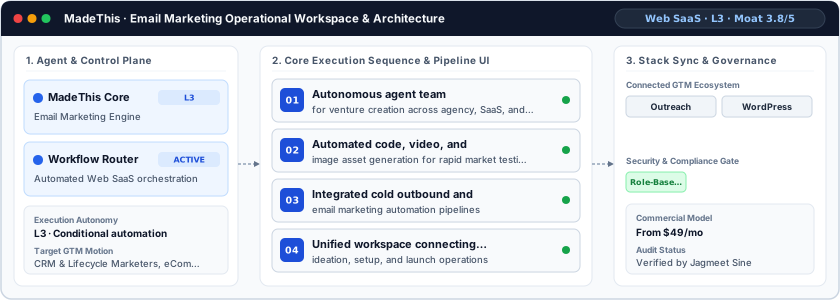
- Autonomous agent team: for venture creation across agency, SaaS, and e-commerce models
- Automated code, video, and: image asset generation for rapid market testing
- Integrated cold outbound and: email marketing automation pipelines
- Unified workspace connecting business: ideation, setup, and launch operations
Cons: operational limitations & risks
- Email Deliverability Risks: The embedded outbound engine lacks enterprise-grade automated mailbox warming schedules, creating critical domain reputation vulnerabilities during unmonitored cold email bursts.
- Deep Customization Bottlenecks: Agent-generated codebase templates enforce rigid schema constraints, restricting deep custom database integrations or complex transactional backend engineering.
- Attribution Model Gaps: Analytics instrumentation relies on surface-level sign-up event tracking rather than multi-touch attribution or direct synchronization with external enterprise data warehouses.
MadeThis TCO & deal-breaker stress test
Simulate 12-month stepped TCO, hidden cost multipliers, contract lock-in exposure, and stack failure modes using only facts verified by Jagmeet Sine on · Capture SHA 080182f1.
MadeThis aligns with your 5-seat / $800/mo profile. Review the walk-away triggers and contract levers below before deployment.
| Plan / Tier | Verified Rate | Scale Fit | Scope & Quota Notes |
|---|---|---|---|
| Starter | $49/mo | 1–2 seats | Built for early founders ready to scale and build a small business |
| Basic | $79/mo | 5 seats | Autonomous AI agent team: |
| Scale | $199/mo | 15 seats | Built for power users to create & run a fully automated business |
- Moat Score
- 3.8 / 5.0
- AI Autonomy
- L3
- Free Tier / Trial
- None disclosed
Triggered audit signals & failure modes
- Published Self-Serve Entry FloorVerified Pricing Ledger
MadeThis publishes a transparent entry point (From $49/mo) for initial validation before committing.
- Tier Fit for 5-Seat Scale: Basic ($79/mo)Verified Tier Schedule
Autonomous AI agent team:
- Primary Operational Bottleneck: Email Deliverability RisksAudit by Jagmeet Sine
The embedded outbound engine lacks enterprise-grade automated mailbox warming schedules, creating critical domain reputation vulnerabilities during unmonitored cold email bursts.
Hidden TCO Multipliers & Quota Gates
- Credit & Usage Burn Multiplier: Automated workflows consume metered credits/usage quotas; multi-step enrichment, voice minutes, or high-frequency agent runs can trigger mid-cycle top-up packs.
- Email Deliverability Risks: The embedded outbound engine lacks enterprise-grade automated mailbox warming schedules, creating critical domain reputation vulnerabilities during unmonitored cold email bursts.
- Deep Customization Bottlenecks: Agent-generated codebase templates enforce rigid schema constraints, restricting deep custom database integrations or complex transactional backend engineering.
When to Walk Away & Negotiation Levers
- Walk away if your workflow requires uncapped enterprise volume on the From $49/mo entry plan without upgrading tiers.
- Walk away if your workflow cannot tolerate email deliverability risks: The embedded outbound engine lacks enterprise-grade automated mailbox warming schedules, creating critical domain reputation vulnerabilities during unmonitored cold email bursts.
- Walk away if deep customization bottlenecks is a deal-breaker for your team: Agent-generated codebase templates enforce rigid schema constraints, restricting deep custom database integrations or complex transactional backend engineering.
- Validate exact quota thresholds (seats, credits, or API calls) included in MadeThis's From $49/mo tier before converting from monthly to annual billing.
- Require a sandbox proof-of-concept testing email deliverability risks against your live CRM/data schema before annual sign-off.
Ask a custom procurement or TCO stress-test question about MadeThis
Lower 5-seat floor (~$13/mo vs. $79 / mo)
Lower 5-seat floor (~$5/mo vs. $79 / mo)
MadeThis key entities, modules & ecosystem stack
MadeThis moat & subtrack positioning
Proprietary multi-agent execution workflows combining website generation, creative asset drafting, and cold email outreach in a unified workspace.
Editorial review
Fact-checked by Jagmeet Sine (Senior MarTech Infrastructure & Agentic Workflow Architect) on .
Background
For non-technical solo entrepreneurs and growth teams tasked with launching commercial projects rapidly, MadeThis addresses the structural barrier of manual company setup. Headquartered in San Francisco, CA, and founded in 2025, the company targets founders seeking an autonomous operating system to conceptualize, launch, and validate digital ventures. Rather than requiring distinct tooling for web design, copywriting, and customer acquisition, the platform provides an integrated workspace where multi-agent workflows execute foundational commercial tasks.
How MadeThis works
At its architectural core, MadeThis functions as an L3 autonomous agent system driven by prompt-directed workflows. Users select venture archetypes—such as SaaS products, marketing agencies, or dropshipping storefronts—which triggers a sequence of generative models. Coding agents construct web surfaces, creative agents synthesize video and image assets, and execution agents orchestrate outbound email infrastructure. The pipeline provisions domain templates, produces conversion copy, and configures lead-capture mechanisms into a single operational interface without requiring human code modifications.
Limitations
Operational considerations and platform boundaries include:
- Email Deliverability Risks: The embedded outbound engine lacks enterprise-grade automated mailbox warming schedules, creating critical domain reputation vulnerabilities during unmonitored cold email bursts.
- Deep Customization Bottlenecks: Agent-generated codebase templates enforce rigid schema constraints, restricting deep custom database integrations or complex transactional backend engineering.
- Attribution Model Gaps: Analytics instrumentation relies on surface-level sign-up event tracking rather than multi-touch attribution or direct synchronization with external enterprise data warehouses.
MadeThis pricing
Commercial access to MadeThis follows a tiered subscription model structured around autonomous agent utilization. Entry-level deployment begins with the Starter tier available at $49/month, which supplies the autonomous agent team, creative asset generators, and outbound email capacity. Enterprise and scaled usage tiers scale pricing to $79, $199, and up to $5000 for high-volume execution, offering higher task execution concurrency and operational agent bandwidth.
How MadeThis compares
Within the automation category, MadeThis navigates an operational niche distinct from specialized point solutions. While 10Web AI targets structured WordPress site generation, AB Tasty delivers enterprise experimentation pipelines, and Ability.ai automates autonomous growth marketing, MadeThis trades architectural specialization for broad venture generation breadth. The platform provides maximum utility for agile bootstrap operators, whereas organizations requiring deep enterprise governance, custom CRM routing, and complex data pipeline integration will find its bundled scaffolding insufficient.
Frequently asked questions about MadeThis
How much does MadeThis cost and what pricing tiers are available?
Published pricing summary for MadeThis: From $49/mo. A permanent free plan is not disclosed for MadeThis. Verified tier schedule: Starter ($49/mo for 1–2 seats); Basic ($79/mo for 5 seats); Scale ($199/mo for 15 seats). Commercial access to MadeThis follows a tiered subscription model structured around autonomous agent utilization. Entry-level deployment begins with the Starter tier available at $49/month, which supplies the autonomous agent team, creative asset generators, and outbound email capacity.
How does MadeThis work and how autonomous is its AI architecture?
Autonomous venture generation platform deploying AI agent teams to design, launch, and market businesses including landing pages and outbound campaigns. Within Email Marketing (AI Email Marketing & Lifecycle Journeys), MarTechRadar rates its execution architecture at L3 · Conditional automation with a verified Moat Score of 3.8 / 5.0 (Proprietary moat). Proprietary multi-agent execution workflows combining website generation, creative asset drafting, and cold email outreach in a unified workspace. Corporate profile: Founded by Cambree Bernkopf, Jacob Wright, operating at 2-10 employees scale.
What are the main limitations of MadeThis and when should buyers walk away?
Based on our editorial technical audit, key operational considerations and boundaries for MadeThis include: (1) Email Deliverability Risks: The embedded outbound engine lacks enterprise-grade automated mailbox warming schedules, creating critical domain reputation vulnerabilities during unmonitored cold email bursts. (2) Deep Customization Bottlenecks: Agent-generated codebase templates enforce rigid schema constraints, restricting deep custom database integrations or complex transactional backend engineering. (3) Attribution Model Gaps: Analytics instrumentation relies on surface-level sign-up event tracking rather than multi-touch attribution or direct synchronization with external enterprise data warehouses. Primary procurement walk-away rule: Walk away if your workflow requires uncapped enterprise volume on the From $49/mo entry plan without upgrading tiers.
What integrations, compliance certifications, and contract terms apply to MadeThis?
Verified ecosystem and stack integrations include Outreach, WordPress. First-party governance and developer endpoints verified on domain include: API Docs (https://www.madethis.com/docs). Key TCO multiplier to watch: Credit & Usage Burn Multiplier (Automated workflows consume metered credits/usage quotas; multi-step enrichment, voice minutes, or high-frequency agent runs can trigger mid-cycle top-up packs.) Before signing a contract, procurement teams should validate exact quota thresholds (seats, credits, or API calls) included in MadeThis's From $49/mo tier before converting from monthly to annual billing.
What are the best MadeThis alternatives and head-to-head competitors in 2026?
Top fact-checked alternatives to MadeThis in Email Marketing (AI Email Marketing & Lifecycle Journeys) include VerticalResponse (From $13/mo), AWeber (From $79/mo), clerk chat (From $5/mo), Justuno (From $59/mo). Within the automation category, MadeThis navigates an operational niche distinct from specialized point solutions.
Verified sources & evidence trail
- Official product domain: https://madethis.com
- Commercial pricing verification: https://www.madethis.com/pricing
- Verified corporate entity profiles (
sameAs): LinkedIn Company Profile · Crunchbase Entity Record - First-party governance & documentation links: API & Docs · Terms · Privacy
- Editorial audit sign-off: Fact-checked by Jagmeet Sine on under the MarTechRadar Evidence-Ledger Protocol.