Botpress Review (2026): AI Marketing Agent Pricing, Pros & Cons
Bottom line
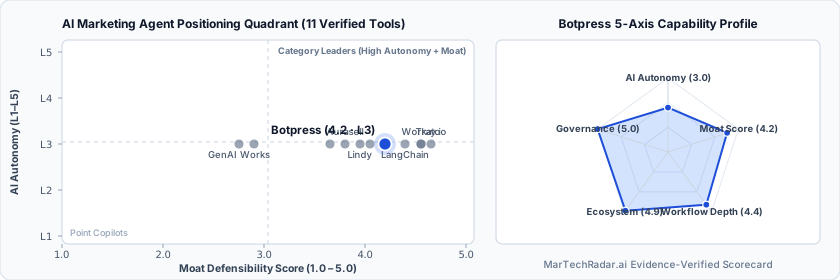
Botpress is a Web SaaS tool for AI Marketing Agent (Autonomous Marketing Agents & Digital Coworkers) in Agent & Marketing Ops. Pricing: Custom / enterprise pricing. Best suited to B2B SaaS, DTC / eCommerce and Enterprise Brands. Editor ratings: AI autonomy L3 (conditional automation); moat score 4.2/5.0 (Proprietary moat). Fact-checked by MarTechRadar Research Desk on Oct 14, 2026.
Developer-centric conversational AI orchestration platform enabling enterprises to build, test, and deploy autonomous LLM agents that execute multi-step.
Is Botpress worth it in 2026? Buyer fit & when to walk away
Choose Botpress if (Best Fit)
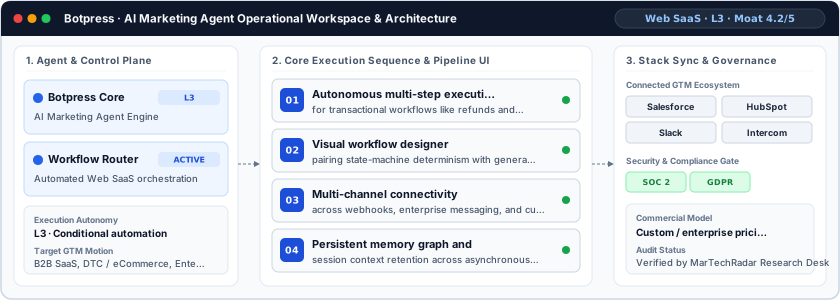
- Target ICP & Stack Fit: You operate as B2B SaaS, DTC / eCommerce and Enterprise Brands requiring a Web SaaS deployment for AI Marketing Agent, with verified ecosystem connectivity for Salesforce, HubSpot, Slack, Intercom.
- L3 Architecture & Defensibility: Proprietary hybrid NLU and LLM routing architecture coupled with visual state-machine debugging, open runtime extensibility, and deep workflow integration capabilities developed since 2017.
- Commercial Model Fit: Your procurement budget aligns with Custom / enterprise pricing and want a self-serve free tier for zero-cost initial validation.
Walk away from Botpress if (Deal-Breakers)
- Walk away if you need published self-serve pricing: Botpress is sold by custom quote.
- Walk away if your workflow cannot tolerate deterministic flow maintenance: Complex conditional workflows require manual visual graph upkeep, which becomes brittle when underlying API schemas or endpoint payloads experience undocumented modifications.
- Walk away if cold-start integration overhead is a deal-breaker for your team: Configuring transactional workflows demands extensive initial developer effort to define custom authentication protocols, rate limits, and webhook failure fallbacks.
Botpress pricing, free plan & scorecard at a glance
| Pricing | Custom / enterprise pricingVendor pricing page |
|---|---|
| Free plan | Yes |
| Delivery | Web SaaS |
| Audience | B2B SaaS, DTC / eCommerce, Enterprise Brands |
| AI autonomy level | L3 · Conditional automationEditor-verified |
| Moat tier & score | 4.2 / 5.0 · Proprietary moatEditor-verified |
| Funding | Venture-backed |
| Total funding | $40M |
| Founders | Justin Watson, Sylvain Perron |
| Company size | 51-200 employees |
| Ecosystem integrations | Salesforce, HubSpot, Slack, Intercom |
| Compliance & governance | SOC 2, GDPR |
| Governance & docs | Trust & Security ↗ · System Status ↗ · API & Docs ↗ · Changelog ↗ · Terms ↗ |
| Headquarters | Montreal, Quebec |
| Founded | 2017 |
| Last verified | Oct 14, 2026 |
Botpress pros & cons: strengths vs. operational limitations
Pros: core strengths & capabilities
- Autonomous multi-step execution: for transactional workflows like refunds and account updates
- Visual workflow designer: pairing state-machine determinism with generative LLM intent resolution
- Multi-channel connectivity: across webhooks, enterprise messaging, and custom API endpoints
- Persistent memory graph and session context retention across asynchronous conversational turns
Cons: operational limitations & risks
- Deterministic Flow Maintenance: Complex conditional workflows require manual visual graph upkeep, which becomes brittle when underlying API schemas or endpoint payloads experience undocumented modifications.
- Cold-Start Integration Overhead: Configuring transactional workflows demands extensive initial developer effort to define custom authentication protocols, rate limits, and webhook failure fallbacks.
- Multi-Turn Context Drift: Extended user sessions with diverging parallel intents can exceed retrieval token windows, occasionally causing agentic workers to drop earlier state variables.
Botpress TCO & deal-breaker stress test
Simulate 12-month stepped TCO, hidden cost multipliers, contract lock-in exposure, and stack failure modes using only facts verified by MarTechRadar Research Desk on 2026-10-14 · Capture SHA 54822a08.
Botpress is viable for 5 seats, but requires commercial or technical verification on the flagged items below.
- Moat Score
- 4.2 / 5.0
- AI Autonomy
- L3
- Free Tier / Trial
- Free plan
Triggered audit signals & failure modes
- Opaque Enterprise Quoting vs. SMB/Mid-Market BudgetVerified Pricing Ledger
Botpress does not disclose a public self-serve floor (Custom / enterprise pricing). Buyers with a $800/mo cap face high sales-qualification friction.
- Published Self-Serve Entry FloorVerified Pricing Ledger
Botpress publishes a transparent entry point (Custom / enterprise pricing) with a free tier for initial validation before committing.
- Primary Operational Bottleneck: Deterministic Flow MaintenanceAudit by MarTechRadar Research Desk
Complex conditional workflows require manual visual graph upkeep, which becomes brittle when underlying API schemas or endpoint payloads experience undocumented modifications.
Test a custom Botpress budget or stack constraint
Lower 5-seat floor (~$100/mo vs. Custom Quote)
Lower 5-seat floor (~$300/mo vs. Custom Quote)
Botpress integrations, API, security & compliance stack
Botpress AI moat & AI Marketing Agent positioning
Proprietary hybrid NLU and LLM routing architecture coupled with visual state-machine debugging, open runtime extensibility, and deep workflow integration capabilities developed since 2017.
Botpress in-depth review, pricing & architecture analysis
Editor sign-off: Oct 14, 2026. How profiles are made.
What is Botpress? Overview & background
Architectural decoupling of generative reasoning from core transactional logic defines Botpress, an AI agent platform founded in 2017 and headquartered in Montreal, Quebec. Backed by $40M in venture funding, the company engineers infrastructure for technical operations teams, product managers, and developers seeking deterministic control over conversational AI. Rather than relying on simple stochastic chat wrappers, the platform functions as an execution runtime where autonomous marketing agents and support coworkers process structured actions against backend enterprise APIs.
How Botpress works: architecture & workflow
At the architectural layer, the system autonomy, Botpress combines autonomous agentic planning with explicit state-machine guardrails. The runtime ingests incoming webhook events, parses user intents using foundational LLM routing, and maintains session state in persistent memory buffers. Dynamic variables pass directly into preconfigured tool-calling nodes that execute external HTTP calls for account updates, refunds, and CRM syncs. Execution branches reconcile model responses against strict schema validation rules before returning finalized payloads to communication channels, alongside native workflow integrations for Salesforce, HubSpot, Slack, and Intercom under verified GDPR governance controls.
Botpress limitations, drawbacks & risks
Operational considerations and platform boundaries include:
- Deterministic Flow Maintenance: Complex conditional workflows require manual visual graph upkeep, which becomes brittle when underlying API schemas or endpoint payloads experience undocumented modifications.
- Cold-Start Integration Overhead: Configuring transactional workflows demands extensive initial developer effort to define custom authentication protocols, rate limits, and webhook failure fallbacks.
- Multi-Turn Context Drift: Extended user sessions with diverging parallel intents can exceed retrieval token windows, occasionally causing agentic workers to drop earlier state variables.
Botpress pricing, plans & cost breakdown
Botpress provides consumption-oriented pricing structured around resolved dialogue volume. Entry-level access begins at a $0 tier offering 100 conversations alongside baseline community support. Tiered expansions introduce scalable conversation packages, including a Plus tier priced at $150 with supplemental conversation blocks, while dedicated enterprise deployments utilize custom contracts to provide volume discounting, SOC 2 compliance governance, and custom service-level agreements.
| Plan / Tier | Verified Price & Billing | Target Seat / Scale Fit | Included Scope & Contract Terms |
|---|---|---|---|
| Free / Sandbox | $0 | Unlimited seats | Free plan or free tier offered by the vendor. |
| Enterprise / Custom | Custom quote | Unlimited seats | Custom-quoted plan; terms come from the vendor's sales team. |
| Contract Watchout: Annual Billing Headline vs. Monthly Premium | The vendor pricing page advertises an annual-billing discount (Save 20%); month-to-month billing carries a higher effective monthly rate. | ||
How Botpress compares vs. competitors & alternatives
Relative to specialized competitors like ai-marketing-claude, allGood, and AskElephant, Botpress differentiates via raw programmatic extensibility and deterministic tool-calling frameworks within the AI Marketing Agent segment. While competitors focus on packaged, turnkey marketing assistant interfaces with minimal technical overhead, Botpress demands developer resources to maximize value. It remains best suited for mid-market and enterprise organizations with established engineering capacity that require deep API orchestration, explicit data sovereignty, and reliable multi-step transactional automation.
Direct competitors & market radar
Top algorithmic competitors based on category positioning, capability overlap, and ICP alignment.
Frequently asked questions about Botpress
Does Botpress publish pricing or require an enterprise quote?
Botpress pricing: Custom / enterprise pricing. A permanent free plan is available. Published tiers: Free / Sandbox ($0); Enterprise / Custom (Custom quote). Botpress provides consumption-oriented pricing structured around resolved dialogue volume. Entry-level access begins at a $0 tier offering 100 conversations alongside baseline community support.
What are the top Botpress alternatives in AI Marketing Agent?
Verified AI Marketing Agent alternatives include Zero ($60–$77/seat/mo), ATC Analytics (From $100/mo), Celonis (Custom / enterprise pricing), LemonLime (From $999/mo). Relative to specialized competitors like ai-marketing-claude, allGood, and AskElephant, Botpress differentiates via raw programmatic extensibility and deterministic tool-calling frameworks within the AI Marketing Agent segment.
What are the main limitations and trade-offs of Botpress?
Operational considerations and platform boundaries include: Deterministic Flow Maintenance: Complex conditional workflows require manual visual graph upkeep, which becomes brittle when underlying API schemas or endpoint payloads experience undocumented modifications. Walk away if you need published self-serve pricing: Botpress is sold by custom quote.
Verified sources & evidence trail
- Official product domain: https://botpress.com
- Commercial pricing verification: https://botpress.com/pricing
- Verified corporate entity profiles (
sameAs): LinkedIn Company Profile · Crunchbase Entity Record - First-party governance & documentation links: Trust & Security · System Status · API & Docs · Changelog · Terms
- Editor sign-off: Oct 14, 2026 (how profiles are made).
