Booth.ai Review (2026): AI Product Photography Pricing, Pros & Cons
Bottom line
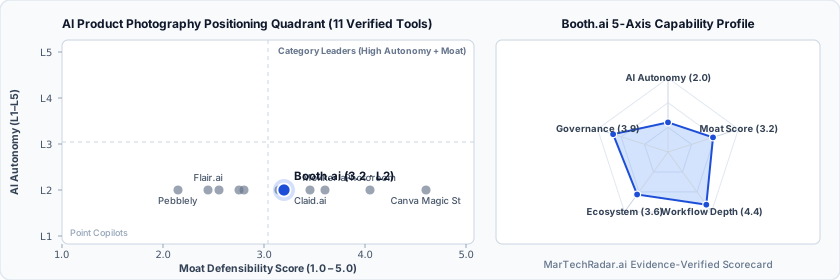
Booth.ai is a Web SaaS tool for AI Product Photography (Product Photography & AI Retouching) in Visual & Creative Media. Pricing: Custom / enterprise pricing. Best suited to DTC / eCommerce. Editor ratings: AI autonomy L2 (workflow copilot); moat score 3.2/5.0 (Workflow-embedded (strong)). Fact-checked by MarTechRadar Research Desk on Oct 16, 2026.
Generative AI product staging platform that converts reference catalog photos into lifestyle imagery using fine-tuned latent diffusion.
Is Booth.ai worth it in 2026? Buyer fit & when to walk away
Choose Booth.ai if (Best Fit)
- Target ICP & Stack Fit: You operate as DTC / eCommerce requiring a Web SaaS deployment for AI Product Photography, with verified ecosystem connectivity for Outreach.
- L2 Architecture & Defensibility: The platform maintained early-mover product photography diffusion workflows, but lacked proprietary hardware defensibility, rendering it vulnerable to rapid commoditization across open diffusion checkpoints.
- Commercial Model Fit: Your procurement budget aligns with Custom / enterprise pricing.
Walk away from Booth.ai if (Deal-Breakers)
- Walk away if you need published self-serve pricing: Booth.ai is sold by custom quote.
- Walk away if your workflow cannot tolerate high-frequency detail distortion: Fine packaging typography, micro-engravings, and specific logo geometry frequently suffer from diffusion distortion, requiring manual vector repositioning in post-production.
- Walk away if lighting and perspective inconsistencies is a deal-breaker for your team: Directional mismatches between ambient prompt illumination and the source camera angle often create synthetic shadows that break consumer photorealism.
Booth.ai pricing, free plan & scorecard at a glance
| Pricing | Custom / enterprise pricing |
|---|---|
| Free plan | No / not disclosed |
| Delivery | Web SaaS |
| Audience | DTC / eCommerce |
| AI autonomy level | L2 · Workflow copilotEditor-verified |
| Moat tier & score | 3.2 / 5.0 · Workflow-embedded (strong)Editor-verified |
| Funding | Undisclosed |
| Total funding | $3.3M |
| Founders | Ian Baldwin, Nick Locascio |
| Company size | 1-10 employees |
| Ecosystem integrations | Outreach |
| Governance & docs | API & Docs ↗ · Terms ↗ · Privacy ↗ |
| Headquarters | Hoffman Estates, Illinois |
| Founded | 2011 |
| Last verified | Oct 16, 2026 |
Booth.ai pros & cons: strengths vs. operational limitations
Pros: core strengths & capabilities
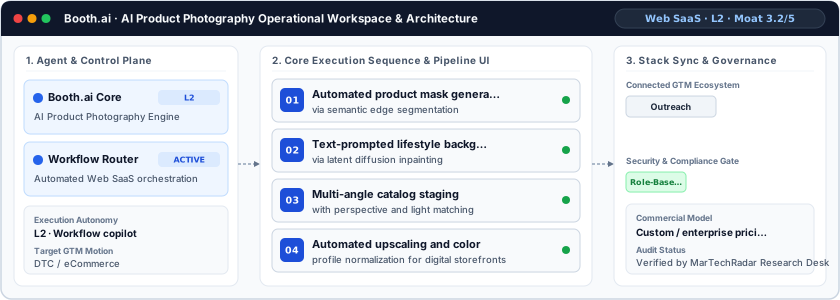
- Automated product mask generation: via semantic edge segmentation
- Text-prompted lifestyle background generation: via latent diffusion inpainting
- Multi-angle catalog staging: with perspective and light matching
- Automated upscaling and color: profile normalization for digital storefronts
Cons: operational limitations & risks
- High-Frequency Detail Distortion: Fine packaging typography, micro-engravings, and specific logo geometry frequently suffer from diffusion distortion, requiring manual vector repositioning in post-production.
- Lighting and Perspective Inconsistencies: Directional mismatches between ambient prompt illumination and the source camera angle often create synthetic shadows that break consumer photorealism.
- Scale and Spatial Misalignment: Generating complex scenes without depth maps occasionally produces scale anomalies, placing small tabletop products out of proportion relative to adjacent background furniture.
Booth.ai TCO & deal-breaker stress test
Simulate 12-month stepped TCO, hidden cost multipliers, contract lock-in exposure, and stack failure modes using only facts verified by MarTechRadar Research Desk on 2026-10-16.
Booth.ai triggers high-severity friction under your 5-seat / $800/mo constraints. Benchmark the verified subtrack alternatives below before committing.
- Moat Score
- 3.2 / 5.0
- AI Autonomy
- L2
- Free Tier / Trial
- None disclosed
Triggered audit signals & failure modes
- Opaque Enterprise Quoting vs. SMB/Mid-Market BudgetVerified Pricing Ledger
Booth.ai does not disclose a public self-serve floor (Custom / enterprise pricing). Buyers with a $800/mo cap face high sales-qualification friction.
- Sales-Gated Contract TermsFact-checked by MarTechRadar Research Desk
The commercial licensing structure historically functioned via custom enterprise pricing available on request through tailored sales quotes based on organizational seat counts and monthly asset generation quotas.
- Primary Operational Bottleneck: High-Frequency Detail DistortionAudit by MarTechRadar Research Desk
Fine packaging typography, micro-engravings, and specific logo geometry frequently suffer from diffusion distortion, requiring manual vector repositioning in post-production.
Test a custom Booth.ai budget or stack constraint
Lower 5-seat floor (~$8/mo vs. Custom Quote) · Transparent self-serve entry without mandatory annual lock-in
Booth.ai integrations, API, security & compliance stack
Booth.ai AI moat & AI Product Photography positioning
The platform maintained early-mover product photography diffusion workflows, but lacked proprietary hardware defensibility, rendering it vulnerable to rapid commoditization across open diffusion checkpoints.
Booth.ai in-depth review, pricing & architecture analysis
Editor sign-off: Oct 16, 2026. How profiles are made.
What is Booth.ai? Overview & background
To bridge the gap between expensive commercial studio photoshoots and high-velocity digital storefront staging, Booth.ai was established in 2011 in Hoffman Estates, Illinois. Backed by $3.3M in venture funding, the platform targeted e-commerce creative directors and direct-to-consumer digital marketers seeking to accelerate visual asset delivery without manual physical sets. By replacing prop sourcing, physical lighting adjustments, and manual retouching with generative image synthesis, the company positioned itself in the product photography and visual asset generation landscape.
How Booth.ai works: architecture & workflow
At an architectural level, the platform operates as an L2 generative workflow combining computer vision segmentation with conditional latent diffusion. Users upload raw product imagery, which passes through an edge-detection and foreground-isolation pipeline to generate an alpha matte of the physical object. The isolated product token is then embedded into a diffusion inpainting pipeline, guided by natural language prompts specifying lighting, environment, and surface textures. The model balances subject fidelity and contextual realism by masking the original SKU pixels while repainting shadow projections, reflections, and surrounding contextual scenes at native export resolutions.
Booth.ai limitations, drawbacks & risks
Operational considerations and platform boundaries include:
- High-Frequency Detail Distortion: Fine packaging typography, micro-engravings, and specific logo geometry frequently suffer from diffusion distortion, requiring manual vector repositioning in post-production.
- Lighting and Perspective Inconsistencies: Directional mismatches between ambient prompt illumination and the source camera angle often create synthetic shadows that break consumer photorealism.
- Scale and Spatial Misalignment: Generating complex scenes without depth maps occasionally produces scale anomalies, placing small tabletop products out of proportion relative to adjacent background furniture.
Booth.ai pricing, plans & cost breakdown
The commercial licensing structure historically functioned via custom enterprise pricing available on request through tailored sales quotes based on organizational seat counts and monthly asset generation quotas. Direct-to-consumer brands and agency teams secured bespoke procurement contracts aligned with catalog ingestion volume rather than published self-serve tiers. Note that current domain operational transitions reflect service changes, and active commercial access requires direct vendor outreach.
| Plan / Tier | Verified Price & Billing | Included Scope & Contract Terms |
|---|---|---|
| Enterprise / Custom | Custom quote | Custom-quoted plan; terms come from the vendor's sales team. |
How Booth.ai compares vs. competitors & alternatives
Compared to direct category competitors like Mogic AI and Photoroom, Booth.ai functions as an alternative focused on reliable workflow execution and transparent unit economics within the AI Product Photography segment.
Frequently asked questions about Booth.ai
Does Booth.ai publish pricing or require an enterprise quote?
Booth.ai pricing: Custom / enterprise pricing. No free plan is publicly disclosed. The commercial licensing structure historically functioned via custom enterprise pricing available on request through tailored sales quotes based on organizational seat counts and monthly asset generation quotas.
What are the top Booth.ai alternatives in AI Product Photography?
Verified AI Product Photography alternatives include Mogic AI (Custom / enterprise pricing), Smartmockups (Custom / enterprise pricing), Sume (Usage-based pricing), Ecomtent ($510–$5,100/seat/mo · Enterprise plan). Compared to direct category competitors like Mogic AI and Photoroom, Booth.ai functions as an alternative focused on reliable workflow execution and transparent unit economics within the AI Product Photography segment.
What are the main limitations and trade-offs of Booth.ai?
Operational considerations and platform boundaries include: High-Frequency Detail Distortion: Fine packaging typography, micro-engravings, and specific logo geometry frequently suffer from diffusion distortion, requiring manual vector repositioning in post-production. Walk away if you need published self-serve pricing: Booth.ai is sold by custom quote.
Verified sources & evidence trail
- Official product domain: https://booth.ai
- Commercial pricing verification: Verified against official vendor pricing policy (Custom / enterprise pricing)
- Verified corporate entity profiles (
sameAs): LinkedIn Company Profile · Crunchbase Entity Record - First-party governance & documentation links: API & Docs · Terms · Privacy
- Editor sign-off: Oct 16, 2026 (how profiles are made).
