Alta Review (2026): AI SDR Pricing, Pros & Cons
Bottom line
Alta is a Web SaaS tool for AI SDR (Autonomous B2B Sales Agents & AI BDRs) in AI SDR & Outbound. Pricing: Pricing not disclosed. Editor ratings: AI autonomy L4 (autonomous agent); moat score 3.4/5.0 (Workflow-embedded (strong)). Fact-checked by MarTechRadar Research Desk on Oct 26, 2026.
Autonomous multi-agent AI GTM platform deploying digital workers for B2B outbound prospecting, instant inbound qualification, and revenue operations.
Is Alta worth it in 2026? Buyer fit & when to walk away
Choose Alta if (Best Fit)
- Target ICP & Stack Fit: You operate as AI SDR teams requiring a Web SaaS deployment for AI SDR, with verified ecosystem connectivity for Salesforce, HubSpot, Outreach, Salesloft.
- L4 Architecture & Defensibility: Alta commands a strong B2B sales automation moat through its coordinated three-agent GTM architecture (Katie, Alex, Luna), shared organizational memory brain, 50+ native integrations, and $32M in Series A venture backing from Entrée Capital and Target Global.
- Commercial Model Fit: Your procurement budget aligns with Pricing not disclosed.
Walk away from Alta if (Deal-Breakers)
- Walk away if you require transparent self-serve monthly billing or your budget ceiling is under $1,000/mo (Alta requires sales-gated custom quoting).
- Walk away if your workflow cannot tolerate primary operational trade-off: In practical enterprise deployments, the primary trade-off is that autonomous multi-channel outreach requires careful domain warm-up, strict ICP exclusion rules, and prompt guardrail tuning to prevent over-messaging enterprise buying committees across email, LinkedIn, and voice channels simultaneously.
- Walk away if functional scope boundary is a deal-breaker for your team: Alta is not built for B2C e-commerce newsletter broadcasting, retail point-of-sale CRM management, or graphic ad creative editing.
Alta pricing, free plan & scorecard at a glance
| Pricing | Pricing not disclosed |
|---|---|
| Free plan | No / not disclosed |
| Delivery | Web SaaS |
| Audience | — |
| AI autonomy level | L4 · Autonomous agentEditor-verified |
| Moat tier & score | 3.4 / 5.0 · Workflow-embedded (strong)Editor-verified |
| Funding | Series A |
| Total funding | $32MBacked by Entrée Capital, Target Global, Mindset Ventures, IN Venture, Verissimo Ventures |
| Founders | Mor Shabtai, Stav Neumark, Tom Hoffen |
| Company size | 11-50 employees |
| Ecosystem integrations | Salesforce, HubSpot, Outreach, Salesloft, Gong, LinkedIn |
| Compliance & governance | SOC 2, ISO 27001 |
| Headquarters | Tel Aviv, Tel Aviv, Israel |
| Founded | 2023 |
| Last verified | Oct 26, 2026 |
Alta pros & cons: strengths vs. operational limitations
Pros: core strengths & capabilities
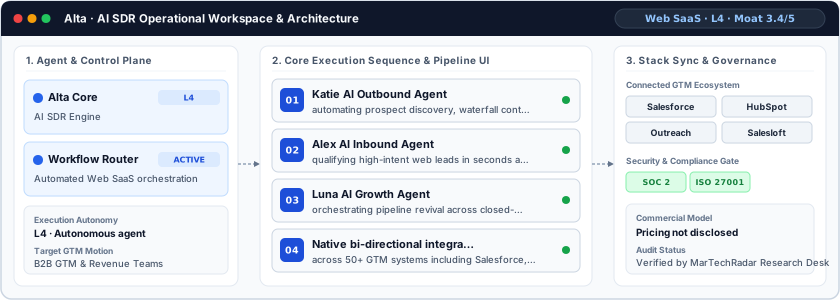
- Katie AI Outbound Agent: automating prospect discovery, waterfall contact enrichment, and multi-channel email, LinkedIn, and voice outreach
- Alex AI Inbound Agent: qualifying high-intent web leads in seconds and booking calendar meetings autonomously
- Luna AI Growth Agent: orchestrating pipeline revival across closed-lost CRM opportunities and buyer intent spikes
- Native bi-directional integration: across 50+ GTM systems including Salesforce, HubSpot, Gong, Outreach, and Salesloft under SOC 2 Type II and ISO 27001 controls
Cons: operational limitations & risks
- Primary Operational Trade-Off: In practical enterprise deployments, the primary trade-off is that autonomous multi-channel outreach requires careful domain warm-up, strict ICP exclusion rules, and prompt guardrail tuning to prevent over-messaging enterprise buying committees across email, LinkedIn, and voice channels simultaneously.
- Functional Scope Boundary: Alta is not built for B2C e-commerce newsletter broadcasting, retail point-of-sale CRM management, or graphic ad creative editing.
- Deployment & Governance Considerations: Additionally, because onboarding involves custom playbook configuration and bi-directional CRM field mapping across 50+ integrations, early-stage teams without defined ICP qualification criteria or clean CRM stage definitions face a steeper initial learning curve and configuration overhead than plug-and-play cold email tools.
Alta TCO & deal-breaker stress test
Simulate 12-month stepped TCO, hidden cost multipliers, contract lock-in exposure, and stack failure modes using only facts verified by MarTechRadar Research Desk on 2026-10-26.
Alta triggers high-severity friction under your 5-seat / $800/mo constraints. Benchmark the verified subtrack alternatives below before committing.
- Moat Score
- 3.4 / 5.0
- AI Autonomy
- L4
- Free Tier / Trial
- None disclosed
Triggered audit signals & failure modes
- Opaque Enterprise Quoting vs. SMB/Mid-Market BudgetVerified Pricing Ledger
Alta does not disclose a public self-serve floor (Pricing not disclosed). Buyers with a $800/mo cap face high sales-qualification friction.
- Sales-Gated Contract TermsFact-checked by MarTechRadar Research Desk
Pricing available on request.
- Primary Operational Bottleneck: Primary Operational Trade-OffAudit by MarTechRadar Research Desk
In practical enterprise deployments, the primary trade-off is that autonomous multi-channel outreach requires careful domain warm-up, strict ICP exclusion rules, and prompt guardrail tuning to prevent over-messaging enterprise buying committees across email, LinkedIn, and voice channels simultaneously.
Test a custom Alta budget or stack constraint
Alta integrations, API, security & compliance stack
Alta AI moat & AI SDR positioning
Alta commands a strong B2B sales automation moat through its coordinated three-agent GTM architecture (Katie, Alex, Luna), shared organizational memory brain, 50+ native integrations, and $32M in Series A venture backing from Entrée Capital and Target Global.
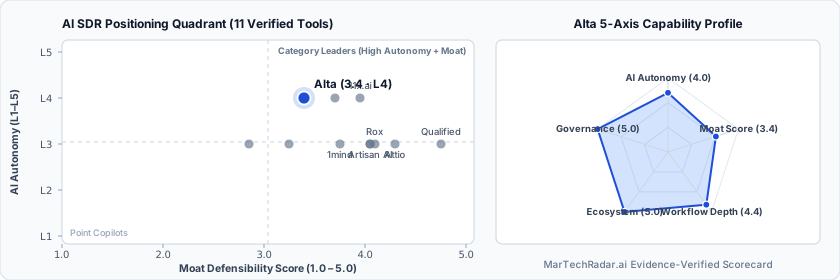
Alta in-depth review, pricing & architecture analysis
Audited by MarTechRadar Research Desk (Evidence-Ledger Verified) on Oct 26, 2026.
What is Alta? Overview & background
Alta is an autonomous multi-agent B2B go-to-market software platform built for VP of Sales leaders, RevOps architects, and demand generation teams. Founded in 2023 by Mor Shabtai, Stav Neumark, and Tom Hoffen and headquartered in Tel Aviv, Israel, the company operates with 11 to 50 employees and has raised $32M across two funding rounds through Series A backed by Entrée Capital, Target Global, Mindset Ventures, IN Venture, and Verissimo Ventures, alongside $25M in announced growth capital. Rather than offering a standalone email sequencer, Alta deploys three specialized digital workers—Katie as an AI Outbound Agent, Alex as an AI Inbound Agent, and Luna as an AI Growth Agent—that automate prospect research, instant inbound qualification, and cross-channel meeting booking, while running active Google Search Sponsored Ads and LinkedIn Ads targeting buyers searching for best ai sdr agent for b2b outbound, alta ai sdr pricing, and an artisan ai alternative.
How Alta works: architecture & workflow
At the technical core of Alta is a multi-agent GTM orchestration architecture built around a shared organizational memory brain and a real-time buyer signal pipeline. Each agent executes a coordinated workflow that ingests firmographic changes, hiring signals, website engagement events, and historical CRM call transcripts to determine optimal outreach timing and channel selection. The underlying LLM reasoning model dynamically branches sequences across personalized email, LinkedIn social touches, and automated voice calling based on live prospect responses. Through native API and webhook integration connectors across more than 50 enterprise tools—including Salesforce, HubSpot, Gong, Outreach, Salesloft, and cloud data warehouses—every prospect interaction writes back directly to the system of record under verified SOC 2 Type II, ISO/IEC 27001, SAML SSO, and AWS private VPC security controls.
Alta limitations, drawbacks & risks
Operational considerations and platform boundaries include:
- Primary Operational Trade-Off: In practical enterprise deployments, the primary trade-off is that autonomous multi-channel outreach requires careful domain warm-up, strict ICP exclusion rules, and prompt guardrail tuning to prevent over-messaging enterprise buying committees across email, LinkedIn, and voice channels simultaneously.
- Functional Scope Boundary: Alta is not built for B2C e-commerce newsletter broadcasting, retail point-of-sale CRM management, or graphic ad creative editing.
- Deployment & Governance Considerations: Additionally, because onboarding involves custom playbook configuration and bi-directional CRM field mapping across 50+ integrations, early-stage teams without defined ICP qualification criteria or clean CRM stage definitions face a steeper initial learning curve and configuration overhead than plug-and-play cold email tools.
Alta pricing, plans & cost breakdown
Pricing available on request. Alta structures its commercial contracts around custom proposals tailored to each organization's active AI agent modules, monthly prospect volume, and sales team size on its official plans page (altahq.com/plans), including white-glove onboarding and free native integrations across existing CRM and sales engagement tools.
| Plan / Tier | Verified Price & Billing | Target Seat / Scale Fit | Included Scope & Contract Terms |
|---|---|---|---|
| Enterprise / Custom | Custom quote | 15–50+ seats (Enterprise SLA) | Sales-negotiated annual contract for custom volume, SSO/RBAC governance, and dedicated SLA. |
| Contract Watchout: Enterprise Governance & Add-On Gating | Advanced capabilities such as Single Sign-On (SSO), custom role permissions, or specialized analytics modules are gated behind upper tiers or paid add-ons. | ||
How Alta compares vs. competitors & alternatives
In the autonomous B2B sales agent and AI SDR market, Alta competes with 11x, Artisan, Relevance AI, and AiSDR within the Autonomous B2B Sales Agents segment, alongside verified subtrack peers such as Octave, DeepSales, and Squirrels. Compared to single-agent cold email tools that lack inbound speed-to-lead qualification or voice calling orchestration, Alta differentiates itself through its unified Katie, Alex, and Luna multi-agent system and shared revenue memory brain. Mid-market and enterprise B2B sales and RevOps teams should evaluate Alta to automate full-funnel outbound prospecting and inbound pipeline conversion.
Frequently asked questions about Alta
Does Alta publish pricing or require an enterprise quote?
Alta pricing: Pricing not disclosed. No free plan is publicly disclosed. Pricing available on request.
What are the top Alta alternatives in AI SDR?
Verified AI SDR alternatives include Rings AI (Pricing not disclosed), Sellva (Custom / enterprise pricing), GrowthSync Digital (Custom / enterprise pricing), Pyto (Custom / enterprise pricing). In the autonomous B2B sales agent and AI SDR market, Alta competes with 11x, Artisan, Relevance AI, and AiSDR within the Autonomous B2B Sales Agents segment, alongside verified subtrack peers such as Octave, DeepSales, and Squirrels.
Verified sources & evidence trail
- Official product domain: https://altahq.com
- Commercial pricing verification: Verified against official vendor pricing policy (Pricing not disclosed)
- Verified corporate entity profiles (
sameAs): LinkedIn Company Profile · Crunchbase Entity Record - Editorial audit sign-off: Audited by MarTechRadar Research Desk (Evidence-Ledger Verified) on Oct 26, 2026.
