ZMO.ai Review (2026): AI Avatar Pricing, Pros & Cons
Bottom line
ZMO.ai is a Web SaaS tool for AI Avatar (Digital Avatars & Presenters) in Visual & Creative Media. Pricing: Custom / enterprise pricing. Best suited to DTC / eCommerce. Editor ratings: AI autonomy L2 (workflow copilot); moat score 3.1/5.0 (Workflow-embedded (strong)). Fact-checked by MarTechRadar Research Desk on Oct 15, 2026.
Multimodal generative AI platform synthesizing virtual models and digital avatar assets for commercial retail and digital media workflows.
Is ZMO.ai worth it in 2026? Buyer fit & when to walk away
Choose ZMO.ai if (Best Fit)
- Target ICP & Stack Fit: You operate as DTC / eCommerce requiring a Web SaaS deployment for AI Avatar.
- L2 Architecture & Defensibility: Domain-specialized synthetic imagery pipelines adapted for e-commerce apparel visualization and commercial character rendering, supported by institutional venture funding.
- Commercial Model Fit: Your procurement budget aligns with Custom / enterprise pricing.
Walk away from ZMO.ai if (Deal-Breakers)
- Walk away if you need published self-serve pricing: ZMO.ai is sold by custom quote.
- Walk away if your workflow cannot tolerate high-frequency texture drift: Fine garment weaves, intricate embroidery, and reflective textiles frequently suffer from latent blur or geometric distortion across synthetic model poses.
- Walk away if domain infrastructure latency is a deal-breaker for your team: Vendor endpoint stability and SSL certificate configuration failures present tangible operational risks for automated programmatic production integrations.
ZMO.ai pricing, free plan & scorecard at a glance
| Pricing | Custom / enterprise pricing |
|---|---|
| Free plan | No / not disclosed |
| Delivery | Web SaaS |
| Audience | DTC / eCommerce |
| AI autonomy level | L2 · Workflow copilotEditor-verified |
| Moat tier & score | 3.1 / 5.0 · Workflow-embedded (strong)Editor-verified |
| Funding | Series A |
| Total funding | $8M |
| Founders | Roger Minzhe Yin |
| Company size | 11-50 employees |
| Headquarters | Sacramento, California, United States |
| Founded | 2020 |
| Last verified | Oct 15, 2026 |
ZMO.ai pros & cons: strengths vs. operational limitations
Pros: core strengths & capabilities
- Synthetic digital model generation: for catalog apparel and merchandise presentation
- Automated facial and pose: rendering conditioned on source garment imagery
- Background replacement and lighting: harmonization for product assets
- Batch asset processing: via programmatic API queues
Cons: operational limitations & risks
- High-Frequency Texture Drift: Fine garment weaves, intricate embroidery, and reflective textiles frequently suffer from latent blur or geometric distortion across synthetic model poses.
- Domain Infrastructure Latency: Vendor endpoint stability and SSL certificate configuration failures present tangible operational risks for automated programmatic production integrations.
- Pose Constraint Boundaries: Dynamic action poses introduce structural alignment artifacts along garment seams, restricting outputs to standard catalog standing configurations.
ZMO.ai TCO & deal-breaker stress test
Simulate 12-month stepped TCO, hidden cost multipliers, contract lock-in exposure, and stack failure modes using only facts verified by MarTechRadar Research Desk on 2026-10-15.
ZMO.ai triggers high-severity friction under your 5-seat / $800/mo constraints. Benchmark the verified subtrack alternatives below before committing.
- Moat Score
- 3.1 / 5.0
- AI Autonomy
- L2
- Free Tier / Trial
- None disclosed
Triggered audit signals & failure modes
- Opaque Enterprise Quoting vs. SMB/Mid-Market BudgetVerified Pricing Ledger
ZMO.ai does not disclose a public self-serve floor (Custom / enterprise pricing). Buyers with a $800/mo cap face high sales-qualification friction.
- Sales-Gated Contract TermsFact-checked by MarTechRadar Research Desk
Commercial access operates under custom enterprise pricing, requiring prospective organizations to contact sales for tailored quotes.
- Primary Operational Bottleneck: High-Frequency Texture DriftAudit by MarTechRadar Research Desk
Fine garment weaves, intricate embroidery, and reflective textiles frequently suffer from latent blur or geometric distortion across synthetic model poses.
Test a custom ZMO.ai budget or stack constraint
Lower 5-seat floor (~$46/mo vs. Custom Quote) · Transparent self-serve entry without mandatory annual lock-in
Lower 5-seat floor (~$40/mo vs. Custom Quote) · Transparent self-serve entry without mandatory annual lock-in
ZMO.ai AI moat & AI Avatar positioning
Domain-specialized synthetic imagery pipelines adapted for e-commerce apparel visualization and commercial character rendering, supported by institutional venture funding.
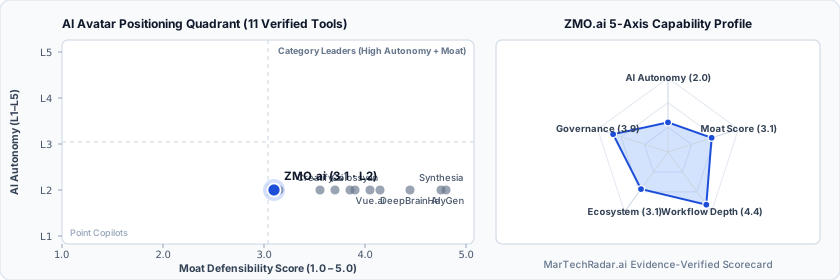
ZMO.ai in-depth review, pricing & architecture analysis
Editor sign-off: Oct 15, 2026. How profiles are made.
What is ZMO.ai? Overview & background
Backed by $8M in venture funding, ZMO.ai was founded in 2020 in Sacramento, California, United States, to address the computational bottleneck of physical commercial photography and synthetic model rendering. Targeting creative operations leads and e-commerce merchandising directors, the company engineers generative visual systems designed to produce on-model digital imagery from static product assets. By programmatically generating synthetic human presenters and virtual mannequins, the platform aims to reduce studio production cycles across global merchandising and digital advertising catalogs.
How ZMO.ai works: architecture & workflow
Architecturally, the platform functions at Level 2 autonomy by executing multi-stage generative diffusion workflows against uploaded garment and product images. The ingestion pipeline extracts flat apparel boundaries, normalizes lighting parameters, and maps texture coordinates across parametric 3D body models. A conditioned image-to-image synthesis pipeline then populates digital avatars across configurable poses, skin tones, and background environments. Workloads execute across distributed GPU rendering queues, routing outputs through edge-preservation filters to maintain fabric draping integrity without manual retouching.
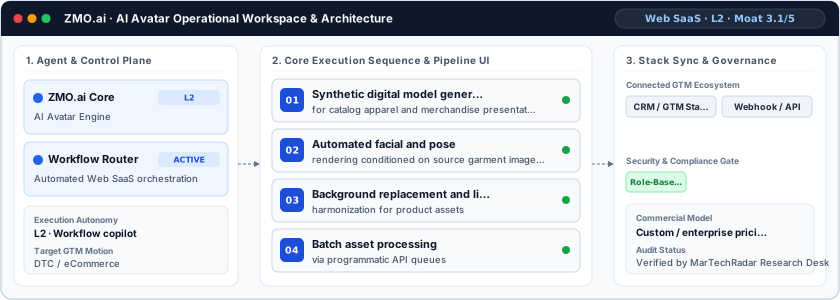
ZMO.ai limitations, drawbacks & risks
Operational considerations and platform boundaries include:
- High-Frequency Texture Drift: Fine garment weaves, intricate embroidery, and reflective textiles frequently suffer from latent blur or geometric distortion across synthetic model poses.
- Domain Infrastructure Latency: Vendor endpoint stability and SSL certificate configuration failures present tangible operational risks for automated programmatic production integrations.
- Pose Constraint Boundaries: Dynamic action poses introduce structural alignment artifacts along garment seams, restricting outputs to standard catalog standing configurations.
ZMO.ai pricing, plans & cost breakdown
Commercial access operates under custom enterprise pricing, requiring prospective organizations to contact sales for tailored quotes. Licensing terms are structured around annual procurement contracts dictated by compute consumption tiers, rendering volume thresholds, and seat allocations. Production-scale API access involves dedicated concurrency guarantees and custom infrastructure provisioning agreements.
| Plan / Tier | Verified Price & Billing | Included Scope & Contract Terms |
|---|---|---|
| Enterprise / Custom | Custom quote | Custom-quoted plan; terms come from the vendor's sales team. |
How ZMO.ai compares vs. competitors & alternatives
While video-centric competitors like Synthesia, HeyGen, and Colossyan specialize in scripted lip-syncing and corporate narration avatars, ZMO.ai concentrates primarily on static merchandising imagery and apparel visualization. Synthesia and HeyGen deliver mature multimodal video studios for enterprise communication, whereas ZMO.ai prioritizes catalog asset generation. The platform suits e-commerce visual merchandising teams requiring high-volume virtual apparel photography rather than dynamic corporate video presenters.
Direct competitors & market radar
Top algorithmic competitors based on category positioning, capability overlap, and ICP alignment.
Frequently asked questions about ZMO.ai
Does ZMO.ai publish pricing or require an enterprise quote?
ZMO.ai pricing: Custom / enterprise pricing. No free plan is publicly disclosed. Commercial access operates under custom enterprise pricing, requiring prospective organizations to contact sales for tailored quotes.
What are the top ZMO.ai alternatives in AI Avatar?
Verified AI Avatar alternatives include Hautech.ai (From $10), Shop OS (Custom / enterprise pricing), Veesual (From $40/mo), Botika.io (From $46/mo). While video-centric competitors like Synthesia, HeyGen, and Colossyan specialize in scripted lip-syncing and corporate narration avatars, ZMO.ai concentrates primarily on static merchandising imagery and apparel visualization.
What are the main limitations and trade-offs of ZMO.ai?
Operational considerations and platform boundaries include: High-Frequency Texture Drift: Fine garment weaves, intricate embroidery, and reflective textiles frequently suffer from latent blur or geometric distortion across synthetic model poses. Walk away if you need published self-serve pricing: ZMO.ai is sold by custom quote.
Verified sources & evidence trail
- Official product domain: https://zmo.ai
- Commercial pricing verification: Verified against official vendor pricing policy (Custom / enterprise pricing)
- Verified corporate entity profiles (
sameAs): LinkedIn Company Profile · Crunchbase Entity Record - Editor sign-off: Oct 15, 2026 (how profiles are made).
