Wavelength Review (2026): CDP Pricing, Limits & Alternatives
Bottom line
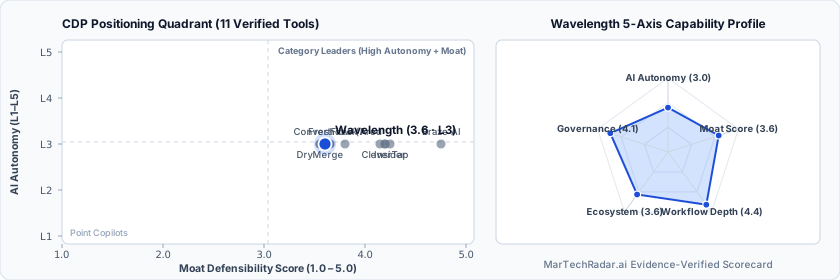
Wavelength is a Web SaaS tool for CDP (Customer Data Platform & Journey Orchestration) in Lifecycle & CDP. Pricing: Pricing not disclosed. Best suited to B2B SaaS and Marketing & Growth Teams. Editor ratings: AI autonomy L3 (conditional automation); moat score 3.6/5.0 (Proprietary moat). Fact-checked by Jagmeet Sine on Oct 16, 2026.
AI-native customer intelligence platform (formerly Assembly) that unifies post-sale GTM data so revenue teams can analyze and act on customer signals.
Wavelength buyer fit verdict: when to choose vs. when to walk away
Choose Wavelength if (Best Fit)
- Target ICP & Stack Fit: You operate as B2B SaaS and Marketing & Growth Teams requiring a Web SaaS deployment for CDP, with verified ecosystem connectivity for Slack.
- L3 Architecture & Defensibility: Unifying fragmented post-sale customer data stacks into a single AI-native customer superintelligence layer embeds into daily CS and GTM decision-making across hundreds of organizations.
- Commercial Model Fit: Your procurement budget aligns with Pricing not disclosed.
Walk away from Wavelength if (Deal-Breakers)
- Walk away if you require transparent self-serve monthly billing or your budget ceiling is under $1,000/mo (Wavelength requires sales-gated custom quoting).
- Walk away if your workflow cannot tolerate cross-stack connector maintenance latency: Maintaining real-time schema synchronization across dozens of custom CRM fields, ticketing systems, and data warehouses introduces initial data-mapping latency and integration friction during enterprise onboarding.
- Walk away if unstructured signal noise bottleneck is a deal-breaker for your team: Synthesizing high-volume support tickets and Slack chatter without tuned relevance filters can surface false-positive account alerts, requiring an initial calibration learning curve for CS operations managers.
Wavelength key facts & scorecard
| Pricing | Pricing not disclosed |
|---|---|
| Free plan | No / not disclosed |
| Delivery | Web SaaS |
| Audience | B2B SaaS, Marketing & Growth Teams |
| AI autonomy level | L3 · Conditional automationEditor-verified |
| Moat tier & score | 3.6 / 5.0 · Proprietary moatEditor-verified |
| Funding | Seed |
| Company size | 2-10 employees |
| Ecosystem integrations | Slack |
| Compliance & governance | SOC 2 |
| Governance & docs | Privacy ↗ |
| Headquarters | San Francisco, CA |
| Founded | 2023 |
| Last verified |
Wavelength pros & cons: strengths vs. operational limitations
Pros: core strengths & capabilities
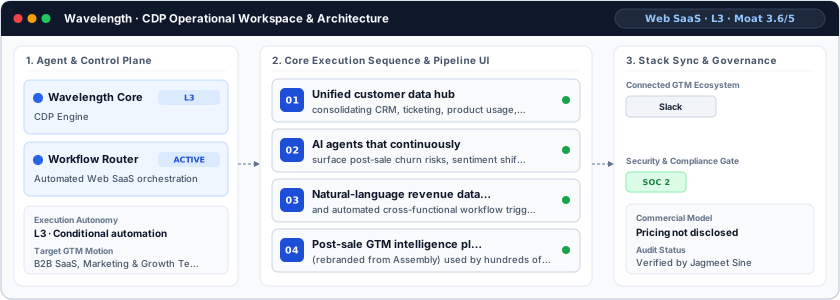
- Unified customer data hub: consolidating CRM, ticketing, product usage, and communication streams
- AI agents that continuously: surface post-sale churn risks, sentiment shifts, and expansion signals
- Natural-language revenue data querying: and automated cross-functional workflow triggers
- Post-sale GTM intelligence platform: (rebranded from Assembly) used by hundreds of customer orgs
Cons: operational limitations & risks
- Cross-Stack Connector Maintenance Latency: Maintaining real-time schema synchronization across dozens of custom CRM fields, ticketing systems, and data warehouses introduces initial data-mapping latency and integration friction during enterprise onboarding.
- Unstructured Signal Noise Bottleneck: Synthesizing high-volume support tickets and Slack chatter without tuned relevance filters can surface false-positive account alerts, requiring an initial calibration learning curve for CS operations managers.
- Enterprise Data Access Governance Barrier: Centralizing sensitive post-sale customer contracts and support transcripts inside a unified AI intelligence platform requires strict role-based permissioning and SOC 2 compliance governance.
Wavelength TCO & deal-breaker stress test
Simulate 12-month stepped TCO, hidden cost multipliers, contract lock-in exposure, and stack failure modes using only facts verified by Jagmeet Sine on · Capture SHA a52a4e21.
Wavelength triggers high-severity friction under your 5-seat / $800/mo constraints. Benchmark the verified subtrack alternatives below before committing.
| Plan / Tier | Verified Rate | Scale Fit | Scope & Quota Notes |
|---|---|---|---|
| Enterprise / Custom | Custom quote | 15–50+ seats (Enterprise SLA) | Sales-negotiated annual contract for custom volume, SSO/RBAC governance, and dedicated SLA. |
- Moat Score
- 3.6 / 5.0
- AI Autonomy
- L3
- Free Tier / Trial
- None disclosed
Triggered audit signals & failure modes
- Opaque Enterprise Quoting vs. SMB/Mid-Market BudgetVerified Pricing Ledger
Wavelength does not disclose a public self-serve floor (Pricing not disclosed). Buyers with a $800/mo cap face high sales-qualification friction.
- Sales-Gated Contract TermsFact-checked by Jagmeet Sine
Pricing is available on request through enterprise sales quotes, with customized tiers based on seat counts or usage volume.
- Primary Operational Bottleneck: Cross-Stack Connector Maintenance LatencyAudit by Jagmeet Sine
Maintaining real-time schema synchronization across dozens of custom CRM fields, ticketing systems, and data warehouses introduces initial data-mapping latency and integration friction during enterprise onboarding.
Hidden TCO Multipliers & Quota Gates
- Cross-Stack Connector Maintenance Latency: Maintaining real-time schema synchronization across dozens of custom CRM fields, ticketing systems, and data warehouses introduces initial data-mapping latency and integration friction during enterprise onboarding.
- Unstructured Signal Noise Bottleneck: Synthesizing high-volume support tickets and Slack chatter without tuned relevance filters can surface false-positive account alerts, requiring an initial calibration learning curve for CS operations managers.
When to Walk Away & Negotiation Levers
- Walk away if you require transparent self-serve monthly billing or your budget ceiling is under $1,000/mo (Wavelength requires sales-gated custom quoting).
- Walk away if your workflow cannot tolerate cross-stack connector maintenance latency: Maintaining real-time schema synchronization across dozens of custom CRM fields, ticketing systems, and data warehouses introduces initial data-mapping latency and integration friction during enterprise onboarding.
- Walk away if unstructured signal noise bottleneck is a deal-breaker for your team: Synthesizing high-volume support tickets and Slack chatter without tuned relevance filters can surface false-positive account alerts, requiring an initial calibration learning curve for CS operations managers.
- Demand a 30- to 60-day paid pilot opt-out clause in the Wavelength order form before signing a 12-month enterprise commitment.
- Require a sandbox proof-of-concept testing cross-stack connector maintenance latency against your live CRM/data schema before annual sign-off.
Ask a custom procurement or TCO stress-test question about Wavelength
Lower 5-seat floor (~$85/mo vs. Custom Quote) · Transparent self-serve entry without mandatory annual lock-in
Lower 5-seat floor (~$19/mo vs. Custom Quote) · Transparent self-serve entry without mandatory annual lock-in
Wavelength key entities, modules & ecosystem stack
Wavelength moat & subtrack positioning
Unifying fragmented post-sale customer data stacks into a single AI-native customer superintelligence layer embeds into daily CS and GTM decision-making across hundreds of organizations.
Editorial review
Fact-checked by Jagmeet Sine (Senior MarTech Infrastructure & Agentic Workflow Architect) on .
Background
Founded in 2023 by Pranav Mallampalli and Deepali Jain and headquartered in San Francisco, CA, Wavelength (joinwavelength.com, formerly known as Assembly / askassembly.com) is an AI-native customer intelligence platform purpose-built for post-sales, customer success, and modern go-to-market (GTM) teams. Operating with a team of 2 to 10 employees and backed by institutional accelerator investor Y Combinator (W24), the company serves hundreds of customer organizations by unifying their fragmented customer data stack into a single "Customer SuperIntelligence" workspace.
How Wavelength works
Wavelength operates at Level 3 autonomy through a cross-platform data ingestion layer, semantic indexing pipeline, and proactive AI agent execution engine. Post-sales teams typically struggle with customer context scattered across CRM records, support helpdesks, Slack channels, call recordings, and product databases. Wavelength ingests and harmonizes these structured and unstructured streams into a unified customer graph, allowing GTM operators to query account health in plain English while autonomous AI agents uncover hidden renewal risks, feature adoption blockers, and upsell triggers and execute immediate follow-up workflows.
Limitations
Operational limitations and technical trade-offs include:
- Cross-Stack Connector Maintenance Latency: Maintaining real-time schema synchronization across dozens of custom CRM fields, ticketing systems, and data warehouses introduces initial data-mapping latency and integration friction during enterprise onboarding.
- Unstructured Signal Noise Bottleneck: Synthesizing high-volume support tickets and Slack chatter without tuned relevance filters can surface false-positive account alerts, requiring an initial calibration learning curve for CS operations managers.
- Enterprise Data Access Governance Barrier: Centralizing sensitive post-sale customer contracts and support transcripts inside a unified AI intelligence platform requires strict role-based permissioning and SOC 2 compliance governance.
Wavelength pricing
Pricing is available on request through enterprise sales quotes, with customized tiers based on seat counts or usage volume. Prospective post-sales and GTM leaders can schedule a customized demonstration directly through the Wavelength website to scope data connectors and agent workflows.
How Wavelength compares
Within the Customer Data Platform & Journey Orchestration and Customer Intelligence category, Wavelength competes against post-sale intelligence alternatives such as Ambral, Gainsight, and Planhat. Versus legacy SQL-heavy BI dashboards or rigid rules-based CS platforms like Gainsight, Wavelength differentiates itself through its unified AI-native Customer SuperIntelligence graph that lets GTM teams access, analyze, and act on unstructured and structured revenue signals in one place. Post-sale revenue teams seeking unified account visibility choose Wavelength.
Frequently asked questions about Wavelength
How much does Wavelength cost and does it require a custom enterprise quote?
Published pricing summary for Wavelength: Pricing not disclosed. A permanent free plan is not disclosed for Wavelength. Pricing is available on request through enterprise sales quotes, with customized tiers based on seat counts or usage volume. Prospective post-sales and GTM leaders can schedule a customized demonstration directly through the Wavelength website to scope data connectors and agent workflows.
How does Wavelength work and how autonomous is its AI architecture?
AI-native customer intelligence platform (formerly Assembly) that unifies post-sale GTM data so revenue teams can analyze and act on customer signals. Within CDP (Customer Data Platform & Journey Orchestration), MarTechRadar rates its execution architecture at L3 · Conditional automation with a verified Moat Score of 3.6 / 5.0 (Proprietary moat). Unifying fragmented post-sale customer data stacks into a single AI-native customer superintelligence layer embeds into daily CS and GTM decision-making across hundreds of organizations. Corporate profile: operating at 2-10 employees scale.
What are the main limitations of Wavelength and when should buyers walk away?
Based on our editorial technical audit, key operational considerations and boundaries for Wavelength include: (1) Cross-Stack Connector Maintenance Latency: Maintaining real-time schema synchronization across dozens of custom CRM fields, ticketing systems, and data warehouses introduces initial data-mapping latency and integration friction during enterprise onboarding. (2) Unstructured Signal Noise Bottleneck: Synthesizing high-volume support tickets and Slack chatter without tuned relevance filters can surface false-positive account alerts, requiring an initial calibration learning curve for CS operations managers. (3) Enterprise Data Access Governance Barrier: Centralizing sensitive post-sale customer contracts and support transcripts inside a unified AI intelligence platform requires strict role-based permissioning and SOC 2 compliance governance. Primary procurement walk-away rule: Walk away if you require transparent self-serve monthly billing or your budget ceiling is under $1,000/mo (Wavelength requires sales-gated custom quoting).
What integrations, compliance certifications, and contract terms apply to Wavelength?
Verified ecosystem and stack integrations include Slack. Documented security and governance attestations include SOC 2. Key TCO multiplier to watch: Cross-Stack Connector Maintenance Latency (Maintaining real-time schema synchronization across dozens of custom CRM fields, ticketing systems, and data warehouses introduces initial data-mapping latency and integration friction during enterprise onboarding.) Before signing a contract, procurement teams should demand a 30- to 60-day paid pilot opt-out clause in the Wavelength order form before signing a 12-month enterprise commitment.
What are the best Wavelength alternatives and head-to-head competitors in 2026?
Top fact-checked alternatives to Wavelength in CDP (Customer Data Platform & Journey Orchestration) include Ambral (Pricing not disclosed), Fixture (Pricing not disclosed), Braze AI (Custom / enterprise pricing), Klaviyo (AI) (Custom / enterprise pricing). Within the Customer Data Platform & Journey Orchestration and Customer Intelligence category, Wavelength competes against post-sale intelligence alternatives such as Ambral, Gainsight, and Planhat.
Verified sources & evidence trail
- Official product domain: https://wavelength.cx/
- Commercial pricing verification: Verified against official vendor pricing policy (Pricing not disclosed)
- Verified corporate entity profiles (
sameAs): LinkedIn Company Profile - First-party governance & documentation links: Privacy
- Editorial audit sign-off: Fact-checked by Jagmeet Sine on under the MarTechRadar Evidence-Ledger Protocol.