Gainsight Review (2026): Predictive AI Pricing, Limits & Alternatives
Bottom line
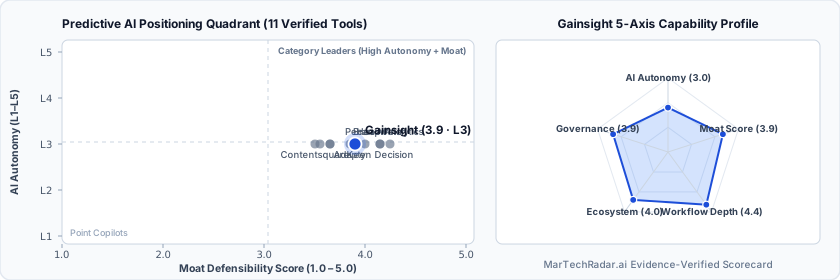
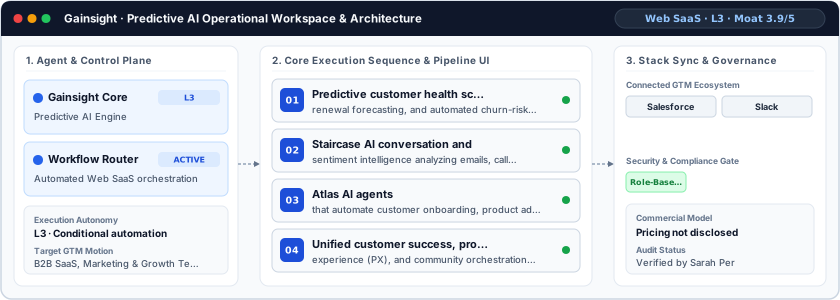
Gainsight is a Web SaaS tool for Predictive AI (Predictive LTV, Churn & Customer Analytics) in Analytics & Attribution. Pricing: Pricing not disclosed. Best suited to B2B SaaS and Marketing & Growth Teams. Editor ratings: AI autonomy L3 (conditional automation); moat score 3.9/5.0 (Proprietary moat). Fact-checked by Sarah Per on Oct 17, 2026.
Enterprise customer success, predictive churn analytics, and post-sale revenue orchestration platform powered by AI agents.
Gainsight buyer fit verdict: when to choose vs. when to walk away
Choose Gainsight if (Best Fit)
- Target ICP & Stack Fit: You operate as B2B SaaS and Marketing & Growth Teams requiring a Web SaaS deployment for Predictive AI, with verified ecosystem connectivity for Salesforce, Slack.
- L3 Architecture & Defensibility: Gainsight commands an enterprise category moat by combining deep post-sale health telemetry, Staircase AI sentiment and churn prediction, and Atlas AI autonomous customer-retention agents.
- Commercial Model Fit: Your procurement budget aligns with Pricing not disclosed.
Walk away from Gainsight if (Deal-Breakers)
- Walk away if you require transparent self-serve monthly billing or your budget ceiling is under $1,000/mo (Gainsight requires sales-gated custom quoting).
- Walk away if your workflow cannot tolerate heavyweight enterprise implementation bottleneck: Deploying Gainsight across fragmented CRM, ERP, product telemetry, and ticketing schemas typically requires dedicated Gainsight administrators and multi-month onboarding, creating a steep complexity barrier for lean startups.
- Walk away if enterprise contract & add-on cost structure is a deal-breaker for your team: Because modules such as Customer Success, Product Experience (PX), and Staircase AI are packaged under multi-year enterprise contracts, total cost of ownership can be prohibitive for early-stage SMBs.
Gainsight key facts & scorecard
| Pricing | Pricing not disclosed |
|---|---|
| Free plan | No / not disclosed |
| Delivery | Web SaaS |
| Audience | B2B SaaS, Marketing & Growth Teams |
| AI autonomy level | L3 · Conditional automationEditor-verified |
| Moat tier & score | 3.9 / 5.0 · Proprietary moatEditor-verified |
| Funding | AcquiredAcquired by Vista Equity Partners |
| Total funding | $156.3M |
| Founders | Jim Eberlin, Mickey Alon |
| Company size | 1,001-5,000 employees |
| Ecosystem integrations | Salesforce, Slack |
| Governance & docs | Trust & Security ↗ · Privacy ↗ |
| Headquarters | San Francisco, California |
| Founded | 2009 |
| Last verified |
Gainsight pros & cons: strengths vs. operational limitations
Pros: core strengths & capabilities
- Predictive customer health scoring,: renewal forecasting, and automated churn-risk playbooks for B2B enterprises
- Staircase AI conversation and: sentiment intelligence analyzing emails, calls, tickets, and Slack channels
- Atlas AI agents: that automate customer onboarding, product adoption nudges, and executive business reviews
- Unified customer success, product: experience (PX), and community orchestration with bidirectional CRM sync
Cons: operational limitations & risks
- Heavyweight Enterprise Implementation Bottleneck: Deploying Gainsight across fragmented CRM, ERP, product telemetry, and ticketing schemas typically requires dedicated Gainsight administrators and multi-month onboarding, creating a steep complexity barrier for lean startups.
- Enterprise Contract & Add-On Cost Structure: Because modules such as Customer Success, Product Experience (PX), and Staircase AI are packaged under multi-year enterprise contracts, total cost of ownership can be prohibitive for early-stage SMBs.
- Rule & Playbook Maintenance Overhead: Without disciplined rev-ops governance, complex health-score weightings and automated CTA rules can generate alert fatigue for frontline customer success managers.
Gainsight TCO & deal-breaker stress test
Simulate 12-month stepped TCO, hidden cost multipliers, contract lock-in exposure, and stack failure modes using only facts verified by Sarah Per on · Capture SHA d961ff9f.
Gainsight triggers high-severity friction under your 5-seat / $800/mo constraints. Benchmark the verified subtrack alternatives below before committing.
| Plan / Tier | Verified Rate | Scale Fit | Scope & Quota Notes |
|---|---|---|---|
| Enterprise / Custom | Custom quote | Unlimited seats (Enterprise SLA) | Sales-negotiated annual contract for custom volume, SSO/RBAC governance, and dedicated SLA. |
- Moat Score
- 3.9 / 5.0
- AI Autonomy
- L3
- Free Tier / Trial
- None disclosed
Triggered audit signals & failure modes
- Opaque Enterprise Quoting vs. SMB/Mid-Market BudgetVerified Pricing Ledger
Gainsight does not disclose a public self-serve floor (Pricing not disclosed). Buyers with a $800/mo cap face high sales-qualification friction.
- Annual Contract Lock-in Risk DetectedFact-checked by Sarah Per
Pricing is available on request through custom enterprise quotes structured around active user seats, managed ARR bands, and selected platform modules (Customer Success, Product Experience, Customer Communities, and Staircase AI).
- Primary Operational Bottleneck: Enterprise Contract & Add-On Cost StructureAudit by Sarah Per
Because modules such as Customer Success, Product Experience (PX), and Staircase AI are packaged under multi-year enterprise contracts, total cost of ownership can be prohibitive for early-stage SMBs.
Hidden TCO Multipliers & Quota Gates
- Per-Seat Linear Scaling: Gainsight prices licenses on a per-user/seat basis (Pricing not disclosed); expanding from 2 to 15+ operators multiplies base recurring spend linearly.
- Enterprise Governance & Add-On Gating: Advanced capabilities such as Single Sign-On (SSO), custom role permissions, or specialized analytics modules are gated behind upper tiers or paid add-ons.
When to Walk Away & Negotiation Levers
- Walk away if you require transparent self-serve monthly billing or your budget ceiling is under $1,000/mo (Gainsight requires sales-gated custom quoting).
- Walk away if your workflow cannot tolerate heavyweight enterprise implementation bottleneck: Deploying Gainsight across fragmented CRM, ERP, product telemetry, and ticketing schemas typically requires dedicated Gainsight administrators and multi-month onboarding, creating a steep complexity barrier for lean startups.
- Walk away if enterprise contract & add-on cost structure is a deal-breaker for your team: Because modules such as Customer Success, Product Experience (PX), and Staircase AI are packaged under multi-year enterprise contracts, total cost of ownership can be prohibitive for early-stage SMBs.
- Demand a 30- to 60-day paid pilot opt-out clause in the Gainsight order form before signing a 12-month enterprise commitment.
- Require a sandbox proof-of-concept testing heavyweight enterprise implementation bottleneck against your live CRM/data schema before annual sign-off.
Ask a custom procurement or TCO stress-test question about Gainsight
Offers a free tier (Free plan · $0/mo · Enterprise plan) · Transparent self-serve entry without mandatory annual lock-in
Verified Predictive AI peer (Pricing not disclosed · Moat 3.8/5.0)
Gainsight key entities, modules & ecosystem stack
Gainsight moat & subtrack positioning
Gainsight commands an enterprise category moat by combining deep post-sale health telemetry, Staircase AI sentiment and churn prediction, and Atlas AI autonomous customer-retention agents.
Editorial review
Fact-checked by Sarah Per (Principal Content Systems & Generative Media Editor) on .
Background
Founded in 2009 by Jim Eberlin and Mickey Alon and headquartered in San Francisco, California, Gainsight (gainsight.com) is an enterprise customer success, product experience, and predictive post-sale revenue analytics platform built for B2B SaaS and recurring-revenue organizations. Operating with a global workforce of 1,001 to 5,000 employees after raising $156.3M in Series E funding from Lightspeed Venture Partners, Insight Partners, Bessemer Venture Partners, Bain Capital Ventures, and Salesforce Ventures prior to its majority acquisition by Vista Equity Partners, the company serves as the system of record for net revenue retention (NRR), churn prevention, and expansion orchestration.
How Gainsight works
Gainsight operates at Level 3 autonomy through a multi-signal customer health engine, Staircase AI unstructured communication analyzer, and Atlas AI autonomous retention agents. The platform ingests product usage telemetry, support tickets, billing records, CRM opportunities, and every customer email, meeting transcript, and Slack message. Staircase AI continuously evaluates stakeholder sentiment and champion departures to surface early churn warnings months before renewal, while Atlas AI agents automate onboarding check-ins, draft executive business review (EBR) decks, and trigger human CSM intervention playbooks when expansion or risk thresholds are crossed.
Limitations
Operational limitations and technical trade-offs include:
- Heavyweight Enterprise Implementation Bottleneck: Deploying Gainsight across fragmented CRM, ERP, product telemetry, and ticketing schemas typically requires dedicated Gainsight administrators and multi-month onboarding, creating a steep complexity barrier for lean startups.
- Enterprise Contract & Add-On Cost Structure: Because modules such as Customer Success, Product Experience (PX), and Staircase AI are packaged under multi-year enterprise contracts, total cost of ownership can be prohibitive for early-stage SMBs.
- Rule & Playbook Maintenance Overhead: Without disciplined rev-ops governance, complex health-score weightings and automated CTA rules can generate alert fatigue for frontline customer success managers.
Gainsight pricing
Pricing is available on request through custom enterprise quotes structured around active user seats, managed ARR bands, and selected platform modules (Customer Success, Product Experience, Customer Communities, and Staircase AI). Enterprise revenue and post-sale leaders can request a tailored commercial proposal via the Gainsight website.
How Gainsight compares
Within the Predictive LTV, Churn & Customer Analytics and Post-Sale Revenue category, Gainsight competes against customer success and retention alternatives such as Vitally, Totango, and ChurnZero. Versus mid-market workspace tools like Vitally that prioritize rapid self-serve setup, Gainsight differentiates itself through enterprise-scale portfolio governance, Staircase AI cross-channel sentiment intelligence, and integrated product-adoption and community clouds. Large B2B software enterprises choose Gainsight to protect net dollar retention at scale.
Frequently asked questions about Gainsight
How much does Gainsight cost and does it require a custom enterprise quote?
Published pricing summary for Gainsight: Pricing not disclosed. A permanent free plan is not disclosed for Gainsight. Pricing is available on request through custom enterprise quotes structured around active user seats, managed ARR bands, and selected platform modules (Customer Success, Product Experience, Customer Communities, and Staircase AI).
How does Gainsight work and how autonomous is its AI architecture?
Enterprise customer success, predictive churn analytics, and post-sale revenue orchestration platform powered by AI agents. Within Predictive AI (Predictive LTV, Churn & Customer Analytics), MarTechRadar rates its execution architecture at L3 · Conditional automation with a verified Moat Score of 3.9 / 5.0 (Proprietary moat). Gainsight commands an enterprise category moat by combining deep post-sale health telemetry, Staircase AI sentiment and churn prediction, and Atlas AI autonomous customer-retention agents. Corporate profile: Founded by Jim Eberlin, Mickey Alon, operating at 1,001-5,000 employees scale, acquired by Vista Equity Partners.
What are the main limitations of Gainsight and when should buyers walk away?
Based on our editorial technical audit, key operational considerations and boundaries for Gainsight include: (1) Heavyweight Enterprise Implementation Bottleneck: Deploying Gainsight across fragmented CRM, ERP, product telemetry, and ticketing schemas typically requires dedicated Gainsight administrators and multi-month onboarding, creating a steep complexity barrier for lean startups. (2) Enterprise Contract & Add-On Cost Structure: Because modules such as Customer Success, Product Experience (PX), and Staircase AI are packaged under multi-year enterprise contracts, total cost of ownership can be prohibitive for early-stage SMBs. (3) Rule & Playbook Maintenance Overhead: Without disciplined rev-ops governance, complex health-score weightings and automated CTA rules can generate alert fatigue for frontline customer success managers. Primary procurement walk-away rule: Walk away if you require transparent self-serve monthly billing or your budget ceiling is under $1,000/mo (Gainsight requires sales-gated custom quoting).
What integrations, compliance certifications, and contract terms apply to Gainsight?
Verified ecosystem and stack integrations include Salesforce, Slack. First-party governance and developer endpoints verified on domain include: Trust/Security (https://www.gainsight.com/security). Key TCO multiplier to watch: Per-Seat Linear Scaling (Gainsight prices licenses on a per-user/seat basis (Pricing not disclosed); expanding from 2 to 15+ operators multiplies base recurring spend linearly.) Before signing a contract, procurement teams should demand a 30- to 60-day paid pilot opt-out clause in the Gainsight order form before signing a 12-month enterprise commitment.
What are the best Gainsight alternatives and head-to-head competitors in 2026?
Top fact-checked alternatives to Gainsight in Predictive AI (Predictive LTV, Churn & Customer Analytics) include Vitally (Pricing not disclosed), Faraday (Pricing not disclosed), Outlit (Pricing not disclosed), Sapien (Pricing not disclosed). Within the Predictive LTV, Churn & Customer Analytics and Post-Sale Revenue category, Gainsight competes against customer success and retention alternatives such as Vitally, Totango, and ChurnZero.
Verified sources & evidence trail
- Official product domain: https://gainsight.com
- Commercial pricing verification: Verified against official vendor pricing policy (Pricing not disclosed)
- Verified corporate entity profiles (
sameAs): LinkedIn Company Profile · Crunchbase Entity Record - First-party governance & documentation links: Trust & Security · Privacy
- Editorial audit sign-off: Fact-checked by Sarah Per on under the MarTechRadar Evidence-Ledger Protocol.