Heap Analytics Review (2026): Predictive AI Pricing, Pros & Cons
Bottom line
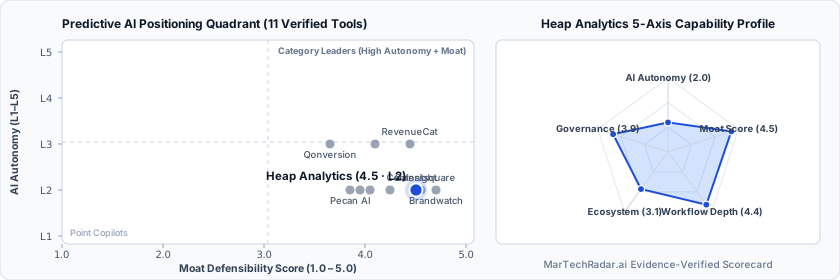
Heap Analytics is a Web SaaS tool for Predictive AI (Predictive LTV, Churn & Customer Analytics) in Analytics & Attribution. Pricing: Custom / enterprise pricing. Best suited to B2B SaaS, DTC / eCommerce and Enterprise Brands. Editor ratings: AI autonomy L2 (workflow copilot); moat score 4.5/5.0 (Proprietary moat (category leader)). Fact-checked by MarTechRadar Research Desk on Oct 11, 2026.
Enterprise behavioral intelligence and digital experience analytics platform that retroactively maps customer journeys via autocaptured interaction data.
Is Heap Analytics worth it in 2026? Buyer fit & when to walk away
Choose Heap Analytics if (Best Fit)
- Target ICP & Stack Fit: You operate as B2B SaaS, DTC / eCommerce and Enterprise Brands requiring a Web SaaS deployment for Predictive AI.
- L2 Architecture & Defensibility: Heap holds technical differentiation through its foundational autocapture architecture and retroactive event modeling, allowing teams to query untagged historical interactions without pre-configuring instrumentation tags.
- Commercial Model Fit: Your procurement budget aligns with Custom / enterprise pricing.
Walk away from Heap Analytics if (Deal-Breakers)
- Walk away if you need published self-serve pricing: Heap Analytics is sold by custom quote.
- Walk away if your workflow cannot tolerate dom volatility maintenance: Dynamic single-page application redesigns or CSS selector refactoring can silently sever retroactively mapped virtual events, necessitating ongoing schema governance to prevent analytical drift.
- Walk away if client-side SDK overhead is a deal-breaker for your team: Extensive DOM listener bindings and interaction interceptors add script payload weight and run-time overhead on resource-constrained mobile web browsers.
Heap Analytics pricing, free plan & scorecard at a glance
| Pricing | Custom / enterprise pricing |
|---|---|
| Free plan | No / not disclosed |
| Delivery | Web SaaS |
| Audience | B2B SaaS, DTC / eCommerce, Enterprise Brands |
| AI autonomy level | L2 · Workflow copilotEditor-verified |
| Moat tier & score | 4.5 / 5.0 · Proprietary moat (category leader)Editor-verified |
| Funding | AcquiredAcquired by Contentsquare |
| Total funding | $218.1MBacked by Menlo Ventures, Pear VC, SV Angel |
| Founders | Matin Movassate, Ravi Parikh |
| Company size | 201-500 employees |
| Governance & docs | Trust & Security ↗ · System Status ↗ · API & Docs ↗ · Privacy ↗ |
| Headquarters | San Francisco, California |
| Founded | 2013 |
| Last verified | Oct 11, 2026 |
Heap Analytics pros & cons: strengths vs. operational limitations
Pros: core strengths & capabilities
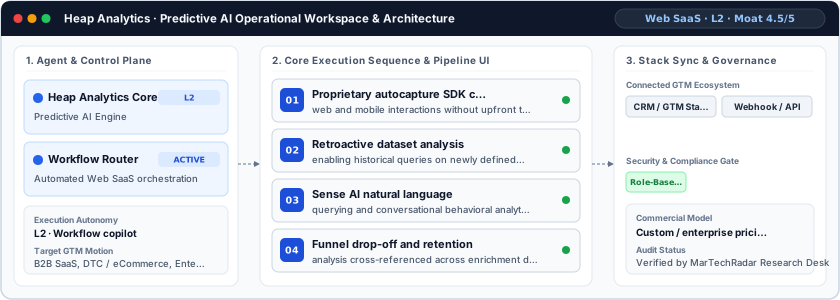
- Proprietary autocapture SDK capturing: web and mobile interactions without upfront tag management
- Retroactive dataset analysis: enabling historical queries on newly defined user interactions
- Sense AI natural language: querying and conversational behavioral analytics assistant
- Funnel drop-off and retention: analysis cross-referenced across enrichment data sources
Cons: operational limitations & risks
- DOM Volatility Maintenance: Dynamic single-page application redesigns or CSS selector refactoring can silently sever retroactively mapped virtual events, necessitating ongoing schema governance to prevent analytical drift.
- Client-Side SDK Overhead: Extensive DOM listener bindings and interaction interceptors add script payload weight and run-time overhead on resource-constrained mobile web browsers.
- Identity Resolution Latency: Stitching anonymous autocaptured interaction sessions to verified cross-device enterprise user profiles introduces synchronization lags during high-throughput ingestion windows.
Heap Analytics TCO & deal-breaker stress test
Simulate 12-month stepped TCO, hidden cost multipliers, contract lock-in exposure, and stack failure modes using only facts verified by MarTechRadar Research Desk on 2026-10-11.
Heap Analytics triggers high-severity friction under your 5-seat / $800/mo constraints. Benchmark the verified subtrack alternatives below before committing.
- Moat Score
- 4.5 / 5.0
- AI Autonomy
- L2
- Free Tier / Trial
- None disclosed
Triggered audit signals & failure modes
- Opaque Enterprise Quoting vs. SMB/Mid-Market BudgetVerified Pricing Ledger
Heap Analytics does not disclose a public self-serve floor (Custom / enterprise pricing). Buyers with a $800/mo cap face high sales-qualification friction.
- Sales-Gated Contract TermsFact-checked by MarTechRadar Research Desk
Heap structures monetization through tiered session-based subscriptions encompassing starter tiers up to custom enterprise deployments. Platform access scales along trackable monthly session volume, analytical data retention duration, and governance features.
- Primary Operational Bottleneck: DOM Volatility MaintenanceAudit by MarTechRadar Research Desk
Dynamic single-page application redesigns or CSS selector refactoring can silently sever retroactively mapped virtual events, necessitating ongoing schema governance to prevent analytical drift.
Test a custom Heap Analytics budget or stack constraint
Transparent self-serve entry without mandatory annual lock-in
Offers a free tier (Free plan · $2,500 · Enterprise plan) · Transparent self-serve entry without mandatory annual lock-in
Heap Analytics AI moat & Predictive AI positioning
Heap holds technical differentiation through its foundational autocapture architecture and retroactive event modeling, allowing teams to query untagged historical interactions without pre-configuring instrumentation tags.
Heap Analytics in-depth review, pricing & architecture analysis
Editor sign-off: Oct 11, 2026. How profiles are made.
What is Heap Analytics? Overview & background
Eliminating engineering-heavy event instrumentation has historically defined digital product analytics. Headquartered in San Francisco, California, Heap Analytics was established in 2013 to resolve client-side tracking gaps through continuous event capture. Backed by $218.1M in venture capital before its alignment with Contentsquare, the company engineered a behavioral data architecture directed at product managers, growth leads, and data engineering teams. Rather than forcing organizations to rely on pre-planned event taxonomies, the platform ingests raw interaction streams across web and mobile surfaces to provide retroactive customer journey intelligence.
How Heap Analytics works: architecture & workflow
The platform operates an L3 autonomous telemetry pipeline powered by proprietary autocapture SDKs. Upon installation, the client script intercepts and ingests DOM mutations, clicks, gesture events, form changes, and page routing into an unaggregated event log without requiring manual telemetry tagging. Data flows into a columnar ingestion cluster where raw interactions are stored intact. Analysts retroactively map business logic using a visual virtual layer, defining events that immediately populate across historical data. Integrated Sense AI models then run automated cohort clustering, funnel anomaly detection, and natural language query generation across those historical behavioral paths.
Heap Analytics limitations, drawbacks & risks
Operational considerations and platform boundaries include:
- DOM Volatility Maintenance: Dynamic single-page application redesigns or CSS selector refactoring can silently sever retroactively mapped virtual events, necessitating ongoing schema governance to prevent analytical drift.
- Client-Side SDK Overhead: Extensive DOM listener bindings and interaction interceptors add script payload weight and run-time overhead on resource-constrained mobile web browsers.
- Identity Resolution Latency: Stitching anonymous autocaptured interaction sessions to verified cross-device enterprise user profiles introduces synchronization lags during high-throughput ingestion windows.
Heap Analytics pricing, plans & cost breakdown
Heap structures monetization through tiered session-based subscriptions encompassing starter tiers up to custom enterprise deployments. Platform access scales along trackable monthly session volume, analytical data retention duration, and governance features. Enterprise licensing requires commercial agreements negotiated directly with enterprise sales, delivering custom quotes based on organizational seat counts, data ingestion scale, dedicated infrastructure, and advanced single sign-on security provisions.
| Plan / Tier | Verified Price & Billing | Target Seat / Scale Fit | Included Scope & Contract Terms |
|---|---|---|---|
| Enterprise / Custom | Custom quote | Unlimited seats | Custom-quoted plan; terms come from the vendor's sales team. |
How Heap Analytics compares vs. competitors & alternatives
Heap contends with Brandwatch, Contentsquare, and Pecan AI within the analytics ecosystem. While Brandwatch emphasizes unstructured social sentiment and Pecan AI focuses on automated tabular machine learning for predictive LTV, Heap specializes in deterministic digital interaction streams. Though Contentsquare traditionally targeted visual digital experience analytics via session replays and heatmaps, Heap delivers deeper retroactive relational querying. It is best suited for cross-functional product organizations requiring granular behavioral analysis without maintaining manual instrumentation pipelines.
Frequently asked questions about Heap Analytics
Does Heap Analytics publish pricing or require an enterprise quote?
Heap Analytics pricing: Custom / enterprise pricing. No free plan is publicly disclosed. Heap structures monetization through tiered session-based subscriptions encompassing starter tiers up to custom enterprise deployments.
What are the top Heap Analytics alternatives in Predictive AI?
Verified Predictive AI alternatives include Contentsquare (€39–€79/mo), Brandwatch (Custom / enterprise pricing), Pecan AI (Custom / enterprise pricing), Keen Decision Systems (Custom / enterprise pricing). Heap contends with Brandwatch, Contentsquare, and Pecan AI within the analytics ecosystem.
What are the main limitations and trade-offs of Heap Analytics?
Operational considerations and platform boundaries include: DOM Volatility Maintenance: Dynamic single-page application redesigns or CSS selector refactoring can silently sever retroactively mapped virtual events, necessitating ongoing schema governance to prevent analytical drift. Walk away if you need published self-serve pricing: Heap Analytics is sold by custom quote.
Verified sources & evidence trail
- Official product domain: https://heap.io
- Commercial pricing verification: Verified against official vendor pricing policy (Custom / enterprise pricing)
- Verified corporate entity profiles (
sameAs): LinkedIn Company Profile · Crunchbase Entity Record - First-party governance & documentation links: Trust & Security · System Status · API & Docs · Privacy
- Editor sign-off: Oct 11, 2026 (how profiles are made).
