Brandwatch Review (2026): Predictive AI Pricing, Pros & Cons
Bottom line
Brandwatch is a Web SaaS tool for Predictive AI (Predictive LTV, Churn & Customer Analytics) in Analytics & Attribution. Pricing: Custom / enterprise pricing. Best suited to Enterprise Brands. Editor ratings: AI autonomy L2 (workflow copilot); moat score 4.7/5.0 (Proprietary moat (category leader)). Fact-checked by MarTechRadar Research Desk on Oct 12, 2026.
Enterprise consumer intelligence and social listening platform analyzing global digital conversations to extract customer sentiment and brand perception.
Is Brandwatch worth it in 2026? Buyer fit & when to walk away
Choose Brandwatch if (Best Fit)
- Target ICP & Stack Fit: You operate as Enterprise Brands requiring a Web SaaS deployment for Predictive AI.
- L2 Architecture & Defensibility: Proprietary crawl index covering more than 1.4 trillion historical web conversations, coupled with deep social network firehose access and the Iris AI NLP analytics engine.
- Commercial Model Fit: Your procurement budget aligns with Custom / enterprise pricing.
Walk away from Brandwatch if (Deal-Breakers)
- Walk away if you need published self-serve pricing: Brandwatch is sold by custom quote.
- Walk away if your workflow cannot tolerate walled-garden API limits: Social privacy rules block access to private groups, closed chat apps, and locked personal profiles.
- Walk away if ambiguous brand name noise is a deal-breaker for your team: Brands with common everyday words as names need careful Boolean filter rules so Iris AI does not pull unrelated chatter.
Brandwatch pricing, free plan & scorecard at a glance
| Pricing | Custom / enterprise pricing |
|---|---|
| Free plan | No / not disclosed |
| Delivery | Web SaaS |
| Audience | Enterprise Brands |
| AI autonomy level | L2 · Workflow copilotEditor-verified |
| Moat tier & score | 4.7 / 5.0 · Proprietary moat (category leader)Editor-verified |
| Funding | AcquiredAcquired by Cision |
| Total funding | $64.7MBacked by Highland Europe |
| Founders | Giles Palmer, Ulrik Bo Larsen |
| Company size | 501-1,000 employees |
| Governance & docs | System Status ↗ · Changelog ↗ |
| Headquarters | London, United Kingdom |
| Founded | 2007 |
| Last verified | Oct 12, 2026 |
Brandwatch pros & cons: strengths vs. operational limitations
Pros: core strengths & capabilities
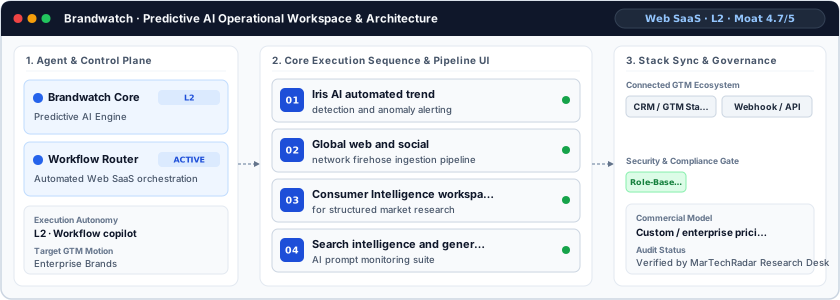
- Iris AI automated trend: detection and anomaly alerting
- Global web and social: network firehose ingestion pipeline
- Consumer Intelligence workspace: for structured market research
- Search intelligence and generative: AI prompt monitoring suite
Cons: operational limitations & risks
- Walled-Garden API Limits: Social privacy rules block access to private groups, closed chat apps, and locked personal profiles.
- Ambiguous Brand Name Noise: Brands with common everyday words as names need careful Boolean filter rules so Iris AI does not pull unrelated chatter.
- Monthly Mention Quota Caps: Sudden viral spikes or overly broad search queries can burn through yearly mention caps early.
Brandwatch TCO & deal-breaker stress test
Simulate 12-month stepped TCO, hidden cost multipliers, contract lock-in exposure, and stack failure modes using only facts verified by MarTechRadar Research Desk on 2026-10-12.
Brandwatch triggers high-severity friction under your 5-seat / $800/mo constraints. Benchmark the verified subtrack alternatives below before committing.
- Moat Score
- 4.7 / 5.0
- AI Autonomy
- L2
- Free Tier / Trial
- None disclosed
Triggered audit signals & failure modes
- Opaque Enterprise Quoting vs. SMB/Mid-Market BudgetVerified Pricing Ledger
Brandwatch does not disclose a public self-serve floor (Custom / enterprise pricing). Buyers with a $800/mo cap face high sales-qualification friction.
- Sales-Gated Contract TermsFact-checked by MarTechRadar Research Desk
Brandwatch sells custom yearly enterprise contracts without public self-serve pricing tiers. Deals scale by yearly mention caps, user seats across its Consumer Intelligence, Social Media Management, and Influencer modules, historical archive depth, and Iris AI add-ons.
- Primary Operational Bottleneck: Walled-Garden API LimitsAudit by MarTechRadar Research Desk
Social privacy rules block access to private groups, closed chat apps, and locked personal profiles.
Test a custom Brandwatch budget or stack constraint
Lower 5-seat floor (~$499/mo vs. Custom Quote) · Transparent self-serve entry without mandatory annual lock-in
Transparent self-serve entry without mandatory annual lock-in
Brandwatch AI moat & Predictive AI positioning
Proprietary crawl index covering more than 1.4 trillion historical web conversations, coupled with deep social network firehose access and the Iris AI NLP analytics engine.
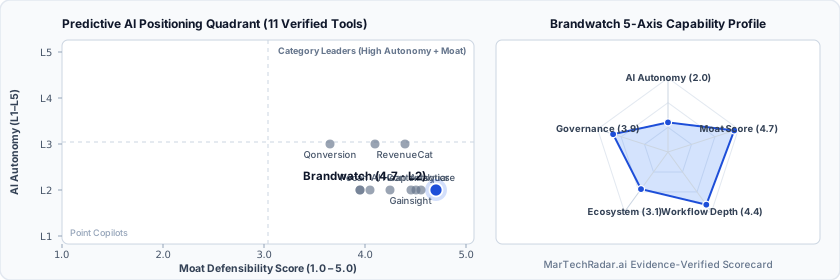
Brandwatch in-depth review, pricing & architecture analysis
Editor sign-off: Oct 12, 2026. How profiles are made.
What is Brandwatch? Overview & background
Founded in 2007 in Brighton and London, United Kingdom, Brandwatch (brandwatch.com) raised $64.7M in funding from investors like Highland Europe before its sale to PR group Cision. Built for market researchers, brand leads, and consumer insights teams, the platform studies public online chatter across the web. It tracks brand health, crisis risks, product feedback, and buyer trends across digital channels so large teams can make faster decisions.
How Brandwatch works: architecture & workflow
At Level 2 autonomy, Brandwatch runs high-speed data pipelines across an archive of over 1.4 trillion past posts from social networks, news sites, forums, blogs, and review sites. Incoming posts pass through Brandwatch's Iris AI engine. Iris AI handles multi-language sentiment scoring, image logo checks, emotion tags, and topic grouping. It flags unusual chat spikes and PR risks on its own, while human analysts build custom Boolean queries and filters to study specific buyer groups and campaign reach.
Brandwatch limitations, drawbacks & risks
Key platform limits and trade-offs include:
- Walled-Garden API Limits: Social privacy rules block access to private groups, closed chat apps, and locked personal profiles.
- Ambiguous Brand Name Noise: Brands with common everyday words as names need careful Boolean filter rules so Iris AI does not pull unrelated chatter.
- Monthly Mention Quota Caps: Sudden viral spikes or overly broad search queries can burn through yearly mention caps early.
Brandwatch pricing, plans & cost breakdown
Brandwatch sells custom yearly enterprise contracts without public self-serve pricing tiers. Deals scale by yearly mention caps, user seats across its Consumer Intelligence, Social Media Management, and Influencer modules, historical archive depth, and Iris AI add-ons.
| Plan / Tier | Verified Price & Billing | Included Scope & Contract Terms |
|---|---|---|
| Enterprise / Custom | Custom quote | Custom-quoted plan; terms come from the vendor's sales team. |
How Brandwatch compares vs. competitors & alternatives
In the social listening and consumer insights market, Brandwatch competes with Meltwater, Sprinklr, Talkwalker (Hootsuite), YouScan, and Sprout Social. Sprout Social focuses mainly on daily social posting and inbox replies. By contrast, Brandwatch stands out for its huge historical archive, flexible Boolean research desk, and Iris AI trend reports for global brands and agencies.
Direct competitors & market radar
Top algorithmic competitors based on category positioning, capability overlap, and ICP alignment.
Frequently asked questions about Brandwatch
Does Brandwatch publish pricing or require an enterprise quote?
Brandwatch pricing: Custom / enterprise pricing. No free plan is publicly disclosed. Brandwatch sells custom yearly enterprise contracts without public self-serve pricing tiers.
What are the top Brandwatch alternatives in Predictive AI?
Verified Predictive AI alternatives include YouScan (From $499/mo · Enterprise plan), BlueOceanAI (Custom / enterprise pricing), Contentsquare (€39–€79/mo), Pecan AI (Custom / enterprise pricing). In the social listening and consumer insights market, Brandwatch competes with Meltwater, Sprinklr, Talkwalker (Hootsuite), YouScan, and Sprout Social. Sprout Social focuses mainly on daily social posting and inbox replies.
What are the main limitations and trade-offs of Brandwatch?
Key platform limits and trade-offs include: Walled-Garden API Limits: Social privacy rules block access to private groups, closed chat apps, and locked personal profiles. Walk away if you need published self-serve pricing: Brandwatch is sold by custom quote.
Verified sources & evidence trail
- Official product domain: https://brandwatch.com
- Commercial pricing verification: Verified against official vendor pricing policy (Custom / enterprise pricing)
- Verified corporate entity profiles (
sameAs): LinkedIn Company Profile · Crunchbase Entity Record - First-party governance & documentation links: System Status · Changelog
- Editor sign-off: Oct 12, 2026 (how profiles are made).
