BlueOceanAI Review (2026): PR Pricing, Limits & Alternatives
Bottom line
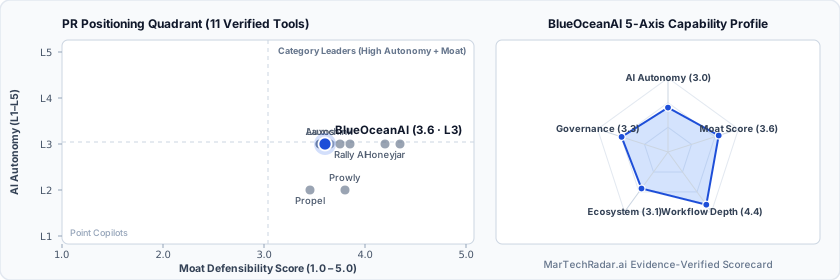
BlueOceanAI is a Web SaaS tool for PR (PR Intelligence & Media Relations) in Social & Influencer. Pricing: Custom / enterprise pricing. Best suited to Social Media Managers, Creator & Influencer Agencies and Brand Community Ops. Editor ratings: AI autonomy L3 (conditional automation); moat score 3.6/5.0 (Proprietary moat). Fact-checked by Tim Fenolz on Oct 14, 2026.
Contextual AI intelligence platform synthesizing brand, competitor, and market data into automated marketing workflows and analytical prompts.
BlueOceanAI buyer fit verdict: when to choose vs. when to walk away
Choose BlueOceanAI if (Best Fit)
- Target ICP & Stack Fit: You operate as Social Media Managers, Creator & Influencer Agencies and Brand Community Ops requiring a Web SaaS deployment for PR, with verified ecosystem connectivity for Outreach.
- L3 Architecture & Defensibility: Consolidates proprietary contextual brand embeddings and structured market intelligence with an extensible prompt template engine for enterprise marketing teams.
- Commercial Model Fit: Your procurement budget aligns with Custom / enterprise pricing.
Walk away from BlueOceanAI if (Deal-Breakers)
- Walk away if you require transparent self-serve monthly billing or your budget ceiling is under $1,000/mo (BlueOceanAI requires sales-gated custom quoting).
- Walk away if your workflow cannot tolerate context drift: Uncalibrated custom prompt templates degrade in utility when underlying taxonomy or competitive groupings alter without prompt maintenance.
- Walk away if data ingestion latency is a deal-breaker for your team: Aggregating asynchronous external competitor signals introduces periodic reporting lag compared to direct real-time news wire listeners.
BlueOceanAI key facts & scorecard
| Pricing | Custom / enterprise pricing |
|---|---|
| Free plan | No / not disclosed |
| Delivery | Web SaaS |
| Audience | Social Media Managers, Creator & Influencer Agencies, Brand Community Ops |
| AI autonomy level | L3 · Conditional automationEditor-verified |
| Moat tier & score | 3.6 / 5.0 · Proprietary moatEditor-verified |
| Funding | Series B |
| Ecosystem integrations | Outreach |
| Governance & docs | Terms ↗ · Privacy ↗ |
| Headquarters | United States |
| Founded | 2019 |
| Last verified |
BlueOceanAI pros & cons: strengths vs. operational limitations
Pros: core strengths & capabilities
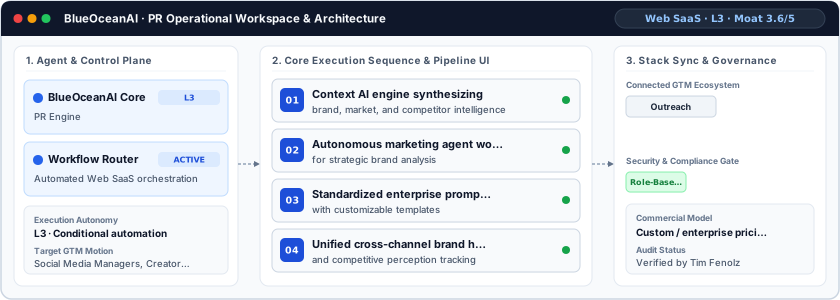
- Context AI engine synthesizing: brand, market, and competitor intelligence
- Autonomous marketing agent workflows: for strategic brand analysis
- Standardized enterprise prompt library: with customizable templates
- Unified cross-channel brand health: and competitive perception tracking
Cons: operational limitations & risks
- Context Drift: Uncalibrated custom prompt templates degrade in utility when underlying taxonomy or competitive groupings alter without prompt maintenance.
- Data Ingestion Latency: Aggregating asynchronous external competitor signals introduces periodic reporting lag compared to direct real-time news wire listeners.
- Custom Model Calibration: Aligning baseline brand context requires significant upfront data onboarding and governance to suppress hallucinated comparative interpretations.
BlueOceanAI TCO & deal-breaker stress test
Simulate 12-month stepped TCO, hidden cost multipliers, contract lock-in exposure, and stack failure modes using only facts verified by Tim Fenolz on · Capture SHA 13f4d360.
BlueOceanAI triggers high-severity friction under your 5-seat / $800/mo constraints. Benchmark the verified subtrack alternatives below before committing.
| Plan / Tier | Verified Rate | Scale Fit | Scope & Quota Notes |
|---|---|---|---|
| Enterprise / Custom | Custom quote | 15–50+ seats (Enterprise SLA) | Sales-negotiated annual contract for custom volume, SSO/RBAC governance, and dedicated SLA. |
- Moat Score
- 3.6 / 5.0
- AI Autonomy
- L3
- Free Tier / Trial
- None disclosed
Triggered audit signals & failure modes
- Opaque Enterprise Quoting vs. SMB/Mid-Market BudgetVerified Pricing Ledger
BlueOceanAI does not disclose a public self-serve floor (Custom / enterprise pricing). Buyers with a $800/mo cap face high sales-qualification friction.
- Sales-Gated Contract TermsFact-checked by Tim Fenolz
Commercial access to BlueOceanAI operates under a tailored enterprise licensing model without published public rates.
- Primary Operational Bottleneck: Context DriftAudit by Tim Fenolz
Uncalibrated custom prompt templates degrade in utility when underlying taxonomy or competitive groupings alter without prompt maintenance.
Hidden TCO Multipliers & Quota Gates
- Context Drift: Uncalibrated custom prompt templates degrade in utility when underlying taxonomy or competitive groupings alter without prompt maintenance.
- Data Ingestion Latency: Aggregating asynchronous external competitor signals introduces periodic reporting lag compared to direct real-time news wire listeners.
When to Walk Away & Negotiation Levers
- Walk away if you require transparent self-serve monthly billing or your budget ceiling is under $1,000/mo (BlueOceanAI requires sales-gated custom quoting).
- Walk away if your workflow cannot tolerate context drift: Uncalibrated custom prompt templates degrade in utility when underlying taxonomy or competitive groupings alter without prompt maintenance.
- Walk away if data ingestion latency is a deal-breaker for your team: Aggregating asynchronous external competitor signals introduces periodic reporting lag compared to direct real-time news wire listeners.
- Demand a 30- to 60-day paid pilot opt-out clause in the BlueOceanAI order form before signing a 12-month enterprise commitment.
- Require a sandbox proof-of-concept testing context drift against your live CRM/data schema before annual sign-off.
Ask a custom procurement or TCO stress-test question about BlueOceanAI
Lower 5-seat floor (~$175/mo vs. Custom Quote) · Transparent self-serve entry without mandatory annual lock-in
Lower 5-seat floor (~$745/mo vs. Custom Quote) · Transparent self-serve entry without mandatory annual lock-in
BlueOceanAI key entities, modules & ecosystem stack
BlueOceanAI moat & subtrack positioning
Consolidates proprietary contextual brand embeddings and structured market intelligence with an extensible prompt template engine for enterprise marketing teams.
Editorial review
Fact-checked by Tim Fenolz (Lead AdTech, Programmatic & Attribution Analyst) on .
Background
Headquartered in the United States, BlueOceanAI serves enterprise marketing leaders, brand strategists, and corporate communications executives tasked with monitoring cross-market positioning. The platform applies contextual artificial intelligence to aggregate brand identity, competitive moves, and customer sentiment into unified decision frameworks. Rather than treating public relations intelligence as isolated coverage clipping, BlueOceanAI positions its system as a contextual synthesis layer that bridges external market signals with corporate strategy.
How BlueOceanAI works
BlueOceanAI operates through a Context AI architecture designed to correlate brand metrics against competitor footprints. The system continuously ingests market data, public domain brand discourse, and commercial content streams. Ingested data feeds an internal intelligence model that parses narrative shifts, positioning drift, and comparative mindshare. Operators interact with this context layer using autonomous marketing agent routines and a prompt library, enabling teams to build prompt templates that evaluate market shifts at Level 3 operational autonomy.
Limitations
Operational considerations and platform boundaries include:
- Context Drift: Uncalibrated custom prompt templates degrade in utility when underlying taxonomy or competitive groupings alter without prompt maintenance.
- Data Ingestion Latency: Aggregating asynchronous external competitor signals introduces periodic reporting lag compared to direct real-time news wire listeners.
- Custom Model Calibration: Aligning baseline brand context requires significant upfront data onboarding and governance to suppress hallucinated comparative interpretations.
BlueOceanAI pricing
Commercial access to BlueOceanAI operates under a tailored enterprise licensing model without published public rates. Pricing is available on request through enterprise sales consultations, with agreements structured according to organizational seat allocations, custom brand context scopes, and analytical volume requirements.
How BlueOceanAI compares
Within PR intelligence and media relations, BlueOceanAI differentiates by prioritizing macro brand context over traditional editorial tracking. While Muck Rack emphasizes verified journalist databases and media outreach, and Propel centers on PR pitch automation and CRM tracking, BlueOceanAI focuses on macro positioning analytics. Similarly, Honeyjar focuses on targeted media campaigns. BlueOceanAI best serves global brand enterprises requiring automated, context-grounded competitive intelligence over manual media contact lists.
Direct competitors & market radar
Top algorithmic competitors based on category positioning, capability overlap, and ICP alignment.
Frequently asked questions about BlueOceanAI
How much does BlueOceanAI cost and does it require a custom enterprise quote?
Published pricing summary for BlueOceanAI: Custom / enterprise pricing. A permanent free plan is not disclosed for BlueOceanAI. Commercial access to BlueOceanAI operates under a tailored enterprise licensing model without published public rates.
How does BlueOceanAI work and how autonomous is its AI architecture?
Contextual AI intelligence platform synthesizing brand, competitor, and market data into automated marketing workflows and analytical prompts. Within PR (PR Intelligence & Media Relations), MarTechRadar rates its execution architecture at L3 · Conditional automation with a verified Moat Score of 3.6 / 5.0 (Proprietary moat). Consolidates proprietary contextual brand embeddings and structured market intelligence with an extensible prompt template engine for enterprise marketing teams.
What are the main limitations of BlueOceanAI and when should buyers walk away?
Based on our editorial technical audit, key operational considerations and boundaries for BlueOceanAI include: (1) Context Drift: Uncalibrated custom prompt templates degrade in utility when underlying taxonomy or competitive groupings alter without prompt maintenance. (2) Data Ingestion Latency: Aggregating asynchronous external competitor signals introduces periodic reporting lag compared to direct real-time news wire listeners. (3) Custom Model Calibration: Aligning baseline brand context requires significant upfront data onboarding and governance to suppress hallucinated comparative interpretations. Primary procurement walk-away rule: Walk away if you require transparent self-serve monthly billing or your budget ceiling is under $1,000/mo (BlueOceanAI requires sales-gated custom quoting).
What integrations, compliance certifications, and contract terms apply to BlueOceanAI?
Verified ecosystem and stack integrations include Outreach. Key TCO multiplier to watch: Context Drift (Uncalibrated custom prompt templates degrade in utility when underlying taxonomy or competitive groupings alter without prompt maintenance.) Before signing a contract, procurement teams should demand a 30- to 60-day paid pilot opt-out clause in the BlueOceanAI order form before signing a 12-month enterprise commitment.
What are the best BlueOceanAI alternatives and head-to-head competitors in 2026?
Top fact-checked alternatives to BlueOceanAI in PR (PR Intelligence & Media Relations) include Brandwatch (Custom / enterprise pricing), Muck Rack (Custom / enterprise pricing), Auxos (Custom / enterprise pricing), Rally AI (Custom / enterprise pricing). Within PR intelligence and media relations, BlueOceanAI differentiates by prioritizing macro brand context over traditional editorial tracking.
Verified sources & evidence trail
- Official product domain: https://blueocean.ai
- Commercial pricing verification: Verified against official vendor pricing policy (Custom / enterprise pricing)
- First-party governance & documentation links: Terms · Privacy
- Editorial audit sign-off: Fact-checked by Tim Fenolz on under the MarTechRadar Evidence-Ledger Protocol.