RunPR Review (2026): PR Pricing, Limits & Alternatives
Bottom line
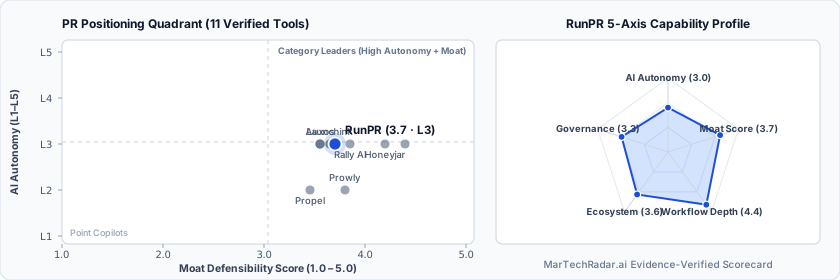
RunPR is a SaaS Platform tool for PR (PR Intelligence & Media Relations) in Social & Influencer. Pricing: $149/seat/mo. Best suited to B2B Marketing & GTM Teams. Editor ratings: AI autonomy L3 (conditional automation); moat score 3.7/5.0 (Proprietary moat). Fact-checked by Jiacky Lee on Oct 18, 2026.
Agency-focused AI PR operating system combining storyline monitoring, reporter matching, grounded pitch drafting, and multi-LLM AI visibility tracking.
RunPR buyer fit verdict: when to choose vs. when to walk away
Choose RunPR if (Best Fit)
- Target ICP & Stack Fit: You operate as B2B Marketing & GTM Teams requiring a SaaS Platform deployment for PR, with verified ecosystem connectivity for Outreach.
- L3 Architecture & Defensibility: RunPR differentiates its agency PR workflow moat by combining client-isolated storyline monitoring, grounded AI pitch drafting with rubric checks, pay-on-success contact unlocks, and multi-LLM AI Visibility tracking.
- Commercial Model Fit: Your procurement budget aligns with $149/seat/mo.
Walk away from RunPR if (Deal-Breakers)
- Walk away if your workflow requires uncapped enterprise volume on the $149/seat/mo entry plan without upgrading tiers.
- Walk away if your workflow cannot tolerate non-interchangeable unit allowance bottleneck: Contact additions, exports, verified-contact unlocks, AI pitch drafts, and email sends are metered as separate unit pools per tier rather than a single fungible credit balance, requiring active agencies to monitor individual quota buckets or purchase $399 pitch add-on packs during heavy launch months.
- Walk away if human-in-the-loop approval dependency is a deal-breaker for your team: By design, RunPR parks generated pitches in an approval dashboard rather than blasting autonomous cold emails, meaning PR account managers must still dedicate review bandwidth to validate angles and send timings.
RunPR key facts & scorecard
| Pricing | $149/seat/moVendor pricing page |
|---|---|
| Free plan | No / not disclosed |
| Delivery | SaaS Platform |
| Audience | B2B Marketing & GTM Teams |
| AI autonomy level | L3 · Conditional automationEditor-verified |
| Moat tier & score | 3.7 / 5.0 · Proprietary moatEditor-verified |
| Funding | Bootstrapped |
| Company size | 2-10 employees |
| Ecosystem integrations | Outreach |
| Governance & docs | API & Docs ↗ · Terms ↗ · Privacy ↗ |
| Headquarters | Miami, Florida, United States |
| Founded | 2024 |
| Last verified |
RunPR pros & cons: strengths vs. operational limitations
Pros: core strengths & capabilities
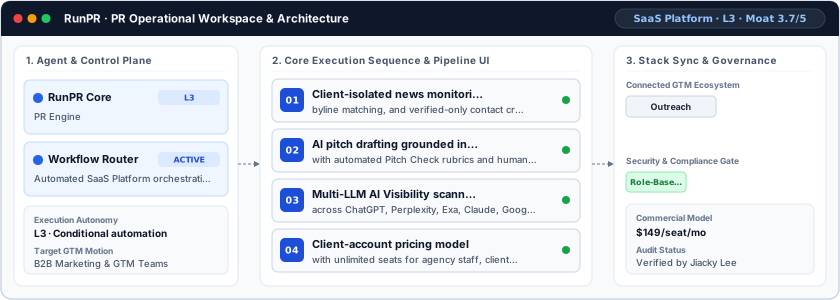
- Client-isolated news monitoring, reporter: byline matching, and verified-only contact credit unlocks
- AI pitch drafting grounded in client expertise: with automated Pitch Check rubrics and human approval queues
- Multi-LLM AI Visibility scanning: across ChatGPT, Perplexity, Exa, Claude, Google Gemini, and Grok
- Client-account pricing model: with unlimited seats for agency staff, clients, and external contractors
Cons: operational limitations & risks
- Non-Interchangeable Unit Allowance Bottleneck: Contact additions, exports, verified-contact unlocks, AI pitch drafts, and email sends are metered as separate unit pools per tier rather than a single fungible credit balance, requiring active agencies to monitor individual quota buckets or purchase $399 pitch add-on packs during heavy launch months.
- Human-in-the-Loop Approval Dependency: By design, RunPR parks generated pitches in an approval dashboard rather than blasting autonomous cold emails, meaning PR account managers must still dedicate review bandwidth to validate angles and send timings.
- Broadcast and Non-Digital Outlet Scope: Journalist matching relies primarily on indexed digital articles and online beat histories, offering less visibility into local television booking producers or print-only trade publications.
RunPR TCO & deal-breaker stress test
Simulate 12-month stepped TCO, hidden cost multipliers, contract lock-in exposure, and stack failure modes using only facts verified by Jiacky Lee on · Capture SHA fbc2e4fb.
RunPR is viable for 5 seats, but requires commercial or technical verification on the flagged items below.
| Plan / Tier | Verified Rate | Scale Fit | Scope & Quota Notes |
|---|---|---|---|
| Entry / Starter | $149/seat/mo | 1–2 seats | Muck Rack Custom quote Brand and agency plans. Pricing depends on your team, including the numb |
| Growth / Professional | $279/seat/mo | 5 seats | Semrush AI PR Toolkit · Business $499 / mo Pro plus competitor media tracking, story-angle sugg |
| Scale / Advanced | $399/seat/mo | 15 seats | PR SOFTWARE COMPARISON |
- Moat Score
- 3.7 / 5.0
- AI Autonomy
- L3
- Free Tier / Trial
- None disclosed
Triggered audit signals & failure modes
- Published Self-Serve Entry FloorVerified Pricing Ledger
RunPR publishes a transparent entry point ($149/seat/mo) for initial validation before committing.
- Linear Per-Seat Scaling (5 Seats × $149/seat/mo)Commercial Model Audit
Base license scales linearly with operator headcount ($745/mo for 5 seats on Entry / Starter).
- Primary Operational Bottleneck: Non-Interchangeable Unit Allowance BottleneckAudit by Jiacky Lee
Contact additions, exports, verified-contact unlocks, AI pitch drafts, and email sends are metered as separate unit pools per tier rather than a single fungible credit balance, requiring active agencies to monitor individual quota buckets or purchase $399 pitch add-on packs during heavy launch months.
Hidden TCO Multipliers & Quota Gates
- Per-Seat Linear Scaling: RunPR prices licenses on a per-user/seat basis ($149/seat/mo); expanding from 2 to 15+ operators multiplies base recurring spend linearly.
- Credit & Usage Burn Multiplier: Automated workflows consume metered credits/usage quotas; multi-step enrichment, voice minutes, or high-frequency agent runs can trigger mid-cycle top-up packs.
- Enterprise Governance & Add-On Gating: Advanced capabilities such as Single Sign-On (SSO), custom role permissions, or specialized analytics modules are gated behind upper tiers or paid add-ons.
When to Walk Away & Negotiation Levers
- Walk away if your workflow requires uncapped enterprise volume on the $149/seat/mo entry plan without upgrading tiers.
- Walk away if your workflow cannot tolerate non-interchangeable unit allowance bottleneck: Contact additions, exports, verified-contact unlocks, AI pitch drafts, and email sends are metered as separate unit pools per tier rather than a single fungible credit balance, requiring active agencies to monitor individual quota buckets or purchase $399 pitch add-on packs during heavy launch months.
- Walk away if human-in-the-loop approval dependency is a deal-breaker for your team: By design, RunPR parks generated pitches in an approval dashboard rather than blasting autonomous cold emails, meaning PR account managers must still dedicate review bandwidth to validate angles and send timings.
- Validate exact quota thresholds (seats, credits, or API calls) included in RunPR's $149/seat/mo tier before converting from monthly to annual billing.
- Require a sandbox proof-of-concept testing non-interchangeable unit allowance bottleneck against your live CRM/data schema before annual sign-off.
Ask a custom procurement or TCO stress-test question about RunPR
Lower 5-seat floor (~$175/mo vs. $745 / mo)
Verified PR peer (Custom / enterprise pricing · Moat 4.4/5.0)
RunPR key entities, modules & ecosystem stack
RunPR moat & subtrack positioning
RunPR differentiates its agency PR workflow moat by combining client-isolated storyline monitoring, grounded AI pitch drafting with rubric checks, pay-on-success contact unlocks, and multi-LLM AI Visibility tracking.
Editorial review
Fact-checked by Jiacky Lee (Managing Editor, AI Autonomy & Moat Methodology) on .
Background
Founded in 2024 and headquartered in Miami, Florida, United States, RunPR (runpr.ai) is an AI-native public relations operating system developed for boutique PR firms, communications studios, and multi-brand agency teams. Operating with a team of 2-10 employees as a bootstrapped software platform built by Embargo Industries / hype lab, the company unifies real-time news monitoring, journalist beat matching, grounded pitch writing, human approval workflows, and generative AI brand visibility tracking into a single client-centric workspace. Rather than penalizing agencies with expensive per-seat licenses across separate media databases, outreach tools, and reporting spreadsheets, RunPR structures its entire workflow around isolated client accounts with unlimited teammate and contractor seats.
How RunPR works
RunPR operates at Level 3 autonomy by orchestrating continuous storyline monitoring, reporter byline research, automated pitch rubric verification, and multi-LLM AI Visibility scanning. Each client account maintains its own dedicated brand voice profile, executive bio repository, news monitors, and sent-history ledger. When RunPR detects a breaking industry storyline or relevant beat shift, its research engine matches the angle to specific journalists based on recent bylines, unlocks verified contact details (burning a contact credit only when a verified email is confirmed), and drafts a tailored pitch grounded in the client's factual expertise. Before any email is dispatched from the agency's verified sending domain, every draft passes through an automated Pitch Check rubric and a human-in-the-loop approval queue. Alongside traditional media delivery and open tracking, RunPR runs standard and deep AI Visibility scans across ChatGPT, Perplexity, Exa, Claude, Google Gemini, and Grok to measure how frequently LLMs cite client brands.
Limitations
Operational limitations and technical trade-offs include:
- Non-Interchangeable Unit Allowance Bottleneck: Contact additions, exports, verified-contact unlocks, AI pitch drafts, and email sends are metered as separate unit pools per tier rather than a single fungible credit balance, requiring active agencies to monitor individual quota buckets or purchase $399 pitch add-on packs during heavy launch months.
- Human-in-the-Loop Approval Dependency: By design, RunPR parks generated pitches in an approval dashboard rather than blasting autonomous cold emails, meaning PR account managers must still dedicate review bandwidth to validate angles and send timings.
- Broadcast and Non-Digital Outlet Scope: Journalist matching relies primarily on indexed digital articles and online beat histories, offering less visibility into local television booking producers or print-only trade publications.
RunPR pricing
RunPR prices its platform by the number of managed client accounts rather than user seats, including unlimited team, client, and contractor seats on every tier. The Solo plan costs $149/month for up to 2 client accounts (including 125 AI-written pitches per client account per month). The Studio plan is priced at $599/month for up to 7 client accounts (approximately 107 pitches per account), and the Agency plan costs $1,499/month for up to 15 client accounts (100 pitches per account), with optional add-on packs of 500 pitches available for $399 and transparent benchmark comparisons published against $149/month, $279/month, and $499/month PR toolkits.
How RunPR compares
Within the PR Intelligence & Media Relations category, RunPR competes against legacy PR suites and agency toolkits such as Muck Rack, Cision, Meltwater, and the Semrush AI PR Toolkit (formerly Prowly). Versus Muck Rack, Cision, and Meltwater, which require custom enterprise quotes and charge per user seat, RunPR differentiates itself through transparent self-serve pricing scaled by client accounts, unlimited seats for agency staff and clients, and pay-on-success contact unlocks. Compared to standalone media list builders like Medialyst, RunPR combines full-cycle agency pitch execution and client reporting with native multi-LLM AI Visibility tracking across ChatGPT, Perplexity, Exa, Claude, Gemini, and Grok.
Frequently asked questions about RunPR
How much does RunPR cost per seat and does it have a free plan?
Published pricing summary for RunPR: $149/seat/mo. A permanent free plan is not disclosed for RunPR. Verified tier schedule: Entry / Starter ($149/seat/mo for 1–2 seats); Growth / Professional ($279/seat/mo for 5 seats); Scale / Advanced ($399/seat/mo for 15 seats). RunPR prices its platform by the number of managed client accounts rather than user seats, including unlimited team, client, and contractor seats on every tier. The Solo plan costs $149/month for up to 2 client accounts (including 125 AI-written pitches per client account per month).
How does RunPR work and how autonomous is its AI architecture?
Agency-focused AI PR operating system combining storyline monitoring, reporter matching, grounded pitch drafting, and multi-LLM AI visibility tracking. Within PR (PR Intelligence & Media Relations), MarTechRadar rates its execution architecture at L3 · Conditional automation with a verified Moat Score of 3.7 / 5.0 (Proprietary moat). RunPR differentiates its agency PR workflow moat by combining client-isolated storyline monitoring, grounded AI pitch drafting with rubric checks, pay-on-success contact unlocks, and multi-LLM AI Visibility tracking. Corporate profile: operating at 2-10 employees scale.
What are the main limitations of RunPR and when should buyers walk away?
Based on our editorial technical audit, key operational considerations and boundaries for RunPR include: (1) Non-Interchangeable Unit Allowance Bottleneck: Contact additions, exports, verified-contact unlocks, AI pitch drafts, and email sends are metered as separate unit pools per tier rather than a single fungible credit balance, requiring active agencies to monitor individual quota buckets or purchase $399 pitch add-on packs during heavy launch months. (2) Human-in-the-Loop Approval Dependency: By design, RunPR parks generated pitches in an approval dashboard rather than blasting autonomous cold emails, meaning PR account managers must still dedicate review bandwidth to validate angles and send timings. (3) Broadcast and Non-Digital Outlet Scope: Journalist matching relies primarily on indexed digital articles and online beat histories, offering less visibility into local television booking producers or print-only trade publications. Primary procurement walk-away rule: Walk away if your workflow requires uncapped enterprise volume on the $149/seat/mo entry plan without upgrading tiers.
What integrations, compliance certifications, and contract terms apply to RunPR?
Verified ecosystem and stack integrations include Outreach. First-party governance and developer endpoints verified on domain include: API Docs (https://runpr.ai/docs). Key TCO multiplier to watch: Per-Seat Linear Scaling (RunPR prices licenses on a per-user/seat basis ($149/seat/mo); expanding from 2 to 15+ operators multiplies base recurring spend linearly.) Before signing a contract, procurement teams should validate exact quota thresholds (seats, credits, or API calls) included in RunPR's $149/seat/mo tier before converting from monthly to annual billing.
What are the best RunPR alternatives and head-to-head competitors in 2026?
Top fact-checked alternatives to RunPR in PR (PR Intelligence & Media Relations) include Muck Rack (Custom / enterprise pricing), Prowly (Custom / enterprise pricing), Cision (Pricing not disclosed), Medialyst (Pricing not disclosed). Within the PR Intelligence & Media Relations category, RunPR competes against legacy PR suites and agency toolkits such as Muck Rack, Cision, Meltwater, and the Semrush AI PR Toolkit (formerly Prowly).
Verified sources & evidence trail
- Official product domain: https://runpr.ai
- Commercial pricing verification: https://runpr.ai/pricing
- Verified corporate entity profiles (
sameAs): LinkedIn Company Profile - First-party governance & documentation links: API & Docs · Terms · Privacy
- Editorial audit sign-off: Fact-checked by Jiacky Lee on under the MarTechRadar Evidence-Ledger Protocol.