Propel Review (2026): PR Pricing, Pros & Cons
Bottom line
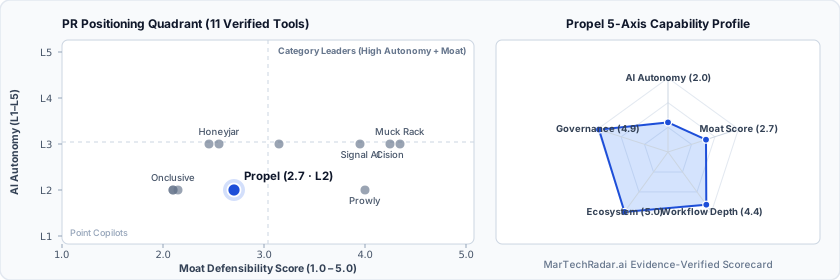
Propel is a Web SaaS tool for PR (PR Intelligence & Media Relations) in Social & Influencer. Pricing: Custom / enterprise pricing. Best suited to Enterprise Brands. Editor ratings: AI autonomy L2 (workflow copilot); moat score 2.7/5.0 (Workflow-embedded). Fact-checked by MarTechRadar Research Desk on Oct 7, 2026.
Public relations CRM and media intelligence platform integrating directly with enterprise email clients to track journalist engagement and streamline PR.
Is Propel worth it in 2026? Buyer fit & when to walk away
Choose Propel if (Best Fit)
- Target ICP & Stack Fit: You operate as Enterprise Brands requiring a Web SaaS deployment for PR, with verified ecosystem connectivity for Salesforce, Outreach, Google Workspace, Gmail.
- L2 Architecture & Defensibility: Propel establishes defensibility through native inbox telemetry inside Gmail and Outlook, coupling bidirectional pitch response data with real-time journalist interaction graphs.
- Commercial Model Fit: Your procurement budget aligns with Custom / enterprise pricing.
Walk away from Propel if (Deal-Breakers)
- Walk away if you need published self-serve pricing: Propel is sold by custom quote.
- Walk away if your workflow cannot tolerate delivery telemetry decay: Pixel-based tracking and link redirection face increasing interference from enterprise mail security firewalls and automated bot clicks, skewing engagement analytics.
- Walk away if media profile stagnation is a deal-breaker for your team: Automated journalist index refreshes can lag behind rapid editorial turnover, causing outreach misdirection if internal teams do not manually verify beat reassignments.
Propel pricing, free plan & scorecard at a glance
| Pricing | Custom / enterprise pricingVendor pricing page |
|---|---|
| Free plan | No / not disclosed |
| Delivery | Web SaaS |
| Audience | Enterprise Brands |
| AI autonomy level | L2 · Workflow copilotEditor-verified |
| Moat tier & score | 2.7 / 5.0 · Workflow-embeddedEditor-verified |
| Funding | Venture-backed |
| Company size | 51-200 employees |
| Ecosystem integrations | Salesforce, Outreach, Google Workspace, Gmail, Microsoft Outlook |
| Compliance & governance | GDPR, CCPA |
| Governance & docs | Trust & Security ↗ · System Status ↗ · Terms ↗ · Privacy ↗ |
| Headquarters | Redwood City, United States |
| Founded | 2015 |
| Last verified | Oct 7, 2026 |
Propel pros & cons: strengths vs. operational limitations
Pros: core strengths & capabilities
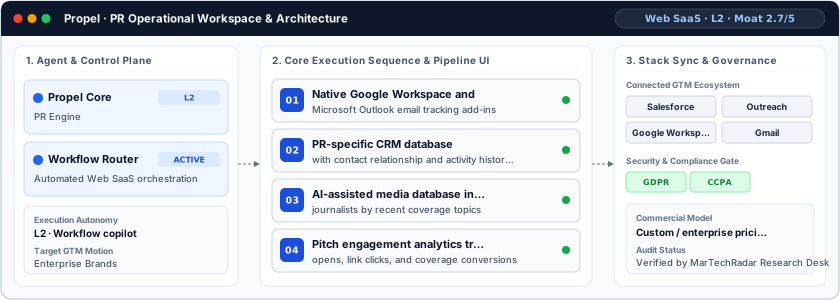
- Native Google Workspace and Microsoft Outlook email tracking add-ins
- PR-specific CRM database: with contact relationship and activity histories
- AI-assisted media database indexing: journalists by recent coverage topics
- Pitch engagement analytics tracking: opens, link clicks, and coverage conversions
Cons: operational limitations & risks
- Delivery Telemetry Decay: Pixel-based tracking and link redirection face increasing interference from enterprise mail security firewalls and automated bot clicks, skewing engagement analytics.
- Media Profile Stagnation: Automated journalist index refreshes can lag behind rapid editorial turnover, causing outreach misdirection if internal teams do not manually verify beat reassignments.
- Inbox Connector Rate Caps: Outreach volume remains strictly bound by Gmail and Outlook tenant API quotas, preventing large broadcast sequences without triggering provider throttling.
Propel TCO & deal-breaker stress test
Simulate 12-month stepped TCO, hidden cost multipliers, contract lock-in exposure, and stack failure modes using only facts verified by MarTechRadar Research Desk on 2026-10-07.
Propel triggers high-severity friction under your 5-seat / $800/mo constraints. Benchmark the verified subtrack alternatives below before committing.
- Moat Score
- 2.7 / 5.0
- AI Autonomy
- L2
- Free Tier / Trial
- None disclosed
Triggered audit signals & failure modes
- Opaque Enterprise Quoting vs. SMB/Mid-Market BudgetVerified Pricing Ledger
Propel does not disclose a public self-serve floor (Custom / enterprise pricing). Buyers with a $800/mo cap face high sales-qualification friction.
- Sales-Gated Contract TermsFact-checked by MarTechRadar Research Desk
Propel provides tiered software packages structured across Essentials, Pro, and Premium operational tiers. In accordance with platform policy, commercial pricing is available on request through tailored enterprise sales quotes based on organizational scale and seats.
- Primary Operational Bottleneck: Delivery Telemetry DecayAudit by MarTechRadar Research Desk
Pixel-based tracking and link redirection face increasing interference from enterprise mail security firewalls and automated bot clicks, skewing engagement analytics.
Test a custom Propel budget or stack constraint
Lower 5-seat floor (~$29/mo vs. Custom Quote) · Transparent self-serve entry without mandatory annual lock-in
Lower 5-seat floor (~$50/mo vs. Custom Quote) · Transparent self-serve entry without mandatory annual lock-in
Propel integrations, API, security & compliance stack
Propel AI moat & PR positioning
Propel establishes defensibility through native inbox telemetry inside Gmail and Outlook, coupling bidirectional pitch response data with real-time journalist interaction graphs.
Propel in-depth review, pricing & architecture analysis
Editor sign-off: Oct 7, 2026. How profiles are made.
What is Propel? Overview & background
Established in 2015 and headquartered in Redwood City, United States, Propel develops public relations software engineered to replace disconnected outreach spreadsheets with an integrated communications workflow. Built primarily for PR agency account leads, corporate communications directors, and enterprise media relations teams, the platform consolidates journalist discovery, outreach logging, and pipeline attribution into a single interface. By linking media contact discovery directly with actual email delivery mechanisms, the software addresses core campaign execution bottlenecks faced by modern communications organizations.
How Propel works: architecture & workflow
At an architectural level, the system operates as an L2 assist platform utilizing native add-ins for Google Workspace and Microsoft Outlook. Pitch generation and delivery occur directly within the user's primary email client while telemetry scripts track message opens, link interactions, and recipient forwarding patterns. In parallel, Propel maintains a synchronized media relationship database, crawling external publication feeds and applying natural language processing to map individual journalists to active beats and recent articles. Communications records, past coverage hits, and engagement signals automatically sync to individual reporter profiles within the central CRM index, alongside native workflow integrations for Salesforce under verified GDPR and CCPA governance controls.
Propel limitations, drawbacks & risks
Operational considerations and platform boundaries include:
- Delivery Telemetry Decay: Pixel-based tracking and link redirection face increasing interference from enterprise mail security firewalls and automated bot clicks, skewing engagement analytics.
- Media Profile Stagnation: Automated journalist index refreshes can lag behind rapid editorial turnover, causing outreach misdirection if internal teams do not manually verify beat reassignments.
- Inbox Connector Rate Caps: Outreach volume remains strictly bound by Gmail and Outlook tenant API quotas, preventing large broadcast sequences without triggering provider throttling.
Propel pricing, plans & cost breakdown
Propel provides tiered software packages structured across Essentials, Pro, and Premium operational tiers. In accordance with platform policy, commercial pricing is available on request through tailored enterprise sales quotes based on organizational scale and seats. Contracts scale based on committed user seats, access to advanced media intelligence features, and extended monitoring integrations, with all tiers including unlimited outreach volume within underlying email tenant limits.
| Plan / Tier | Verified Price & Billing | Included Scope & Contract Terms |
|---|---|---|
| Enterprise / Custom | Custom quote | Custom-quoted plan; terms come from the vendor's sales team. |
How Propel compares vs. competitors & alternatives
Within PR Intelligence and Media Relations, Propel competes directly with Muck Rack, Prowly, and Honeyjar. While Muck Rack relies on curated proprietary journalist profiles and broad newsroom verification, Propel differentiates by embedding its CRM directly into daily email infrastructure. Prowly focuses heavily on brand newsroom hosting and small agency workflows, whereas Propel emphasizes pipeline attribution and pitching analytics. Mid-sized agencies and corporate PR teams seeking inbox-level engagement tracking benefit most from Propel over passive directory tools.
Direct competitors & market radar
Top algorithmic competitors based on category positioning, capability overlap, and ICP alignment.
Frequently asked questions about Propel
Does Propel publish pricing or require an enterprise quote?
Propel pricing: Custom / enterprise pricing. No free plan is publicly disclosed. Propel provides tiered software packages structured across Essentials, Pro, and Premium operational tiers.
What are the top Propel alternatives in PR?
Verified PR alternatives include Muck Rack (Custom / enterprise pricing), Prowly (Custom / enterprise pricing), Honeyjar (From $175/mo), Rally AI (Custom / enterprise pricing). Within PR Intelligence and Media Relations, Propel competes directly with Muck Rack, Prowly, and Honeyjar.
What are the main limitations and trade-offs of Propel?
Operational considerations and platform boundaries include: Delivery Telemetry Decay: Pixel-based tracking and link redirection face increasing interference from enterprise mail security firewalls and automated bot clicks, skewing engagement analytics. Walk away if you need published self-serve pricing: Propel is sold by custom quote.
Verified sources & evidence trail
- Official product domain: https://propelsoftware.com
- Commercial pricing verification: https://www.propelmypr.com/pricing
- Verified corporate entity profiles (
sameAs): LinkedIn Company Profile - First-party governance & documentation links: Trust & Security · System Status · Terms · Privacy
- Editor sign-off: Oct 7, 2026 (how profiles are made).
