State Affairs Review (2026): PR Pricing, Limits & Alternatives
Bottom line
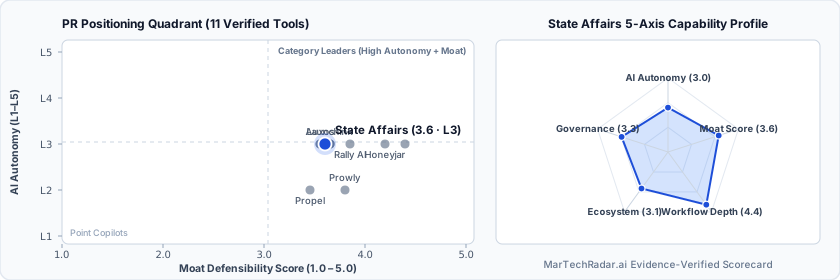
State Affairs is a Web SaaS tool for PR (PR Intelligence & Media Relations) in Social & Influencer. Pricing: Custom / enterprise pricing. Best suited to Social Media Managers, Creator & Influencer Agencies and Brand Community Ops. Editor ratings: AI autonomy L3 (conditional automation); moat score 3.6/5.0 (Proprietary moat). Fact-checked by Sarah Per on Oct 15, 2026.
PR and policy intelligence platform delivering real-time statehouse monitoring, media tracking, and stakeholder relationship infrastructure for regulatory.
State Affairs buyer fit verdict: when to choose vs. when to walk away
Choose State Affairs if (Best Fit)
- Target ICP & Stack Fit: You operate as Social Media Managers, Creator & Influencer Agencies and Brand Community Ops requiring a Web SaaS deployment for PR, with verified ecosystem connectivity for Outreach.
- L3 Architecture & Defensibility: Deep domain specialization in state-level legislative monitoring coupled with media relation graphs, providing cross-jurisdictional intelligence that generalist PR suites fail to cover.
- Commercial Model Fit: Your procurement budget aligns with Custom / enterprise pricing.
Walk away from State Affairs if (Deal-Breakers)
- Walk away if you require transparent self-serve monthly billing or your budget ceiling is under $1,000/mo (State Affairs requires sales-gated custom quoting).
- Walk away if your workflow cannot tolerate jurisdictional data latency: Scraping cadence depends on public statehouse portals, resulting in variable update speeds and ingestion lags when state government sites experience downtime.
- Walk away if contact roster decay is a deal-breaker for your team: High turnover rates across local statehouse journalism beats require manual validation of reporter beats to prevent high email bounce rates.
State Affairs key facts & scorecard
| Pricing | Custom / enterprise pricing |
|---|---|
| Free plan | No / not disclosed |
| Delivery | Web SaaS |
| Audience | Social Media Managers, Creator & Influencer Agencies, Brand Community Ops |
| AI autonomy level | L3 · Conditional automationEditor-verified |
| Moat tier & score | 3.6 / 5.0 · Proprietary moatEditor-verified |
| Funding | Series B |
| Ecosystem integrations | Outreach |
| Headquarters | United States |
| Founded | 2021 |
| Last verified |
State Affairs pros & cons: strengths vs. operational limitations
Pros: core strengths & capabilities
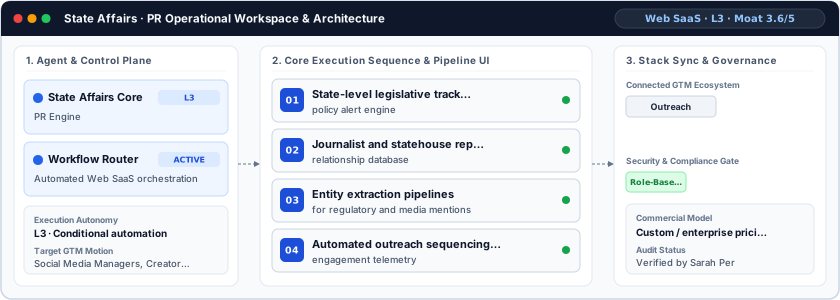
- State-level legislative tracking and: policy alert engine
- Journalist and statehouse reporter: relationship database
- Entity extraction pipelines: for regulatory and media mentions
- Automated outreach sequencing and: engagement telemetry
Cons: operational limitations & risks
- Jurisdictional Data Latency: Scraping cadence depends on public statehouse portals, resulting in variable update speeds and ingestion lags when state government sites experience downtime.
- Contact Roster Decay: High turnover rates across local statehouse journalism beats require manual validation of reporter beats to prevent high email bounce rates.
- Downstream Schema Normalization: Exporting customized policy-media entity maps to standard CRM records demands ongoing data schema maintenance to avoid misaligned contact properties.
State Affairs TCO & deal-breaker stress test
Simulate 12-month stepped TCO, hidden cost multipliers, contract lock-in exposure, and stack failure modes using only facts verified by Sarah Per on .
State Affairs triggers high-severity friction under your 5-seat / $800/mo constraints. Benchmark the verified subtrack alternatives below before committing.
| Plan / Tier | Verified Rate | Scale Fit | Scope & Quota Notes |
|---|---|---|---|
| Enterprise / Custom | Custom quote | 15–50+ seats (Enterprise SLA) | Sales-negotiated annual contract for custom volume, SSO/RBAC governance, and dedicated SLA. |
- Moat Score
- 3.6 / 5.0
- AI Autonomy
- L3
- Free Tier / Trial
- None disclosed
Triggered audit signals & failure modes
- Opaque Enterprise Quoting vs. SMB/Mid-Market BudgetVerified Pricing Ledger
State Affairs does not disclose a public self-serve floor (Custom / enterprise pricing). Buyers with a $800/mo cap face high sales-qualification friction.
- Sales-Gated Contract TermsFact-checked by Sarah Per
Pricing is available on request through tailored enterprise sales quotes, with custom enterprise tiers structured around organizational scale, user seats, and workflow volume.
- Primary Operational Bottleneck: Jurisdictional Data LatencyAudit by Sarah Per
Scraping cadence depends on public statehouse portals, resulting in variable update speeds and ingestion lags when state government sites experience downtime.
Hidden TCO Multipliers & Quota Gates
- Jurisdictional Data Latency: Scraping cadence depends on public statehouse portals, resulting in variable update speeds and ingestion lags when state government sites experience downtime.
- Contact Roster Decay: High turnover rates across local statehouse journalism beats require manual validation of reporter beats to prevent high email bounce rates.
When to Walk Away & Negotiation Levers
- Walk away if you require transparent self-serve monthly billing or your budget ceiling is under $1,000/mo (State Affairs requires sales-gated custom quoting).
- Walk away if your workflow cannot tolerate jurisdictional data latency: Scraping cadence depends on public statehouse portals, resulting in variable update speeds and ingestion lags when state government sites experience downtime.
- Walk away if contact roster decay is a deal-breaker for your team: High turnover rates across local statehouse journalism beats require manual validation of reporter beats to prevent high email bounce rates.
- Demand a 30- to 60-day paid pilot opt-out clause in the State Affairs order form before signing a 12-month enterprise commitment.
- Require a sandbox proof-of-concept testing jurisdictional data latency against your live CRM/data schema before annual sign-off.
Ask a custom procurement or TCO stress-test question about State Affairs
Lower 5-seat floor (~$175/mo vs. Custom Quote) · Transparent self-serve entry without mandatory annual lock-in
Offers a free tier (Free plan · $0/mo · Enterprise plan) · Transparent self-serve entry without mandatory annual lock-in
State Affairs key entities, modules & ecosystem stack
State Affairs moat & subtrack positioning
Deep domain specialization in state-level legislative monitoring coupled with media relation graphs, providing cross-jurisdictional intelligence that generalist PR suites fail to cover.
Editorial review
Fact-checked by Sarah Per (Principal Content Systems & Generative Media Editor) on .
Background
Headquartered in the United States, State Affairs provides dedicated public relations and policy intelligence infrastructure designed to bridge the operational gap between government relations and communications. Targeted at corporate public affairs directors, policy communicators, and regulatory affairs teams, the platform consolidates state-level policy tracking with localized media outreach workflows. It eliminates fragmented monitoring by unifying regional reporter engagement and legislative monitoring into a coordinated operational environment.
How State Affairs works
The platform functions via an ingestion pipeline that continuously scrapes statehouse docket feeds, localized news registries, and journalist rosters across multiple jurisdictions. Incoming unstructured legislative and editorial texts are parsed using natural language processing to extract policy entities, sponsor networks, and editorial stances. At an L3 conditional autonomy tier, the system matches shifting policy developments with indexed statehouse reporters and automatically triggers contextual outreach briefs and monitoring alerts to communicators.
Limitations
Operational considerations and platform boundaries include:
- Jurisdictional Data Latency: Scraping cadence depends on public statehouse portals, resulting in variable update speeds and ingestion lags when state government sites experience downtime.
- Contact Roster Decay: High turnover rates across local statehouse journalism beats require manual validation of reporter beats to prevent high email bounce rates.
- Downstream Schema Normalization: Exporting customized policy-media entity maps to standard CRM records demands ongoing data schema maintenance to avoid misaligned contact properties.
State Affairs pricing
Pricing is available on request through tailored enterprise sales quotes, with custom enterprise tiers structured around organizational scale, user seats, and workflow volume.
How State Affairs compares
State Affairs occupies a specialized niche compared to national PR intelligence systems like Muck Rack and Propel. While Muck Rack provides extensive global media directories and Propel optimizes PR workflow analytics, they exhibit limited visibility into state-level policy shifts. Honeyjar focuses primarily on creator and brand media workflows. State Affairs is engineered specifically for heavily regulated enterprises and public affairs agencies that require unified statehouse legislative alerts directly paired with reporter relationship tooling. It is best suited for enterprise marketing teams and growth practitioners seeking disciplined workflow orchestration.
Direct competitors & market radar
Top algorithmic competitors based on category positioning, capability overlap, and ICP alignment.
Frequently asked questions about State Affairs
How much does State Affairs cost and does it require a custom enterprise quote?
Published pricing summary for State Affairs: Custom / enterprise pricing. A permanent free plan is not disclosed for State Affairs. Pricing is available on request through tailored enterprise sales quotes, with custom enterprise tiers structured around organizational scale, user seats, and workflow volume.
How does State Affairs work and how autonomous is its AI architecture?
PR and policy intelligence platform delivering real-time statehouse monitoring, media tracking, and stakeholder relationship infrastructure for regulatory. Within PR (PR Intelligence & Media Relations), MarTechRadar rates its execution architecture at L3 · Conditional automation with a verified Moat Score of 3.6 / 5.0 (Proprietary moat). Deep domain specialization in state-level legislative monitoring coupled with media relation graphs, providing cross-jurisdictional intelligence that generalist PR suites fail to cover.
What are the main limitations of State Affairs and when should buyers walk away?
Based on our editorial technical audit, key operational considerations and boundaries for State Affairs include: (1) Jurisdictional Data Latency: Scraping cadence depends on public statehouse portals, resulting in variable update speeds and ingestion lags when state government sites experience downtime. (2) Contact Roster Decay: High turnover rates across local statehouse journalism beats require manual validation of reporter beats to prevent high email bounce rates. (3) Downstream Schema Normalization: Exporting customized policy-media entity maps to standard CRM records demands ongoing data schema maintenance to avoid misaligned contact properties. Primary procurement walk-away rule: Walk away if you require transparent self-serve monthly billing or your budget ceiling is under $1,000/mo (State Affairs requires sales-gated custom quoting).
What integrations, compliance certifications, and contract terms apply to State Affairs?
Verified ecosystem and stack integrations include Outreach. Key TCO multiplier to watch: Jurisdictional Data Latency (Scraping cadence depends on public statehouse portals, resulting in variable update speeds and ingestion lags when state government sites experience downtime.) Before signing a contract, procurement teams should demand a 30- to 60-day paid pilot opt-out clause in the State Affairs order form before signing a 12-month enterprise commitment.
What are the best State Affairs alternatives and head-to-head competitors in 2026?
Top fact-checked alternatives to State Affairs in PR (PR Intelligence & Media Relations) include Signal AI (Pricing not disclosed), PRophet (Free plan · $0/mo · Enterprise plan), Launchink (Custom / enterprise pricing), Terac (Custom / enterprise pricing). State Affairs occupies a specialized niche compared to national PR intelligence systems like Muck Rack and Propel. While Muck Rack provides extensive global media directories and Propel optimizes PR workflow analytics, they exhibit limited visibility into state-level policy shifts.
Verified sources & evidence trail
- Official product domain: https://stateaffairs.com/
- Commercial pricing verification: Verified against official vendor pricing policy (Custom / enterprise pricing)
- Editorial audit sign-off: Fact-checked by Sarah Per on under the MarTechRadar Evidence-Ledger Protocol.