Vitally Review (2026): Predictive AI Pricing, Limits & Alternatives
Bottom line
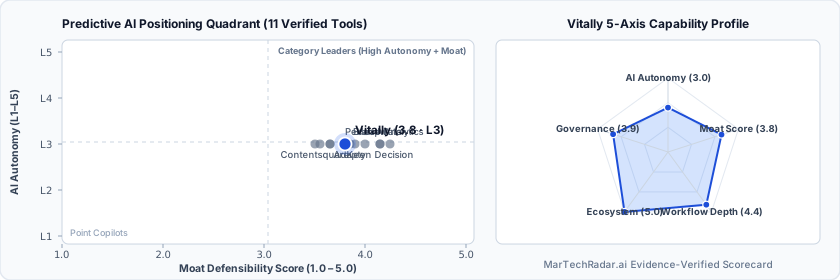
Vitally is a Web SaaS tool for Predictive AI (Predictive LTV, Churn & Customer Analytics) in Analytics & Attribution. Pricing: Pricing not disclosed. Best suited to B2B SaaS and Marketing & Growth Teams. Editor ratings: AI autonomy L3 (conditional automation); moat score 3.8/5.0 (Proprietary moat). Fact-checked by Jagmeet Sine on Oct 17, 2026.
AI-powered customer success and predictive revenue retention workspace uniting health scoring, project docs, and automation.
Vitally buyer fit verdict: when to choose vs. when to walk away
Choose Vitally if (Best Fit)
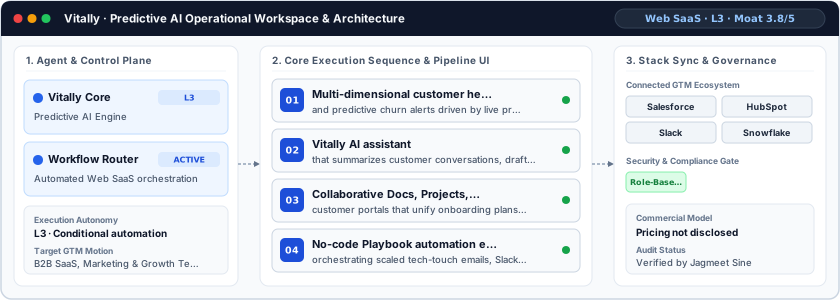
- Target ICP & Stack Fit: You operate as B2B SaaS and Marketing & Growth Teams requiring a Web SaaS deployment for Predictive AI, with verified ecosystem connectivity for Salesforce, HubSpot, Slack, Snowflake.
- L3 Architecture & Defensibility: Vitally builds strong mid-market and enterprise retention defensibility by combining real-time product telemetry health scoring, AI conversation summaries, and collaborative customer onboarding workspaces.
- Commercial Model Fit: Your procurement budget aligns with Pricing not disclosed.
Walk away from Vitally if (Deal-Breakers)
- Walk away if you require transparent self-serve monthly billing or your budget ceiling is under $1,000/mo (Vitally requires sales-gated custom quoting).
- Walk away if your workflow cannot tolerate product event schema mapping bottleneck: Unlocking accurate usage-based churn and expansion predictions requires clean user-to-account identity mapping from product analytics or cloud data warehouses, creating an initial data-plumbing learning curve.
- Walk away if B2B subscription model specificity is a deal-breaker for your team: Vitally is engineered around recurring B2B account hierarchies, seat utilization, and contract renewals, making it unsuitable for transactional B2C e-commerce merchants.
Vitally key facts & scorecard
| Pricing | Pricing not disclosed |
|---|---|
| Free plan | No / not disclosed |
| Delivery | Web SaaS |
| Audience | B2B SaaS, Marketing & Growth Teams |
| AI autonomy level | L3 · Conditional automationEditor-verified |
| Moat tier & score | 3.8 / 5.0 · Proprietary moatEditor-verified |
| Funding | Series B |
| Total funding | $39.2M |
| Company size | 51-200 employees |
| Ecosystem integrations | Salesforce, HubSpot, Slack, Snowflake, Twilio Segment, Amplitude |
| Governance & docs | Trust & Security ↗ · API & Docs ↗ · Privacy ↗ |
| Headquarters | Brooklyn, New York |
| Founded | 2017 |
| Last verified |
Vitally pros & cons: strengths vs. operational limitations
Pros: core strengths & capabilities
- Multi-dimensional customer health scoring: and predictive churn alerts driven by live product usage and CRM data
- Vitally AI assistant: that summarizes customer conversations, drafts follow-ups, and extracts risk signals
- Collaborative Docs, Projects, and: customer portals that unify onboarding plans and executive business reviews
- No-code Playbook automation engine: orchestrating scaled tech-touch emails, Slack alerts, and task routing
Cons: operational limitations & risks
- Product Event Schema Mapping Bottleneck: Unlocking accurate usage-based churn and expansion predictions requires clean user-to-account identity mapping from product analytics or cloud data warehouses, creating an initial data-plumbing learning curve.
- B2B Subscription Model Specificity: Vitally is engineered around recurring B2B account hierarchies, seat utilization, and contract renewals, making it unsuitable for transactional B2C e-commerce merchants.
- Quote-Based Commercial Packaging: Because Vitally tailors its Tech-Touch, Hybrid-Touch, and High-Touch plans via custom sales quotes rather than publishing flat self-serve seat prices, prospective buyers must complete a discovery call to benchmark costs.
Vitally TCO & deal-breaker stress test
Simulate 12-month stepped TCO, hidden cost multipliers, contract lock-in exposure, and stack failure modes using only facts verified by Jagmeet Sine on · Capture SHA 92f6909b.
Vitally triggers high-severity friction under your 5-seat / $800/mo constraints. Benchmark the verified subtrack alternatives below before committing.
| Plan / Tier | Verified Rate | Scale Fit | Scope & Quota Notes |
|---|---|---|---|
| Enterprise / Custom | Custom quote | 15–50+ seats (Enterprise SLA) | Sales-negotiated annual contract for custom volume, SSO/RBAC governance, and dedicated SLA. |
- Moat Score
- 3.8 / 5.0
- AI Autonomy
- L3
- Free Tier / Trial
- None disclosed
Triggered audit signals & failure modes
- Opaque Enterprise Quoting vs. SMB/Mid-Market BudgetVerified Pricing Ledger
Vitally does not disclose a public self-serve floor (Pricing not disclosed). Buyers with a $800/mo cap face high sales-qualification friction.
- Sales-Gated Contract TermsFact-checked by Jagmeet Sine
Pricing is available on request through custom commercial quotes structured across three maturity tiers—Tech-Touch, Hybrid-Touch, and High-Touch—scaled by customer success seat counts and data connector requirements.
- Usage / Credit Burn VolatilityCommercial Model Audit
Vitally uses credit or usage-metered billing (Pricing not disclosed). High-volume automated workflows across 5 seats can trigger mid-cycle overage charges.
- Primary Operational Bottleneck: B2B Subscription Model SpecificityAudit by Jagmeet Sine
Vitally is engineered around recurring B2B account hierarchies, seat utilization, and contract renewals, making it unsuitable for transactional B2C e-commerce merchants.
Hidden TCO Multipliers & Quota Gates
- Enterprise Governance & Add-On Gating: Advanced capabilities such as Single Sign-On (SSO), custom role permissions, or specialized analytics modules are gated behind upper tiers or paid add-ons.
- Product Event Schema Mapping Bottleneck: Unlocking accurate usage-based churn and expansion predictions requires clean user-to-account identity mapping from product analytics or cloud data warehouses, creating an initial data-plumbing learning curve.
- B2B Subscription Model Specificity: Vitally is engineered around recurring B2B account hierarchies, seat utilization, and contract renewals, making it unsuitable for transactional B2C e-commerce merchants.
When to Walk Away & Negotiation Levers
- Walk away if you require transparent self-serve monthly billing or your budget ceiling is under $1,000/mo (Vitally requires sales-gated custom quoting).
- Walk away if your workflow cannot tolerate product event schema mapping bottleneck: Unlocking accurate usage-based churn and expansion predictions requires clean user-to-account identity mapping from product analytics or cloud data warehouses, creating an initial data-plumbing learning curve.
- Walk away if B2B subscription model specificity is a deal-breaker for your team: Vitally is engineered around recurring B2B account hierarchies, seat utilization, and contract renewals, making it unsuitable for transactional B2C e-commerce merchants.
- Demand a 30- to 60-day paid pilot opt-out clause in the Vitally order form before signing a 12-month enterprise commitment.
- Require a sandbox proof-of-concept testing product event schema mapping bottleneck against your live CRM/data schema before annual sign-off.
Ask a custom procurement or TCO stress-test question about Vitally
Offers a free tier (Free plan · $0/mo · Enterprise plan) · Transparent self-serve entry without mandatory annual lock-in
Verified Predictive AI peer (Pricing not disclosed · Moat 3.9/5.0)
Vitally key entities, modules & ecosystem stack
Vitally moat & subtrack positioning
Vitally builds strong mid-market and enterprise retention defensibility by combining real-time product telemetry health scoring, AI conversation summaries, and collaborative customer onboarding workspaces.
Editorial review
Fact-checked by Jagmeet Sine (Senior MarTech Infrastructure & Agentic Workflow Architect) on .
Background
Founded in 2017 by Jamie Davidson and Patrick Vatterott and headquartered in Brooklyn, New York, Vitally (vitally.io) is an AI-powered customer success productivity and predictive revenue retention platform built for B2B SaaS and subscription growth teams. Operating with a team of 51 to 200 employees and backed by $39.2M in Series B funding from Andreessen Horowitz (a16z), Techstars, Founder Collective, NewView Capital, and Right Side Capital Management, the company enables customer success and revenue operations teams to predict churn, accelerate onboarding, and scale net dollar retention.
How Vitally works
Vitally operates at Level 3 autonomy through a real-time customer data hub, an AI-augmented workspace (Vitally AI), and a declarative Playbook automation engine. Rather than separating analytics dashboards from the daily tools CSMs use to manage accounts, Vitally ingests product usage events (Segment, Mixpanel, Amplitude, Snowflake), CRM records (Salesforce, HubSpot), support tickets (Zendesk, Intercom), and financial billing data (Stripe, Chargebee) into a unified workspace. Vitally calculates dynamic health scores, uses generative AI to synthesize account histories and meeting notes, and triggers automated tech-touch email campaigns or CSM intervention tasks when usage drops or expansion signals appear.
Limitations
Operational limitations and technical trade-offs include:
- Product Event Schema Mapping Bottleneck: Unlocking accurate usage-based churn and expansion predictions requires clean user-to-account identity mapping from product analytics or cloud data warehouses, creating an initial data-plumbing learning curve.
- B2B Subscription Model Specificity: Vitally is engineered around recurring B2B account hierarchies, seat utilization, and contract renewals, making it unsuitable for transactional B2C e-commerce merchants.
- Quote-Based Commercial Packaging: Because Vitally tailors its Tech-Touch, Hybrid-Touch, and High-Touch plans via custom sales quotes rather than publishing flat self-serve seat prices, prospective buyers must complete a discovery call to benchmark costs.
Vitally pricing
Pricing is available on request through custom commercial quotes structured across three maturity tiers—Tech-Touch, Hybrid-Touch, and High-Touch—scaled by customer success seat counts and data connector requirements. Revenue and customer success leaders can request a personalized pricing proposal and live demo via the Vitally website.
How Vitally compares
Within the Predictive LTV, Churn & Customer Analytics and Customer Success category, Vitally competes against post-sale retention alternatives such as Gainsight, Totango, and ChurnZero. Versus legacy enterprise monoliths like Gainsight that require dedicated full-time administrators and months of setup, Vitally differentiates itself by blending real-time product health telemetry with Notion-style collaborative Docs, Projects, and rapid no-code playbook automation. High-growth B2B SaaS teams choose Vitally to scale customer success productivity without administrative bloat.
Frequently asked questions about Vitally
How much does Vitally cost and does it require a custom enterprise quote?
Published pricing summary for Vitally: Pricing not disclosed. A permanent free plan is not disclosed for Vitally. Pricing is available on request through custom commercial quotes structured across three maturity tiers—Tech-Touch, Hybrid-Touch, and High-Touch—scaled by customer success seat counts and data connector requirements.
How does Vitally work and how autonomous is its AI architecture?
AI-powered customer success and predictive revenue retention workspace uniting health scoring, project docs, and automation. Within Predictive AI (Predictive LTV, Churn & Customer Analytics), MarTechRadar rates its execution architecture at L3 · Conditional automation with a verified Moat Score of 3.8 / 5.0 (Proprietary moat). Vitally builds strong mid-market and enterprise retention defensibility by combining real-time product telemetry health scoring, AI conversation summaries, and collaborative customer onboarding workspaces. Corporate profile: operating at 51-200 employees scale.
What are the main limitations of Vitally and when should buyers walk away?
Based on our editorial technical audit, key operational considerations and boundaries for Vitally include: (1) Product Event Schema Mapping Bottleneck: Unlocking accurate usage-based churn and expansion predictions requires clean user-to-account identity mapping from product analytics or cloud data warehouses, creating an initial data-plumbing learning curve. (2) B2B Subscription Model Specificity: Vitally is engineered around recurring B2B account hierarchies, seat utilization, and contract renewals, making it unsuitable for transactional B2C e-commerce merchants. (3) Quote-Based Commercial Packaging: Because Vitally tailors its Tech-Touch, Hybrid-Touch, and High-Touch plans via custom sales quotes rather than publishing flat self-serve seat prices, prospective buyers must complete a discovery call to benchmark costs. Primary procurement walk-away rule: Walk away if you require transparent self-serve monthly billing or your budget ceiling is under $1,000/mo (Vitally requires sales-gated custom quoting).
What integrations, compliance certifications, and contract terms apply to Vitally?
Verified ecosystem and stack integrations include Salesforce, HubSpot, Slack, Snowflake, Twilio Segment, Amplitude, Mixpanel, Zendesk, Intercom, Notion. First-party governance and developer endpoints verified on domain include: Trust/Security (https://www.vitally.io/security), API Docs (https://docs.vitally.io). Key TCO multiplier to watch: Enterprise Governance & Add-On Gating (Advanced capabilities such as Single Sign-On (SSO), custom role permissions, or specialized analytics modules are gated behind upper tiers or paid add-ons.) Before signing a contract, procurement teams should demand a 30- to 60-day paid pilot opt-out clause in the Vitally order form before signing a 12-month enterprise commitment.
What are the best Vitally alternatives and head-to-head competitors in 2026?
Top fact-checked alternatives to Vitally in Predictive AI (Predictive LTV, Churn & Customer Analytics) include Gainsight (Pricing not disclosed), Outlit (Pricing not disclosed), Survicate AI (Custom / enterprise pricing), Synthesio (Custom / enterprise pricing). Within the Predictive LTV, Churn & Customer Analytics and Customer Success category, Vitally competes against post-sale retention alternatives such as Gainsight, Totango, and ChurnZero.
Verified sources & evidence trail
- Official product domain: https://vitally.io
- Commercial pricing verification: Verified against official vendor pricing policy (Pricing not disclosed)
- Verified corporate entity profiles (
sameAs): LinkedIn Company Profile · Crunchbase Entity Record - First-party governance & documentation links: Trust & Security · API & Docs · Privacy
- Editorial audit sign-off: Fact-checked by Jagmeet Sine on under the MarTechRadar Evidence-Ledger Protocol.