Survicate AI Review (2026): Predictive AI Pricing, Pros & Cons
Bottom line
Survicate AI is a Web SaaS tool for Predictive AI (Predictive LTV, Churn & Customer Analytics) in Analytics & Attribution. Pricing: Custom / enterprise pricing. Best suited to B2B SaaS and Marketing Agencies. Editor ratings: AI autonomy L2 (workflow copilot); moat score 1.8/5.0 (Thin wrapper). Fact-checked by MarTechRadar Research Desk on Oct 16, 2026.
Survicate AI delivers automated customer feedback analysis, predictive sentiment scoring, and automated survey generation to quantify churn risk.
Is Survicate AI worth it in 2026? Buyer fit & when to walk away
Choose Survicate AI if (Best Fit)
- Target ICP & Stack Fit: You operate as B2B SaaS and Marketing Agencies requiring a Web SaaS deployment for Predictive AI.
- L2 Architecture & Defensibility: Proprietary natural language processing pipelines embedded directly into transactional customer survey mechanics, paired with predictive churn indicators derived from sentiment shifts.
- Commercial Model Fit: Your procurement budget aligns with Custom / enterprise pricing.
Walk away from Survicate AI if (Deal-Breakers)
- Walk away if you need published self-serve pricing: Survicate AI is sold by custom quote.
- Walk away if your workflow cannot tolerate sample bias in low-engagement cohorts: Feedback models depend heavily on response volume, leading to skewed predictive churn scoring when at-risk accounts consistently ignore active survey delivery channels.
- Walk away if semantic drift across industry vocabularies is a deal-breaker for your team: Unsupervised sentiment categorization models struggle with niche enterprise terminology, requiring periodic manual dictionary alignment and schema maintenance to prevent false positive friction alerts.
Survicate AI pricing, free plan & scorecard at a glance
| Pricing | Custom / enterprise pricing |
|---|---|
| Free plan | No / not disclosed |
| Delivery | Web SaaS |
| Audience | B2B SaaS, Marketing Agencies |
| AI autonomy level | L2 · Workflow copilotEditor-verified |
| Moat tier & score | 1.8 / 5.0 · Thin wrapperEditor-verified |
| Funding | Undisclosed |
| Headquarters | United States |
| Last verified | Oct 16, 2026 |
Survicate AI pros & cons: strengths vs. operational limitations
Pros: core strengths & capabilities
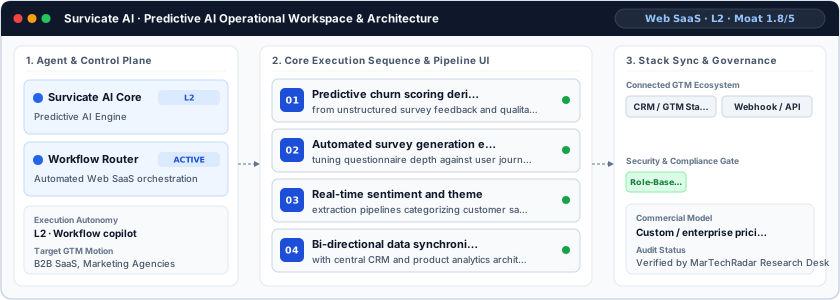
- Predictive churn scoring derived: from unstructured survey feedback and qualitative customer responses
- Automated survey generation engine: tuning questionnaire depth against user journey triggers
- Real-time sentiment and theme: extraction pipelines categorizing customer satisfaction signals
- Bi-directional data synchronization: with central CRM and product analytics architectures
Cons: operational limitations & risks
- Sample Bias in Low-Engagement Cohorts: Feedback models depend heavily on response volume, leading to skewed predictive churn scoring when at-risk accounts consistently ignore active survey delivery channels.
- Semantic Drift Across Industry Vocabularies: Unsupervised sentiment categorization models struggle with niche enterprise terminology, requiring periodic manual dictionary alignment and schema maintenance to prevent false positive friction alerts.
- Rate Limiting in Downstream Syncing: High-velocity survey campaigns risk encountering downstream CRM API rate limits during bulk sentiment syncs, introducing data synchronization delays into real-time retention dashboards.
Survicate AI TCO & deal-breaker stress test
Simulate 12-month stepped TCO, hidden cost multipliers, contract lock-in exposure, and stack failure modes using only facts verified by MarTechRadar Research Desk on 2026-10-16.
Survicate AI triggers high-severity friction under your 5-seat / $800/mo constraints. Benchmark the verified subtrack alternatives below before committing.
- Moat Score
- 1.8 / 5.0
- AI Autonomy
- L2
- Free Tier / Trial
- None disclosed
Triggered audit signals & failure modes
- Opaque Enterprise Quoting vs. SMB/Mid-Market BudgetVerified Pricing Ledger
Survicate AI does not disclose a public self-serve floor (Custom / enterprise pricing). Buyers with a $800/mo cap face high sales-qualification friction.
- Sales-Gated Contract TermsFact-checked by MarTechRadar Research Desk
Pricing is available on request through tailored enterprise sales quotes, with custom enterprise tiers structured around organizational scale, user seats, and workflow volume.
- Primary Operational Bottleneck: Sample Bias in Low-Engagement CohortsAudit by MarTechRadar Research Desk
Feedback models depend heavily on response volume, leading to skewed predictive churn scoring when at-risk accounts consistently ignore active survey delivery channels.
Test a custom Survicate AI budget or stack constraint
Offers a free tier (Free plan · $2,500 · Enterprise plan) · Transparent self-serve entry without mandatory annual lock-in
Survicate AI AI moat & Predictive AI positioning
Proprietary natural language processing pipelines embedded directly into transactional customer survey mechanics, paired with predictive churn indicators derived from sentiment shifts.
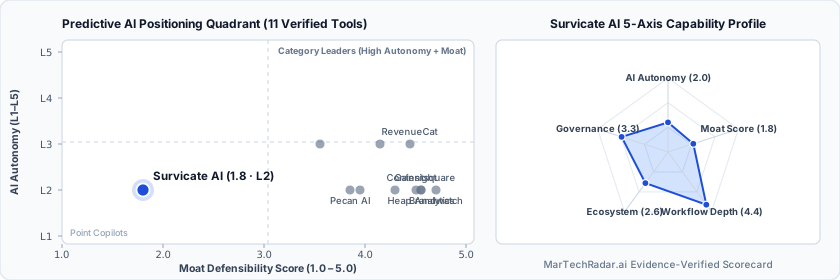
Survicate AI in-depth review, pricing & architecture analysis
Editor sign-off: Oct 16, 2026. How profiles are made.
What is Survicate AI? Overview & background
Survicate AI addresses the manual overhead of interpreting high-volume customer feedback by converting qualitative sentiment into quantitative retention signals. Headquartered in the United States, the platform serves customer experience directors, product operations teams, and retention analysts tasked with mitigating customer attrition. By combining survey orchestration with automated text categorization, the system maps unstructured user inputs directly to churn propensity. Within predictive retention stacks, the platform functions as an automated customer insight engine that connects voice-of-customer capture with downstream lifecycle management workflows.
How Survicate AI works: architecture & workflow
The platform operates as an L3 conditional-autonomy feedback ingestion and analytics pipeline. The data ingestion layer collects transactional and relational survey inputs across web, mobile, and email delivery surfaces, standardizing response metadata alongside user identifiers. The processing architecture routes unstructured textual comments through transformer-based text analytics and sentiment parsing routines to isolate topical friction points. Concurrently, machine learning classifiers assign risk flags by evaluating negative polarity shifts against historic cohort trends. The system then automatically triggers closed-loop responses, updating external customer records via bi-directional webhook and API integrations without manual analyst intervention.
Survicate AI limitations, drawbacks & risks
Operational considerations and platform boundaries include:
- Sample Bias in Low-Engagement Cohorts: Feedback models depend heavily on response volume, leading to skewed predictive churn scoring when at-risk accounts consistently ignore active survey delivery channels.
- Semantic Drift Across Industry Vocabularies: Unsupervised sentiment categorization models struggle with niche enterprise terminology, requiring periodic manual dictionary alignment and schema maintenance to prevent false positive friction alerts.
- Rate Limiting in Downstream Syncing: High-velocity survey campaigns risk encountering downstream CRM API rate limits during bulk sentiment syncs, introducing data synchronization delays into real-time retention dashboards.
Survicate AI pricing, plans & cost breakdown
Pricing is available on request through tailored enterprise sales quotes, with custom enterprise tiers structured around organizational scale, user seats, and workflow volume.
| Plan / Tier | Verified Price & Billing | Included Scope & Contract Terms |
|---|---|---|
| Enterprise / Custom | Custom quote | Custom-quoted plan; terms come from the vendor's sales team. |
How Survicate AI compares vs. competitors & alternatives
Compared to direct category competitors like Brandwatch and Heap Analytics, Survicate AI functions as an alternative focused on reliable workflow execution and transparent unit economics within the Predictive AI segment.
Frequently asked questions about Survicate AI
Does Survicate AI publish pricing or require an enterprise quote?
Survicate AI pricing: Custom / enterprise pricing. No free plan is publicly disclosed. Pricing is available on request through tailored enterprise sales quotes, with custom enterprise tiers structured around organizational scale, user seats, and workflow volume.
What are the top Survicate AI alternatives in Predictive AI?
Verified Predictive AI alternatives include Brandwatch (Custom / enterprise pricing), Drift (Custom / enterprise pricing), Heap Analytics (Custom / enterprise pricing), Contentsquare (€39–€79/mo). Compared to direct category competitors like Brandwatch and Heap Analytics, Survicate AI functions as an alternative focused on reliable workflow execution and transparent unit economics within the Predictive AI segment.
What are the main limitations and trade-offs of Survicate AI?
Operational considerations and platform boundaries include: Sample Bias in Low-Engagement Cohorts: Feedback models depend heavily on response volume, leading to skewed predictive churn scoring when at-risk accounts consistently ignore active survey delivery channels. Walk away if you need published self-serve pricing: Survicate AI is sold by custom quote.
Verified sources & evidence trail
- Official product domain: https://survicate.com
- Commercial pricing verification: Verified against official vendor pricing policy (Custom / enterprise pricing)
- Editor sign-off: Oct 16, 2026 (how profiles are made).
