Schema App Review (2026): Technical SEO Pricing, Pros & Cons
Bottom line
Schema App is a Web SaaS tool for Technical SEO (Technical SEO Auditing & Indexing) in GEO & AI SEO. Pricing: Custom / enterprise pricing. Best suited to DTC / eCommerce and Enterprise Brands. Editor ratings: AI autonomy L2 (workflow copilot); moat score 3.1/5.0 (Workflow-embedded (strong)). Fact-checked by MarTechRadar Research Desk on Oct 15, 2026.
Enterprise semantic data platform that converts website content into dynamic Schema.org knowledge graphs and deploys JSON-LD markup across digital properties.
Is Schema App worth it in 2026? Buyer fit & when to walk away
Choose Schema App if (Best Fit)
- Target ICP & Stack Fit: You operate as DTC / eCommerce and Enterprise Brands requiring a Web SaaS deployment for Technical SEO.
- L2 Architecture & Defensibility: Proprietary semantic mapping engine that models website entity relationships into interconnected RDF knowledge graphs, integrated with dynamic CDN and JavaScript delivery mechanisms.
- Commercial Model Fit: Your procurement budget aligns with Custom / enterprise pricing.
Walk away from Schema App if (Deal-Breakers)
- Walk away if you need published self-serve pricing: Schema App is sold by custom quote.
- Walk away if your workflow cannot tolerate client-side rendering dependency: When deployed purely via client-side JavaScript tags, crawlers that bypass second-wave script execution or enforce tight rendering timeouts may fail to parse injected JSON-LD graphs consistently.
- Walk away if dom mutation sensitivity is a deal-breaker for your team: Unannounced template restructurings or class name refactors within the client CMS frequently break predefined extraction selectors, necessitating manual re-mapping within the visual editor.
Schema App pricing, free plan & scorecard at a glance
| Pricing | Custom / enterprise pricing |
|---|---|
| Free plan | No / not disclosed |
| Delivery | Web SaaS |
| Audience | DTC / eCommerce, Enterprise Brands |
| AI autonomy level | L2 · Workflow copilotEditor-verified |
| Moat tier & score | 3.1 / 5.0 · Workflow-embedded (strong)Editor-verified |
| Funding | Bootstrapped |
| Founders | Mark van Berkel, Martha van Berkel |
| Company size | 11-50 employees |
| Governance & docs | Trust & Security ↗ · System Status ↗ · Privacy ↗ |
| Headquarters | Guelph, Ontario |
| Founded | 2011 |
| Last verified | Oct 15, 2026 |
Schema App pros & cons: strengths vs. operational limitations
Pros: core strengths & capabilities
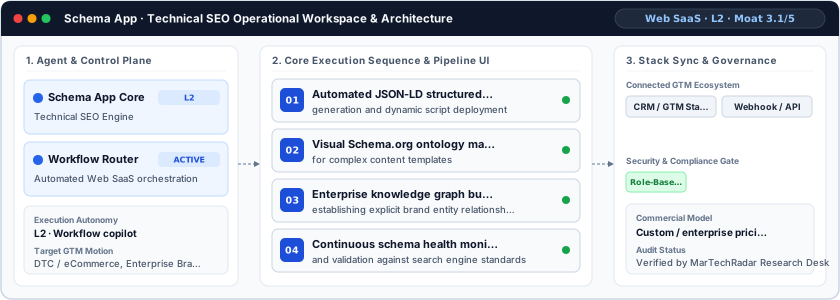
- Automated JSON-LD structured data: generation and dynamic script deployment
- Visual Schema.org ontology mapping editor: for complex content templates
- Enterprise knowledge graph builder: establishing explicit brand entity relationships
- Continuous schema health monitoring and validation against search engine standards
Cons: operational limitations & risks
- Client-Side Rendering Dependency: When deployed purely via client-side JavaScript tags, crawlers that bypass second-wave script execution or enforce tight rendering timeouts may fail to parse injected JSON-LD graphs consistently.
- DOM Mutation Sensitivity: Unannounced template restructurings or class name refactors within the client CMS frequently break predefined extraction selectors, necessitating manual re-mapping within the visual editor.
- Ontology Drift Overhead: Aligning deep enterprise taxonomies with evolving Schema.org guidelines and Google rich result specifications demands continuous governance to prevent sudden deprecation errors.
Schema App TCO & deal-breaker stress test
Simulate 12-month stepped TCO, hidden cost multipliers, contract lock-in exposure, and stack failure modes using only facts verified by MarTechRadar Research Desk on 2026-10-15.
Schema App triggers high-severity friction under your 5-seat / $800/mo constraints. Benchmark the verified subtrack alternatives below before committing.
- Moat Score
- 3.1 / 5.0
- AI Autonomy
- L2
- Free Tier / Trial
- None disclosed
Triggered audit signals & failure modes
- Opaque Enterprise Quoting vs. SMB/Mid-Market BudgetVerified Pricing Ledger
Schema App does not disclose a public self-serve floor (Custom / enterprise pricing). Buyers with a $800/mo cap face high sales-qualification friction.
- Sales-Gated Contract TermsFact-checked by MarTechRadar Research Desk
Pricing is available on request through tailored enterprise sales quotes, with custom enterprise tiers structured around organizational scale, user seats, and workflow volume.
- Primary Operational Bottleneck: Client-Side Rendering DependencyAudit by MarTechRadar Research Desk
When deployed purely via client-side JavaScript tags, crawlers that bypass second-wave script execution or enforce tight rendering timeouts may fail to parse injected JSON-LD graphs consistently.
Test a custom Schema App budget or stack constraint
Lower 5-seat floor (~$500/mo vs. Custom Quote) · Transparent self-serve entry without mandatory annual lock-in
Lower 5-seat floor (~$55/mo vs. Custom Quote) · Transparent self-serve entry without mandatory annual lock-in
Schema App AI moat & Technical SEO positioning
Proprietary semantic mapping engine that models website entity relationships into interconnected RDF knowledge graphs, integrated with dynamic CDN and JavaScript delivery mechanisms.
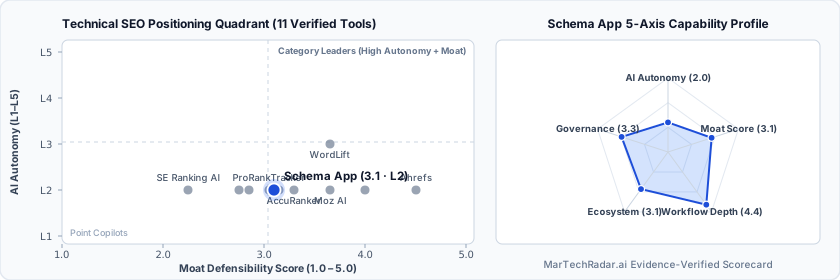
Schema App in-depth review, pricing & architecture analysis
Editor sign-off: Oct 15, 2026. How profiles are made.
What is Schema App? Overview & background
For enterprise technical search marketers managing sprawling web estates, maintaining compliant structured data across dynamic templates presents a persistent engineering bottleneck. Founded in 2011 in Guelph, Ontario, Schema App was built to automate the construction and deployment of semantic data layers without requiring hardcoded updates from development teams. The platform addresses organic search directors and digital transformation leaders who need search crawlers and generative answer engines to interpret multi-domain brand assets accurately.
How Schema App works: architecture & workflow
Operating at an L2 autonomy profile, Schema App abstracts Schema.org vocabulary mapping into an external orchestration layer. The platform ingests webpage HTML, CMS templates, and raw entity attributes via API or client-side crawl, translating raw page elements into standardized RDF triples. Its engine compiles dynamic, connected JSON-LD graphs representing products, organizations, and editorial content. Deployment executes programmatically via tag management systems, native CMS plugins, or edge compute integrations, decoupling schema injection entirely from standard web deployment cycles.
Schema App limitations, drawbacks & risks
Operational considerations and platform boundaries include:
- Client-Side Rendering Dependency: When deployed purely via client-side JavaScript tags, crawlers that bypass second-wave script execution or enforce tight rendering timeouts may fail to parse injected JSON-LD graphs consistently.
- DOM Mutation Sensitivity: Unannounced template restructurings or class name refactors within the client CMS frequently break predefined extraction selectors, necessitating manual re-mapping within the visual editor.
- Ontology Drift Overhead: Aligning deep enterprise taxonomies with evolving Schema.org guidelines and Google rich result specifications demands continuous governance to prevent sudden deprecation errors.
Schema App pricing, plans & cost breakdown
Pricing is available on request through tailored enterprise sales quotes, with custom enterprise tiers structured around organizational scale, user seats, and workflow volume.
| Plan / Tier | Verified Price & Billing | Included Scope & Contract Terms |
|---|---|---|
| Enterprise / Custom | Custom quote | Custom-quoted plan; terms come from the vendor's sales team. |
How Schema App compares vs. competitors & alternatives
Within the Technical SEO and structured data automation market, Schema App competes against enterprise technical SEO platforms like Botify and Conductor AI, WordPress-native schema plugins like All in One SEO and Yoast AI, and technical crawlers like Screaming Frog SEO and Sitebulb that validate JSON-LD markup. Unlike CMS-bound plugins or audit-only crawlers, Schema App provides an external semantic knowledge graph layer that deploys connected Schema.org markup across complex multi-CMS enterprise estates.
Direct competitors & market radar
Top algorithmic competitors based on category positioning, capability overlap, and ICP alignment.
Frequently asked questions about Schema App
Does Schema App publish pricing or require an enterprise quote?
Schema App pricing: Custom / enterprise pricing. No free plan is publicly disclosed. Pricing is available on request through tailored enterprise sales quotes, with custom enterprise tiers structured around organizational scale, user seats, and workflow volume.
What are the top Schema App alternatives in Technical SEO?
Verified Technical SEO alternatives include WordLift (From $799/yr), Yoast AI (Custom / enterprise pricing), Sitebulb ($11–$125/mo), Huckabuy (Free plan · $500–$50,000/mo · Enterprise plan). Within the Technical SEO and structured data automation market, Schema App competes against enterprise technical SEO platforms like Botify and Conductor AI, WordPress-native schema plugins like All in One SEO and Yoast AI, and technical crawlers like Screaming Frog SEO and Sitebulb that validate JSON-LD markup.
What are the main limitations and trade-offs of Schema App?
Operational considerations and platform boundaries include: Client-Side Rendering Dependency: When deployed purely via client-side JavaScript tags, crawlers that bypass second-wave script execution or enforce tight rendering timeouts may fail to parse injected JSON-LD graphs consistently. Walk away if you need published self-serve pricing: Schema App is sold by custom quote.
Verified sources & evidence trail
- Official product domain: https://schemaapp.com
- Commercial pricing verification: Verified against official vendor pricing policy (Custom / enterprise pricing)
- Verified corporate entity profiles (
sameAs): LinkedIn Company Profile · Crunchbase Entity Record - First-party governance & documentation links: Trust & Security · System Status · Privacy
- Editor sign-off: Oct 15, 2026 (how profiles are made).
