Botify Review (2026): Technical SEO Pricing, Pros & Cons
Bottom line
Botify is a Web SaaS tool for Technical SEO (Technical SEO Auditing & Indexing) in GEO & AI SEO. Pricing: Custom / enterprise pricing. Best suited to DTC / eCommerce and Enterprise Brands. Editor ratings: AI autonomy L2 (workflow copilot); moat score 4.0/5.0 (Proprietary moat). Fact-checked by MarTechRadar Research Desk on Oct 6, 2026.
Enterprise technical SEO platform combining cloud-scale web crawling, log file analysis, and edge-rendered automated indexing remediation for large sites.
Is Botify worth it in 2026? Buyer fit & when to walk away
Choose Botify if (Best Fit)
- Target ICP & Stack Fit: You operate as DTC / eCommerce and Enterprise Brands requiring a Web SaaS deployment for Technical SEO.
- L2 Architecture & Defensibility: Botify maintains an analytical moat through its unified data model linking cloud crawl data directly with edge server access logs at enterprise scale, paired with CDN-level automated remediation capabilities.
- Commercial Model Fit: Your procurement budget aligns with Custom / enterprise pricing.
Walk away from Botify if (Deal-Breakers)
- Walk away if you need published self-serve pricing: Botify is sold by custom quote.
- Walk away if your workflow cannot tolerate cdn and log pipeline overhead: Deployment requires engineering integration with CDN log streaming or S3 ingestion buckets, creating initial onboarding latency when security teams audit log access permissions.
- Walk away if javascript rendering credit constraints is a deal-breaker for your team: Executing full Headless Chrome rendering across deep architectures consumes heavy cloud computing units, requiring selective URL sample rules on secondary catalog facets.
Botify pricing, free plan & scorecard at a glance
| Pricing | Custom / enterprise pricing |
|---|---|
| Free plan | No / not disclosed |
| Delivery | Web SaaS |
| Audience | DTC / eCommerce, Enterprise Brands |
| AI autonomy level | L2 · Workflow copilotEditor-verified |
| Moat tier & score | 4.0 / 5.0 · Proprietary moatEditor-verified |
| Funding | Series C+ |
| Total funding | $82.0MBacked by Eurazeo, Ventech, InfraVia, Bpifrance |
| Founders | Adrien Menard, Alexandre Boucherot, Stephane Chauvin, Thomas Grange |
| Company size | 201-500 employees |
| Headquarters | Paris, France |
| Founded | 2012 |
| Last verified | Oct 6, 2026 |
Botify pros & cons: strengths vs. operational limitations
Pros: core strengths & capabilities
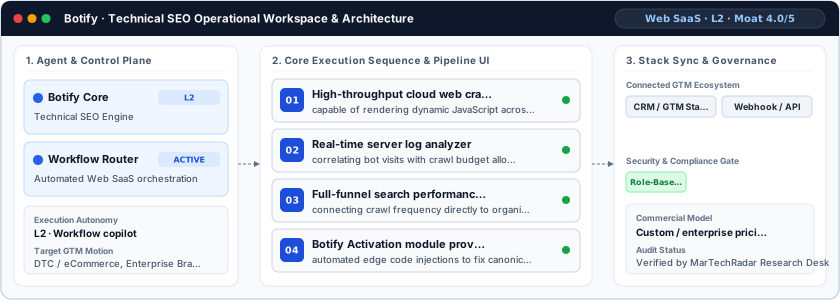
- High-throughput cloud web crawler: capable of rendering dynamic JavaScript across millions of URLs
- Real-time server log analyzer: correlating bot visits with crawl budget allocations and index coverage
- Full-funnel search performance attribution: connecting crawl frequency directly to organic impressions and revenue
- Botify Activation module providing: automated edge code injections to fix canonical tags, pagination, and internal links
Cons: operational limitations & risks
- CDN and Log Pipeline Overhead: Deployment requires engineering integration with CDN log streaming or S3 ingestion buckets, creating initial onboarding latency when security teams audit log access permissions.
- JavaScript Rendering Credit Constraints: Executing full Headless Chrome rendering across deep architectures consumes heavy cloud computing units, requiring selective URL sample rules on secondary catalog facets.
- Dynamic URL Facet Maintenance: Catalog redesigns and unhandled query parameters can generate multi-million URL crawl traps, necessitating manual exclusion configurations to prevent data skewing.
Botify TCO & deal-breaker stress test
Simulate 12-month stepped TCO, hidden cost multipliers, contract lock-in exposure, and stack failure modes using only facts verified by MarTechRadar Research Desk on 2026-10-06.
Botify triggers high-severity friction under your 5-seat / $800/mo constraints. Benchmark the verified subtrack alternatives below before committing.
- Moat Score
- 4.0 / 5.0
- AI Autonomy
- L2
- Free Tier / Trial
- None disclosed
Triggered audit signals & failure modes
- Opaque Enterprise Quoting vs. SMB/Mid-Market BudgetVerified Pricing Ledger
Botify does not disclose a public self-serve floor (Custom / enterprise pricing). Buyers with a $800/mo cap face high sales-qualification friction.
- Sales-Gated Contract TermsFact-checked by MarTechRadar Research Desk
Commercial access is available on request through tailored enterprise sales quotes based on organizational scale and seats.
- Primary Operational Bottleneck: JavaScript Rendering Credit ConstraintsAudit by MarTechRadar Research Desk
Executing full Headless Chrome rendering across deep architectures consumes heavy cloud computing units, requiring selective URL sample rules on secondary catalog facets.
Test a custom Botify budget or stack constraint
Lower 5-seat floor (~$145/mo vs. Custom Quote) · Transparent self-serve entry without mandatory annual lock-in
Lower 5-seat floor (~$139/mo vs. Custom Quote) · Transparent self-serve entry without mandatory annual lock-in
Botify AI moat & Technical SEO positioning
Botify maintains an analytical moat through its unified data model linking cloud crawl data directly with edge server access logs at enterprise scale, paired with CDN-level automated remediation capabilities.
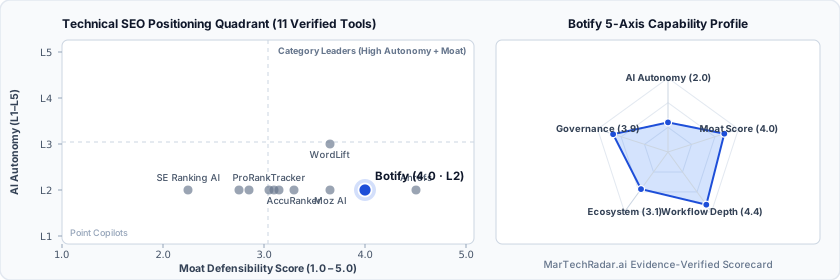
Botify in-depth review, pricing & architecture analysis
Editor sign-off: Oct 6, 2026. How profiles are made.
What is Botify? Overview & background
Architectural fragmentation between server log pipelines, client-side JavaScript rendering, and search engine crawler behavior creates indexing gaps on high-velocity domains. Botify was established in 2012 in Paris, France, to resolve this data divergence across multi-million URL estates. Backed by $82.0M in venture funding, the company engineers its technical SEO auditing infrastructure specifically for technical search directors, web operations leads, and software engineering teams managing large e-commerce catalogs and content publishing platforms.
How Botify works: architecture & workflow
Botify couples a distributed cloud crawler with a high-throughput server log ingestion engine, operating at an L3 technical autonomy tier. The crawler renders single-page and server-side applications at multi-thousand pages per second, parsing internal linking graphs and status codes. In parallel, its log parsing pipeline ingests raw HTTP web server and CDN access logs (such as Cloudflare and Fastly). The platform cross-references these datasets to uncover orphan pages, identify crawl budget traps, and evaluate Googlebot request efficiency. Edge-layer workers allow engineers to deploy canonical tags and indexing instructions without core codebase redeployments.
Botify limitations, drawbacks & risks
Operational considerations and platform boundaries include:
- CDN and Log Pipeline Overhead: Deployment requires engineering integration with CDN log streaming or S3 ingestion buckets, creating initial onboarding latency when security teams audit log access permissions.
- JavaScript Rendering Credit Constraints: Executing full Headless Chrome rendering across deep architectures consumes heavy cloud computing units, requiring selective URL sample rules on secondary catalog facets.
- Dynamic URL Facet Maintenance: Catalog redesigns and unhandled query parameters can generate multi-million URL crawl traps, necessitating manual exclusion configurations to prevent data skewing.
Botify pricing, plans & cost breakdown
Commercial access is available on request through tailored enterprise sales quotes based on organizational scale and seats. The subscription model packages licensing tiers primarily governed by total annual URL crawl capacity, log file processing volume, and access to CDN-level edge activation capabilities.
| Plan / Tier | Verified Price & Billing | Included Scope & Contract Terms |
|---|---|---|
| Enterprise / Custom | Custom quote | Custom-quoted plan; terms come from the vendor's sales team. |
How Botify compares vs. competitors & alternatives
Within enterprise technical SEO, Botify competes against desktop auditing applications like Screaming Frog SEO and Sitebulb, enterprise organic marketing suites like Conductor AI, and all-in-one search analytics platforms like Ahrefs and Semrush. While Screaming Frog SEO and Sitebulb provide deep local crawls for domains under several hundred thousand URLs, and Ahrefs and Semrush focus on off-page backlink graphs and keyword research, Botify combines a centralized cloud crawler, native CDN server log ingestion, and edge remediation for catalogs scaling beyond ten million pages.
Direct competitors & market radar
Top algorithmic competitors based on category positioning, capability overlap, and ICP alignment.
Frequently asked questions about Botify
Does Botify publish pricing or require an enterprise quote?
Botify pricing: Custom / enterprise pricing. No free plan is publicly disclosed. Commercial access is available on request through tailored enterprise sales quotes based on organizational scale and seats.
What are the top Botify alternatives in Technical SEO?
Verified Technical SEO alternatives include Semrush (Free plan · $139–$299/mo), Ahrefs (Free plan · $29–$1,499/mo), Quattr (Custom / enterprise pricing), Conductor AI (Custom / enterprise pricing). Within enterprise technical SEO, Botify competes against desktop auditing applications like Screaming Frog SEO and Sitebulb, enterprise organic marketing suites like Conductor AI, and all-in-one search analytics platforms like Ahrefs and Semrush.
What are the main limitations and trade-offs of Botify?
Operational considerations and platform boundaries include: CDN and Log Pipeline Overhead: Deployment requires engineering integration with CDN log streaming or S3 ingestion buckets, creating initial onboarding latency when security teams audit log access permissions. Walk away if you need published self-serve pricing: Botify is sold by custom quote.
Verified sources & evidence trail
- Official product domain: https://botify.com
- Commercial pricing verification: Verified against official vendor pricing policy (Custom / enterprise pricing)
- Verified corporate entity profiles (
sameAs): LinkedIn Company Profile · Crunchbase Entity Record - Editor sign-off: Oct 6, 2026 (how profiles are made).
