Sitebulb Review (2026): Technical SEO Pricing, Pros & Cons
Bottom line
Sitebulb is a Web SaaS tool for Technical SEO (Technical SEO Auditing & Indexing) in GEO & AI SEO. Pricing: $11–$125/mo. Best suited to DTC / eCommerce and Enterprise Brands. Editor ratings: AI autonomy L2 (workflow copilot); moat score 2.3/5.0 (Workflow-embedded). Fact-checked by MarTechRadar Research Desk on Oct 7, 2026.
Technical website crawler offering desktop and cloud-based site auditing with visual crawl maps, JavaScript rendering, and automated issue prioritization.
Is Sitebulb worth it in 2026? Buyer fit & when to walk away
Choose Sitebulb if (Best Fit)
- Target ICP & Stack Fit: You operate as DTC / eCommerce and Enterprise Brands requiring a Web SaaS deployment for Technical SEO, with verified ecosystem connectivity for Google Analytics 4 (GA4), Google Search Console, Model Context Protocol (MCP).
- L2 Architecture & Defensibility: Sitebulb maintains differentiation through its proprietary diagnostic hints engine that converts raw structural crawl telemetry into prioritized visual explanations, paired with native Model Context Protocol (MCP) endpoints for local LLM orchestration.
- Commercial Model Fit: Your procurement budget aligns with $11–$125/mo.
Walk away from Sitebulb if (Deal-Breakers)
- Walk away if you need off-page backlink prospecting and competitor keyword gap databases.
Sitebulb pricing, free plan & scorecard at a glance
| Pricing | $11–$125/moVendor pricing page |
|---|---|
| Free plan | No / not disclosed |
| Delivery | Web SaaS |
| Audience | DTC / eCommerce, Enterprise Brands |
| AI autonomy level | L2 · Workflow copilotEditor-verified |
| Moat tier & score | 2.3 / 5.0 · Workflow-embeddedEditor-verified |
| Funding | Bootstrapped |
| Company size | 2-10 employees |
| Ecosystem integrations | Google Analytics 4 (GA4), Google Search Console, Model Context Protocol (MCP) |
| Governance & docs | Changelog ↗ |
| Headquarters | Biddenden, United Kingdom |
| Founded | 2017 |
| Last verified | Oct 7, 2026 |
Sitebulb pros & cons: strengths vs. operational limitations
Pros: core strengths & capabilities
- Dual-engine crawling supporting standard: HTML parsing alongside headless Chromium JavaScript rendering
- Automated diagnostic audit hints scoring: across more than 300 technical SEO issues
- Interactive crawl maps visualizing: internal link topology and directory depth
- Integration: with Google Search Console, Google Analytics, and external data exports
Cons: operational limitations & risks
- Local Hardware Resource Contention: Desktop installations depend heavily on local CPU and RAM availability during headless Chromium JavaScript execution, triggering performance bottlenecks on multi-hundred-thousand-URL crawls.
- Rendering Queue Latency: Heavy client-side single-page applications cause rendering wait states, slowing audit completion rates compared to non-rendering HTML crawlers on extensive inventories.
- Lack of Autonomous Remediation: The system identifies routing and tag anomalies but cannot automatically push edge-level code changes or canonical updates to origin production servers.
Sitebulb TCO & deal-breaker stress test
Simulate 12-month stepped TCO, hidden cost multipliers, contract lock-in exposure, and stack failure modes using only facts verified by MarTechRadar Research Desk on 2026-10-07 · Capture SHA 256c796f.
Sitebulb aligns with your 5-seat / $800/mo profile. Review the walk-away triggers and contract levers below before deployment.
- Moat Score
- 2.3 / 5.0
- AI Autonomy
- L2
- Free Tier / Trial
- None disclosed
Triggered audit signals & failure modes
- Published Self-Serve Entry FloorVerified Pricing Ledger
Sitebulb publishes a transparent entry point ($11–$125/mo) for initial validation before committing.
- Linear Per-Seat Scaling (5 Seats × $11/seat/mo)Commercial Model Audit
Base license scales linearly with operator headcount ($55/mo for 5 seats on Pro Desktop).
- Primary Operational Bottleneck: Local Hardware Resource ContentionAudit by MarTechRadar Research Desk
Desktop installations depend heavily on local CPU and RAM availability during headless Chromium JavaScript execution, triggering performance bottlenecks on multi-hundred-thousand-URL crawls.
Test a custom Sitebulb budget or stack constraint
Lower 5-seat floor (~$83/mo vs. $86 / mo)
Fits within $800/mo budget (Free plan · $29–$1,499/mo)
Sitebulb integrations, API, security & compliance stack
Sitebulb AI moat & Technical SEO positioning
Sitebulb maintains differentiation through its proprietary diagnostic hints engine that converts raw structural crawl telemetry into prioritized visual explanations, paired with native Model Context Protocol (MCP) endpoints for local LLM orchestration.
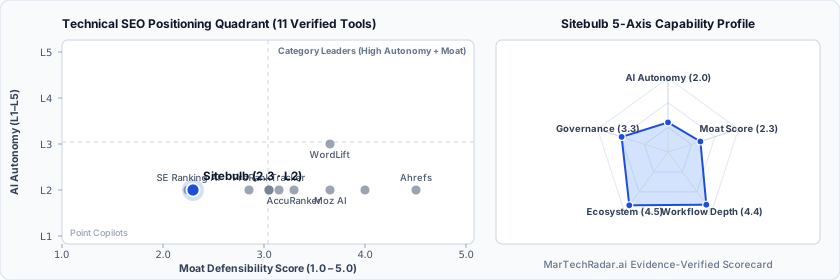
Sitebulb in-depth review, pricing & architecture analysis
Editor sign-off: Oct 7, 2026. How profiles are made.
What is Sitebulb? Overview & background
For technical search consultants and agency auditors tasked with resolving site architecture defects, Sitebulb automates deep crawl diagnostics and prioritization. Headquartered in Biddenden, United Kingdom, and founded in 2017, the vendor engineers specialized website analysis software deployed across desktop and cloud infrastructure. Instead of delivering unformatted tabular data dumps, the system organizes crawl graphs, JavaScript execution states, and indexability signals into structured diagnostic narratives tailored for webmasters and digital marketing engineers.
How Sitebulb works: architecture & workflow
Sitebulb functions through a multi-threaded web crawler paired with a headless Chromium rendering environment to parse client-side code and document object model updates. The ingestion pipeline queries target domains, logging response headers, internal anchor topology, canonical directives, structured data validation, and asset latency. Telemetry is evaluated by a rule-based diagnostic engine checking against 300 preconfigured failure modes. Operating at an L2 autonomy level, it calculates dependency paths, visualizes internal linking structures, and feeds raw audit telemetry directly to local AI agents via a dedicated Model Context Protocol interface.
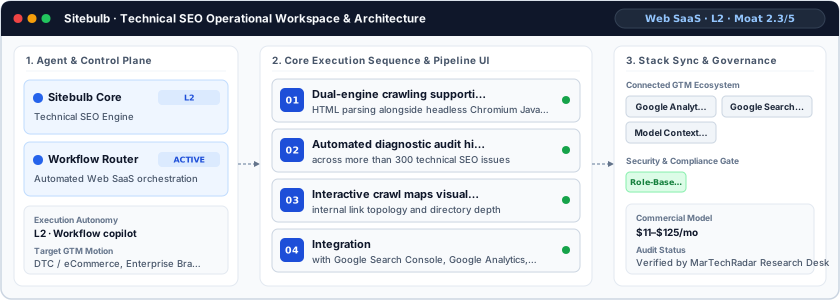
Sitebulb limitations, drawbacks & risks
Operational considerations and platform boundaries include:
- Local Hardware Resource Contention: Desktop installations depend heavily on local CPU and RAM availability during headless Chromium JavaScript execution, triggering performance bottlenecks on multi-hundred-thousand-URL crawls.
- Rendering Queue Latency: Heavy client-side single-page applications cause rendering wait states, slowing audit completion rates compared to non-rendering HTML crawlers on extensive inventories.
- Lack of Autonomous Remediation: The system identifies routing and tag anomalies but cannot automatically push edge-level code changes or canonical updates to origin production servers.
Sitebulb pricing, plans & cost breakdown
Commercial access operates across modular monthly tiers spanning desktop installs and hosted cloud instances. Entry pricing begins at $11 per month for single-project or localized usage scopes, scaling through standard packages at $18 and $42 monthly based on seat allocations and URL quotas. Enterprise-grade server instances and scaled cloud crawl capacities reach $125 per month, with all commercial tiers granting access to core audit rules, rendering capabilities, and the Model Context Protocol connector.
| Plan / Tier | Verified Price & Billing | Included Scope & Contract Terms | |
|---|---|---|---|
| Lite Desktop | $18/mo | Entry desktop technical SEO auditor with visual crawl maps and prioritized hints. | |
| Pro Desktop | $42/mo | Up to 500k URLs/audit, headless Chrome JS rendering, MCP support; extra desktop users cost $11/mo each above the $42/mo base seat. | |
| Cloud Server | $125/mo | Hosted cloud crawler with scheduled audits, shared team access, and zero local RAM bottlenecks. | |
| Contract Watchout: Technical Crawler Only (No Backlink Index) | Sitebulb replaces Ahrefs Site Audit credit burn ($18-$125/mo), but does not include an external backlink or keyword volume database. | ||
How Sitebulb compares vs. competitors & alternatives
Sitebulb differentiates from Screaming Frog by offering visual diagnostic hierarchies and interpreted hints rather than purely tabular data outputs. However, Screaming Frog provides greater command-line scripting flexibility on local environments. Against enterprise cloud crawlers like Botify, Sitebulb trades native log-file integration and multi-million-page real-time data ingestion for lightweight operational setups and accessible cost structures. It remains optimized for mid-market technical teams and agencies needing high visual audit clarity without multi-month platform onboardings.
Frequently asked questions about Sitebulb
How much does Sitebulb cost in 2026?
Sitebulb pricing: $11–$125/mo. No free plan is publicly disclosed. Published tiers: Lite Desktop ($18/mo); Pro Desktop ($42/mo); Cloud Server ($125/mo). Commercial access operates across modular monthly tiers spanning desktop installs and hosted cloud instances.
What are the top Sitebulb alternatives in Technical SEO?
Verified Technical SEO alternatives include Lumar (DeepCrawl) (Custom / enterprise pricing), Botify (Custom / enterprise pricing), WordLift (From $799/yr), Ahrefs (Free plan · $29–$1,499/mo). Sitebulb differentiates from Screaming Frog by offering visual diagnostic hierarchies and interpreted hints rather than purely tabular data outputs.
What are the main limitations and trade-offs of Sitebulb?
Operational considerations and platform boundaries include: Local Hardware Resource Contention: Desktop installations depend heavily on local CPU and RAM availability during headless Chromium JavaScript execution, triggering performance bottlenecks on multi-hundred-thousand-URL crawls. Walk away if you need off-page backlink prospecting and competitor keyword gap databases.
Verified sources & evidence trail
- Official product domain: https://sitebulb.com
- Commercial pricing verification: https://sitebulb.com/subscriptions/pricing/index/?annual=false
- Verified corporate entity profiles (
sameAs): LinkedIn Company Profile · Crunchbase Entity Record - First-party governance & documentation links: Changelog
- Editor sign-off: Oct 7, 2026 (how profiles are made).
