Yoast AI Review (2026): Content Optimization Pricing, Pros & Cons
Bottom line
Yoast AI is a Web SaaS tool for Content Optimization (Content Optimization & SERP Intelligence) in GEO & AI SEO. Pricing: Custom / enterprise pricing. Best suited to DTC / eCommerce and Creators / Solo. Editor ratings: AI autonomy L2 (workflow copilot); moat score 4.1/5.0 (Proprietary moat). Fact-checked by MarTechRadar Research Desk on Oct 15, 2026.
WordPress-native content optimization engine utilizing embedded generative models to automate on-page search metadata and readability scoring.
Is Yoast AI worth it in 2026? Buyer fit & when to walk away
Choose Yoast AI if (Best Fit)
- Target ICP & Stack Fit: You operate as DTC / eCommerce and Creators / Solo requiring a Web SaaS deployment for Content Optimization, with verified ecosystem connectivity for Shopify, WooCommerce, WordPress.
- L2 Architecture & Defensibility: Deep structural integration within the WordPress Gutenberg editor ecosystem paired with differentiated distribution across millions of production CMS deployments.
- Commercial Model Fit: Your procurement budget aligns with Custom / enterprise pricing.
Walk away from Yoast AI if (Deal-Breakers)
- Walk away if you need published self-serve pricing: Yoast AI is sold by custom quote.
- Walk away if your workflow cannot tolerate ecosystem coupling: Execution remains strictly bound to the WordPress CMS runtime, preventing native deployment across headless React frontends or competing architectures without custom decoupling.
- Walk away if inference latency is a deal-breaker for your team: Outbound API calls for automated title and meta description generation can introduce synchronous UI blocking within the post editor during network latency spikes.
Yoast AI pricing, free plan & scorecard at a glance
| Pricing | Custom / enterprise pricing |
|---|---|
| Free plan | No / not disclosed |
| Delivery | Web SaaS |
| Audience | DTC / eCommerce, Creators / Solo |
| AI autonomy level | L2 · Workflow copilotEditor-verified |
| Moat tier & score | 4.1 / 5.0 · Proprietary moatEditor-verified |
| Funding | AcquiredAcquired by Newfold Digital |
| Founders | Joost de Valk |
| Company size | 51-200 employees |
| Ecosystem integrations | Shopify, WooCommerce, WordPress |
| Governance & docs | API & Docs ↗ · Terms ↗ · Privacy ↗ |
| Headquarters | Wijchen, Gelderland |
| Founded | 2010 |
| Last verified | Oct 15, 2026 |
Yoast AI pros & cons: strengths vs. operational limitations
Pros: core strengths & capabilities
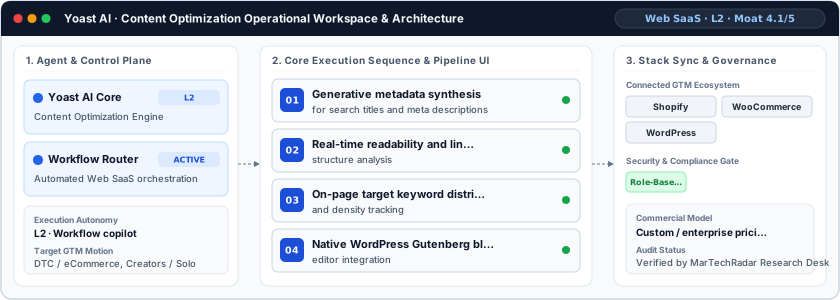
- Generative metadata synthesis: for search titles and meta descriptions
- Real-time readability and linguistic: structure analysis
- On-page target keyword distribution and density tracking
- Native WordPress Gutenberg block: editor integration
Cons: operational limitations & risks
- Ecosystem Coupling: Execution remains strictly bound to the WordPress CMS runtime, preventing native deployment across headless React frontends or competing architectures without custom decoupling.
- Inference Latency: Outbound API calls for automated title and meta description generation can introduce synchronous UI blocking within the post editor during network latency spikes.
- Corpus Context Window: Generative recommendations evaluate isolated single-post payloads rather than full site domain taxonomies, risking topical cannibalization across parallel content assets.
Yoast AI TCO & deal-breaker stress test
Simulate 12-month stepped TCO, hidden cost multipliers, contract lock-in exposure, and stack failure modes using only facts verified by MarTechRadar Research Desk on 2026-10-15.
Yoast AI triggers high-severity friction under your 5-seat / $800/mo constraints. Benchmark the verified subtrack alternatives below before committing.
- Moat Score
- 4.1 / 5.0
- AI Autonomy
- L2
- Free Tier / Trial
- None disclosed
Triggered audit signals & failure modes
- Opaque Enterprise Quoting vs. SMB/Mid-Market BudgetVerified Pricing Ledger
Yoast AI does not disclose a public self-serve floor (Custom / enterprise pricing). Buyers with a $800/mo cap face high sales-qualification friction.
- Sales-Gated Contract TermsFact-checked by MarTechRadar Research Desk
Yoast AI is distributed through structured commercial tiers aligned with Yoast SEO subscription bundles. Commercial pricing is available on request through tailored enterprise sales quotes based on organizational scale and seats.
- Primary Operational Bottleneck: Ecosystem CouplingAudit by MarTechRadar Research Desk
Execution remains strictly bound to the WordPress CMS runtime, preventing native deployment across headless React frontends or competing architectures without custom decoupling.
Test a custom Yoast AI budget or stack constraint
Lower 5-seat floor (~$39/mo vs. Custom Quote) · Transparent self-serve entry without mandatory annual lock-in
Lower 5-seat floor (~$50/mo vs. Custom Quote) · Transparent self-serve entry without mandatory annual lock-in
Yoast AI integrations, API, security & compliance stack
Yoast AI AI moat & Content Optimization positioning
Deep structural integration within the WordPress Gutenberg editor ecosystem paired with differentiated distribution across millions of production CMS deployments.
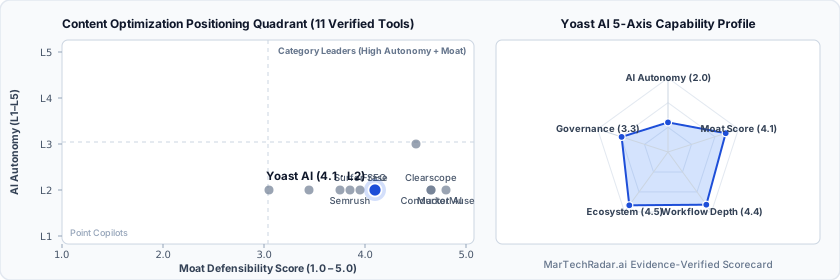
Yoast AI in-depth review, pricing & architecture analysis
Editor sign-off: Oct 15, 2026. How profiles are made.
What is Yoast AI? Overview & background
Established in 2010 in Wijchen, Gelderland, and later acquired by Newfold Digital, Yoast developed Yoast AI to extend its content optimization ecosystem directly within web publishing workflows. Serving digital editors, enterprise content strategists, and in-house search marketers, the platform addresses the mechanical overhead of manual on-page search metadata generation. By embedding contextual language generation into the native content management system, Yoast AI shifts routine search compliance from external spreadsheets into the core editorial publishing interface.
How Yoast AI works: architecture & workflow
Operating at an L2 autonomy tier, Yoast AI acts as an in-line assistant embedded within the WordPress Gutenberg block editor. The system ingests the raw document Object Model, parsing heading hierarchies, body text, and existing taxonomy tags. It runs syntactic analysis using deterministic heuristics for passive voice, transition word density, and Flesch reading ease. Concurrently, it routes sanitized document excerpts to external large language model endpoints to generate search titles and meta descriptions calibrated to target keyword constraints, requiring human editorial approval before persisting metadata to the database, alongside native workflow integrations for Shopify and WooCommerce.
Yoast AI limitations, drawbacks & risks
Operational considerations and platform boundaries include:
- Ecosystem Coupling: Execution remains strictly bound to the WordPress CMS runtime, preventing native deployment across headless React frontends or competing architectures without custom decoupling.
- Inference Latency: Outbound API calls for automated title and meta description generation can introduce synchronous UI blocking within the post editor during network latency spikes.
- Corpus Context Window: Generative recommendations evaluate isolated single-post payloads rather than full site domain taxonomies, risking topical cannibalization across parallel content assets.
Yoast AI pricing, plans & cost breakdown
Yoast AI is distributed through structured commercial tiers aligned with Yoast SEO subscription bundles. Commercial pricing is available on request through tailored enterprise sales quotes based on organizational scale and seats. High-volume publishing operations and agency networks negotiate specialized enterprise agreements covering multi-site environments, aggregated API consumption, centralized account governance, and priority technical support.
| Plan / Tier | Verified Price & Billing | Included Scope & Contract Terms |
|---|---|---|
| Enterprise / Custom | Custom quote | Custom-quoted plan; terms come from the vendor's sales team. |
How Yoast AI compares vs. competitors & alternatives
Within the Content Optimization sector, Yoast AI competes directly against WordPress-native SEO plugins like All in One SEO, standalone semantic editors like Surfer SEO, Clearscope, and Frase, and off-page search intelligence platforms like Ahrefs and Semrush. Unlike Ahrefs and Semrush, which operate expansive external crawl indexes and competitive SERP databases outside the CMS, Yoast AI optimizes on-page metadata and readability directly inside the WordPress authoring canvas.
Direct competitors & market radar
Top algorithmic competitors based on category positioning, capability overlap, and ICP alignment.
Frequently asked questions about Yoast AI
Does Yoast AI publish pricing or require an enterprise quote?
Yoast AI pricing: Custom / enterprise pricing. No free plan is publicly disclosed. Yoast AI is distributed through structured commercial tiers aligned with Yoast SEO subscription bundles. Commercial pricing is available on request through tailored enterprise sales quotes based on organizational scale and seats.
What are the top Yoast AI alternatives in Content Optimization?
Verified Content Optimization alternatives include WordLift (From $799/yr), Frase ($39–$239/mo), All in One SEO (From $49.50/mo), Taja AI (From $15.99/mo). Within the Content Optimization sector, Yoast AI competes directly against WordPress-native SEO plugins like All in One SEO, standalone semantic editors like Surfer SEO, Clearscope, and Frase, and off-page search intelligence platforms like Ahrefs and Semrush.
What are the main limitations and trade-offs of Yoast AI?
Operational considerations and platform boundaries include: Ecosystem Coupling: Execution remains strictly bound to the WordPress CMS runtime, preventing native deployment across headless React frontends or competing architectures without custom decoupling. Walk away if you need published self-serve pricing: Yoast AI is sold by custom quote.
Verified sources & evidence trail
- Official product domain: https://yoast.com
- Commercial pricing verification: Verified against official vendor pricing policy (Custom / enterprise pricing)
- Verified corporate entity profiles (
sameAs): LinkedIn Company Profile · Crunchbase Entity Record - First-party governance & documentation links: API & Docs · Terms · Privacy
- Editor sign-off: Oct 15, 2026 (how profiles are made).
