Reo.Dev Review (2026): AI SDR Pricing, Limits & Alternatives
Bottom line
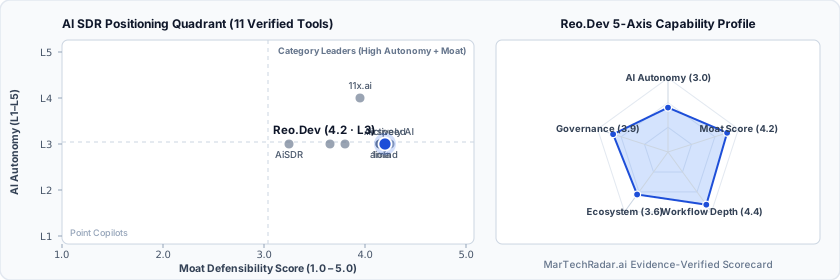
Reo.Dev is a Web SaaS tool for AI SDR (Autonomous B2B Sales Agents & AI BDRs) in AI SDR & Outbound. Pricing: Custom / enterprise pricing. Best suited to B2B Sales Leaders, SDR/BDR Teams and Revenue Operations (RevOps). Editor ratings: AI autonomy L3 (conditional automation); moat score 4.2/5.0 (Proprietary moat). Fact-checked by Anthony Hay on Oct 12, 2026.
Reo.Dev delivers an autonomous technical revenue mesh that decodes developer intent signals to drive outbound sales for enterprise developer-tool vendors.
Reo.Dev buyer fit verdict: when to choose vs. when to walk away
Choose Reo.Dev if (Best Fit)
- Target ICP & Stack Fit: You operate as B2B Sales Leaders, SDR/BDR Teams and Revenue Operations (RevOps) requiring a Web SaaS deployment for AI SDR, with verified ecosystem connectivity for Outreach.
- L3 Architecture & Defensibility: Defensibility stems from a proprietary technical identity graph linking anonymous developer activity across open-source code repositories, SDK package registries, and API docs to verified enterprise accounts.
- Commercial Model Fit: Your procurement budget aligns with Custom / enterprise pricing.
Walk away from Reo.Dev if (Deal-Breakers)
- Walk away if you require transparent self-serve monthly billing or your budget ceiling is under $1,000/mo (Reo.Dev requires sales-gated custom quoting).
- Walk away if your workflow cannot tolerate attribution obfuscation: Corporate VPNs, dynamic developer proxies, and private code forks often degrade IP-to-domain resolution accuracy, introducing noise into target account identification.
- Walk away if open-source noise is a deal-breaker for your team: High-volume student activity, bot commits, and non-commercial open-source hobbyists frequently trigger false positive intent alerts that require manual filtering rules.
Reo.Dev key facts & scorecard
| Pricing | Custom / enterprise pricing |
|---|---|
| Free plan | No / not disclosed |
| Delivery | Web SaaS |
| Audience | B2B Sales Leaders, SDR/BDR Teams, Revenue Operations (RevOps) |
| AI autonomy level | L3 · Conditional automationEditor-verified |
| Moat tier & score | 4.2 / 5.0 · Proprietary moatEditor-verified |
| Funding | Series A |
| Total funding | $20.4MBacked by Elevation Capital |
| Founders | Achintya Gupta, Gaurav Jain, Piyush Agarwal |
| Company size | 11-50 employees |
| Ecosystem integrations | Outreach |
| Governance & docs | System Status ↗ · API & Docs ↗ · Changelog ↗ · Terms ↗ · Privacy ↗ |
| Headquarters | San Francisco |
| Founded | 2023 |
| Last verified |
Reo.Dev pros & cons: strengths vs. operational limitations
Pros: core strengths & capabilities
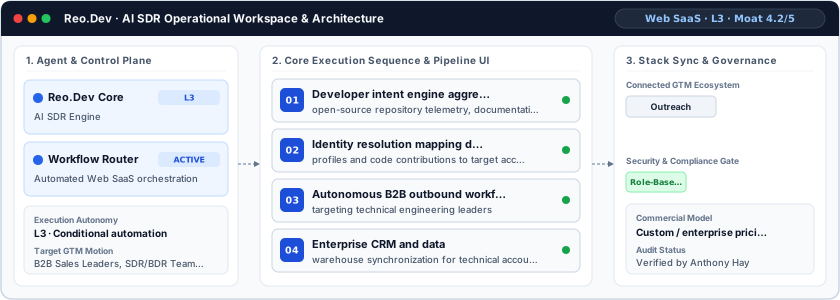
- Developer intent engine aggregating: open-source repository telemetry, documentation visits, and package downloads
- Identity resolution mapping developer: profiles and code contributions to target accounts
- Autonomous B2B outbound workflows: targeting technical engineering leaders
- Enterprise CRM and data: warehouse synchronization for technical account scoring
Cons: operational limitations & risks
- Attribution Obfuscation: Corporate VPNs, dynamic developer proxies, and private code forks often degrade IP-to-domain resolution accuracy, introducing noise into target account identification.
- Open-Source Noise: High-volume student activity, bot commits, and non-commercial open-source hobbyists frequently trigger false positive intent alerts that require manual filtering rules.
- Outbound Velocity Bounds: Engineering audiences exhibit severe backlash against aggressive automated outreach, enforcing lower outreach volume caps compared to traditional sales agent platforms.
Reo.Dev TCO & deal-breaker stress test
Simulate 12-month stepped TCO, hidden cost multipliers, contract lock-in exposure, and stack failure modes using only facts verified by Anthony Hay on · Capture SHA 0518e7e8.
Reo.Dev triggers high-severity friction under your 5-seat / $800/mo constraints. Benchmark the verified subtrack alternatives below before committing.
| Plan / Tier | Verified Rate | Scale Fit | Scope & Quota Notes |
|---|---|---|---|
| Enterprise / Custom | Custom quote | 15–50+ seats (Enterprise SLA) | Sales-negotiated annual contract for custom volume, SSO/RBAC governance, and dedicated SLA. |
- Moat Score
- 4.2 / 5.0
- AI Autonomy
- L3
- Free Tier / Trial
- None disclosed
Triggered audit signals & failure modes
- Opaque Enterprise Quoting vs. SMB/Mid-Market BudgetVerified Pricing Ledger
Reo.Dev does not disclose a public self-serve floor (Custom / enterprise pricing). Buyers with a $800/mo cap face high sales-qualification friction.
- Sales-Gated Contract TermsFact-checked by Anthony Hay
Commercial pricing is available on request through tailored enterprise sales quotes based on organizational scale and seats.
- Primary Operational Bottleneck: Attribution ObfuscationAudit by Anthony Hay
Corporate VPNs, dynamic developer proxies, and private code forks often degrade IP-to-domain resolution accuracy, introducing noise into target account identification.
Hidden TCO Multipliers & Quota Gates
- Attribution Obfuscation: Corporate VPNs, dynamic developer proxies, and private code forks often degrade IP-to-domain resolution accuracy, introducing noise into target account identification.
- Open-Source Noise: High-volume student activity, bot commits, and non-commercial open-source hobbyists frequently trigger false positive intent alerts that require manual filtering rules.
When to Walk Away & Negotiation Levers
- Walk away if you require transparent self-serve monthly billing or your budget ceiling is under $1,000/mo (Reo.Dev requires sales-gated custom quoting).
- Walk away if your workflow cannot tolerate attribution obfuscation: Corporate VPNs, dynamic developer proxies, and private code forks often degrade IP-to-domain resolution accuracy, introducing noise into target account identification.
- Walk away if open-source noise is a deal-breaker for your team: High-volume student activity, bot commits, and non-commercial open-source hobbyists frequently trigger false positive intent alerts that require manual filtering rules.
- Demand a 30- to 60-day paid pilot opt-out clause in the Reo.Dev order form before signing a 12-month enterprise commitment.
- Require a sandbox proof-of-concept testing attribution obfuscation against your live CRM/data schema before annual sign-off.
Ask a custom procurement or TCO stress-test question about Reo.Dev
Offers a free tier (Free plan · $0/mo · Enterprise plan) · Transparent self-serve entry without mandatory annual lock-in
Verified AI SDR peer (Custom / enterprise pricing · Moat 4.2/5.0)
Reo.Dev key entities, modules & ecosystem stack
Reo.Dev moat & subtrack positioning
Defensibility stems from a proprietary technical identity graph linking anonymous developer activity across open-source code repositories, SDK package registries, and API docs to verified enterprise accounts.
Editorial review
Fact-checked by Anthony Hay (Senior SEO, Search Intelligence & Content Operations Editor) on .
Background
Architected as a specialized revenue intelligence layer, Reo.Dev provides an autonomous go-to-market platform focused on tracking engineering and developer buyer intent. Established in 2023 and headquartered in San Francisco, the venture has raised $20.4M in institutional funding to capture pre-pipeline signals across developer ecosystems. The platform directly targets vice presidents of sales, developer relations leaders, and revenue operations directors at developer-first tooling, infrastructure, and API software vendors.
How Reo.Dev works
Reo.Dev deploys an event ingestion mesh that captures open-source code activity, documentation usage, package manager downloads, and public repository engagements. Operating at an autonomous L3 execution tier, the system maps non-traditional intent signals to target corporate accounts via an identity resolution engine. Once developer interest crosses intent thresholds, algorithmic scoring pipelines trigger autonomous outreach workflows and pipe prioritized accounts into existing revenue operations tools.
Limitations
Operational considerations and platform boundaries include:
- Attribution Obfuscation: Corporate VPNs, dynamic developer proxies, and private code forks often degrade IP-to-domain resolution accuracy, introducing noise into target account identification.
- Open-Source Noise: High-volume student activity, bot commits, and non-commercial open-source hobbyists frequently trigger false positive intent alerts that require manual filtering rules.
- Outbound Velocity Bounds: Engineering audiences exhibit severe backlash against aggressive automated outreach, enforcing lower outreach volume caps compared to traditional sales agent platforms.
Reo.Dev pricing
Commercial pricing is available on request through tailored enterprise sales quotes based on organizational scale and seats. The procurement structure functions as an annual software subscription tied to monitored account volume, data pipeline consumption, and integrated sales representative seats, excluding public list prices.
How Reo.Dev compares
Within autonomous sales agent environments, general-purpose engines like 11x.ai focus on broad business-to-business pipeline generation, while platforms like 1mind and Actively AI prioritize multi-channel cadence automation. Reo.Dev differentiates through deep technical intent graphing, replacing generic firmographics with open-source and API telemetry. The system fits commercial sales organizations selling complex cloud infrastructure, cybersecurity tooling, and software developer kits to technical leadership.
Direct competitors & market radar
Top algorithmic competitors based on category positioning, capability overlap, and ICP alignment.
Frequently asked questions about Reo.Dev
How much does Reo.Dev cost and does it require a custom enterprise quote?
Published pricing summary for Reo.Dev: Custom / enterprise pricing. A permanent free plan is not disclosed for Reo.Dev. Commercial pricing is available on request through tailored enterprise sales quotes based on organizational scale and seats.
How does Reo.Dev work and how autonomous is its AI architecture?
Reo.Dev delivers an autonomous technical revenue mesh that decodes developer intent signals to drive outbound sales for enterprise developer-tool vendors. Within AI SDR (Autonomous B2B Sales Agents & AI BDRs), MarTechRadar rates its execution architecture at L3 · Conditional automation with a verified Moat Score of 4.2 / 5.0 (Proprietary moat). Defensibility stems from a proprietary technical identity graph linking anonymous developer activity across open-source code repositories, SDK package registries, and API docs to verified enterprise accounts. Corporate profile: Founded by Achintya Gupta, Gaurav Jain, Piyush Agarwal, operating at 11-50 employees scale.
What are the main limitations of Reo.Dev and when should buyers walk away?
Based on our editorial technical audit, key operational considerations and boundaries for Reo.Dev include: (1) Attribution Obfuscation: Corporate VPNs, dynamic developer proxies, and private code forks often degrade IP-to-domain resolution accuracy, introducing noise into target account identification. (2) Open-Source Noise: High-volume student activity, bot commits, and non-commercial open-source hobbyists frequently trigger false positive intent alerts that require manual filtering rules. (3) Outbound Velocity Bounds: Engineering audiences exhibit severe backlash against aggressive automated outreach, enforcing lower outreach volume caps compared to traditional sales agent platforms. Primary procurement walk-away rule: Walk away if you require transparent self-serve monthly billing or your budget ceiling is under $1,000/mo (Reo.Dev requires sales-gated custom quoting).
What integrations, compliance certifications, and contract terms apply to Reo.Dev?
Verified ecosystem and stack integrations include Outreach. First-party governance and developer endpoints verified on domain include: Status (https://status.reo.dev), API Docs (https://docs.reo.dev). Key TCO multiplier to watch: Attribution Obfuscation (Corporate VPNs, dynamic developer proxies, and private code forks often degrade IP-to-domain resolution accuracy, introducing noise into target account identification.) Before signing a contract, procurement teams should demand a 30- to 60-day paid pilot opt-out clause in the Reo.Dev order form before signing a 12-month enterprise commitment.
What are the best Reo.Dev alternatives and head-to-head competitors in 2026?
Top fact-checked alternatives to Reo.Dev in AI SDR (Autonomous B2B Sales Agents & AI BDRs) include Needle (Free plan · $0/mo · Enterprise plan), Pocus (Custom / enterprise pricing), qodek (Custom / enterprise pricing), RightBound (Custom / enterprise pricing). Within autonomous sales agent environments, general-purpose engines like 11x.ai focus on broad business-to-business pipeline generation, while platforms like 1mind and Actively AI prioritize multi-channel cadence automation.
Verified sources & evidence trail
- Official product domain: https://www.reo.dev
- Commercial pricing verification: Verified against official vendor pricing policy (Custom / enterprise pricing)
- Verified corporate entity profiles (
sameAs): LinkedIn Company Profile · Crunchbase Entity Record - First-party governance & documentation links: System Status · API & Docs · Changelog · Terms · Privacy
- Editorial audit sign-off: Fact-checked by Anthony Hay on under the MarTechRadar Evidence-Ledger Protocol.