Pocus Review (2026): AI SDR Pricing, Limits & Alternatives
Bottom line
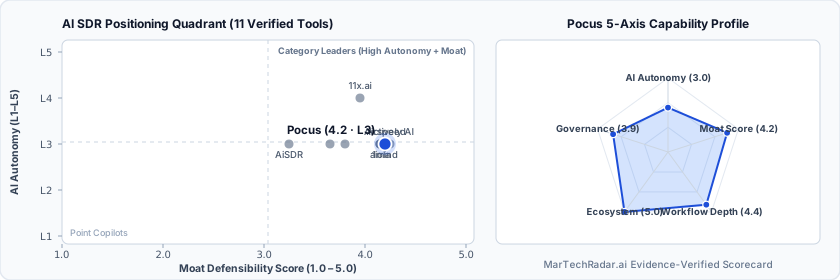
Pocus is a Web SaaS tool for AI SDR (Autonomous B2B Sales Agents & AI BDRs) in AI SDR & Outbound. Pricing: Custom / enterprise pricing. Best suited to B2B Sales Leaders, SDR/BDR Teams and Revenue Operations (RevOps). Editor ratings: AI autonomy L3 (conditional automation); moat score 4.2/5.0 (Proprietary moat). Fact-checked by Jagmeet Sine on Oct 12, 2026.
Product-led sales intelligence engine transforming event-level telemetry into actionable outbound prospecting signals and automated account prioritization.
Pocus buyer fit verdict: when to choose vs. when to walk away
Choose Pocus if (Best Fit)
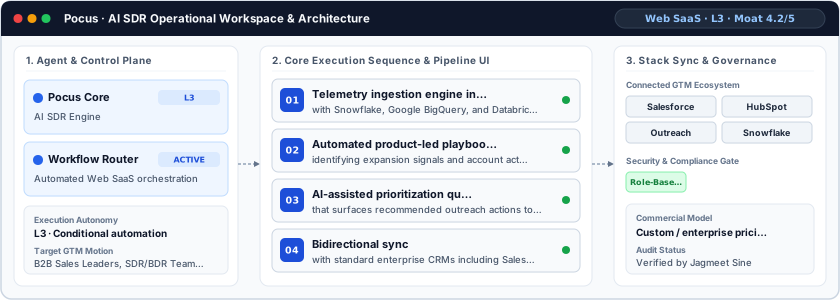
- Target ICP & Stack Fit: You operate as B2B Sales Leaders, SDR/BDR Teams and Revenue Operations (RevOps) requiring a Web SaaS deployment for AI SDR, with verified ecosystem connectivity for Salesforce, HubSpot, Outreach, Snowflake.
- L3 Architecture & Defensibility: Deep integration with cloud data warehouses and proprietary product telemetry aggregation rules, enabling sales teams to operationalize complex product usage signals without dedicated engineering resources.
- Commercial Model Fit: Your procurement budget aligns with Custom / enterprise pricing.
Walk away from Pocus if (Deal-Breakers)
- Walk away if you require transparent self-serve monthly billing or your budget ceiling is under $1,000/mo (Pocus requires sales-gated custom quoting).
- Walk away if your workflow cannot tolerate data warehouse schema dependency: The system requires well-modeled upstream telemetry tables, meaning changes to product event schemas or warehouse structures can break automated playbook evaluation rules.
- Walk away if event latency constraints is a deal-breaker for your team: Near-real-time account scoring depends heavily on underlying data warehouse sync cadences, often introducing operational batch delays of several hours.
Pocus key facts & scorecard
| Pricing | Custom / enterprise pricing |
|---|---|
| Free plan | No / not disclosed |
| Delivery | Web SaaS |
| Audience | B2B Sales Leaders, SDR/BDR Teams, Revenue Operations (RevOps) |
| AI autonomy level | L3 · Conditional automationEditor-verified |
| Moat tier & score | 4.2 / 5.0 · Proprietary moatEditor-verified |
| Funding | AcquiredAcquired by Apollo.io |
| Total funding | $23MBacked by Pear VC, BoxGroup |
| Founders | Alexa Grabell, Isaac Pohl-Zaretsky |
| Company size | 11-50 employees |
| Ecosystem integrations | Salesforce, HubSpot, Outreach, Snowflake, Google BigQuery, Databricks |
| Governance & docs | Terms ↗ · Privacy ↗ |
| Headquarters | San Francisco |
| Founded | 2021 |
| Last verified |
Pocus pros & cons: strengths vs. operational limitations
Pros: core strengths & capabilities
- Telemetry ingestion engine integrating: with Snowflake, Google BigQuery, and Databricks
- Automated product-led playbook triggers: identifying expansion signals and account activation thresholds
- AI-assisted prioritization queue: that surfaces recommended outreach actions to sales reps
- Bidirectional sync: with standard enterprise CRMs including Salesforce and HubSpot
Cons: operational limitations & risks
- Data Warehouse Schema Dependency: The system requires well-modeled upstream telemetry tables, meaning changes to product event schemas or warehouse structures can break automated playbook evaluation rules.
- Event Latency Constraints: Near-real-time account scoring depends heavily on underlying data warehouse sync cadences, often introducing operational batch delays of several hours.
- Rule Maintenance Overhead: Dynamic go-to-market workflows require continuous manual calibration of scoring criteria and activation thresholds as product packaging shifts.
Pocus TCO & deal-breaker stress test
Simulate 12-month stepped TCO, hidden cost multipliers, contract lock-in exposure, and stack failure modes using only facts verified by Jagmeet Sine on · Capture SHA b94b96a9.
Pocus triggers high-severity friction under your 5-seat / $800/mo constraints. Benchmark the verified subtrack alternatives below before committing.
| Plan / Tier | Verified Rate | Scale Fit | Scope & Quota Notes |
|---|---|---|---|
| Entry / Starter | $10/mo | 1–2 seats | hours saved per rep per week |
| Enterprise / Custom | Custom quote | 15–50+ seats (Enterprise SLA) | Sales-negotiated annual contract for custom volume, SSO/RBAC governance, and dedicated SLA. |
- Moat Score
- 4.2 / 5.0
- AI Autonomy
- L3
- Free Tier / Trial
- None disclosed
Triggered audit signals & failure modes
- Opaque Enterprise Quoting vs. SMB/Mid-Market BudgetVerified Pricing Ledger
Pocus does not disclose a public self-serve floor (Custom / enterprise pricing). Buyers with a $800/mo cap face high sales-qualification friction.
- Sales-Gated Contract TermsFact-checked by Jagmeet Sine
Pocus provides commercial access through tailored enterprise sales quotes based on organizational scale and seats.
- Primary Operational Bottleneck: Data Warehouse Schema DependencyAudit by Jagmeet Sine
The system requires well-modeled upstream telemetry tables, meaning changes to product event schemas or warehouse structures can break automated playbook evaluation rules.
Hidden TCO Multipliers & Quota Gates
- Profile / Workspace Quota Ceilings: Base tiers cap the number of connected profiles, workspaces, or contact records, forcing tier upgrades before seat limits are reached.
- Data Warehouse Schema Dependency: The system requires well-modeled upstream telemetry tables, meaning changes to product event schemas or warehouse structures can break automated playbook evaluation rules.
- Event Latency Constraints: Near-real-time account scoring depends heavily on underlying data warehouse sync cadences, often introducing operational batch delays of several hours.
When to Walk Away & Negotiation Levers
- Walk away if you require transparent self-serve monthly billing or your budget ceiling is under $1,000/mo (Pocus requires sales-gated custom quoting).
- Walk away if your workflow cannot tolerate data warehouse schema dependency: The system requires well-modeled upstream telemetry tables, meaning changes to product event schemas or warehouse structures can break automated playbook evaluation rules.
- Walk away if event latency constraints is a deal-breaker for your team: Near-real-time account scoring depends heavily on underlying data warehouse sync cadences, often introducing operational batch delays of several hours.
- Demand a 30- to 60-day paid pilot opt-out clause in the Pocus order form before signing a 12-month enterprise commitment.
- Require a sandbox proof-of-concept testing data warehouse schema dependency against your live CRM/data schema before annual sign-off.
Ask a custom procurement or TCO stress-test question about Pocus
Offers a free tier (Free plan · $0/mo · Enterprise plan) · Transparent self-serve entry without mandatory annual lock-in
Offers a free tier (Free plan · $0/mo · Enterprise plan) · Transparent self-serve entry without mandatory annual lock-in
Pocus key entities, modules & ecosystem stack
Pocus moat & subtrack positioning
Deep integration with cloud data warehouses and proprietary product telemetry aggregation rules, enabling sales teams to operationalize complex product usage signals without dedicated engineering resources.
Editorial review
Fact-checked by Jagmeet Sine (Senior MarTech Infrastructure & Agentic Workflow Architect) on .
Background
Modern software organizations operating self-serve models often fail to translate active product usage into enterprise contracts due to disconnected telemetry. Headquartered in San Francisco and founded in 2021, Pocus addresses this friction by operationalizing usage metrics for enterprise sales pipelines. Backed by $23M in venture funding, the platform targets revenue operations leaders and enterprise sales directors who need to convert product engagement into qualified pipeline.
How Pocus works
Operating at an L3 autonomy profile, Pocus functions by ingesting granular product telemetry from cloud data warehouses like Snowflake and BigQuery alongside product analytics tools. Its algorithmic pipeline parses workspace creations, feature consumption, and license thresholds, scoring them against defined qualification playbooks. The system autonomously generates prioritized account lists, recommends outreach sequencing, and pushes surfaced sales actions directly into CRM environments without requiring manual query construction.
Limitations
Operational considerations and platform boundaries include:
- Data Warehouse Schema Dependency: The system requires well-modeled upstream telemetry tables, meaning changes to product event schemas or warehouse structures can break automated playbook evaluation rules.
- Event Latency Constraints: Near-real-time account scoring depends heavily on underlying data warehouse sync cadences, often introducing operational batch delays of several hours.
- Rule Maintenance Overhead: Dynamic go-to-market workflows require continuous manual calibration of scoring criteria and activation thresholds as product packaging shifts.
Pocus pricing
Pocus provides commercial access through tailored enterprise sales quotes based on organizational scale and seats. The procurement structure accommodates custom deployment scopes, scaling by tracked workspace volume and active sales seats, with commercial pricing available on request.
How Pocus compares
Within autonomous sales execution, 11x.ai, 1mind, and Actively AI prioritize cold outbound sequencing via autonomous agents. Pocus differentiates by centering its execution on first-party product telemetry rather than unverified third-party intent data. Consequently, the platform is optimal for product-led growth enterprises managing large user bases, whereas competitors suit pure top-of-funnel cold outreach environments. Enterprise procurement teams evaluating deployment readiness should assess API webhook throughput, role-based access governance, and bilateral data synchronization latency against existing marketing technology infrastructure before committing to multi-year production rollouts.
Direct competitors & market radar
Top algorithmic competitors based on category positioning, capability overlap, and ICP alignment.
Frequently asked questions about Pocus
How much does Pocus cost and does it require a custom enterprise quote?
Published pricing summary for Pocus: Custom / enterprise pricing. A permanent free plan is not disclosed for Pocus. Verified tier schedule: Entry / Starter ($10/mo for 1–2 seats); Enterprise / Custom (Custom quote for 15–50+ seats (Enterprise SLA)). Pocus provides commercial access through tailored enterprise sales quotes based on organizational scale and seats. The procurement structure accommodates custom deployment scopes, scaling by tracked workspace volume and active sales seats, with commercial pricing available on request.
How does Pocus work and how autonomous is its AI architecture?
Product-led sales intelligence engine transforming event-level telemetry into actionable outbound prospecting signals and automated account prioritization. Within AI SDR (Autonomous B2B Sales Agents & AI BDRs), MarTechRadar rates its execution architecture at L3 · Conditional automation with a verified Moat Score of 4.2 / 5.0 (Proprietary moat). Deep integration with cloud data warehouses and proprietary product telemetry aggregation rules, enabling sales teams to operationalize complex product usage signals without dedicated engineering resources. Corporate profile: Founded by Alexa Grabell, Isaac Pohl-Zaretsky, operating at 11-50 employees scale, acquired by Apollo.io.
What are the main limitations of Pocus and when should buyers walk away?
Based on our editorial technical audit, key operational considerations and boundaries for Pocus include: (1) Data Warehouse Schema Dependency: The system requires well-modeled upstream telemetry tables, meaning changes to product event schemas or warehouse structures can break automated playbook evaluation rules. (2) Event Latency Constraints: Near-real-time account scoring depends heavily on underlying data warehouse sync cadences, often introducing operational batch delays of several hours. (3) Rule Maintenance Overhead: Dynamic go-to-market workflows require continuous manual calibration of scoring criteria and activation thresholds as product packaging shifts. Primary procurement walk-away rule: Walk away if you require transparent self-serve monthly billing or your budget ceiling is under $1,000/mo (Pocus requires sales-gated custom quoting).
What integrations, compliance certifications, and contract terms apply to Pocus?
Verified ecosystem and stack integrations include Salesforce, HubSpot, Outreach, Snowflake, Google BigQuery, Databricks. Key TCO multiplier to watch: Profile / Workspace Quota Ceilings (Base tiers cap the number of connected profiles, workspaces, or contact records, forcing tier upgrades before seat limits are reached.) Before signing a contract, procurement teams should demand a 30- to 60-day paid pilot opt-out clause in the Pocus order form before signing a 12-month enterprise commitment.
What are the best Pocus alternatives and head-to-head competitors in 2026?
Top fact-checked alternatives to Pocus in AI SDR (Autonomous B2B Sales Agents & AI BDRs) include Grain AI (Free plan · $0/mo · Enterprise plan), Needle (Free plan · $0/mo · Enterprise plan), qodek (Custom / enterprise pricing), Reo.Dev (Custom / enterprise pricing). Within autonomous sales execution, 11x.ai, 1mind, and Actively AI prioritize cold outbound sequencing via autonomous agents. Pocus differentiates by centering its execution on first-party product telemetry rather than unverified third-party intent data.
Verified sources & evidence trail
- Official product domain: https://www.pocus.com
- Commercial pricing verification: Verified against official vendor pricing policy (Custom / enterprise pricing)
- Verified corporate entity profiles (
sameAs): LinkedIn Company Profile · Crunchbase Entity Record - First-party governance & documentation links: Terms · Privacy
- Editorial audit sign-off: Fact-checked by Jagmeet Sine on under the MarTechRadar Evidence-Ledger Protocol.