RankIQ Review (2026): Content Optimization Pricing, Pros & Cons
Bottom line
RankIQ is a Web SaaS tool for Content Optimization (Content Optimization & SERP Intelligence) in GEO & AI SEO. Pricing: Custom / enterprise pricing. Best suited to Creators / Solo. Editor ratings: AI autonomy L2 (workflow copilot); moat score 2.2/5.0 (Workflow-embedded). Fact-checked by MarTechRadar Research Desk on Oct 15, 2026.
SEO content optimization platform combining curated keyword libraries, algorithmic content grading, and multi-model LLM generation for search rankings.
Is RankIQ worth it in 2026? Buyer fit & when to walk away
Choose RankIQ if (Best Fit)
- Target ICP & Stack Fit: You operate as Creators / Solo requiring a Web SaaS deployment for Content Optimization.
- L2 Architecture & Defensibility: Curated low-competition keyword databases indexed across niche publisher verticals combined with proprietary content grading heuristics and native multi-model LLM generation workflows.
- Commercial Model Fit: Your procurement budget aligns with Custom / enterprise pricing.
Walk away from RankIQ if (Deal-Breakers)
- Walk away if you need published self-serve pricing: RankIQ is sold by custom quote.
- Walk away if your workflow cannot tolerate algorithmic keyword scope: Content planners are confined to the platform's pre-analyzed keyword repository, restricting dynamic, on-demand query parsing for novel technical niches or real-time breaking events.
- Walk away if content homogenization risk is a deal-breaker for your team: Prescriptive semantic scoring rules and automated multi-LLM generation templates can yield formulaic prose patterns that require heavy editorial refinement to maintain distinct brand differentiation.
RankIQ pricing, free plan & scorecard at a glance
| Pricing | Custom / enterprise pricing |
|---|---|
| Free plan | No / not disclosed |
| Delivery | Web SaaS |
| Audience | Creators / Solo |
| AI autonomy level | L2 · Workflow copilotEditor-verified |
| Moat tier & score | 2.2 / 5.0 · Workflow-embeddedEditor-verified |
| Funding | Bootstrapped |
| Company size | 2-10 employees |
| Headquarters | The Woodlands, Texas |
| Founded | 2021 |
| Last verified | Oct 15, 2026 |
RankIQ pros & cons: strengths vs. operational limitations
Pros: core strengths & capabilities
- Algorithmic content grader analyzing: search intent and critical semantic topics
- Niche-specific keyword research library: identifying low-competition ranking opportunities
- Multi-LLM content generation integrating: Claude, Gemini, and ChatGPT models
- AEO and GEO optimization: modules targeting search AI overviews and conversational queries
Cons: operational limitations & risks
- Algorithmic Keyword Scope: Content planners are confined to the platform's pre-analyzed keyword repository, restricting dynamic, on-demand query parsing for novel technical niches or real-time breaking events.
- Content Homogenization Risk: Prescriptive semantic scoring rules and automated multi-LLM generation templates can yield formulaic prose patterns that require heavy editorial refinement to maintain distinct brand differentiation.
- Search Engine Volatility Lag: Grading rubrics depend on historical ranking snapshots, introducing lag during core search algorithmic updates or sudden shifts in search engine layout architecture.
RankIQ TCO & deal-breaker stress test
Simulate 12-month stepped TCO, hidden cost multipliers, contract lock-in exposure, and stack failure modes using only facts verified by MarTechRadar Research Desk on 2026-10-15.
RankIQ triggers high-severity friction under your 5-seat / $800/mo constraints. Benchmark the verified subtrack alternatives below before committing.
- Moat Score
- 2.2 / 5.0
- AI Autonomy
- L2
- Free Tier / Trial
- None disclosed
Triggered audit signals & failure modes
- Opaque Enterprise Quoting vs. SMB/Mid-Market BudgetVerified Pricing Ledger
RankIQ does not disclose a public self-serve floor (Custom / enterprise pricing). Buyers with a $800/mo cap face high sales-qualification friction.
- Sales-Gated Contract TermsFact-checked by MarTechRadar Research Desk
Commercial pricing is available on request through tailored enterprise sales quotes based on organizational scale and seats.
- Primary Operational Bottleneck: Algorithmic Keyword ScopeAudit by MarTechRadar Research Desk
Content planners are confined to the platform's pre-analyzed keyword repository, restricting dynamic, on-demand query parsing for novel technical niches or real-time breaking events.
Test a custom RankIQ budget or stack constraint
Lower 5-seat floor (~$21/mo vs. Custom Quote) · Transparent self-serve entry without mandatory annual lock-in
Lower 5-seat floor (~$299/mo vs. Custom Quote) · Transparent self-serve entry without mandatory annual lock-in
RankIQ AI moat & Content Optimization positioning
Curated low-competition keyword databases indexed across niche publisher verticals combined with proprietary content grading heuristics and native multi-model LLM generation workflows.
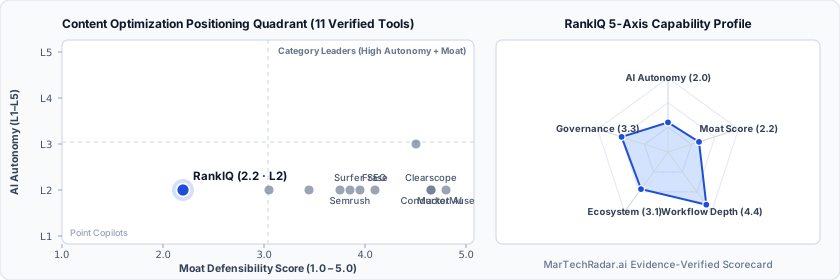
RankIQ in-depth review, pricing & architecture analysis
Editor sign-off: Oct 15, 2026. How profiles are made.
What is RankIQ? Overview & background
For digital publishing teams and enterprise content strategists tasked with capturing high-intent organic search volume, RankIQ delivers a structured content optimization and generation environment. Headquartered in The Woodlands, Texas, and founded in 2021, the company targets content operators seeking to improve organic search visibility and Generative Engine Optimization (GEO). The software operationalizes search intent data to guide long-form editorial composition without requiring deep technical SEO expertise.
How RankIQ works: architecture & workflow
At its technical core, RankIQ operates an algorithmic research pipeline that surfaces pre-vetted, low-competition keywords across publishing verticals. The system feeds target terms into a proprietary content grader, which performs semantic text analysis against top-ranking SERP documents to generate a prescriptive inventory of latent semantic topics, required headings, and optimal document lengths. For drafting, the platform orchestrates external foundation models—including Claude, Gemini, and ChatGPT—via automated prompts to generate unified bundles of long-form articles, social distribution copy, and promotional email sequences under human editorial review.
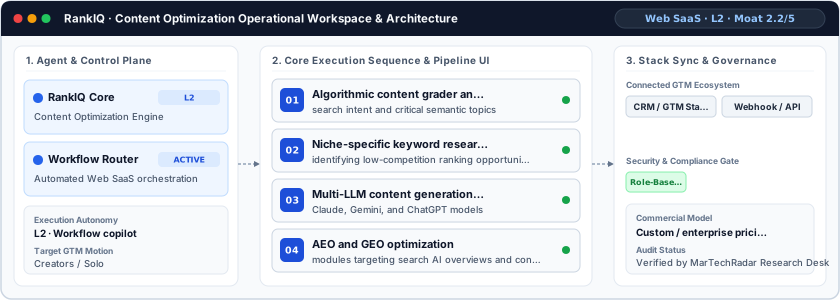
RankIQ limitations, drawbacks & risks
Operational considerations and platform boundaries include:
- Algorithmic Keyword Scope: Content planners are confined to the platform's pre-analyzed keyword repository, restricting dynamic, on-demand query parsing for novel technical niches or real-time breaking events.
- Content Homogenization Risk: Prescriptive semantic scoring rules and automated multi-LLM generation templates can yield formulaic prose patterns that require heavy editorial refinement to maintain distinct brand differentiation.
- Search Engine Volatility Lag: Grading rubrics depend on historical ranking snapshots, introducing lag during core search algorithmic updates or sudden shifts in search engine layout architecture.
RankIQ pricing, plans & cost breakdown
Commercial pricing is available on request through tailored enterprise sales quotes based on organizational scale and seats. The licensing model provides access to RankIQ's curated keyword databases, the algorithmic content grading interface, and programmatic access to underlying third-party language models for multi-channel asset generation.
| Plan / Tier | Verified Price & Billing | Included Scope & Contract Terms |
|---|---|---|
| Enterprise / Custom | Custom quote | Custom-quoted plan; terms come from the vendor's sales team. |
How RankIQ compares vs. competitors & alternatives
Compared to direct category competitors like Typeface and Amdahl, RankIQ functions as an alternative focused on reliable workflow execution and transparent unit economics within the AI Content Marketing segment.
Direct competitors & market radar
Top algorithmic competitors based on category positioning, capability overlap, and ICP alignment.
Frequently asked questions about RankIQ
Does RankIQ publish pricing or require an enterprise quote?
RankIQ pricing: Custom / enterprise pricing. No free plan is publicly disclosed. Commercial pricing is available on request through tailored enterprise sales quotes based on organizational scale and seats.
What are the top RankIQ alternatives in Content Optimization?
Verified Content Optimization alternatives include Scalenut ($21–$199/mo), Seonix (Free plan · $49–$1,200/mo · Enterprise plan), Service Stories (From $299/mo), amTop Pvt Ltd (Custom / enterprise pricing). Compared to direct category competitors like Typeface and Amdahl, RankIQ functions as an alternative focused on reliable workflow execution and transparent unit economics within the AI Content Marketing segment.
What are the main limitations and trade-offs of RankIQ?
Operational considerations and platform boundaries include: Algorithmic Keyword Scope: Content planners are confined to the platform's pre-analyzed keyword repository, restricting dynamic, on-demand query parsing for novel technical niches or real-time breaking events. Walk away if you need published self-serve pricing: RankIQ is sold by custom quote.
Verified sources & evidence trail
- Official product domain: https://rankiq.com
- Commercial pricing verification: Verified against official vendor pricing policy (Custom / enterprise pricing)
- Verified corporate entity profiles (
sameAs): LinkedIn Company Profile · Crunchbase Entity Record - Editor sign-off: Oct 15, 2026 (how profiles are made).
