Quotient Review (2026): AI Content Marketing Pricing, Limits & Alternatives
Bottom line
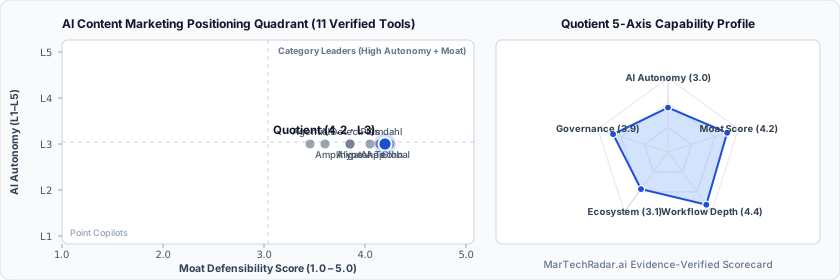
Quotient is a Web SaaS tool for AI Content Marketing (Enterprise & Long-Form Brand Content) in Copy & Content. Pricing: Free plan · $0/mo · Enterprise plan. Best suited to Enterprise Content Teams, Brand Marketers and Global Copywriters. Editor ratings: AI autonomy L3 (conditional automation); moat score 4.2/5.0 (Proprietary moat). Fact-checked by Tim Fenolz on Oct 14, 2026.
Autonomous marketing execution platform orchestrating multi-channel scheduling, long-form content generation, and programmatic campaign delivery.
Quotient buyer fit verdict: when to choose vs. when to walk away
Choose Quotient if (Best Fit)
- Target ICP & Stack Fit: You operate as Enterprise Content Teams, Brand Marketers and Global Copywriters requiring a Web SaaS deployment for AI Content Marketing.
- L3 Architecture & Defensibility: Quotient builds defensibility through unified cross-channel agentic execution that combines multi-LLM generation with direct dispatch rails, automating downstream publication tasks beyond standard draft generation.
- Commercial Model Fit: Your procurement budget aligns with Free plan · $0/mo · Enterprise plan and want a self-serve free tier for zero-cost initial validation.
Walk away from Quotient if (Deal-Breakers)
- Walk away if your workflow requires uncapped enterprise volume on the Free plan · $0/mo · Enterprise plan entry plan without upgrading tiers.
- Walk away if your workflow cannot tolerate throughput throttling: Agent operations rely on discrete token quotas that enforce hard usage cutoffs when consumption thresholds are met mid-campaign.
- Walk away if social platform schema drift is a deal-breaker for your team: Automated cross-posting flows remain susceptible to upstream third-party API deprecations, requiring periodic reconfiguration of social connection tokens.
Quotient key facts & scorecard
| Pricing | Free plan · $0/mo · Enterprise planVendor pricing page |
|---|---|
| Free plan | Yes |
| Delivery | Web SaaS |
| Audience | Enterprise Content Teams, Brand Marketers, Global Copywriters |
| AI autonomy level | L3 · Conditional automationEditor-verified |
| Moat tier & score | 4.2 / 5.0 · Proprietary moatEditor-verified |
| Funding | Seed |
| Total funding | $5M |
| Founders | Marc Ferrentino, Max Davish |
| Company size | 2-10 employees |
| Governance & docs | API & Docs ↗ · Terms ↗ · Privacy ↗ |
| Headquarters | Brooklyn, New York |
| Founded | 2024 |
| Last verified |
Quotient pros & cons: strengths vs. operational limitations
Pros: core strengths & capabilities
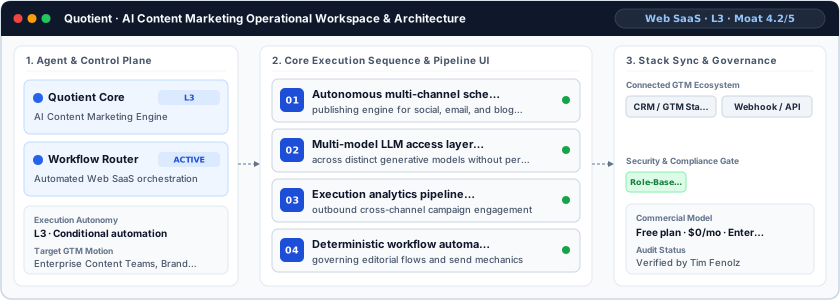
- Autonomous multi-channel scheduling and: publishing engine for social, email, and blog content
- Multi-model LLM access layer routing tasks: across distinct generative models without per-model markup
- Execution analytics pipeline tracking: outbound cross-channel campaign engagement
- Deterministic workflow automation module: governing editorial flows and send mechanics
Cons: operational limitations & risks
- Throughput throttling: Agent operations rely on discrete token quotas that enforce hard usage cutoffs when consumption thresholds are met mid-campaign.
- Social platform schema drift: Automated cross-posting flows remain susceptible to upstream third-party API deprecations, requiring periodic reconfiguration of social connection tokens.
- Domain deliverability constraints: Outbound email sequences require dedicated DNS and domain warming configurations outside the system to prevent high-volume autonomous dispatches from triggering spam filters.
Quotient TCO & deal-breaker stress test
Simulate 12-month stepped TCO, hidden cost multipliers, contract lock-in exposure, and stack failure modes using only facts verified by Tim Fenolz on · Capture SHA d2ad655a.
Quotient is viable for 5 seats, but requires commercial or technical verification on the flagged items below.
| Plan / Tier | Verified Rate | Scale Fit | Scope & Quota Notes |
|---|---|---|---|
| Free / Sandbox | $0 | 1–2 seats (Evaluation) | Entry free tier with capped usage or feature quotas for initial workflow testing. |
| Entry / Starter | $26/mo | 1–2 seats | Social posts: $0.10/post |
| Free | $49/mo | 5 seats | Verified $49/mo tier from vendor pricing schedule. |
| Enterprise / Custom | Custom quote | 15–50+ seats (Enterprise SLA) | Sales-negotiated annual contract for custom volume, SSO/RBAC governance, and dedicated SLA. |
- Moat Score
- 4.2 / 5.0
- AI Autonomy
- L3
- Free Tier / Trial
- Free plan
Triggered audit signals & failure modes
- Opaque Enterprise Quoting vs. SMB/Mid-Market BudgetVerified Pricing Ledger
Quotient does not disclose a public self-serve floor (Free plan · $0/mo · Enterprise plan). Buyers with a $800/mo cap face high sales-qualification friction.
- Published Self-Serve Entry FloorVerified Pricing Ledger
Quotient publishes a transparent entry point (Free plan · $0/mo · Enterprise plan) with a free tier for initial validation before committing.
- Tier Fit for 5-Seat Scale: Entry / Starter ($26/mo)Verified Tier Schedule
Social posts: $0.10/post
- Primary Operational Bottleneck: Throughput throttlingAudit by Tim Fenolz
Agent operations rely on discrete token quotas that enforce hard usage cutoffs when consumption thresholds are met mid-campaign.
Hidden TCO Multipliers & Quota Gates
- Credit & Usage Burn Multiplier: Automated workflows consume metered credits/usage quotas; multi-step enrichment, voice minutes, or high-frequency agent runs can trigger mid-cycle top-up packs.
- Enterprise Governance & Add-On Gating: Advanced capabilities such as Single Sign-On (SSO), custom role permissions, or specialized analytics modules are gated behind upper tiers or paid add-ons.
When to Walk Away & Negotiation Levers
- Walk away if your workflow requires uncapped enterprise volume on the Free plan · $0/mo · Enterprise plan entry plan without upgrading tiers.
- Walk away if your workflow cannot tolerate throughput throttling: Agent operations rely on discrete token quotas that enforce hard usage cutoffs when consumption thresholds are met mid-campaign.
- Walk away if social platform schema drift is a deal-breaker for your team: Automated cross-posting flows remain susceptible to upstream third-party API deprecations, requiring periodic reconfiguration of social connection tokens.
- Validate exact quota thresholds (seats, credits, or API calls) included in Quotient's Free plan · $0/mo · Enterprise plan tier before converting from monthly to annual billing.
- Require a sandbox proof-of-concept testing throughput throttling against your live CRM/data schema before annual sign-off.
Ask a custom procurement or TCO stress-test question about Quotient
Lower 5-seat floor (~$120/mo vs. Custom Quote)
Lower 5-seat floor (~$24/mo vs. Custom Quote)
Quotient moat & subtrack positioning
Quotient builds defensibility through unified cross-channel agentic execution that combines multi-LLM generation with direct dispatch rails, automating downstream publication tasks beyond standard draft generation.
Editorial review
Fact-checked by Tim Fenolz (Lead AdTech, Programmatic & Attribution Analyst) on .
Background
Architected as an execution layer for multi-channel editorial operations, Quotient replaces disconnected drafting tools with an autonomous marketing operations engine. Headquartered in Brooklyn, New York, and established in 2024, the company launched with $5M in venture funding to relieve brand editors and growth leads from manual distribution tasks. By combining generative production with programmatic delivery, the platform unifies asset creation, audience sequencing, and cross-channel dispatch into a single control plane designed specifically for corporate content teams.
How Quotient works
At its technical foundation, Quotient runs an autonomous L3 execution pipeline combining multi-model LLM routing with deterministic scheduling APIs. The system ingests campaign briefs, style guidelines, and historical engagement data, then orchestrates task-specific agents across integrated models to construct long-form articles, social distributions, and outbound email cadences. Rather than stopping at copy generation, the platform directly handles queue dispatch, payload formatting, and automated sending across external channel endpoints, feeding performance telemetry back into an integrated analytics framework to guide future editorial runs.
Limitations
Operational considerations and platform boundaries include:
- Throughput throttling: Agent operations rely on discrete token quotas that enforce hard usage cutoffs when consumption thresholds are met mid-campaign.
- Social platform schema drift: Automated cross-posting flows remain susceptible to upstream third-party API deprecations, requiring periodic reconfiguration of social connection tokens.
- Domain deliverability constraints: Outbound email sequences require dedicated DNS and domain warming configurations outside the system to prevent high-volume autonomous dispatches from triggering spam filters.
Quotient pricing
Quotient structures licensing around execution credits, outbound transmission volumes, and connected accounts. Entry-level access begins on a free tier at $0 per month, which provisions 500 AI credits, one active flow, and a hard usage cap. Scaling organizations transition to the Starter tier at $49 per month for higher throughput, while advanced teams utilize custom enterprise plans designed for expanded seat counts, extensive flow limits, and tailored enterprise compliance guarantees.
How Quotient compares
Within the enterprise editorial content space, Quotient operates against point solutions like AIDetectPlus, Aha Global, and Agentio. While AIDetectPlus focuses narrowly on syntax verification and Agentio optimizes creator ad distribution, Quotient executes autonomous cross-channel publishing workflows directly. It is best suited for resource-constrained growth marketing teams seeking an autonomous execution agent that bridges the gap between raw copy generation and multi-channel technical dispatch.
Direct competitors & market radar
Top algorithmic competitors based on category positioning, capability overlap, and ICP alignment.
Frequently asked questions about Quotient
How much does Quotient cost and what pricing tiers are available?
Published pricing summary for Quotient: Free plan · $0/mo · Enterprise plan. Quotient includes a free tier or sandbox entry point. Verified tier schedule: Free / Sandbox ($0 for 1–2 seats (Evaluation)); Entry / Starter ($26/mo for 1–2 seats); Free ($49/mo for 5 seats); Enterprise / Custom (Custom quote for 15–50+ seats (Enterprise SLA)). Quotient structures licensing around execution credits, outbound transmission volumes, and connected accounts. Entry-level access begins on a free tier at $0 per month, which provisions 500 AI credits, one active flow, and a hard usage cap.
How does Quotient work and how autonomous is its AI architecture?
Autonomous marketing execution platform orchestrating multi-channel scheduling, long-form content generation, and programmatic campaign delivery. Within AI Content Marketing (Enterprise & Long-Form Brand Content), MarTechRadar rates its execution architecture at L3 · Conditional automation with a verified Moat Score of 4.2 / 5.0 (Proprietary moat). Quotient builds defensibility through unified cross-channel agentic execution that combines multi-LLM generation with direct dispatch rails, automating downstream publication tasks beyond standard draft generation. Corporate profile: Founded by Marc Ferrentino, Max Davish, operating at 2-10 employees scale.
What are the main limitations of Quotient and when should buyers walk away?
Based on our editorial technical audit, key operational considerations and boundaries for Quotient include: (1) Throughput throttling: Agent operations rely on discrete token quotas that enforce hard usage cutoffs when consumption thresholds are met mid-campaign. (2) Social platform schema drift: Automated cross-posting flows remain susceptible to upstream third-party API deprecations, requiring periodic reconfiguration of social connection tokens. (3) Domain deliverability constraints: Outbound email sequences require dedicated DNS and domain warming configurations outside the system to prevent high-volume autonomous dispatches from triggering spam filters. Primary procurement walk-away rule: Walk away if your workflow requires uncapped enterprise volume on the Free plan · $0/mo · Enterprise plan entry plan without upgrading tiers.
What integrations, compliance certifications, and contract terms apply to Quotient?
First-party governance and developer endpoints verified on domain include: API Docs (https://www.getquotient.ai/docs). Key TCO multiplier to watch: Credit & Usage Burn Multiplier (Automated workflows consume metered credits/usage quotas; multi-step enrichment, voice minutes, or high-frequency agent runs can trigger mid-cycle top-up packs.) Before signing a contract, procurement teams should validate exact quota thresholds (seats, credits, or API calls) included in Quotient's Free plan · $0/mo · Enterprise plan tier before converting from monthly to annual billing.
What are the best Quotient alternatives and head-to-head competitors in 2026?
Top fact-checked alternatives to Quotient in AI Content Marketing (Enterprise & Long-Form Brand Content) include Metadata.io (Custom / enterprise pricing), Vee (Custom / enterprise pricing), TextCortex (From $23.99/mo), Ramdam (From $120/mo). Within the enterprise editorial content space, Quotient operates against point solutions like AIDetectPlus, Aha Global, and Agentio. While AIDetectPlus focuses narrowly on syntax verification and Agentio optimizes creator ad distribution, Quotient executes autonomous cross-channel publishing workflows directly.
Verified sources & evidence trail
- Official product domain: https://www.getquotient.ai
- Commercial pricing verification: https://www.getquotient.ai/pricing
- Verified corporate entity profiles (
sameAs): LinkedIn Company Profile · Crunchbase Entity Record - First-party governance & documentation links: API & Docs · Terms · Privacy
- Editorial audit sign-off: Fact-checked by Tim Fenolz on under the MarTechRadar Evidence-Ledger Protocol.