Metadata.io Review (2026): DCO Pricing, Pros & Cons
Bottom line
Metadata.io is a Web SaaS tool for DCO (Dynamic Creative Optimization / DCO) in AdTech & Paid Media. Pricing: Custom / enterprise pricing. Best suited to B2B SaaS, DTC / eCommerce and Enterprise Brands. Editor ratings: AI autonomy L3 (conditional automation); moat score 4.2/5.0 (Proprietary moat). Fact-checked by MarTechRadar Research Desk on Oct 12, 2026.
Autonomous B2B demand generation platform executing dynamic multivariate ad experiments and pipeline optimization across LinkedIn, Meta, and Google Ads.
Is Metadata.io worth it in 2026? Buyer fit & when to walk away
Choose Metadata.io if (Best Fit)
- Target ICP & Stack Fit: You operate as B2B SaaS, DTC / eCommerce and Enterprise Brands requiring a Web SaaS deployment for DCO, with verified ecosystem connectivity for Salesforce, HubSpot, LinkedIn.
- L3 Architecture & Defensibility: Closed-loop revenue attribution connecting native ad networks directly to CRM opportunity pipeline, combined with autonomous multivariate campaign deployment across 12 channels.
- Commercial Model Fit: Your procurement budget aligns with Custom / enterprise pricing.
Walk away from Metadata.io if (Deal-Breakers)
- Walk away if you need published self-serve pricing: Metadata.io is sold by custom quote.
- Walk away if your workflow cannot tolerate API rate limits: High-frequency campaign generation triggers restrictive publisher throttling thresholds on networks like LinkedIn, delaying multi-variant deployment batches.
- Walk away if attribution window lag is a deal-breaker for your team: Protracted enterprise sales cycles delay downstream conversion signals, forcing autonomous bid algorithms to rely on intermediate proxy metrics during initial phases.
Metadata.io pricing, free plan & scorecard at a glance
| Pricing | Custom / enterprise pricing |
|---|---|
| Free plan | No / not disclosed |
| Delivery | Web SaaS |
| Audience | B2B SaaS, DTC / eCommerce, Enterprise Brands |
| AI autonomy level | L3 · Conditional automationEditor-verified |
| Moat tier & score | 4.2 / 5.0 · Proprietary moatEditor-verified |
| Funding | Venture-backed |
| Total funding | $53.8MBacked by Gaingels, 500 Global, Mana Ventures, Greycroft, Partech |
| Founders | Asaf Shilat, Gil Allouche, Yan Manevich |
| Company size | 51-200 employees |
| Ecosystem integrations | Salesforce, HubSpot, LinkedIn |
| Governance & docs | API & Docs ↗ · Changelog ↗ · Terms ↗ · Privacy ↗ |
| Headquarters | San Jose, California |
| Founded | 2015 |
| Last verified | Oct 12, 2026 |
Metadata.io pros & cons: strengths vs. operational limitations
Pros: core strengths & capabilities
- Multivariate experimentation engine testing: ad copy, visual assets, and audiences across paid channels
- Closed-loop attribution integrating: with Salesforce and HubSpot to optimize against pipeline revenue
- Multi-channel audience orchestration spanning: paid social, search, display, and connected TV
- Automated ad variant deployment and budget rebalancing based on downstream opportunity conversion rates
Cons: operational limitations & risks
- API Rate Limits: High-frequency campaign generation triggers restrictive publisher throttling thresholds on networks like LinkedIn, delaying multi-variant deployment batches.
- Attribution Window Lag: Protracted enterprise sales cycles delay downstream conversion signals, forcing autonomous bid algorithms to rely on intermediate proxy metrics during initial phases.
- Schema Maintenance: Custom CRM pipeline stages and field migrations require continuous integration maintenance to prevent attribution desynchronization across active experiments.
Metadata.io TCO & deal-breaker stress test
Simulate 12-month stepped TCO, hidden cost multipliers, contract lock-in exposure, and stack failure modes using only facts verified by MarTechRadar Research Desk on 2026-10-12.
Metadata.io triggers high-severity friction under your 5-seat / $800/mo constraints. Benchmark the verified subtrack alternatives below before committing.
- Moat Score
- 4.2 / 5.0
- AI Autonomy
- L3
- Free Tier / Trial
- None disclosed
Triggered audit signals & failure modes
- Opaque Enterprise Quoting vs. SMB/Mid-Market BudgetVerified Pricing Ledger
Metadata.io does not disclose a public self-serve floor (Custom / enterprise pricing). Buyers with a $800/mo cap face high sales-qualification friction.
- Sales-Gated Contract TermsFact-checked by MarTechRadar Research Desk
Metadata.io operates on a direct sales model where commercial pricing is available on request through tailored enterprise sales quotes based on organizational scale and seats.
- Primary Operational Bottleneck: API Rate LimitsAudit by MarTechRadar Research Desk
High-frequency campaign generation triggers restrictive publisher throttling thresholds on networks like LinkedIn, delaying multi-variant deployment batches.
Test a custom Metadata.io budget or stack constraint
Lower 5-seat floor (~$14/mo vs. Custom Quote) · Transparent self-serve entry without mandatory annual lock-in
Offers a free tier (Custom / enterprise pricing) · Transparent self-serve entry without mandatory annual lock-in
Metadata.io integrations, API, security & compliance stack
Metadata.io AI moat & DCO positioning
Closed-loop revenue attribution connecting native ad networks directly to CRM opportunity pipeline, combined with autonomous multivariate campaign deployment across 12 channels.
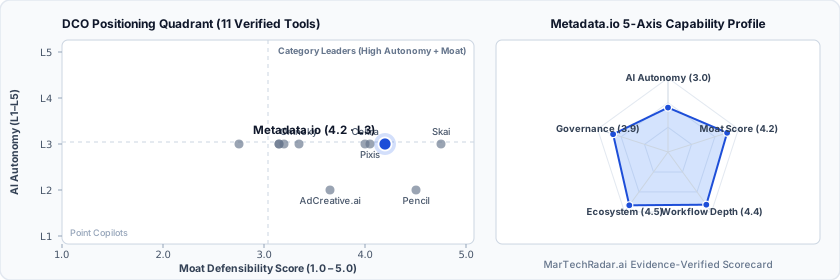
Metadata.io in-depth review, pricing & architecture analysis
Editor sign-off: Oct 12, 2026. How profiles are made.
What is Metadata.io? Overview & background
Architected as a continuous feedback loop between ad network APIs and downstream revenue data, Metadata.io was established in 2015 in San Jose, California. Supported by $53.8M in venture funding, the company addresses the structural divide between top-of-funnel ad execution and CRM opportunity creation. Designed primarily for enterprise growth leaders and performance marketing teams, the platform replaces manual ad operations with programmatic experimentation geared directly toward qualified pipeline rather than vanity impressions.
How Metadata.io works: architecture & workflow
At Level 3 autonomy, the platform ingests first-party CRM records, intent signals, and audience lists, passing them into an experimentation graph. Operators supply modular parameters—copy variations, visual collateral, and offer mechanisms—which the system factorially generates and deploys via native APIs across channels like LinkedIn, Google, and Meta. It continuously queries downstream CRM milestone progression, recalculating budget distribution and retiring underperforming variants based on opportunity pipeline generation rather than platform-reported click-through rates.
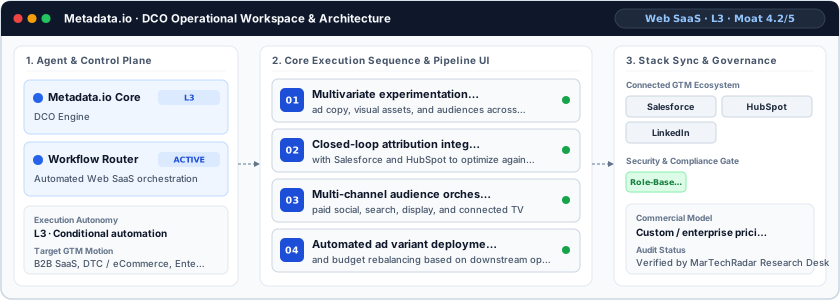
Metadata.io limitations, drawbacks & risks
Operational considerations and platform boundaries include:
- API Rate Limits: High-frequency campaign generation triggers restrictive publisher throttling thresholds on networks like LinkedIn, delaying multi-variant deployment batches.
- Attribution Window Lag: Protracted enterprise sales cycles delay downstream conversion signals, forcing autonomous bid algorithms to rely on intermediate proxy metrics during initial phases.
- Schema Maintenance: Custom CRM pipeline stages and field migrations require continuous integration maintenance to prevent attribution desynchronization across active experiments.
Metadata.io pricing, plans & cost breakdown
Metadata.io operates on a direct sales model where commercial pricing is available on request through tailored enterprise sales quotes based on organizational scale and seats. Contracts are custom-structured according to connected ad channels, aggregate managed ad spend under orchestration, and specific platform functionality tiers spanning audience management, execution tooling, and automated algorithmic bidding modules.
| Plan / Tier | Verified Price & Billing | Included Scope & Contract Terms |
|---|---|---|
| Enterprise / Custom | Custom quote | Custom-quoted plan; terms come from the vendor's sales team. |
How Metadata.io compares vs. competitors & alternatives
Compared to templated dynamic creative generation systems like AdCreative.ai, Abyssale, and 7Pi, which focus heavily on visual layer production, Metadata.io prioritizes end-to-end media operations and downstream revenue attribution. While creative automation suites excel at asset formatting velocity, they lack native closed-loop bid orchestration. Consequently, Metadata.io is optimal for B2B mid-market and enterprise organizations running substantial multi-channel paid budgets that demand programmatic pipeline verification over manual campaign assembly.
Direct competitors & market radar
Top algorithmic competitors based on category positioning, capability overlap, and ICP alignment.
Frequently asked questions about Metadata.io
Does Metadata.io publish pricing or require an enterprise quote?
Metadata.io pricing: Custom / enterprise pricing. No free plan is publicly disclosed. Metadata.io operates on a direct sales model where commercial pricing is available on request through tailored enterprise sales quotes based on organizational scale and seats.
What are the top Metadata.io alternatives in DCO?
Verified DCO alternatives include N.Rich (From $34,830/yr), Quotient (Custom / enterprise pricing), 6sense (Custom / enterprise pricing), HyperAd io (Custom / enterprise pricing). Compared to templated dynamic creative generation systems like AdCreative.ai, Abyssale, and 7Pi, which focus heavily on visual layer production, Metadata.io prioritizes end-to-end media operations and downstream revenue attribution.
What are the main limitations and trade-offs of Metadata.io?
Operational considerations and platform boundaries include: API Rate Limits: High-frequency campaign generation triggers restrictive publisher throttling thresholds on networks like LinkedIn, delaying multi-variant deployment batches. Walk away if you need published self-serve pricing: Metadata.io is sold by custom quote.
Verified sources & evidence trail
- Official product domain: https://metadata.io
- Commercial pricing verification: Verified against official vendor pricing policy (Custom / enterprise pricing)
- Verified corporate entity profiles (
sameAs): LinkedIn Company Profile · Crunchbase Entity Record - First-party governance & documentation links: API & Docs · Changelog · Terms · Privacy
- Editor sign-off: Oct 12, 2026 (how profiles are made).
