Bannerflow Review (2026): DCO Pricing, Pros & Cons
Bottom line
Bannerflow is a Web SaaS tool for DCO (Dynamic Creative Optimization / DCO) in AdTech & Paid Media. Pricing: Custom / enterprise pricing. Best suited to DTC / eCommerce. Editor ratings: AI autonomy L3 (conditional automation); moat score 3.2/5.0 (Workflow-embedded (strong)). Fact-checked by MarTechRadar Research Desk on Oct 4, 2026.
Enterprise creative management platform automating multi-market display, social, and video ad production with dynamic creative optimization and real-time.
Is Bannerflow worth it in 2026? Buyer fit & when to walk away
Choose Bannerflow if (Best Fit)
- Target ICP & Stack Fit: You operate as DTC / eCommerce requiring a Web SaaS deployment for DCO.
- L3 Architecture & Defensibility: Proprietary cloud-based HTML5 rendering architecture coupled with end-to-end creative management workflows, extensive ad server integrations, and dynamic data feed orchestration.
- Commercial Model Fit: Your procurement budget aligns with Custom / enterprise pricing.
Walk away from Bannerflow if (Deal-Breakers)
- Walk away if you need published self-serve pricing: Bannerflow is sold by custom quote.
- Walk away if your workflow cannot tolerate feed schema sensitivity: Pipeline execution hinges strictly on consistent data feed syntax, where unannounced structural changes or missing catalog attributes can halt dynamic rendering passes.
- Walk away if external ad server latency is a deal-breaker for your team: Third-party publisher ad-server caching delays can impede instant creative swaps across programmatic ad exchanges during rapid campaign updates.
Bannerflow pricing, free plan & scorecard at a glance
| Pricing | Custom / enterprise pricing |
|---|---|
| Free plan | No / not disclosed |
| Delivery | Web SaaS |
| Audience | DTC / eCommerce |
| AI autonomy level | L3 · Conditional automationEditor-verified |
| Moat tier & score | 3.2 / 5.0 · Workflow-embedded (strong)Editor-verified |
| Funding | Undisclosed |
| Total funding | UndisclosedBacked by Tenzing |
| Founders | Daniel Fahlen, Daniel Jacobsson, Emanuel Lundman |
| Company size | 51-200 employees |
| Compliance & governance | GDPR |
| Governance & docs | Privacy ↗ |
| Headquarters | Stockholm, Sweden |
| Founded | 2010 |
| Last verified | Oct 4, 2026 |
Bannerflow pros & cons: strengths vs. operational limitations
Pros: core strengths & capabilities
- Master ad creation studio: supporting automated multi-format and multi-size responsive variations
- Dynamic creative optimization engine: binding live data feeds to digital ad elements
- Multi-market translation and localization: workflow with asset version control
- Omnichannel distribution pipelines directly: publishing to major DSPs and ad networks
Cons: operational limitations & risks
- Feed Schema Sensitivity: Pipeline execution hinges strictly on consistent data feed syntax, where unannounced structural changes or missing catalog attributes can halt dynamic rendering passes.
- External Ad Server Latency: Third-party publisher ad-server caching delays can impede instant creative swaps across programmatic ad exchanges during rapid campaign updates.
- Custom Scripting Constraints: Advanced bespoke JavaScript interactions outside the platform's native animation framework demand manual workarounds that bypass automated quality checks.
Bannerflow TCO & deal-breaker stress test
Simulate 12-month stepped TCO, hidden cost multipliers, contract lock-in exposure, and stack failure modes using only facts verified by MarTechRadar Research Desk on 2026-10-04.
Bannerflow triggers high-severity friction under your 5-seat / $800/mo constraints. Benchmark the verified subtrack alternatives below before committing.
- Moat Score
- 3.2 / 5.0
- AI Autonomy
- L3
- Free Tier / Trial
- None disclosed
Triggered audit signals & failure modes
- Opaque Enterprise Quoting vs. SMB/Mid-Market BudgetVerified Pricing Ledger
Bannerflow does not disclose a public self-serve floor (Custom / enterprise pricing). Buyers with a $800/mo cap face high sales-qualification friction.
- Sales-Gated Contract TermsFact-checked by MarTechRadar Research Desk
Bannerflow delivers its software via an enterprise subscription structure. Commercial pricing is available on request through tailored enterprise sales quotes based on organizational scale and seats.
- Primary Operational Bottleneck: Feed Schema SensitivityAudit by MarTechRadar Research Desk
Pipeline execution hinges strictly on consistent data feed syntax, where unannounced structural changes or missing catalog attributes can halt dynamic rendering passes.
Test a custom Bannerflow budget or stack constraint
Lower 5-seat floor (~$49/mo vs. Custom Quote) · Transparent self-serve entry without mandatory annual lock-in
Lower 5-seat floor (~$180/mo vs. Custom Quote) · Transparent self-serve entry without mandatory annual lock-in
Bannerflow integrations, API, security & compliance stack
Bannerflow AI moat & DCO positioning
Proprietary cloud-based HTML5 rendering architecture coupled with end-to-end creative management workflows, extensive ad server integrations, and dynamic data feed orchestration.
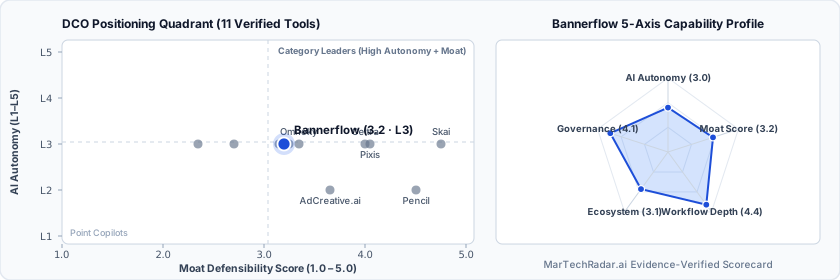
Bannerflow in-depth review, pricing & architecture analysis
Editor sign-off: Oct 4, 2026. How profiles are made.
What is Bannerflow? Overview & background
Architectured around a cloud-based Creative Management Platform (CMP), Bannerflow was founded in 2010 in Stockholm, Sweden, to replace fragmented desktop design suites and manual HTML5 ad assembly. Designed primarily for enterprise marketing teams, digital media agencies, and multi-market brand operations, the system unifies creative production, localization, and ad-serving pipelines into a single operating environment. By decoupling design layout logic from dynamic asset feeds, the platform resolves the recurring bottlenecks that arise when managing cross-channel campaigns across international territories.
How Bannerflow works: architecture & workflow
At the architectural layer, the system autonomy, Bannerflow processes a master creative concept and algorithmically generates multi-format variations across display, social, and digital out-of-home dimensions. Its rendering engine parses structured dynamic data feeds—including product catalogs via JSON, XML, or CSV—to populate localized copy, currency symbols, imagery, and call-to-action assets directly into live templates. In-house designers manage base styling parameters, while automated validation rules verify file size boundaries and media standards prior to syndication via direct ad-server and DSP connectors under verified GDPR governance controls.
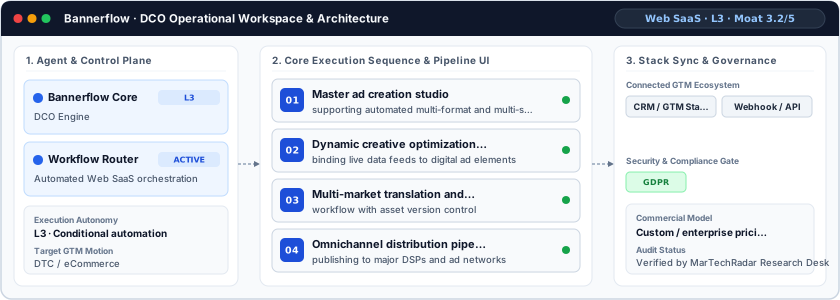
Bannerflow limitations, drawbacks & risks
Operational considerations and platform boundaries include:
- Feed Schema Sensitivity: Pipeline execution hinges strictly on consistent data feed syntax, where unannounced structural changes or missing catalog attributes can halt dynamic rendering passes.
- External Ad Server Latency: Third-party publisher ad-server caching delays can impede instant creative swaps across programmatic ad exchanges during rapid campaign updates.
- Custom Scripting Constraints: Advanced bespoke JavaScript interactions outside the platform's native animation framework demand manual workarounds that bypass automated quality checks.
Bannerflow pricing, plans & cost breakdown
Bannerflow delivers its software via an enterprise subscription structure. Commercial pricing is available on request through tailored enterprise sales quotes based on organizational scale and seats. Contracts reflect specific operational parameters, including active brand workspaces, dynamic data feed throughput, and ad distribution network connections, without public transactional tiers.
| Plan / Tier | Verified Price & Billing | Included Scope & Contract Terms |
|---|---|---|
| Enterprise / Custom | Custom quote | Custom-quoted plan; terms come from the vendor's sales team. |
How Bannerflow compares vs. competitors & alternatives
Within the dynamic creative optimization sector, Bannerflow competes against 7Pi, Abyssale, and AdCreative.ai within the DCO segment. While Abyssale focuses heavily on API-first image and banner generation, and AdCreative.ai concentrates on algorithmic conversion-focused asset variations, Bannerflow differentiates through its enterprise-grade CMP governance, multi-language localization workflows, and direct publisher ad-serving capabilities. The solution is best aligned with multi-region enterprises managing high-volume, multi-market display and performance campaigns that require centralized creative governance.
Direct competitors & market radar
Top algorithmic competitors based on category positioning, capability overlap, and ICP alignment.
Frequently asked questions about Bannerflow
Does Bannerflow publish pricing or require an enterprise quote?
Bannerflow pricing: Custom / enterprise pricing. No free plan is publicly disclosed. Bannerflow delivers its software via an enterprise subscription structure. Commercial pricing is available on request through tailored enterprise sales quotes based on organizational scale and seats.
What are the top Bannerflow alternatives in DCO?
Verified DCO alternatives include AdCreative.ai (Custom / enterprise pricing), Abyssale (From $36/mo), Kuaizi.ai (Custom / enterprise pricing), Omneky (Custom / enterprise pricing). Within the dynamic creative optimization sector, Bannerflow competes against 7Pi, Abyssale, and AdCreative.ai within the DCO segment.
What are the main limitations and trade-offs of Bannerflow?
Operational considerations and platform boundaries include: Feed Schema Sensitivity: Pipeline execution hinges strictly on consistent data feed syntax, where unannounced structural changes or missing catalog attributes can halt dynamic rendering passes. Walk away if you need published self-serve pricing: Bannerflow is sold by custom quote.
Verified sources & evidence trail
- Official product domain: https://bannerflow.com
- Commercial pricing verification: Verified against official vendor pricing policy (Custom / enterprise pricing)
- Verified corporate entity profiles (
sameAs): LinkedIn Company Profile · Crunchbase Entity Record - First-party governance & documentation links: Privacy
- Editor sign-off: Oct 4, 2026 (how profiles are made).
