Terminus Review (2026): ABM Pricing, Limits & Alternatives
Bottom line
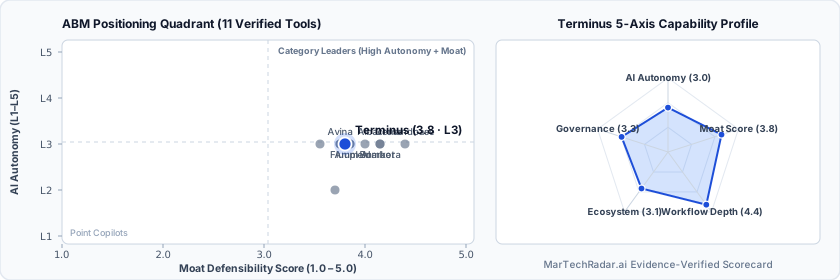
Terminus is a Web SaaS tool for ABM (Buyer Intent Data & Account-Based Marketing) in AI SDR & Outbound. Pricing: Custom / enterprise pricing. Best suited to B2B SaaS, DTC / eCommerce and Enterprise Brands. Editor ratings: AI autonomy L3 (conditional automation); moat score 3.8/5.0 (Proprietary moat). Fact-checked by Julie Brot on Oct 12, 2026.
Account-based marketing platform combining buyer intent intelligence, IP-targeted display advertising, and multi-channel engagement to coordinate.
Terminus buyer fit verdict: when to choose vs. when to walk away
Choose Terminus if (Best Fit)
- Target ICP & Stack Fit: You operate as B2B SaaS, DTC / eCommerce and Enterprise Brands requiring a Web SaaS deployment for ABM, with verified ecosystem connectivity for Outreach.
- L3 Architecture & Defensibility: Deep multi-channel distribution network spanning programmatic DSP display, dynamic email signature banners, and IP-to-domain account resolution graph.
- Commercial Model Fit: Your procurement budget aligns with Custom / enterprise pricing.
Walk away from Terminus if (Deal-Breakers)
- Walk away if you require transparent self-serve monthly billing or your budget ceiling is under $1,000/mo (Terminus requires sales-gated custom quoting).
- Walk away if your workflow cannot tolerate signal latency: Intent surge signals and third-party bidstream aggregation introduce reporting delays that can obscure real-time shifts in buyer behavior.
- Walk away if identity resolution degradation is a deal-breaker for your team: Hybrid work environments and VPN adoption degrade reverse-IP lookup accuracy, leading to unmapped target account traffic.
Terminus key facts & scorecard
| Pricing | Custom / enterprise pricing |
|---|---|
| Free plan | No / not disclosed |
| Delivery | Web SaaS |
| Audience | B2B SaaS, DTC / eCommerce, Enterprise Brands |
| AI autonomy level | L3 · Conditional automationEditor-verified |
| Moat tier & score | 3.8 / 5.0 · Proprietary moatEditor-verified |
| Funding | Series C+ |
| Ecosystem integrations | Outreach |
| Governance & docs | Trust & Security ↗ · Terms ↗ · Privacy ↗ |
| Headquarters | United States |
| Founded | 2014 |
| Last verified |
Terminus pros & cons: strengths vs. operational limitations
Pros: core strengths & capabilities
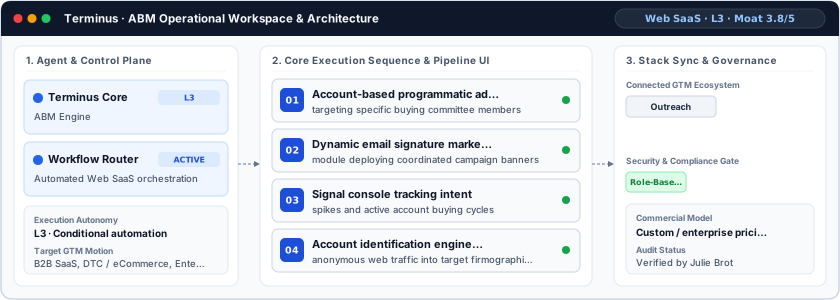
- Account-based programmatic advertising engine: targeting specific buying committee members
- Dynamic email signature marketing: module deploying coordinated campaign banners
- Signal console tracking intent: spikes and active account buying cycles
- Account identification engine resolving: anonymous web traffic into target firmographics
Cons: operational limitations & risks
- Signal Latency: Intent surge signals and third-party bidstream aggregation introduce reporting delays that can obscure real-time shifts in buyer behavior.
- Identity Resolution Degradation: Hybrid work environments and VPN adoption degrade reverse-IP lookup accuracy, leading to unmapped target account traffic.
- Display Network Ad Fatigue: Narrow target account lists face rapid banner saturation within programmatic channels without frequent creative rotation.
Terminus TCO & deal-breaker stress test
Simulate 12-month stepped TCO, hidden cost multipliers, contract lock-in exposure, and stack failure modes using only facts verified by Julie Brot on · Capture SHA 5a0c0485.
Terminus triggers high-severity friction under your 5-seat / $800/mo constraints. Benchmark the verified subtrack alternatives below before committing.
| Plan / Tier | Verified Rate | Scale Fit | Scope & Quota Notes |
|---|---|---|---|
| Enterprise / Custom | Custom quote | 15–50+ seats (Enterprise SLA) | Sales-negotiated annual contract for custom volume, SSO/RBAC governance, and dedicated SLA. |
- Moat Score
- 3.8 / 5.0
- AI Autonomy
- L3
- Free Tier / Trial
- None disclosed
Triggered audit signals & failure modes
- Opaque Enterprise Quoting vs. SMB/Mid-Market BudgetVerified Pricing Ledger
Terminus does not disclose a public self-serve floor (Custom / enterprise pricing). Buyers with a $800/mo cap face high sales-qualification friction.
- Sales-Gated Contract TermsFact-checked by Julie Brot
Terminus operates under an enterprise licensing structure without public tiers. Commercial pricing is available on request through tailored enterprise sales quotes based on organizational scale and seats.
- Primary Operational Bottleneck: Signal LatencyAudit by Julie Brot
Intent surge signals and third-party bidstream aggregation introduce reporting delays that can obscure real-time shifts in buyer behavior.
Hidden TCO Multipliers & Quota Gates
- Signal Latency: Intent surge signals and third-party bidstream aggregation introduce reporting delays that can obscure real-time shifts in buyer behavior.
- Identity Resolution Degradation: Hybrid work environments and VPN adoption degrade reverse-IP lookup accuracy, leading to unmapped target account traffic.
When to Walk Away & Negotiation Levers
- Walk away if you require transparent self-serve monthly billing or your budget ceiling is under $1,000/mo (Terminus requires sales-gated custom quoting).
- Walk away if your workflow cannot tolerate signal latency: Intent surge signals and third-party bidstream aggregation introduce reporting delays that can obscure real-time shifts in buyer behavior.
- Walk away if identity resolution degradation is a deal-breaker for your team: Hybrid work environments and VPN adoption degrade reverse-IP lookup accuracy, leading to unmapped target account traffic.
- Demand a 30- to 60-day paid pilot opt-out clause in the Terminus order form before signing a 12-month enterprise commitment.
- Require a sandbox proof-of-concept testing signal latency against your live CRM/data schema before annual sign-off.
Ask a custom procurement or TCO stress-test question about Terminus
Lower 5-seat floor (~$99/mo vs. Custom Quote) · Transparent self-serve entry without mandatory annual lock-in
Lower 5-seat floor (~$29/mo vs. Custom Quote) · Transparent self-serve entry without mandatory annual lock-in
Terminus key entities, modules & ecosystem stack
Terminus moat & subtrack positioning
Deep multi-channel distribution network spanning programmatic DSP display, dynamic email signature banners, and IP-to-domain account resolution graph.
Editorial review
Fact-checked by Julie Brot (Enterprise SaaS Governance & Procurement Editor) on .
Background
For enterprise revenue leaders seeking to align sales and marketing around high-value accounts, Terminus delivers an account-based marketing platform centered on buying committee engagement. Founded in 2014 in the United States, the company serves B2B marketing organizations that require targeted outreach across complex enterprise purchase paths. By unifying intent signals with multi-channel campaign delivery, the platform addresses the challenge of identifying and activating target accounts throughout the deal cycle.
How Terminus works
At an architectural level, Terminus operates as an orchestration engine integrating account resolution with omni-channel delivery. The system ingests first-party web engagement, CRM data, and third-party intent signals into its signal console to monitor buying spikes and account progression. Identified accounts trigger programmatic advertising via an integrated DSP, personalized on-site content, and dynamic banners injected across corporate email signatures. These automated workflows continuously refresh audience segments and sync engagement scores back to connected sales systems.
Limitations
Operational considerations and platform boundaries include:
- Signal Latency: Intent surge signals and third-party bidstream aggregation introduce reporting delays that can obscure real-time shifts in buyer behavior.
- Identity Resolution Degradation: Hybrid work environments and VPN adoption degrade reverse-IP lookup accuracy, leading to unmapped target account traffic.
- Display Network Ad Fatigue: Narrow target account lists face rapid banner saturation within programmatic channels without frequent creative rotation.
Terminus pricing
Terminus operates under an enterprise licensing structure without public tiers. Commercial pricing is available on request through tailored enterprise sales quotes based on organizational scale and seats. Contracts typically incorporate annual software commitments that scale according to target account volume, ad spend commitments, and deployed channel modules such as email experiences or web personalization.
How Terminus compares
Within the account-based marketing category, Terminus competes directly with 6sense, Albacross, and Amplemarket. While 6sense emphasizes deep predictive machine learning for intent modeling and sales prioritization, Terminus focuses on multi-touch coordination via advertising and email signature channels. Albacross provides lighter reverse-IP lead tracking, and Amplemarket centers on sales engagement workflows. Terminus fits enterprise B2B teams requiring structured account orchestration across marketing touchpoints.
Direct competitors & market radar
Top algorithmic competitors based on category positioning, capability overlap, and ICP alignment.
Frequently asked questions about Terminus
How much does Terminus cost and does it require a custom enterprise quote?
Published pricing summary for Terminus: Custom / enterprise pricing. A permanent free plan is not disclosed for Terminus. Terminus operates under an enterprise licensing structure without public tiers. Commercial pricing is available on request through tailored enterprise sales quotes based on organizational scale and seats.
How does Terminus work and how autonomous is its AI architecture?
Account-based marketing platform combining buyer intent intelligence, IP-targeted display advertising, and multi-channel engagement to coordinate. Within ABM (Buyer Intent Data & Account-Based Marketing), MarTechRadar rates its execution architecture at L3 · Conditional automation with a verified Moat Score of 3.8 / 5.0 (Proprietary moat). Deep multi-channel distribution network spanning programmatic DSP display, dynamic email signature banners, and IP-to-domain account resolution graph.
What are the main limitations of Terminus and when should buyers walk away?
Based on our editorial technical audit, key operational considerations and boundaries for Terminus include: (1) Signal Latency: Intent surge signals and third-party bidstream aggregation introduce reporting delays that can obscure real-time shifts in buyer behavior. (2) Identity Resolution Degradation: Hybrid work environments and VPN adoption degrade reverse-IP lookup accuracy, leading to unmapped target account traffic. (3) Display Network Ad Fatigue: Narrow target account lists face rapid banner saturation within programmatic channels without frequent creative rotation. Primary procurement walk-away rule: Walk away if you require transparent self-serve monthly billing or your budget ceiling is under $1,000/mo (Terminus requires sales-gated custom quoting).
What integrations, compliance certifications, and contract terms apply to Terminus?
Verified ecosystem and stack integrations include Outreach. First-party governance and developer endpoints verified on domain include: Trust/Security (https://trust.demandscience.com). Key TCO multiplier to watch: Signal Latency (Intent surge signals and third-party bidstream aggregation introduce reporting delays that can obscure real-time shifts in buyer behavior.) Before signing a contract, procurement teams should demand a 30- to 60-day paid pilot opt-out clause in the Terminus order form before signing a 12-month enterprise commitment.
What are the best Terminus alternatives and head-to-head competitors in 2026?
Top fact-checked alternatives to Terminus in ABM (Buyer Intent Data & Account-Based Marketing) include N.Rich (From $34,830/yr), Demandbase (Custom / enterprise pricing), Bombora (Custom / enterprise pricing), UpLead ($99–$199/mo). Within the account-based marketing category, Terminus competes directly with 6sense, Albacross, and Amplemarket. While 6sense emphasizes deep predictive machine learning for intent modeling and sales prioritization, Terminus focuses on multi-touch coordination via advertising and email signature channels.
Verified sources & evidence trail
- Official product domain: https://terminus.com
- Commercial pricing verification: Verified against official vendor pricing policy (Custom / enterprise pricing)
- First-party governance & documentation links: Trust & Security · Terms · Privacy
- Editorial audit sign-off: Fact-checked by Julie Brot on under the MarTechRadar Evidence-Ledger Protocol.