Happenstance Review (2026): ABM Pricing, Limits & Alternatives
Bottom line
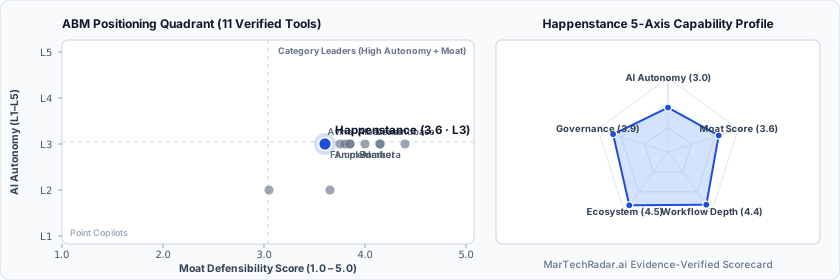
Happenstance is a Web SaaS tool for ABM (Buyer Intent Data & Account-Based Marketing) in AI SDR & Outbound. Pricing: Free plan · $0/mo. Best suited to B2B SaaS and Marketing & Growth Teams. Editor ratings: AI autonomy L3 (conditional automation); moat score 3.6/5.0 (Proprietary moat). Fact-checked by Jagmeet Sine on Oct 16, 2026.
AI people search engine that uncovers warm introductions and target prospects across team email and social graphs.
Happenstance buyer fit verdict: when to choose vs. when to walk away
Choose Happenstance if (Best Fit)
- Target ICP & Stack Fit: You operate as B2B SaaS and Marketing & Growth Teams requiring a Web SaaS deployment for ABM, with verified ecosystem connectivity for Gmail, Microsoft Outlook, LinkedIn.
- L3 Architecture & Defensibility: Happenstance builds network-effect defensibility by indexing private first-party relationship graphs across Gmail, LinkedIn, and X, enabling collaborative team-wide warm intro discovery and semantic people search.
- Commercial Model Fit: Your procurement budget aligns with Free plan · $0/mo and want a self-serve free tier for zero-cost initial validation.
Walk away from Happenstance if (Deal-Breakers)
- Walk away if your workflow requires uncapped enterprise volume on the Free plan · $0/mo entry plan without upgrading tiers.
- Walk away if your workflow cannot tolerate bounded by connected first- and second-degree graphs: Because Happenstance is architected to search and activate warm paths across connected personal and team networks, it cannot replace a cold B2B contact database when targeting industries where the team has zero prior relationship overlap.
- Walk away if team graph participation bottleneck is a deal-breaker for your team: The commercial utility of Happenstance Groups depends heavily on executives, founders, and board members connecting their email and social accounts, creating an internal adoption hurdle for privacy-sensitive stakeholders.
Happenstance key facts & scorecard
| Pricing | Free plan · $0/moVendor pricing page |
|---|---|
| Free plan | Yes |
| Delivery | Web SaaS |
| Audience | B2B SaaS, Marketing & Growth Teams |
| AI autonomy level | L3 · Conditional automationEditor-verified |
| Moat tier & score | 3.6 / 5.0 · Proprietary moatEditor-verified |
| Funding | Seed |
| Total funding | $500K |
| Founders | Alex Teichman |
| Company size | 2-10 employees |
| Ecosystem integrations | Gmail, Microsoft Outlook, LinkedIn |
| Governance & docs | Trust & Security ↗ · API & Docs ↗ · Terms ↗ · Privacy ↗ |
| Headquarters | San Francisco, California |
| Founded | 2023 |
| Last verified |
Happenstance pros & cons: strengths vs. operational limitations
Pros: core strengths & capabilities
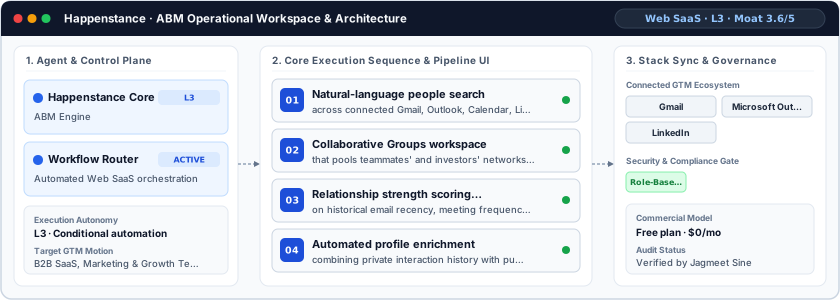
- Natural-language people search: across connected Gmail, Outlook, Calendar, LinkedIn, and X relationship graphs
- Collaborative Groups workspace: that pools teammates' and investors' networks for warm introduction routing
- Relationship strength scoring based: on historical email recency, meeting frequency, and mutual context
- Automated profile enrichment: combining private interaction history with public career and company data
Cons: operational limitations & risks
- Bounded by Connected First- and Second-Degree Graphs: Because Happenstance is architected to search and activate warm paths across connected personal and team networks, it cannot replace a cold B2B contact database when targeting industries where the team has zero prior relationship overlap.
- Team Graph Participation Bottleneck: The commercial utility of Happenstance Groups depends heavily on executives, founders, and board members connecting their email and social accounts, creating an internal adoption hurdle for privacy-sensitive stakeholders.
- No Native Cold Sequencing Engine: Happenstance excels at warm intro discovery and relationship mapping but does not include automated multi-step cold email sequencing or dialer workflows.
Happenstance TCO & deal-breaker stress test
Simulate 12-month stepped TCO, hidden cost multipliers, contract lock-in exposure, and stack failure modes using only facts verified by Jagmeet Sine on · Capture SHA 99606131.
Happenstance is viable for 5 seats, but requires commercial or technical verification on the flagged items below.
| Plan / Tier | Verified Rate | Scale Fit | Scope & Quota Notes |
|---|---|---|---|
| Free / Sandbox | $0 | 1–2 seats (Evaluation) | Entry free tier with capped usage or feature quotas for initial workflow testing. |
| Team | $24/mo | 1–2 seats | Assign Pro seats, buy API credits, and track usage on one bill. Add seats for members who need |
- Moat Score
- 3.6 / 5.0
- AI Autonomy
- L3
- Free Tier / Trial
- Free plan
Triggered audit signals & failure modes
- Opaque Enterprise Quoting vs. SMB/Mid-Market BudgetVerified Pricing Ledger
Happenstance does not disclose a public self-serve floor (Free plan · $0/mo). Buyers with a $800/mo cap face high sales-qualification friction.
- Published Self-Serve Entry FloorVerified Pricing Ledger
Happenstance publishes a transparent entry point (Free plan · $0/mo) with a free tier for initial validation before committing.
- Primary Operational Bottleneck: Bounded by Connected First- and Second-Degree GraphsAudit by Jagmeet Sine
Because Happenstance is architected to search and activate warm paths across connected personal and team networks, it cannot replace a cold B2B contact database when targeting industries where the team has zero prior relationship overlap.
Hidden TCO Multipliers & Quota Gates
- Per-Seat Linear Scaling: Happenstance prices licenses on a per-user/seat basis (Free plan · $0/mo); expanding from 2 to 15+ operators multiplies base recurring spend linearly.
- Credit & Usage Burn Multiplier: Automated workflows consume metered credits/usage quotas; multi-step enrichment, voice minutes, or high-frequency agent runs can trigger mid-cycle top-up packs.
When to Walk Away & Negotiation Levers
- Walk away if your workflow requires uncapped enterprise volume on the Free plan · $0/mo entry plan without upgrading tiers.
- Walk away if your workflow cannot tolerate bounded by connected first- and second-degree graphs: Because Happenstance is architected to search and activate warm paths across connected personal and team networks, it cannot replace a cold B2B contact database when targeting industries where the team has zero prior relationship overlap.
- Walk away if team graph participation bottleneck is a deal-breaker for your team: The commercial utility of Happenstance Groups depends heavily on executives, founders, and board members connecting their email and social accounts, creating an internal adoption hurdle for privacy-sensitive stakeholders.
- Validate exact quota thresholds (seats, credits, or API calls) included in Happenstance's Free plan · $0/mo tier before converting from monthly to annual billing.
- Require a sandbox proof-of-concept testing bounded by connected first- and second-degree graphs against your live CRM/data schema before annual sign-off.
Ask a custom procurement or TCO stress-test question about Happenstance
Lower 5-seat floor (~$29/mo vs. Custom Quote)
Lower 5-seat floor (~$259/mo vs. Custom Quote)
Happenstance key entities, modules & ecosystem stack
Happenstance moat & subtrack positioning
Happenstance builds network-effect defensibility by indexing private first-party relationship graphs across Gmail, LinkedIn, and X, enabling collaborative team-wide warm intro discovery and semantic people search.
Editorial review
Fact-checked by Jagmeet Sine (Senior MarTech Infrastructure & Agentic Workflow Architect) on .
Background
Founded in 2023 by Alex Teichman and headquartered in San Francisco, California, Happenstance (happenstance.ai) is an AI-powered relationship intelligence and natural-language people search engine built for B2B sales teams, founders, recruiters, and venture investors. Operating with a team of 2 to 10 employees and backed by $500K in Seed funding from Y Combinator (W24), Pioneer Fund, and Team Ignite Ventures, the company replaces fragmented contact books and manual LinkedIn mutual-connection checks with a unified semantic search interface over an organization's real-world communication history.
How Happenstance works
Happenstance operates at Level 3 autonomy through a multi-graph identity resolution pipeline, private communication metadata indexer, and natural-language retrieval engine. With user permission, Happenstance connects to Gmail, Google Calendar, LinkedIn, and X, deduplicating contacts across handles and email addresses into enriched person entities. Users query their collective network in plain English—such as VPs of Engineering at Series B fintech companies in New York—and Happenstance's Collaborative Groups feature highlights which colleague, executive, or investor holds the strongest real-world relationship based on historical email and meeting frequency to broker a warm introduction without exposing private email bodies.
Limitations
Operational limitations and technical trade-offs include:
- Bounded by Connected First- and Second-Degree Graphs: Because Happenstance is architected to search and activate warm paths across connected personal and team networks, it cannot replace a cold B2B contact database when targeting industries where the team has zero prior relationship overlap.
- Team Graph Participation Bottleneck: The commercial utility of Happenstance Groups depends heavily on executives, founders, and board members connecting their email and social accounts, creating an internal adoption hurdle for privacy-sensitive stakeholders.
- No Native Cold Sequencing Engine: Happenstance excels at warm intro discovery and relationship mapping but does not include automated multi-step cold email sequencing or dialer workflows.
Happenstance pricing
Happenstance publishes transparent self-serve pricing on its official pricing page (happenstance.ai/pricing). The Free tier ($0/mo) allows individuals to connect their accounts, run natural-language network searches, and collaborate in shared groups, while the Pro plan ($24/mo) unlocks expanded monthly search and research query allowances, deeper multi-network graph indexing, and priority profile enrichment.
How Happenstance compares
Within the Sales Engagement & Conversation Intelligence and Relationship Intelligence category, Happenstance competes against network mapping and warm-intro alternatives such as Affinity, Clay (personal CRM), and Dex. Versus heavyweight investment-bank CRMs like Affinity that require expensive annual seat contracts, Happenstance differentiates itself through natural-language semantic search across combined Gmail, LinkedIn, and X graphs and an accessible $0/mo to $24/mo self-serve model. Founders, GTM operators, and deal teams choose Happenstance to turn dormant team connections into warm sales pipeline.
Frequently asked questions about Happenstance
How much does Happenstance cost and what pricing tiers are available?
Published pricing summary for Happenstance: Free plan · $0/mo. Happenstance includes a free tier or sandbox entry point. Verified tier schedule: Free / Sandbox ($0 for 1–2 seats (Evaluation)); Team ($24/mo for 1–2 seats). Happenstance publishes transparent self-serve pricing on its official pricing page (`happenstance.ai/pricing`).
How does Happenstance work and how autonomous is its AI architecture?
AI people search engine that uncovers warm introductions and target prospects across team email and social graphs. Within ABM (Buyer Intent Data & Account-Based Marketing), MarTechRadar rates its execution architecture at L3 · Conditional automation with a verified Moat Score of 3.6 / 5.0 (Proprietary moat). Happenstance builds network-effect defensibility by indexing private first-party relationship graphs across Gmail, LinkedIn, and X, enabling collaborative team-wide warm intro discovery and semantic people search. Corporate profile: Founded by Alex Teichman, operating at 2-10 employees scale.
What are the main limitations of Happenstance and when should buyers walk away?
Based on our editorial technical audit, key operational considerations and boundaries for Happenstance include: (1) Bounded by Connected First- and Second-Degree Graphs: Because Happenstance is architected to search and activate warm paths across connected personal and team networks, it cannot replace a cold B2B contact database when targeting industries where the team has zero prior relationship overlap. (2) Team Graph Participation Bottleneck: The commercial utility of Happenstance Groups depends heavily on executives, founders, and board members connecting their email and social accounts, creating an internal adoption hurdle for privacy-sensitive stakeholders. (3) No Native Cold Sequencing Engine: Happenstance excels at warm intro discovery and relationship mapping but does not include automated multi-step cold email sequencing or dialer workflows. Primary procurement walk-away rule: Walk away if your workflow requires uncapped enterprise volume on the Free plan · $0/mo entry plan without upgrading tiers.
What integrations, compliance certifications, and contract terms apply to Happenstance?
Verified ecosystem and stack integrations include Gmail, Microsoft Outlook, LinkedIn. First-party governance and developer endpoints verified on domain include: Trust/Security (https://happenstance.ai/security), API Docs (https://happenstance.ai/developer/mcp). Key TCO multiplier to watch: Per-Seat Linear Scaling (Happenstance prices licenses on a per-user/seat basis (Free plan · $0/mo); expanding from 2 to 15+ operators multiplies base recurring spend linearly.) Before signing a contract, procurement teams should validate exact quota thresholds (seats, credits, or API calls) included in Happenstance's Free plan · $0/mo tier before converting from monthly to annual billing.
What are the best Happenstance alternatives and head-to-head competitors in 2026?
Top fact-checked alternatives to Happenstance in ABM (Buyer Intent Data & Account-Based Marketing) include Warmly (From $10,000/yr), Fluum AI (Custom / enterprise pricing), Dealfront (Free plan · From €79/mo), Optimly AI (Free plan · $0/mo · Enterprise plan). Within the Sales Engagement & Conversation Intelligence and Relationship Intelligence category, Happenstance competes against network mapping and warm-intro alternatives such as Affinity, Clay (personal CRM), and Dex.
Verified sources & evidence trail
- Official product domain: https://happenstance.ai
- Commercial pricing verification: https://happenstance.ai/pricing
- Verified corporate entity profiles (
sameAs): LinkedIn Company Profile · Crunchbase Entity Record - First-party governance & documentation links: Trust & Security · API & Docs · Terms · Privacy
- Editorial audit sign-off: Fact-checked by Jagmeet Sine on under the MarTechRadar Evidence-Ledger Protocol.