Post Planner Review (2026): Social Media Scheduling Pricing, Pros & Cons
Bottom line
Post Planner is a Web SaaS tool for Social Media Scheduling (Social Media Scheduling & Auto-Publishing) in Social & Influencer. Pricing: Free plan · $9–$119/mo. Best suited to Creators / Solo. Editor ratings: AI autonomy L3 (conditional automation); moat score 2.7/5.0 (Workflow-embedded). Fact-checked by MarTechRadar Research Desk on Oct 14, 2026.
Cloud-based social media scheduling and content curation engine that automates cross-network post distribution and audience engagement discovery.
Is Post Planner worth it in 2026? Buyer fit & when to walk away
Choose Post Planner if (Best Fit)
- Target ICP & Stack Fit: You operate as Creators / Solo requiring a Web SaaS deployment for Social Media Scheduling.
- L3 Architecture & Defensibility: Post Planner derives defensibility from its historical content-performance data repository and algorithmic recommendation framework, which surfaces high-engagement industry media across ten supported external publishing endpoints.
- Commercial Model Fit: Your procurement budget aligns with Free plan · $9–$119/mo and want a self-serve free tier for zero-cost initial validation.
Walk away from Post Planner if (Deal-Breakers)
- Walk away if your workflow cannot tolerate API rate limiting and token expiration: Automated queues depend directly on third-party platform API permissions, which can experience token revocations or throttle throughput during burst publishing periods.
- Walk away if curated stream relevance drift is a deal-breaker for your team: Automated content discovery feeds rely on keyword and aggregate engagement thresholds, requiring periodic human tuning to prevent off-brand or duplicate content suggestions.
Post Planner pricing, free plan & scorecard at a glance
| Pricing | Free plan · $9–$119/moVendor pricing page |
|---|---|
| Free plan | Yes |
| Delivery | Web SaaS |
| Audience | Creators / Solo |
| AI autonomy level | L3 · Conditional automationEditor-verified |
| Moat tier & score | 2.7 / 5.0 · Workflow-embeddedEditor-verified |
| Funding | Bootstrapped |
| Founders | Joshua Parkinson |
| Company size | 2-10 employees |
| Governance & docs | Terms ↗ · Privacy ↗ |
| Headquarters | San Francisco, California |
| Founded | 2011 |
| Last verified | Oct 14, 2026 |
Post Planner pros & cons: strengths vs. operational limitations
Pros: core strengths & capabilities
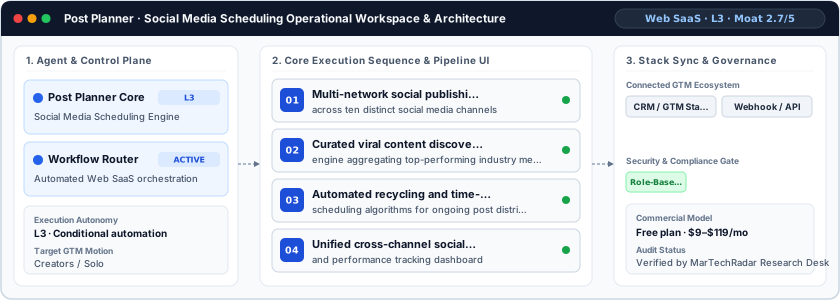
- Multi-network social publishing and queuing: across ten distinct social media channels
- Curated viral content discovery: engine aggregating top-performing industry media feeds
- Automated recycling and time-slot: scheduling algorithms for ongoing post distribution
- Unified cross-channel social analytics and performance tracking dashboard
Cons: operational limitations & risks
- API Rate Limiting and Token Expiration: Automated queues depend directly on third-party platform API permissions, which can experience token revocations or throttle throughput during burst publishing periods.
- Curated Stream Relevance Drift: Automated content discovery feeds rely on keyword and aggregate engagement thresholds, requiring periodic human tuning to prevent off-brand or duplicate content suggestions.
- Bi-directional Community Moderation Gaps: The system focuses on outbound distribution rather than inbound ticket resolution, limiting its utility for teams requiring full omnichannel customer service governance.
Post Planner TCO & deal-breaker stress test
Simulate 12-month stepped TCO, hidden cost multipliers, contract lock-in exposure, and stack failure modes using only facts verified by MarTechRadar Research Desk on 2026-10-14 · Capture SHA ee48552e.
Post Planner aligns with your 5-seat / $800/mo profile. Review the walk-away triggers and contract levers below before deployment.
- Moat Score
- 2.7 / 5.0
- AI Autonomy
- L3
- Free Tier / Trial
- Free plan
Triggered audit signals & failure modes
- Published Self-Serve Entry FloorVerified Pricing Ledger
Post Planner publishes a transparent entry point (Free plan · $9–$119/mo) with a free tier for initial validation before committing.
- Tier Fit for 5-Seat Scale: Growth ($39/mo)Verified Tier Schedule
Verified $39/mo Growth tier from vendor pricing schedule.
- Primary Operational Bottleneck: API Rate Limiting and Token ExpirationAudit by MarTechRadar Research Desk
Automated queues depend directly on third-party platform API permissions, which can experience token revocations or throttle throughput during burst publishing periods.
Test a custom Post Planner budget or stack constraint
Lower 5-seat floor (~$14/mo vs. $39 / mo)
Lower 5-seat floor (~$13/mo vs. $39 / mo)
Post Planner AI moat & Social Media Scheduling positioning
Post Planner derives defensibility from its historical content-performance data repository and algorithmic recommendation framework, which surfaces high-engagement industry media across ten supported external publishing endpoints.
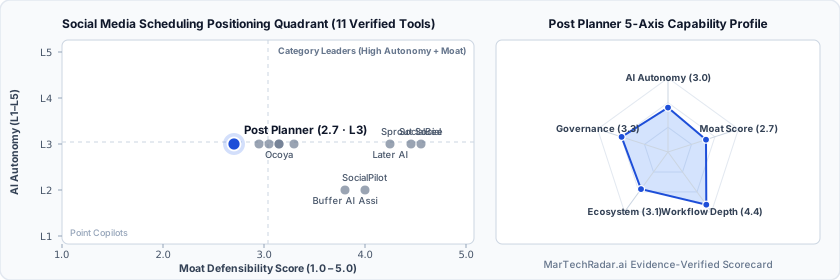
Post Planner in-depth review, pricing & architecture analysis
Editor sign-off: Oct 14, 2026. How profiles are made.
What is Post Planner? Overview & background
For distributed marketing teams tasked with sustaining consistent multi-channel output, Post Planner addresses the operational overhead of content sourcing and cross-network distribution. Established in 2011 and headquartered in San Francisco, California, the platform serves content managers, digital agencies, and social operations directors seeking predictable audience reach. Sitting squarely within the social media scheduling and auto-publishing landscape, the platform centralizes media queuing and viral trend identification into a structured execution environment.
How Post Planner works: architecture & workflow
At an architectural level, Post Planner functions at Level 3 autonomy by executing programmatic social scheduling coupled with continuous stream curation. The platform ingests real-time engagement telemetry across public web sources and RSS endpoints, scoring content feasibility against historical engagement baselines. Once ingested, assets are queued through an automated dispatch engine that coordinates with external platform APIs across ten supported social networks. Distributed task queues dispatch media payloads based on predefined calendar slots, managing rate limits and payload transformations for varied social network requirements.
Post Planner limitations, drawbacks & risks
Operational considerations and platform boundaries include:
- API Rate Limiting and Token Expiration: Automated queues depend directly on third-party platform API permissions, which can experience token revocations or throttle throughput during burst publishing periods.
- Curated Stream Relevance Drift: Automated content discovery feeds rely on keyword and aggregate engagement thresholds, requiring periodic human tuning to prevent off-brand or duplicate content suggestions.
- Bi-directional Community Moderation Gaps: The system focuses on outbound distribution rather than inbound ticket resolution, limiting its utility for teams requiring full omnichannel customer service governance.
Post Planner pricing, plans & cost breakdown
Post Planner utilizes a tiered software-as-a-service licensing structure categorized by connected social profiles, scheduled post quotas, and active administrative seats. Self-serve plans include a Free tier (1 social account, 1 user, 10 scheduled posts), Starter at $9/month billed annually ($108/year for 3 social accounts and 150 scheduled posts), Growth at $39/month ($468/year for 15 social accounts and 2 users), Business at $69/month ($828/year for 25 social accounts and 5 users), and Agency at $119/month ($1,428/year for 50 social accounts and 10 users).
| Plan / Tier | Verified Price & Billing | Included Scope & Contract Terms |
|---|---|---|
| Free / Sandbox | $0 | Free plan or free tier offered by the vendor. |
| Starter | $9/mo | Verified $9/mo Starter tier from vendor pricing schedule. |
| Growth | $39/mo | Verified $39/mo Growth tier from vendor pricing schedule. |
| Business | $69/mo | Verified $69/mo Business tier from vendor pricing schedule. |
| Agency | $119/mo | Verified $119/mo Agency tier from vendor pricing schedule. |
How Post Planner compares vs. competitors & alternatives
Within the auto-publishing category, Post Planner competes alongside Agorapulse, Antela.ai, Inc., and Apaya. Whereas Agorapulse emphasizes comprehensive social listening, unified team inboxes, and complex CRM integration, Post Planner prioritizes rapid asset curation and automated queuing mechanics. Antela.ai, Inc. and Apaya lean further into autonomous generative copy production, while Post Planner remains focused on curated content aggregation and reliable scheduling infrastructure. It best fits mid-sized marketing teams requiring automated posting consistency without the deployment overhead of enterprise-scale social governance suites.
Frequently asked questions about Post Planner
How much does Post Planner cost in 2026?
Post Planner pricing: Free plan · $9–$119/mo. A permanent free plan is available. Published tiers: Free / Sandbox ($0); Starter ($9/mo); Growth ($39/mo); Business ($69/mo); Agency ($119/mo). Post Planner utilizes a tiered software-as-a-service licensing structure categorized by connected social profiles, scheduled post quotas, and active administrative seats.
What are the top Post Planner alternatives in Social Media Scheduling?
Verified Social Media Scheduling alternatives include Planoly ($14–$47/mo), Plann (From $12.50/mo), RecurPost ($9–$79/mo), askpolly (Custom / enterprise pricing). Within the auto-publishing category, Post Planner competes alongside Agorapulse, Antela.ai, Inc., and Apaya.
What are the main limitations and trade-offs of Post Planner?
Operational considerations and platform boundaries include: API Rate Limiting and Token Expiration: Automated queues depend directly on third-party platform API permissions, which can experience token revocations or throttle throughput during burst publishing periods. Walk away if your workflow cannot tolerate API rate limiting and token expiration: Automated queues depend directly on third-party platform API permissions, which can experience token revocations or throttle throughput during burst publishing periods.
Verified sources & evidence trail
- Official product domain: https://postplanner.com
- Commercial pricing verification: https://www.postplanner.com/pricing
- Verified corporate entity profiles (
sameAs): LinkedIn Company Profile · Crunchbase Entity Record - First-party governance & documentation links: Terms · Privacy
- Editor sign-off: Oct 14, 2026 (how profiles are made).
