Planoly Review (2026): Social Media Scheduling Pricing, Pros & Cons
Bottom line
Planoly is a Web SaaS tool for Social Media Scheduling (Social Media Scheduling & Auto-Publishing) in Social & Influencer. Pricing: $14–$47/mo. Best suited to DTC / eCommerce and Creators / Solo. Editor ratings: AI autonomy L3 (conditional automation); moat score 3.8/5.0 (Proprietary moat). Fact-checked by MarTechRadar Research Desk on Oct 14, 2026.
Visual social media planning and scheduling platform optimizing multi-channel content workflows, visual grid layouts, and automated publishing pipelines.
Is Planoly worth it in 2026? Buyer fit & when to walk away
Choose Planoly if (Best Fit)
- Target ICP & Stack Fit: You operate as DTC / eCommerce and Creators / Solo requiring a Web SaaS deployment for Social Media Scheduling, with verified ecosystem connectivity for HubSpot, LinkedIn.
- L3 Architecture & Defensibility: Planoly maintains defensibility through deep historical visual planning workflows, dedicated visual-first grid composition tools, and broad platform integrations tailored for creators and mid-market retail brands.
- Commercial Model Fit: Your procurement budget aligns with $14–$47/mo.
Walk away from Planoly if (Deal-Breakers)
- Walk away if your workflow cannot tolerate social token drops: Auto-posting relies on social network APIs and OAuth tokens, which can expire and pause scheduled posts if users do not re-login.
- Walk away if video aspect ratio checks is a deal-breaker for your team: High-res videos sometimes need crop or format tweaks before queuing to match strict Reels, TikTok, or YouTube Shorts rules.
Planoly pricing, free plan & scorecard at a glance
| Pricing | $14–$47/moVendor pricing page |
|---|---|
| Free plan | No / not disclosed |
| Delivery | Web SaaS |
| Audience | DTC / eCommerce, Creators / Solo |
| AI autonomy level | L3 · Conditional automationEditor-verified |
| Moat tier & score | 3.8 / 5.0 · Proprietary moatEditor-verified |
| Funding | AcquiredAcquired by Traject |
| Founders | Andy Hoang, Brandy Pham, Kenny Teng, Thai Huynh |
| Company size | 11-50 employees |
| Ecosystem integrations | HubSpot, LinkedIn |
| Governance & docs | Terms ↗ · Privacy ↗ |
| Headquarters | Austin, TX |
| Founded | 2015 |
| Last verified | Oct 14, 2026 |
Planoly pros & cons: strengths vs. operational limitations
Pros: core strengths & capabilities
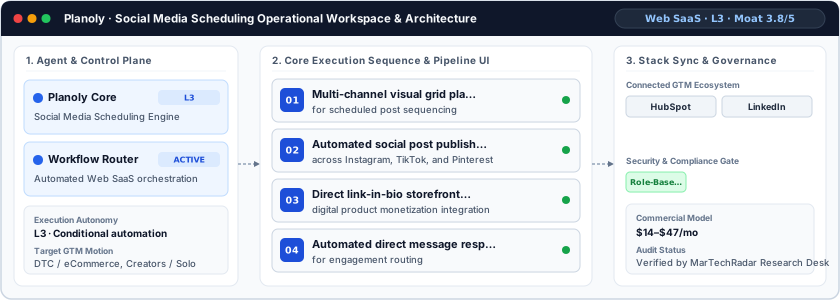
- Multi-channel visual grid planner: for scheduled post sequencing
- Automated social post publishing: across Instagram, TikTok, and Pinterest
- Direct link-in-bio storefront and digital product monetization integration
- Automated direct message response workflows: for engagement routing
Cons: operational limitations & risks
- Social Token Drops: Auto-posting relies on social network APIs and OAuth tokens, which can expire and pause scheduled posts if users do not re-login.
- Video Aspect Ratio Checks: High-res videos sometimes need crop or format tweaks before queuing to match strict Reels, TikTok, or YouTube Shorts rules.
- Light Enterprise Controls: The app lacks deep multi-stage legal approval chains and complex role permissions needed by huge global conglomerates.
Planoly TCO & deal-breaker stress test
Simulate 12-month stepped TCO, hidden cost multipliers, contract lock-in exposure, and stack failure modes using only facts verified by MarTechRadar Research Desk on 2026-10-14 · Capture SHA e7742f53.
Planoly aligns with your 5-seat / $800/mo profile. Review the walk-away triggers and contract levers below before deployment.
- Moat Score
- 3.8 / 5.0
- AI Autonomy
- L3
- Free Tier / Trial
- None disclosed
Triggered audit signals & failure modes
- Published Self-Serve Entry FloorVerified Pricing Ledger
Planoly publishes a transparent entry point ($14–$47/mo) for initial validation before committing.
- Tier Fit for 5-Seat Scale: Teams ($24/mo)Verified Tier Schedule
Verified $24/mo Teams tier from vendor pricing schedule.
- Primary Operational Bottleneck: Social Token DropsAudit by MarTechRadar Research Desk
Auto-posting relies on social network APIs and OAuth tokens, which can expire and pause scheduled posts if users do not re-login.
Test a custom Planoly budget or stack constraint
Lower 5-seat floor (~$13/mo vs. $24 / mo)
Lower 5-seat floor (~$8/mo vs. $24 / mo)
Planoly integrations, API, security & compliance stack
Planoly AI moat & Social Media Scheduling positioning
Planoly maintains defensibility through deep historical visual planning workflows, dedicated visual-first grid composition tools, and broad platform integrations tailored for creators and mid-market retail brands.
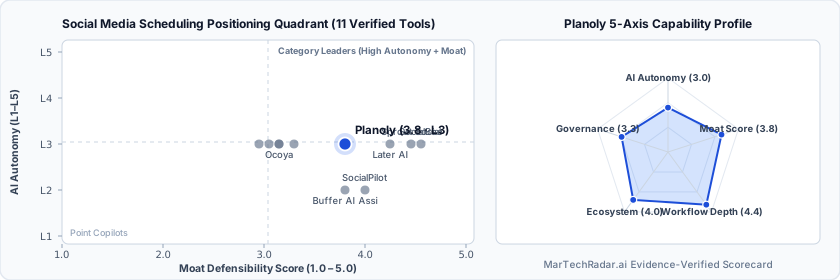
Planoly in-depth review, pricing & architecture analysis
Editor sign-off: Oct 14, 2026. How profiles are made.
What is Planoly? Overview & background
For creator-led brands and social teams that care about visual feed aesthetics, Planoly (planoly.com) offers drag-and-drop grid planning and auto-posting. Founded in 2015 in Austin, TX, the platform was later acquired by Traject to lead its social publishing suite. Built for social media managers, retail brands, and creators, the tool brings photo and video prep, grid layout previews, and multi-channel scheduling into one workspace.
How Planoly works: architecture & workflow
At Level 3 autonomy, Planoly connects straight to official APIs across Instagram, TikTok, Pinterest, YouTube, and LinkedIn. Users upload photos and video clips into a visual grid where they can drag tiles to preview how their feed will look before posting. A background queue worker checks platform rate limits, publishes scheduled posts via OAuth tokens, and pulls back post engagement stats on its own. Native workflow links also connect with HubSpot and Canva.
Planoly limitations, drawbacks & risks
Key platform limits and trade-offs include:
- Social Token Drops: Auto-posting relies on social network APIs and OAuth tokens, which can expire and pause scheduled posts if users do not re-login.
- Video Aspect Ratio Checks: High-res videos sometimes need crop or format tweaks before queuing to match strict Reels, TikTok, or YouTube Shorts rules.
- Light Enterprise Controls: The app lacks deep multi-stage legal approval chains and complex role permissions needed by huge global conglomerates.
Planoly pricing, plans & cost breakdown
Planoly sells tiered monthly and annual plans at planoly.com/pricing. The Starter plan begins at $14/month for solo creators managing 1 social set, scaling through Growth at $24/month and Pro at $47/month. Higher plans add more social profile sets, team seats, link-in-bio store tools, and auto-DM reply add-ons.
| Plan / Tier | Verified Price & Billing | Included Scope & Contract Terms | |
|---|---|---|---|
| Starter | $14/mo | Verified $14/mo Starter tier from vendor pricing schedule. | |
| Teams | $24/mo | Verified $24/mo Teams tier from vendor pricing schedule. | |
| Pro | $47/mo | Best for agencies | |
| Contract Watchout: Annual Billing Headline vs. Monthly Premium | The vendor pricing page advertises an annual-billing discount (Save up to 15%); month-to-month billing carries a higher effective monthly rate. | ||
How Planoly compares vs. competitors & alternatives
In the visual social scheduling market, Planoly competes with Later, Buffer, and Agorapulse. While Agorapulse focuses on enterprise social care inboxes and Buffer offers simple text-first queues, Planoly centers on visual Instagram and TikTok grid planning paired with creator store links. It fits visual retail brands, influencers, and boutique agencies that put feed aesthetics first.
Frequently asked questions about Planoly
How much does Planoly cost in 2026?
Planoly pricing: $14–$47/mo. No free plan is publicly disclosed. Published tiers: Starter ($14/mo); Teams ($24/mo); Pro ($47/mo). Planoly sells tiered monthly and annual plans at `planoly.com/pricing`. The Starter plan begins at $14/month for solo creators managing 1 social set, scaling through Growth at $24/month and Pro at $47/month.
What are the top Planoly alternatives in Social Media Scheduling?
Verified Social Media Scheduling alternatives include MeetEdgar ($24.91–$41.58/mo), Plann (From $12.50/mo), Post Planner (Free plan · $9–$119/mo), Publer (From $8/mo). In the visual social scheduling market, Planoly competes with Later, Buffer, and Agorapulse.
What are the main limitations and trade-offs of Planoly?
Key platform limits and trade-offs include: Social Token Drops: Auto-posting relies on social network APIs and OAuth tokens, which can expire and pause scheduled posts if users do not re-login. Walk away if your workflow cannot tolerate social token drops: Auto-posting relies on social network APIs and OAuth tokens, which can expire and pause scheduled posts if users do not re-login.
Verified sources & evidence trail
- Official product domain: https://planoly.com
- Commercial pricing verification: https://www.planoly.com/pricing
- Verified corporate entity profiles (
sameAs): LinkedIn Company Profile · Crunchbase Entity Record - First-party governance & documentation links: Terms · Privacy
- Editor sign-off: Oct 14, 2026 (how profiles are made).
