Buffer AI Assistant Review (2026): Social Media Scheduling Pricing, Pros & Cons
Bottom line
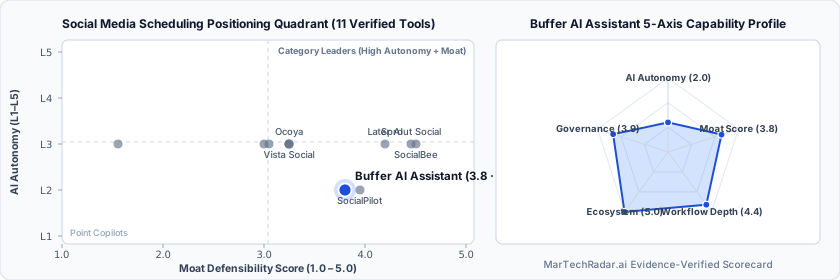
Buffer AI Assistant is a Web SaaS tool for Social Media Scheduling (Social Media Scheduling & Auto-Publishing) in Social & Influencer. Pricing: Free plan · $5–$10/mo. Best suited to Creators / Solo. Editor ratings: AI autonomy L2 (workflow copilot); moat score 3.8/5.0 (Proprietary moat). Fact-checked by MarTechRadar Research Desk on Oct 6, 2026.
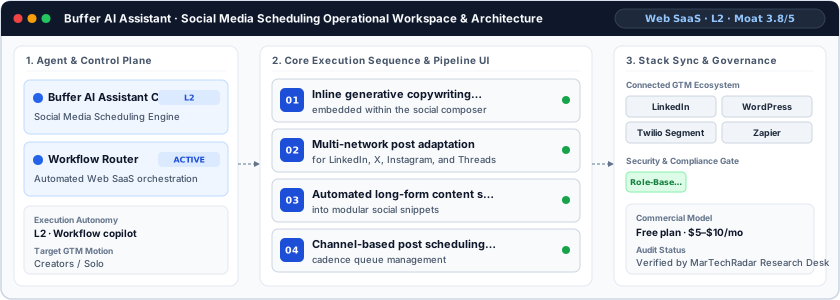
Inline generative assistant within Buffer's multi-channel scheduling suite, transforming raw copy and long-form excerpts into network-formatted posts.
Is Buffer AI Assistant worth it in 2026? Buyer fit & when to walk away
Choose Buffer AI Assistant if (Best Fit)
- Target ICP & Stack Fit: You operate as Creators / Solo requiring a Web SaaS deployment for Social Media Scheduling, with verified ecosystem connectivity for LinkedIn, WordPress, Twilio Segment, Zapier.
- L2 Architecture & Defensibility: Defensibility relies on deep workflow entrenchment within Buffer's scheduling graph and multi-channel distribution queue rather than proprietary machine learning models. High cross-network integration reliability serves as its functional retention mechanism.
- Commercial Model Fit: Your procurement budget aligns with Free plan · $5–$10/mo and want a self-serve free tier for zero-cost initial validation.
Walk away from Buffer AI Assistant if (Deal-Breakers)
- Walk away if your workflow cannot tolerate rate limiting and network policy volatility: The system remains bound by third-party social API throughput caps and sudden schema deprecations, forcing manual queue realignment during network outages.
- Walk away if absence of autonomous closed-loop feedback is a deal-breaker for your team: The engine lacks autonomous self-optimization; post copy is not dynamically modified post-publication based on real-time performance telemetry or audience sentiment.
Buffer AI Assistant pricing, free plan & scorecard at a glance
| Pricing | Free plan · $5–$10/moVendor pricing page |
|---|---|
| Free plan | Yes |
| Delivery | Web SaaS |
| Audience | Creators / Solo |
| AI autonomy level | L2 · Workflow copilotEditor-verified |
| Moat tier & score | 3.8 / 5.0 · Proprietary moatEditor-verified |
| Funding | Seed |
| Total funding | $4.0MBacked by Collaborative Fund, Bossa Invest, Red Swan Ventures, AngelPad, Tiny Capital |
| Founders | Joel Gascoigne, Leo Widrich |
| Company size | 51-200 employees |
| Ecosystem integrations | LinkedIn, WordPress, Twilio Segment, Zapier, n8n |
| Governance & docs | System Status ↗ · API & Docs ↗ · Changelog ↗ |
| Headquarters | San Francisco, United States |
| Founded | 2010 |
| Last verified | Oct 6, 2026 |
Buffer AI Assistant pros & cons: strengths vs. operational limitations
Pros: core strengths & capabilities
- Inline generative copywriting assistant: embedded within the social composer
- Multi-network post adaptation: for LinkedIn, X, Instagram, and Threads
- Automated long-form content summarization: into modular social snippets
- Channel-based post scheduling and cadence queue management
Cons: operational limitations & risks
- Rate Limiting and Network Policy Volatility: The system remains bound by third-party social API throughput caps and sudden schema deprecations, forcing manual queue realignment during network outages.
- Absence of Autonomous Closed-Loop Feedback: The engine lacks autonomous self-optimization; post copy is not dynamically modified post-publication based on real-time performance telemetry or audience sentiment.
- Multimodal Ingestion Constraints: Generative operations are restricted strictly to text, lacking automated video cutdown capabilities or dynamic image asset generation within the composer interface.
Buffer AI Assistant TCO & deal-breaker stress test
Simulate 12-month stepped TCO, hidden cost multipliers, contract lock-in exposure, and stack failure modes using only facts verified by MarTechRadar Research Desk on 2026-10-06 · Capture SHA fd3cb955.
Buffer AI Assistant aligns with your 5-seat / $800/mo profile. Review the walk-away triggers and contract levers below before deployment.
- Moat Score
- 3.8 / 5.0
- AI Autonomy
- L2
- Free Tier / Trial
- Free plan
Triggered audit signals & failure modes
- Published Self-Serve Entry FloorVerified Pricing Ledger
Buffer AI Assistant publishes a transparent entry point (Free plan · $5–$10/mo) with a free tier for initial validation before committing.
- Tier Fit for 5-Seat Scale: Team ($10/mo)Verified Tier Schedule
1 channel · $120 billed yearly (save 2 months)
- Primary Operational Bottleneck: Rate Limiting and Network Policy VolatilityAudit by MarTechRadar Research Desk
The system remains bound by third-party social API throughput caps and sudden schema deprecations, forcing manual queue realignment during network outages.
Test a custom Buffer AI Assistant budget or stack constraint
Fits within $800/mo budget ($20–$100/mo)
Fits within $800/mo budget (From $79/seat/mo)
Buffer AI Assistant integrations, API, security & compliance stack
Buffer AI Assistant AI moat & Social Media Scheduling positioning
Defensibility relies on deep workflow entrenchment within Buffer's scheduling graph and multi-channel distribution queue rather than proprietary machine learning models. High cross-network integration reliability serves as its functional retention mechanism.
Buffer AI Assistant in-depth review, pricing & architecture analysis
Editor sign-off: Oct 6, 2026. How profiles are made.
What is Buffer AI Assistant? Overview & background
Established with $4.0M in historical capital and founded in 2010 in San Francisco, United States, Buffer operates as a focused social management provider. Rather than pursuing hyper-growth venture trajectories, the organization built a cash-flow-conscious multi-channel distribution engine. The Buffer AI Assistant extends this product foundation, offering lean marketing teams, independent creators, and digital agencies an integrated copy generation module inside their daily publishing workspace.
How Buffer AI Assistant works: architecture & workflow
Operating at an L2 autonomy rating, the tool functions as an inline human-in-the-loop copilot embedded directly within the composition modal. When an operator inputs raw text or long-form excerpts, the module routes structured prompts to external large language models to reformat character counts, adjust tonal registers, and generate platform-tailored variations for networks such as LinkedIn, X, and Instagram. The resulting variations populate the scheduling pipeline, where human confirmation remains required before distribution across connected channel endpoints, alongside native workflow integrations for Zapier, WordPress, and n8n.
Buffer AI Assistant limitations, drawbacks & risks
Operational considerations and platform boundaries include:
- Rate Limiting and Network Policy Volatility: The system remains bound by third-party social API throughput caps and sudden schema deprecations, forcing manual queue realignment during network outages.
- Absence of Autonomous Closed-Loop Feedback: The engine lacks autonomous self-optimization; post copy is not dynamically modified post-publication based on real-time performance telemetry or audience sentiment.
- Multimodal Ingestion Constraints: Generative operations are restricted strictly to text, lacking automated video cutdown capabilities or dynamic image asset generation within the composer interface.
Buffer AI Assistant pricing, plans & cost breakdown
Buffer monetizes through a modular, channel-metered subscription model that includes a permanent Free plan supporting up to three channels with fixed scheduling ceilings. Paid tiers follow a transparent structure scaled at $5 to $10 per channel per month, varying based on billing cadence and advanced collaboration requirements. This per-channel billing enables organizations to control software licensing costs directly against their active digital footprint.
| Plan / Tier | Verified Price & Billing | Included Scope & Contract Terms |
|---|---|---|
| Free / Sandbox | $0 | Free plan or free tier offered by the vendor. |
| Essentials | $5/mo | 1 channel · $60 billed yearly (save 2 months) |
| Team | $10/mo | 1 channel · $120 billed yearly (save 2 months) |
How Buffer AI Assistant compares vs. competitors & alternatives
In contrast to unified social listening suites like Agorapulse, Buffer AI Assistant emphasizes lightweight queue execution rather than deep governance or social inbox routing within the Social Media Scheduling segment. While emerging automation tools such as Antela.ai, Inc. and Apaya prioritize programmatic, multi-agent content pipelines, Buffer preserves manual editorial control within an unbloated user interface. It remains best suited for lean teams prioritizing operational simplicity and predictable per-channel unit economics over complex enterprise compliance workflows.
Direct competitors & market radar
Top algorithmic competitors based on category positioning, capability overlap, and ICP alignment.
Frequently asked questions about Buffer AI Assistant
How much does Buffer AI Assistant cost in 2026?
Buffer AI Assistant pricing: Free plan · $5–$10/mo. A permanent free plan is available. Published tiers: Free / Sandbox ($0); Essentials ($5/mo); Team ($10/mo). Buffer monetizes through a modular, channel-metered subscription model that includes a permanent Free plan supporting up to three channels with fixed scheduling ceilings.
What are the top Buffer AI Assistant alternatives in Social Media Scheduling?
Verified Social Media Scheduling alternatives include Crowdfire (Custom / enterprise pricing), Mora AI (Custom / enterprise pricing), Apaya (Custom / enterprise pricing), Sprout Social AI ($199–$399/seat/mo). In contrast to unified social listening suites like Agorapulse, Buffer AI Assistant emphasizes lightweight queue execution rather than deep governance or social inbox routing within the Social Media Scheduling segment.
What are the main limitations and trade-offs of Buffer AI Assistant?
Operational considerations and platform boundaries include: Rate Limiting and Network Policy Volatility: The system remains bound by third-party social API throughput caps and sudden schema deprecations, forcing manual queue realignment during network outages. Walk away if your workflow cannot tolerate rate limiting and network policy volatility: The system remains bound by third-party social API throughput caps and sudden schema deprecations, forcing manual queue realignment during network outages.
Verified sources & evidence trail
- Official product domain: https://buffer.com
- Commercial pricing verification: https://buffer.com/pricing
- Verified corporate entity profiles (
sameAs): LinkedIn Company Profile · Crunchbase Entity Record - First-party governance & documentation links: System Status · API & Docs · Changelog
- Editor sign-off: Oct 6, 2026 (how profiles are made).
