Crowdfire Review (2026): Social Media Scheduling Pricing, Pros & Cons
Bottom line
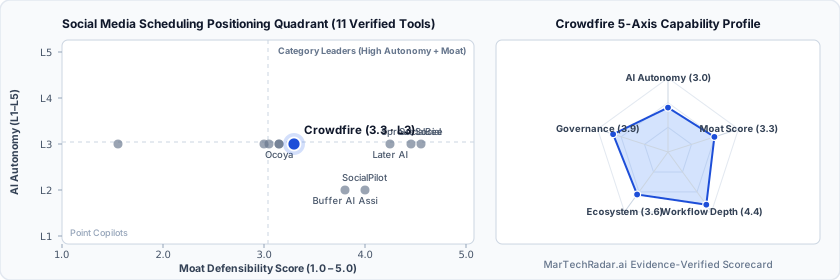
Crowdfire is a Web SaaS tool for Social Media Scheduling (Social Media Scheduling & Auto-Publishing) in Social & Influencer. Pricing: Custom / enterprise pricing. Best suited to Creators / Solo. Editor ratings: AI autonomy L3 (conditional automation); moat score 3.3/5.0 (Workflow-embedded (strong)). Fact-checked by MarTechRadar Research Desk on Oct 14, 2026.
Multi-platform social content management and discovery engine orchestrating cross-network publishing schedules, article curation feeds, and performance.
Is Crowdfire worth it in 2026? Buyer fit & when to walk away
Choose Crowdfire if (Best Fit)
- Target ICP & Stack Fit: You operate as Creators / Solo requiring a Web SaaS deployment for Social Media Scheduling, with verified ecosystem connectivity for Twilio Segment.
- L3 Architecture & Defensibility: Historical user footprint and domain longevity offset by legacy API dependency and strategic repositioning toward editorial tech content.
- Commercial Model Fit: Your procurement budget aligns with Custom / enterprise pricing.
Walk away from Crowdfire if (Deal-Breakers)
- Walk away if you need published self-serve pricing: Crowdfire is sold by custom quote.
- Walk away if your workflow cannot tolerate API rate limits: Publishing queues remain susceptible to upstream provider API throttling and breaking permission deprecations across external social networks.
- Walk away if schema maintenance is a deal-breaker for your team: Changes in third-party media formatting requirements require frequent pipeline updates, occasionally causing payload rejection during automated image syndication.
Crowdfire pricing, free plan & scorecard at a glance
| Pricing | Custom / enterprise pricing |
|---|---|
| Free plan | No / not disclosed |
| Delivery | Web SaaS |
| Audience | Creators / Solo |
| AI autonomy level | L3 · Conditional automationEditor-verified |
| Moat tier & score | 3.3 / 5.0 · Workflow-embedded (strong)Editor-verified |
| Funding | Series A |
| Total funding | $2.5M |
| Founders | Anirudh Khusape, Nischal Shetty, Sameer Mhatre, Siddharth Menon |
| Company size | 11-50 employees |
| Ecosystem integrations | Twilio Segment |
| Headquarters | Navi Mumbai, Maharashtra |
| Founded | 2010 |
| Last verified | Oct 14, 2026 |
Crowdfire pros & cons: strengths vs. operational limitations
Pros: core strengths & capabilities
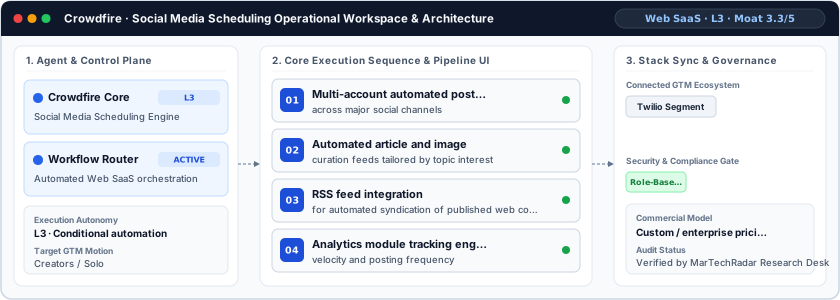
- Multi-account automated post scheduling: across major social channels
- Automated article and image: curation feeds tailored by topic interest
- RSS feed integration: for automated syndication of published web content
- Analytics module tracking engagement: velocity and posting frequency
Cons: operational limitations & risks
- API Rate Limits: Publishing queues remain susceptible to upstream provider API throttling and breaking permission deprecations across external social networks.
- Schema Maintenance: Changes in third-party media formatting requirements require frequent pipeline updates, occasionally causing payload rejection during automated image syndication.
- Attribution Window Lag: Engagement analytics pipelines aggregate performance metrics asynchronously, creating reporting delays when reconciling cross-channel campaign conversions.
Crowdfire TCO & deal-breaker stress test
Simulate 12-month stepped TCO, hidden cost multipliers, contract lock-in exposure, and stack failure modes using only facts verified by MarTechRadar Research Desk on 2026-10-14.
Crowdfire triggers high-severity friction under your 5-seat / $800/mo constraints. Benchmark the verified subtrack alternatives below before committing.
- Moat Score
- 3.3 / 5.0
- AI Autonomy
- L3
- Free Tier / Trial
- None disclosed
Triggered audit signals & failure modes
- Opaque Enterprise Quoting vs. SMB/Mid-Market BudgetVerified Pricing Ledger
Crowdfire does not disclose a public self-serve floor (Custom / enterprise pricing). Buyers with a $800/mo cap face high sales-qualification friction.
- Sales-Gated Contract TermsFact-checked by MarTechRadar Research Desk
Commercial pricing is available on request through tailored enterprise sales quotes based on organizational scale and seats. The licensing model adapts to the volume of connected social accounts, team user seats, and scheduled publication thresholds.
- Primary Operational Bottleneck: API Rate LimitsAudit by MarTechRadar Research Desk
Publishing queues remain susceptible to upstream provider API throttling and breaking permission deprecations across external social networks.
Test a custom Crowdfire budget or stack constraint
Lower 5-seat floor (~$19/mo vs. Custom Quote) · Transparent self-serve entry without mandatory annual lock-in
Lower 5-seat floor (~$20/mo vs. Custom Quote) · Transparent self-serve entry without mandatory annual lock-in
Crowdfire integrations, API, security & compliance stack
Crowdfire AI moat & Social Media Scheduling positioning
Historical user footprint and domain longevity offset by legacy API dependency and strategic repositioning toward editorial tech content.
Crowdfire in-depth review, pricing & architecture analysis
Editor sign-off: Oct 14, 2026. How profiles are made.
What is Crowdfire? Overview & background
Across distributed multi-channel brand operations, social syndication pipelines require continuous orchestration to prevent audience attrition. Headquartered in Navi Mumbai, Maharashtra, Crowdfire was founded in 2010 to serve social media managers and digital creators navigating multi-network distribution. Backed by $2.5M in total funding, the platform established early traction as an automated audience management utility before broadening into scheduled posting, cross-channel curation, and hybrid media insights.
How Crowdfire works: architecture & workflow
Crowdfire functions at an L3 autonomy tier by combining scheduled publishing queues with automated third-party content discovery streams. The ingestion architecture pulls external RSS feeds, image repositories, and topic queries, structuring candidate posts into staging queues for scheduled release across supported social graphs via standard OAuth endpoints. Algorithmic sorting filters recommended web articles based on category relevance, allowing marketing operators to populate recurring content calendars with minimal manual composition overhead.
Crowdfire limitations, drawbacks & risks
Operational considerations and platform boundaries include:
- API Rate Limits: Publishing queues remain susceptible to upstream provider API throttling and breaking permission deprecations across external social networks.
- Schema Maintenance: Changes in third-party media formatting requirements require frequent pipeline updates, occasionally causing payload rejection during automated image syndication.
- Attribution Window Lag: Engagement analytics pipelines aggregate performance metrics asynchronously, creating reporting delays when reconciling cross-channel campaign conversions.
Crowdfire pricing, plans & cost breakdown
Commercial pricing is available on request through tailored enterprise sales quotes based on organizational scale and seats. The licensing model adapts to the volume of connected social accounts, team user seats, and scheduled publication thresholds. Deployments are provisioned through centralized account management without standardized self-serve tiers, requiring prospective clients to engage direct procurement representatives to establish contract parameters and functional service scopes.
| Plan / Tier | Verified Price & Billing | Included Scope & Contract Terms |
|---|---|---|
| Enterprise / Custom | Custom quote | Custom-quoted plan; terms come from the vendor's sales team. |
How Crowdfire compares vs. competitors & alternatives
Within the social publishing sector, Crowdfire encounters mature enterprise alternatives like Agorapulse alongside workflow tools like Antela.ai, Inc. and Apaya within the Social Media Scheduling segment. While Agorapulse prioritizes comprehensive social inbox management and deep compliance auditing for mid-market agencies, Crowdfire maintains a lighter footprint focused on automated RSS syndication and interest-based content sourcing. The platform is best matched for independent creator networks and smaller marketing teams requiring straightforward cross-network content scheduling without complex governance layers.
Direct competitors & market radar
Top algorithmic competitors based on category positioning, capability overlap, and ICP alignment.
Frequently asked questions about Crowdfire
Does Crowdfire publish pricing or require an enterprise quote?
Crowdfire pricing: Custom / enterprise pricing. No free plan is publicly disclosed. Commercial pricing is available on request through tailored enterprise sales quotes based on organizational scale and seats.
What are the top Crowdfire alternatives in Social Media Scheduling?
Verified Social Media Scheduling alternatives include Buffer AI Assistant (Free plan · $5–$10/mo), SocialPilot ($20–$100/mo), Later AI ($18.75–$82.50/mo), Publer (From $8/mo). Within the social publishing sector, Crowdfire encounters mature enterprise alternatives like Agorapulse alongside workflow tools like Antela.ai, Inc. and Apaya within the Social Media Scheduling segment.
What are the main limitations and trade-offs of Crowdfire?
Operational considerations and platform boundaries include: API Rate Limits: Publishing queues remain susceptible to upstream provider API throttling and breaking permission deprecations across external social networks. Walk away if you need published self-serve pricing: Crowdfire is sold by custom quote.
Verified sources & evidence trail
- Official product domain: https://crowdfireapp.com
- Commercial pricing verification: Verified against official vendor pricing policy (Custom / enterprise pricing)
- Verified corporate entity profiles (
sameAs): LinkedIn Company Profile · Crunchbase Entity Record - Editor sign-off: Oct 14, 2026 (how profiles are made).
