Buffer AI Assistant vs FeedHive
Reviewed by MarTechRadar Research Desk. Pricing & entity snapshots verified Oct 14, 2026.
Buffer AI Assistant (Web SaaS) and FeedHive (Web SaaS) both compete in Social Media Scheduling & Auto-Publishing. On pricing, Buffer AI Assistant lists Free plan · $5–$10/mo (free plan), whereas FeedHive lists From $15/mo (no free plan disclosed). Technically, Buffer AI Assistant is rated L2 · Workflow copilot with a 3.8/5.0 (Proprietary moat) moat, while FeedHive is rated L3 · Conditional automation with a 3.8/5.0 (Proprietary moat) moat. Corporate profile: Buffer AI Assistant (founded 2010, HQ San Francisco, United States, $4.0M funding) vs. FeedHive (founded 2021, HQ Zurich, CH). Verified by the MarTechRadar Research Desk (Oct 6, 2026 for Buffer AI Assistant; Oct 14, 2026 for FeedHive). At a 5-seat team baseline, Buffer AI Assistant starts at ~$10/mo (base) vs FeedHive at ~$15/mo (base).
Buffer AI Assistant
Inline generative assistant within Buffer's multi-channel scheduling suite, transforming raw copy and long-form excerpts into network-formatted posts.
5-User Team Cost: ~$10/mo (base) (Free plan · $5–$10/mo) · Autonomy: L2 · Workflow copilot · Moat: 3.8/5.0 (Proprietary moat)
Target fit: Creators / Solo (Web SaaS)
FeedHive
AI-powered social media scheduling, automation, and analytics platform helping marketing teams scale multi-channel social workflows.
5-User Team Cost: ~$15/mo (base) (From $15/mo) · Autonomy: L3 · Conditional automation · Moat: 3.8/5.0 (Proprietary moat)
Target fit: B2B SaaS, Creators / Solo (Web SaaS)
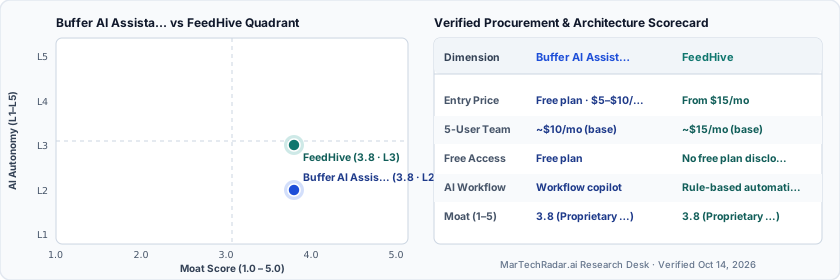
How Buffer AI Assistant and FeedHive differ
- Pricing model: Buffer AI Assistant is freemium, FeedHive is subscription.
- Entry price: Buffer AI Assistant starts lower (Free plan · $5–$10/mo) than FeedHive (From $15/mo).
- Buffer AI Assistant has a free plan; none is recorded for FeedHive.
- AI autonomy: FeedHive is rated L3 · Conditional automation, Buffer AI Assistant L2 · Workflow copilot on the MarTechRadar scale.
- Buffer AI Assistant was founded earlier (2010) than FeedHive (2021).
- Headquarters: Buffer AI Assistant in San Francisco, United States, FeedHive in Zurich, CH.
- Company headcount: Buffer AI Assistant is 51-200 employees; FeedHive is 2-10 employees.
- Ecosystem stack: Buffer AI Assistant connects with LinkedIn, WordPress, Twilio Segment, Zapier; FeedHive connects with Zapier.
Computed from the fields below. Only editor-verified ratings and vendor-sourced prices are compared.
When to choose Buffer AI Assistant vs FeedHive (and when to walk away)
Choose Buffer AI Assistant if
- Target ICP & Stack Fit: You operate as Creators / Solo requiring a Web SaaS deployment for Social Media Scheduling, with verified ecosystem connectivity for LinkedIn, WordPress, Twilio Segment, Zapier.
- L2 Architecture & Defensibility: Defensibility relies on deep workflow entrenchment within Buffer's scheduling graph and multi-channel distribution queue rather than proprietary machine learning models. High cross-network integration reliability serves as its functional retention mechanism.
- Commercial Model Fit: Your procurement budget aligns with Free plan · $5–$10/mo and want a self-serve free tier for zero-cost initial validation.
Walk away from Buffer AI Assistant if
- Walk away if your workflow requires uncapped enterprise volume on the Free plan · $5–$10/mo entry plan without upgrading tiers.
- Walk away if your workflow cannot tolerate rate limiting and network policy volatility: The system remains bound by third-party social API throughput caps and sudden schema deprecations, forcing manual queue realignment during network outages.
- Walk away if absence of autonomous closed-loop feedback is a deal-breaker for your team: The engine lacks autonomous self-optimization; post copy is not dynamically modified post-publication based on real-time performance telemetry or audience sentiment.
Choose FeedHive if
- Target ICP & Stack Fit: You operate as B2B SaaS and Creators / Solo requiring a Web SaaS deployment for Social Media Scheduling, with verified ecosystem connectivity for Zapier.
- L3 Architecture & Defensibility: Algorithmic recycling queues, AI assistant generation integrated with native scheduling pipelines, and programmatic agent orchestration across platforms.
- Commercial Model Fit: Your procurement budget aligns with From $15/mo.
Walk away from FeedHive if
- Walk away if your workflow requires uncapped enterprise volume on the From $15/mo entry plan without upgrading tiers.
- Walk away if your workflow cannot tolerate social API token resets: Social network API tokens expire from time to time or hit rate caps, so users must reconnect accounts by hand.
- Walk away if monthly AI credit quotas is a deal-breaker for your team: Heavy batch writing can use up fixed monthly AI credits on entry plans during busy launch weeks.
Side-by-side facts
| Field | Buffer AI Assistant | FeedHive |
|---|---|---|
| Subtrack | Social Media Scheduling & Auto-Publishing | Social Media Scheduling & Auto-Publishing |
| Pricing | Free plan · $5–$10/mo | From $15/mo |
| Pricing model | Freemium | Subscription |
| Published pricing tiers | Free / Sandbox ($0) · Essentials ($5/mo) · Team ($10/mo) | — |
| Free access | Free plan | No free plan disclosed |
| Enterprise plan | Not recorded | Not recorded |
| AI autonomy level | L2 · Workflow copilot | L3 · Conditional automation |
| Moat tier & score | 3.8 / 5.0 · Proprietary moat | 3.8 / 5.0 · Proprietary moat |
| Delivery | Web SaaS | Web SaaS |
| Audience | Creators / Solo | B2B SaaS, Creators / Solo |
| Ecosystem integrations | LinkedIn, WordPress, Twilio Segment, Zapier, n8n | Zapier |
| Funding & backing | $4.0M · Backed by Collaborative Fund, Bossa Invest, Red Swan Ventures, AngelPad, Tiny Capital | Undisclosed |
| Founders | Joel Gascoigne, Leo Widrich | — |
| Company size | 51-200 employees | 2-10 employees |
| Founded | 2010 | 2021 |
| Headquarters | San Francisco, United States | Zurich, CH |
| Fact-checked | MarTechRadar Research Desk, Oct 6, 2026 | MarTechRadar Research Desk, Oct 14, 2026 |
| Governance & docs | System Status ↗ · API & Docs ↗ · Changelog ↗ | API & Docs ↗ · Terms ↗ · Privacy ↗ |
Buffer AI Assistant vs FeedHive: TCO & constraint stress test
Test how both tools behave under your team size, monthly budget ceiling, CRM ecosystem, and governance guardrails.
Buffer AI Assistant
Low Procurement Risk · Strong Fit- Published Self-Serve Entry Floor: Buffer AI Assistant publishes a transparent entry point (Free plan · $5–$10/mo) with a free tier for initial validation before committing.
- Tier Fit for 5-Seat Scale: Team ($10/mo): 1 channel · $120 billed yearly (save 2 months)
- Primary Operational Bottleneck: Rate Limiting and Network Policy Volatility: The system remains bound by third-party social API throughput caps and sudden schema deprecations, forcing manual queue realignment during network outages.
Walk-Away Rule: Walk away if your workflow requires uncapped enterprise volume on the Free plan · $5–$10/mo entry plan without upgrading tiers.
Negotiation Lever: Validate exact quota thresholds (seats, credits, or API calls) included in Buffer AI Assistant's Free plan · $5–$10/mo tier before converting from monthly to annual billing.
FeedHive
Low Procurement Risk · Strong Fit- Published Self-Serve Entry Floor: FeedHive publishes a transparent entry point (From $15/mo) for initial validation before committing.
- Primary Operational Bottleneck: Monthly AI Credit Quotas: Heavy batch writing can use up fixed monthly AI credits on entry plans during busy launch weeks.
Walk-Away Rule: Walk away if your workflow requires uncapped enterprise volume on the From $15/mo entry plan without upgrading tiers.
Negotiation Lever: Validate exact quota thresholds (seats, credits, or API calls) included in FeedHive's From $15/mo tier before converting from monthly to annual billing.
Limitations
Buffer AI Assistant
Operational considerations and platform boundaries include: Rate Limiting and Network Policy Volatility: The system remains bound by third-party social API throughput caps and sudden schema deprecations, forcing manual queue realignment during network outages.Full limitations in the Buffer AI Assistant review
FeedHive
Key platform limits and trade-offs include: Social API Token Resets: Social network API tokens expire from time to time or hit rate caps, so users must reconnect accounts by hand. Monthly AI Credit Quotas: Heavy batch writing can use up fixed monthly AI credits on entry plans during busy launch weeks.Full limitations in the FeedHive review
Official vendor architectural differentiators & migration proof
To help buyers evaluate real-world switching costs, verified founders, solutions architects, and PMMs at both Buffer AI Assistant and FeedHive can submit up to 3 evidence-backed architectural differentiators or verified customer migration case studies.
Why teams choose Buffer AI Assistant over FeedHive
Work at Buffer AI Assistant? Verify your official domain email to publish 3 technical differentiators, migration benchmarks, or a head-to-head buyer sandbox offer on this comparison page:
+ Submit Buffer AI Assistant Official Differentiators & Case Study →Why teams choose FeedHive over Buffer AI Assistant
Work at FeedHive? Verify your official domain email to publish 3 technical differentiators, migration benchmarks, or a head-to-head buyer sandbox offer on this comparison page:
+ Submit FeedHive Official Differentiators & Case Study →Pricing notes & tier schedules
Buffer AI Assistant: Free plan · $5–$10/mo
Buffer monetizes through a modular, channel-metered subscription model that includes a permanent Free plan supporting up to three channels with fixed scheduling ceilings.
- Free / Sandbox ($0, 1–2 seats (Evaluation)): Entry free tier with capped usage or feature quotas for initial workflow testing.
- Essentials ($5/mo, 1–2 seats): 1 channel · $60 billed yearly (save 2 months)
- Team ($10/mo, 5 seats): 1 channel · $120 billed yearly (save 2 months)
- Credit & Usage Burn Multiplier: Workflows on Buffer AI Assistant consume metered credits or usage quotas; high-volume AI generation, batch queries, or recurring automation runs can exhaust base allocations and trigger mid-cycle top-up packs.
- Rate Limiting and Network Policy Volatility: The system remains bound by third-party social API throughput caps and sudden schema deprecations, forcing manual queue realignment during network outages.
FeedHive: From $15/mo
FeedHive offers self-serve monthly plans starting at $15/month (or $180/year when billed yearly). Higher plans scale by linked social profiles, team seats, client approval flows, trigger rules, and monthly AI writing credits.
- Annual Billing Headline vs. Monthly Premium: Headline entry rates reflect annual billing commitments (Save up to 30%); month-to-month flexibility carries a higher effective monthly rate or requires annual prepayment.
- Credit & Usage Burn Multiplier: Workflows on FeedHive consume metered credits or usage quotas; high-volume AI generation, batch queries, or recurring automation runs can exhaust base allocations and trigger mid-cycle top-up packs.
Frequently asked questions: Buffer AI Assistant vs FeedHive
How does Buffer AI Assistant pricing compare to FeedHive in 2026?
Buffer AI Assistant is listed at Free plan · $5–$10/mo (freemium, free plan), whereas FeedHive is listed at From $15/mo (subscription, no free plan disclosed).
How do Buffer AI Assistant and FeedHive compare on AI autonomy and moat depth?
On the MarTechRadar L1–L5 scale, Buffer AI Assistant is rated L2 · Workflow copilot with a Proprietary moat moat (3.8/5.0), while FeedHive is rated L3 · Conditional automation with a Proprietary moat moat (3.8/5.0).
Which teams are Buffer AI Assistant and FeedHive built for?
Buffer AI Assistant is a Web SaaS product in Social Media Scheduling & Auto-Publishing designed for Creators / Solo. FeedHive is a Web SaaS product in Social Media Scheduling & Auto-Publishing designed for B2B SaaS, Creators / Solo.
What are the main limitations of Buffer AI Assistant vs FeedHive?
For Buffer AI Assistant: Operational considerations and platform boundaries include: Rate Limiting and Network Policy Volatility: The system remains bound by third-party social API throughput caps and sudden schema deprecations, forcing manual queue realignment during network outages. For FeedHive: Key platform limits and trade-offs include: Social API Token Resets: Social network API tokens expire from time to time or hit rate caps, so users must reconnect accounts by hand. Monthly AI Credit Quotas: Heavy batch writing can use up fixed monthly AI credits on entry plans during busy launch weeks.
What are the hidden TCO drivers and contract negotiation levers for Buffer AI Assistant vs FeedHive?
For Buffer AI Assistant: Credit & Usage Burn Multiplier (Workflows on Buffer AI Assistant consume metered credits or usage quotas; high-volume AI generation, batch queries, or recurring automation runs can exhaust base allocations and trigger mid-cycle top-up packs.) Negotiation lever: Validate exact quota thresholds (seats, credits, or API calls) included in Buffer AI Assistant's Free plan · $5–$10/mo tier before converting from monthly to annual billing. For FeedHive: Annual Billing Headline vs. Monthly Premium (Headline entry rates reflect annual billing commitments (Save up to 30%); month-to-month flexibility carries a higher effective monthly rate or requires annual prepayment.) Negotiation lever: Validate exact quota thresholds (seats, credits, or API calls) included in FeedHive's From $15/mo tier before converting from monthly to annual billing.
Excerpts are quoted verbatim from each fact-checked review. Last updated Oct 14, 2026.